A Couple of Weeks in Cusco, Peru

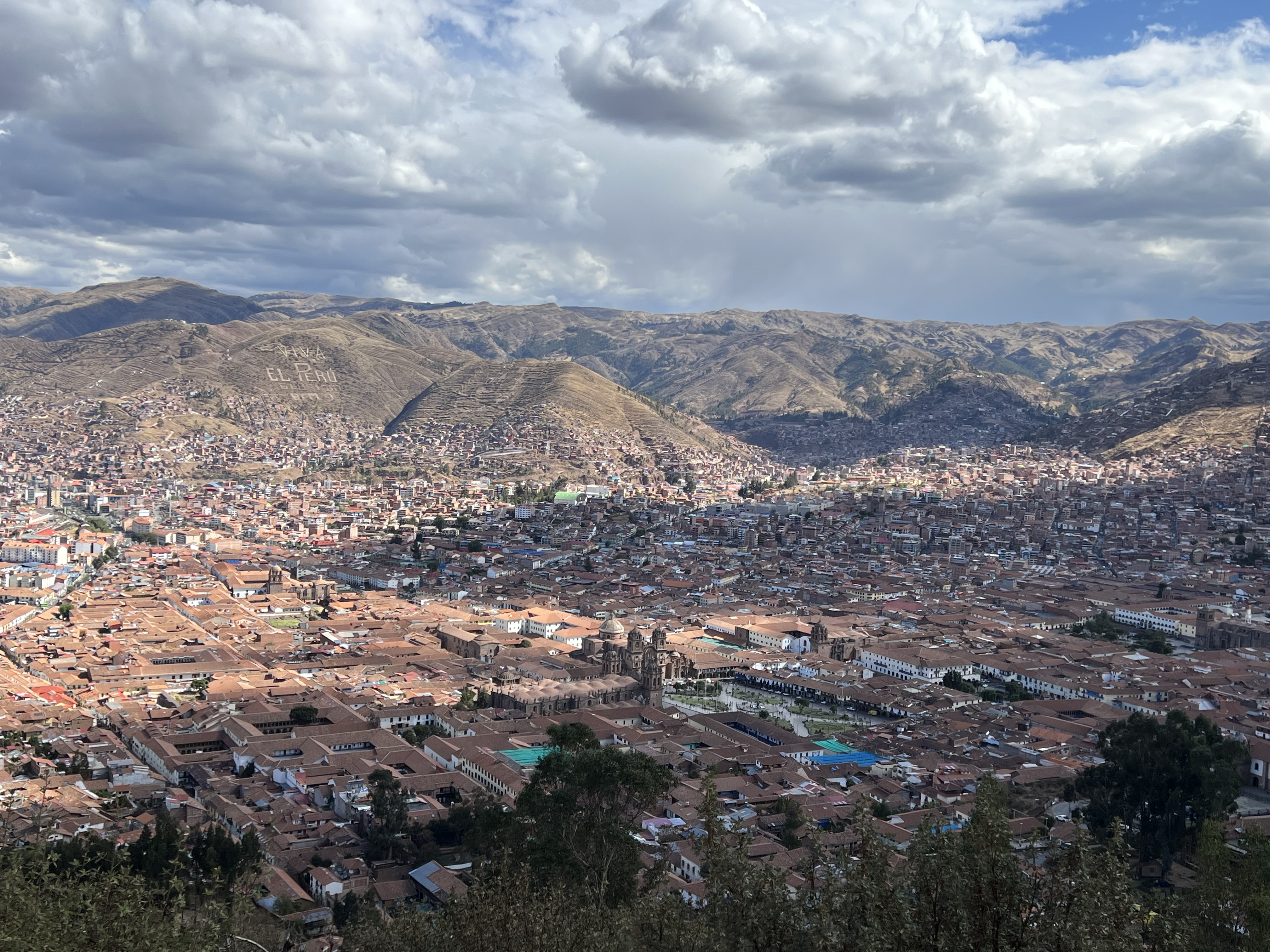
                                  View of Cusco from Cristo Blanco

A Couple of Weeks in Cusco

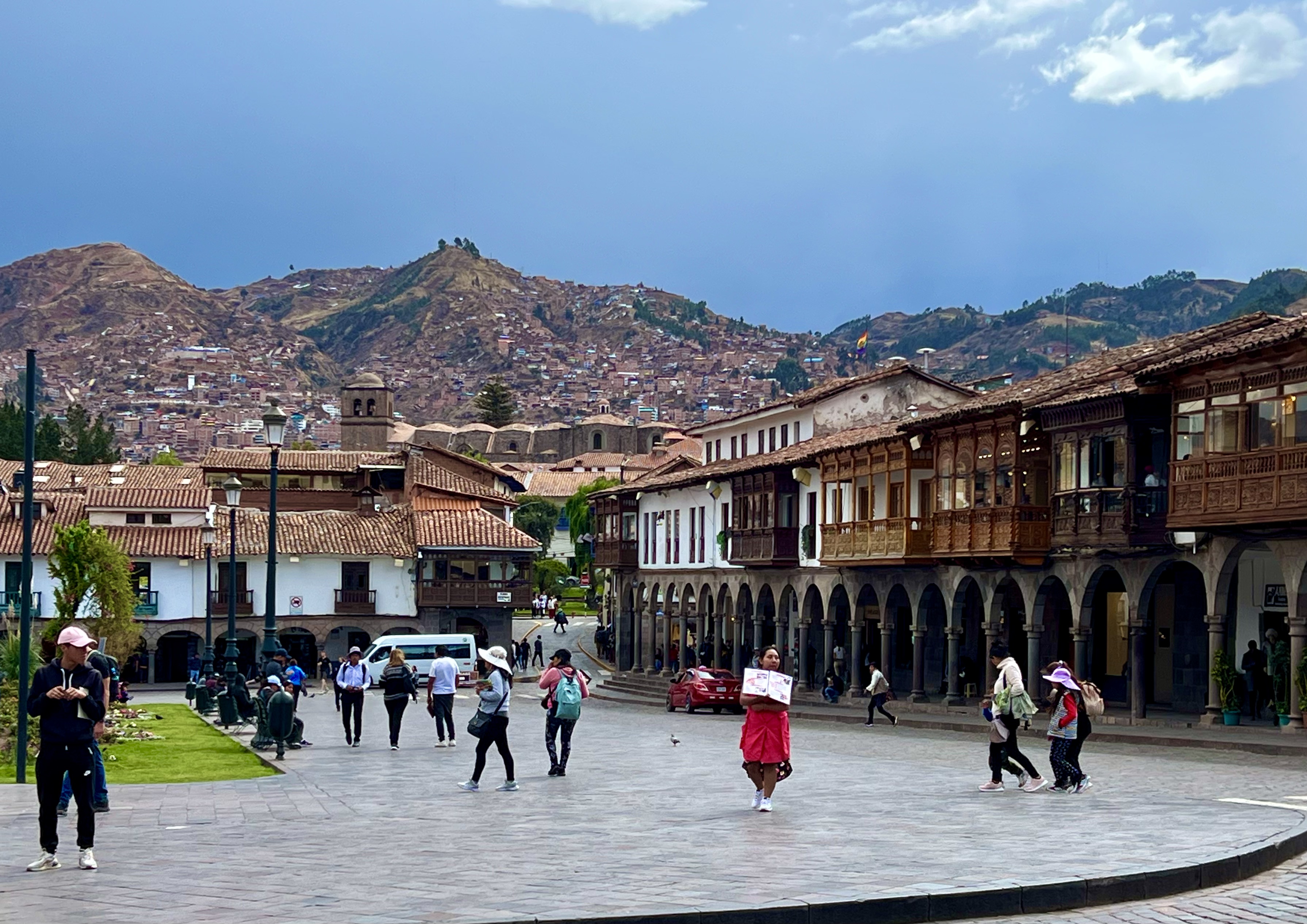
I returned to Cusco after a hiatus of about 25 years to find that the city has mushroomed up all the surrounding hills and down through the valley.  The Centro Historico has luckily not changed too much other than there are many more souvenir shops, more international brand stores (Starbucks, Merrill, Patagonia, etc.) and women peddling massages throughout the area around the Plaza de Armas.
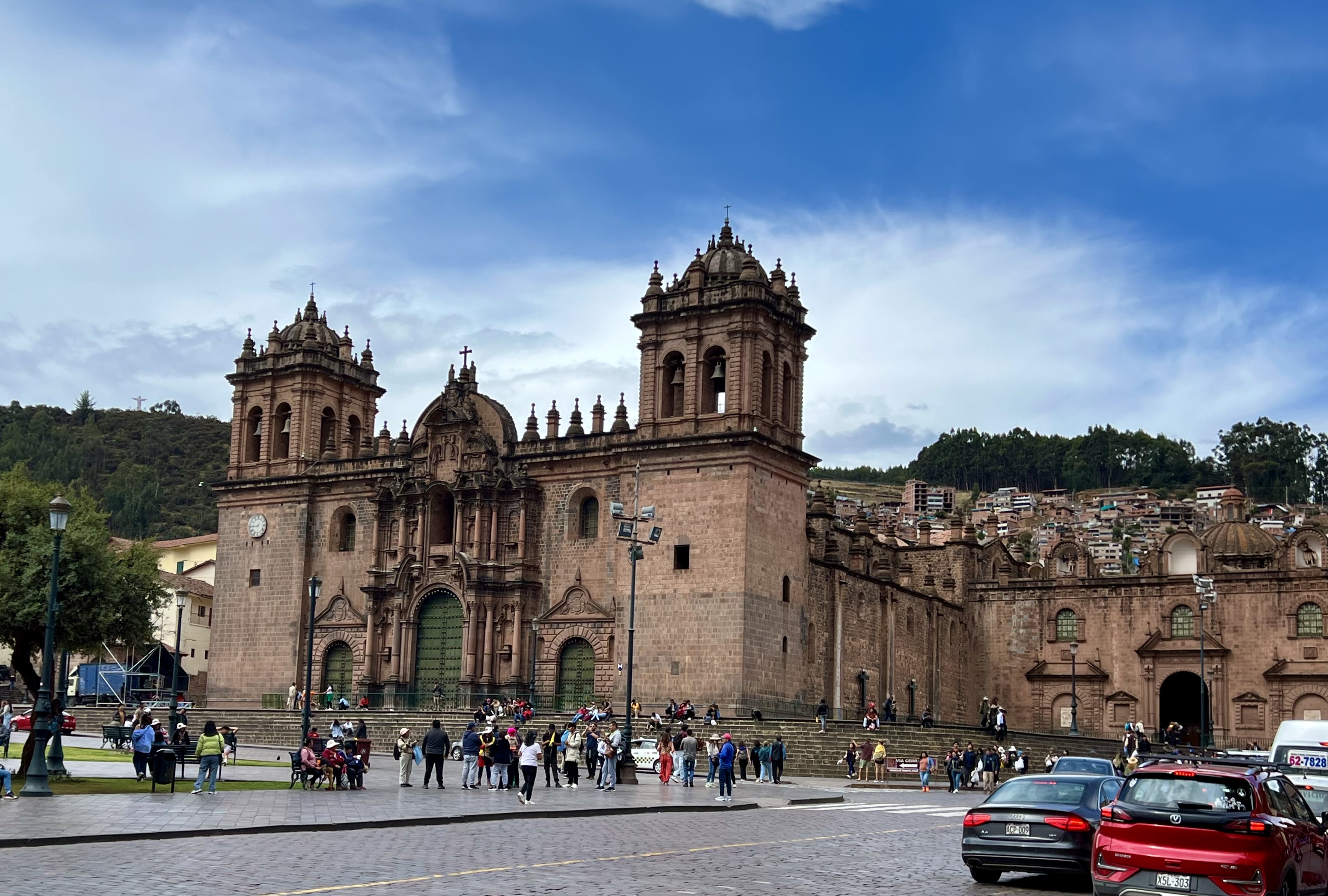
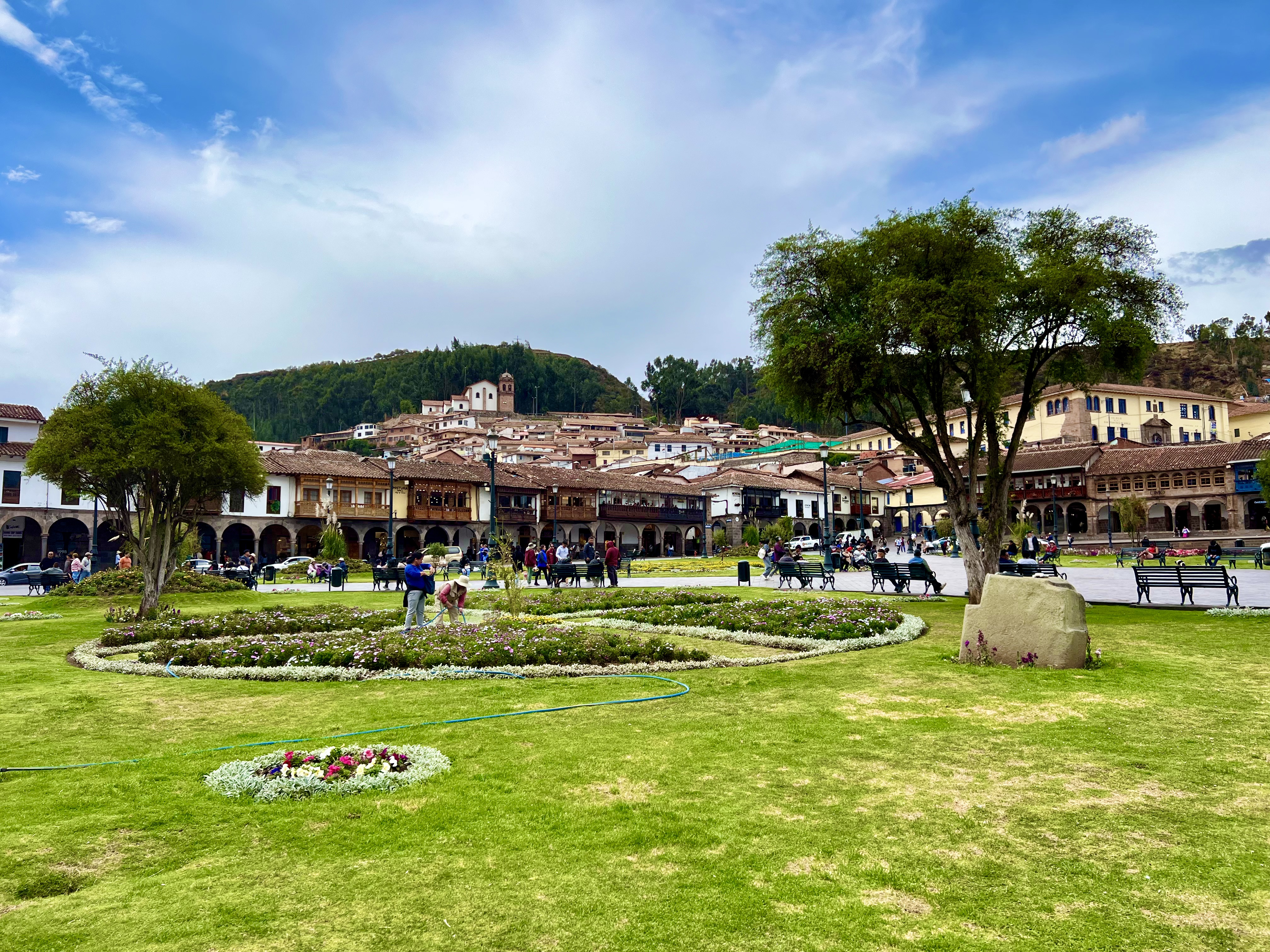
Mass tourism has hit Cusco as it has in many places around the globe.  It is understandable because Cusco, the former capital of the Incan Empire, is the starting point for visiting Machu Picchu. Twenty-five years ago, my daughter and I went to the archeological site and had it pretty much to ourselves and the llamas; today one has to purchase a time slot to visit.  I chose not to ruin a beautiful memory and did not return this trip. Instead, I visited some places that I had missed before, including sites in the south valley, as well as Pisac, Palccoyo and Waqrapukara.  My main reason for visiting Cusco this trip, however, was to spend two weeks at a language school to improve my Spanish before continuing throughout Peru and Patagonia.
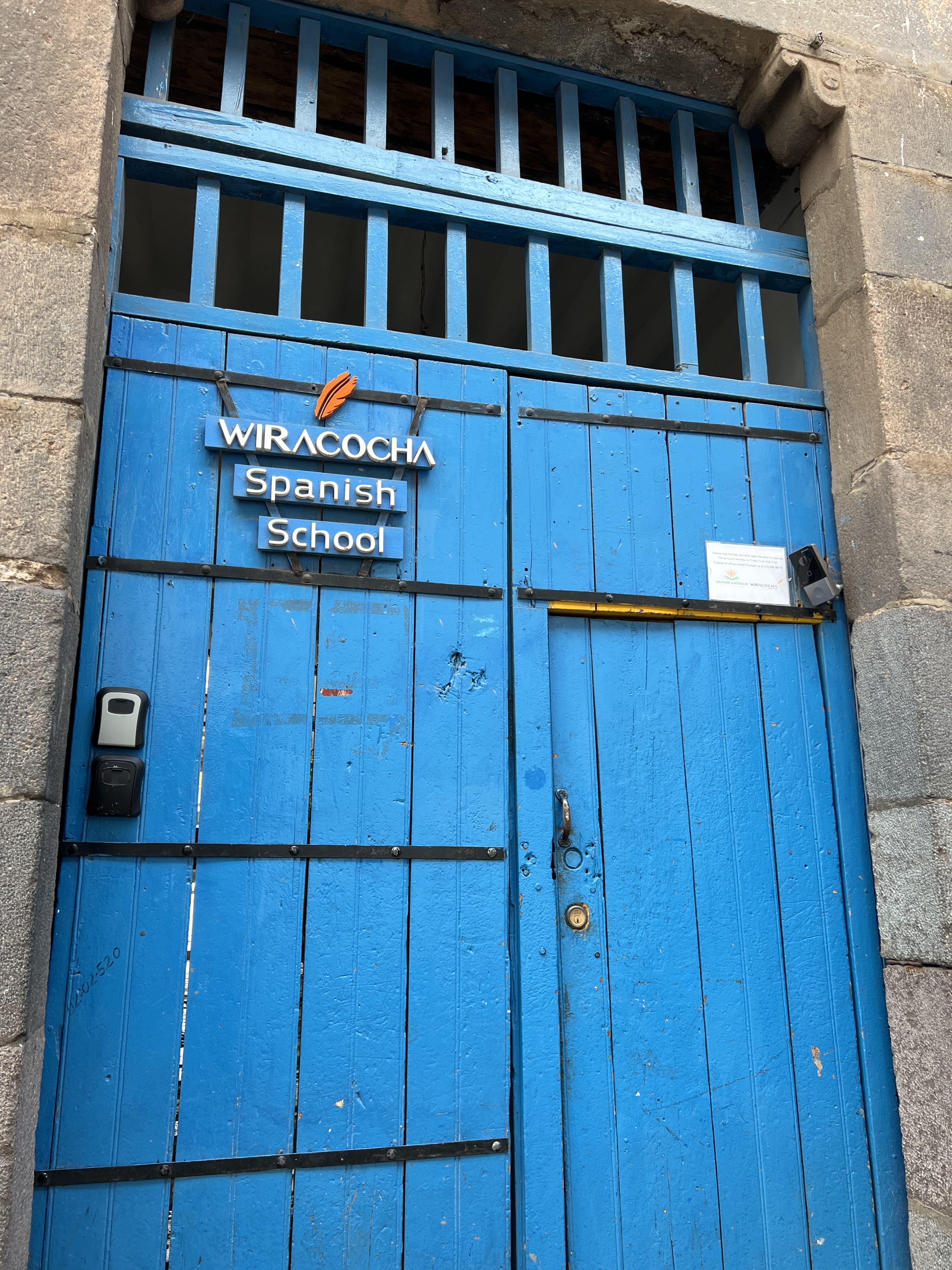
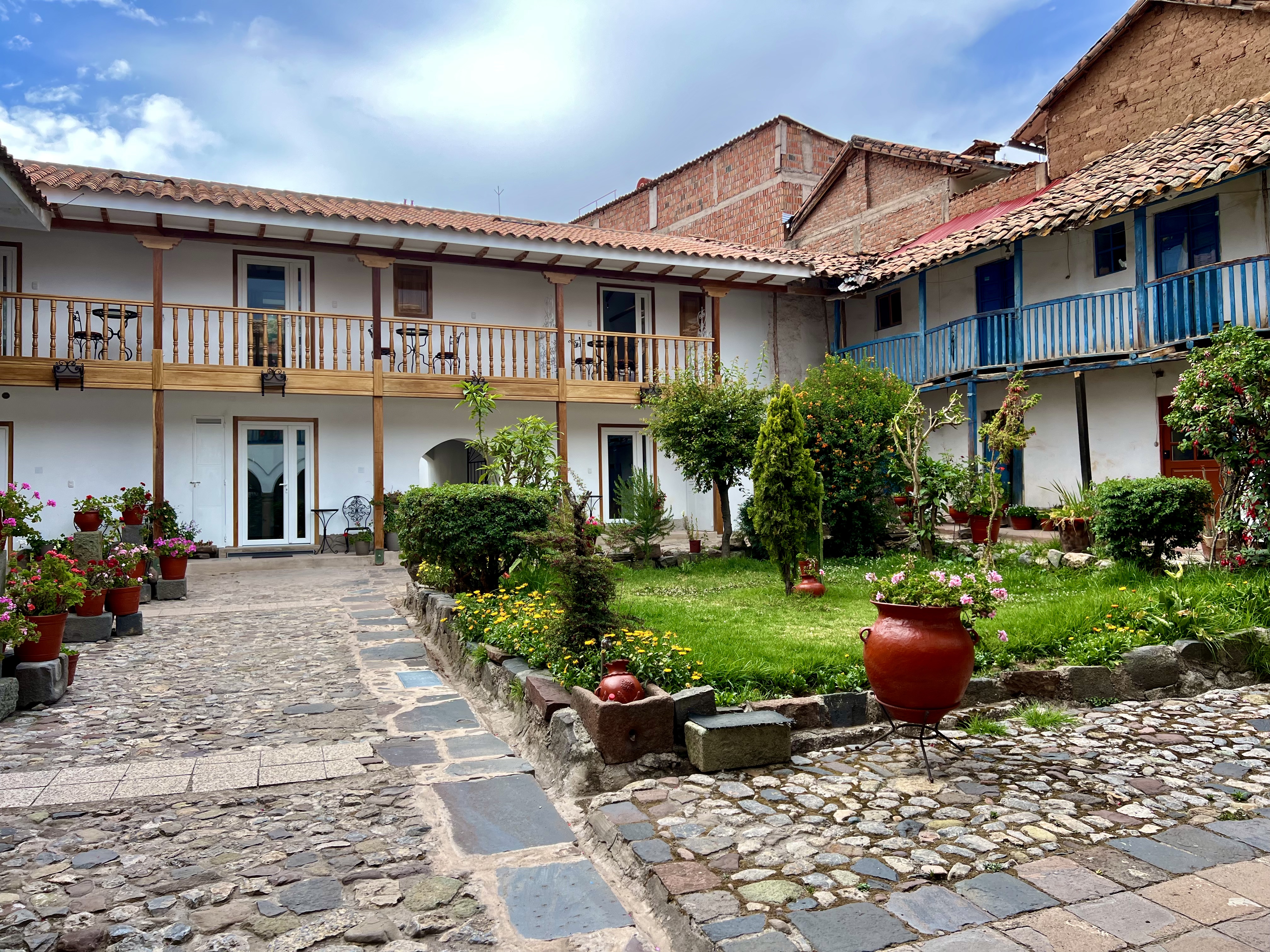
The school I chose was Mundo Antiguo, (formerly Wiracocha) and I was very pleased with them.  I had private lessons for 2-3 hours a day, but even those who were doing regular classes only had 2-4 people in them. The instructors were all well prepared and were good language teachers. The school has events every night during the week that fosters interaction among the students and locals and even has a salsa class on Tuesday nights. The class was quite amusing as we had to switch partners with each new step, so that everyone in the room had a chance to dance with at least half of the participants. The school itself is about two and a half blocks behind Plaza de Armas, i.e., directly in the center of town on the way up to the San Blas district, which is one of the artisan areas. The school offers rooms with families if one chooses that option. I decided to go with an Airbnb as I prefer my privacy and a private bathroom, but those who were with families seemed to have a great time.  If anyone is interested in learning Spanish or improving their Spanish skills, I can highly recommend this school. Cusco is also a lot safer (and less expensive) than many other places in Latin America and has a wealth of history and culture.

Walk to school amid remnants of Inca walls

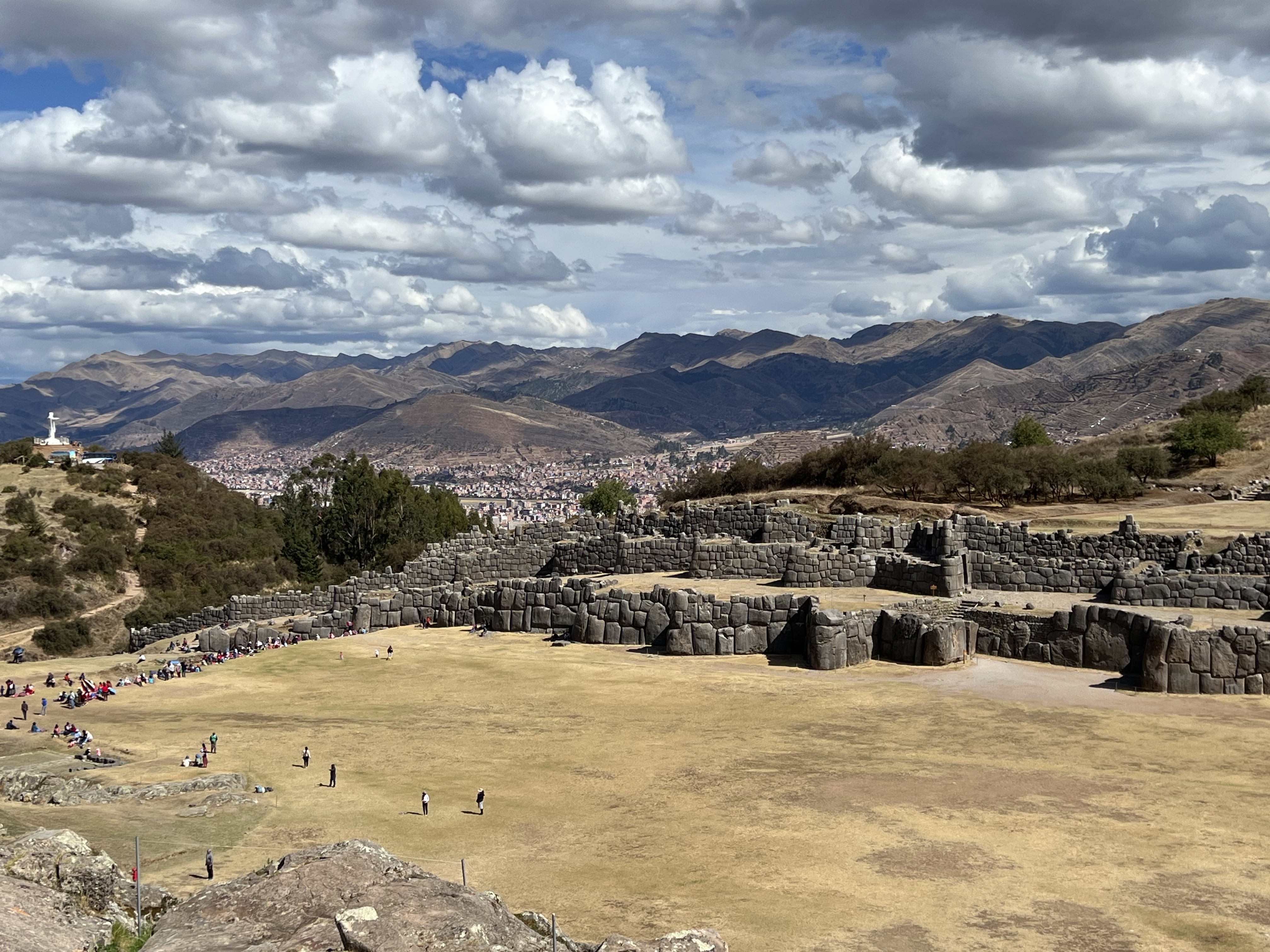
 As it was the center of the Incan Empire and the remnants of Incan buildings are visible beneath the Spanish additions, Cusco’s streets reference Andean history since at the latest the 14th C. The empire’s capital was constructed on previous settlements, but developed in the shape of a puma, with the head in the hills and the body stretching along the valley. Saqsaywaman is the fortress and religious site overlooking the city and was near the former head. According to traditional Andean belief there are three worlds with deities governing each. Some of the Incan beliefs incorporated earlier traditions from their conquered territories including the Huari/Wari (the spellings change). Their three gods for the three realms were: Hanan Pacha, who rules over the world above and is represented by condors and birds; Uku Pacha, who rules over the world below and is represented by snakes and serpents. In the Incan tradition, this is the world of Pacha Mama, Mother Earth.  The here and now of our world is overseen by Kay Pancha, who oversees all the natural elements and is represented by a puma or jaguar. Throughout these worlds there is the principal of duality. All aspects have their opposite: male/female, sun/moon, earth/water etc. It is only through the joining of opposites that life can begin. In the Incan world temples dotted the landscape and the four temples above Cusco are related to the four elements. Saqsaywaman is the closest to the city and represents earth, above the earth is Qenco, which is related to fire, above that Puka Pukara, which is for air and above that Tambomachay for water.
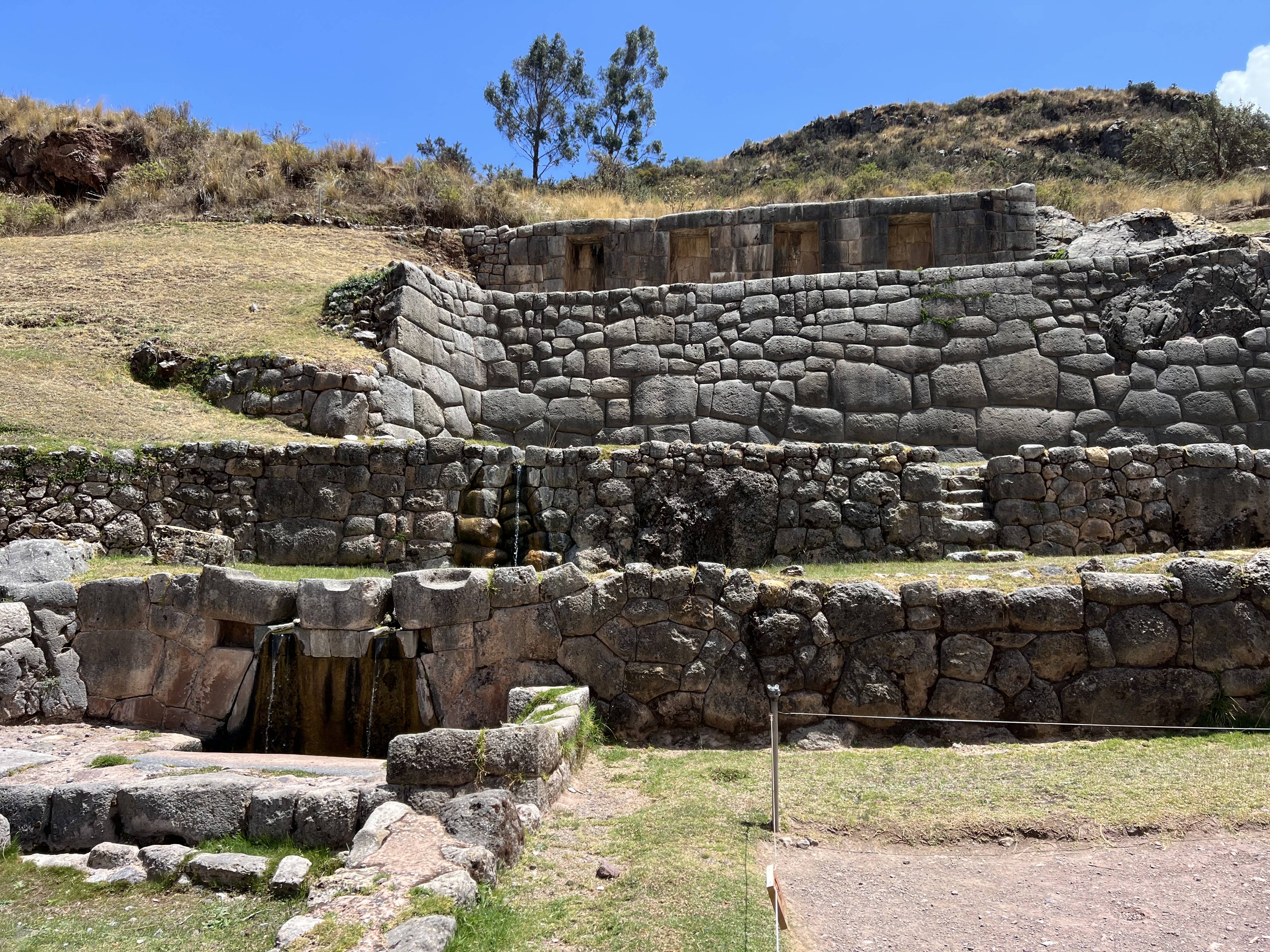
Tambomachy
Saqsaywaman

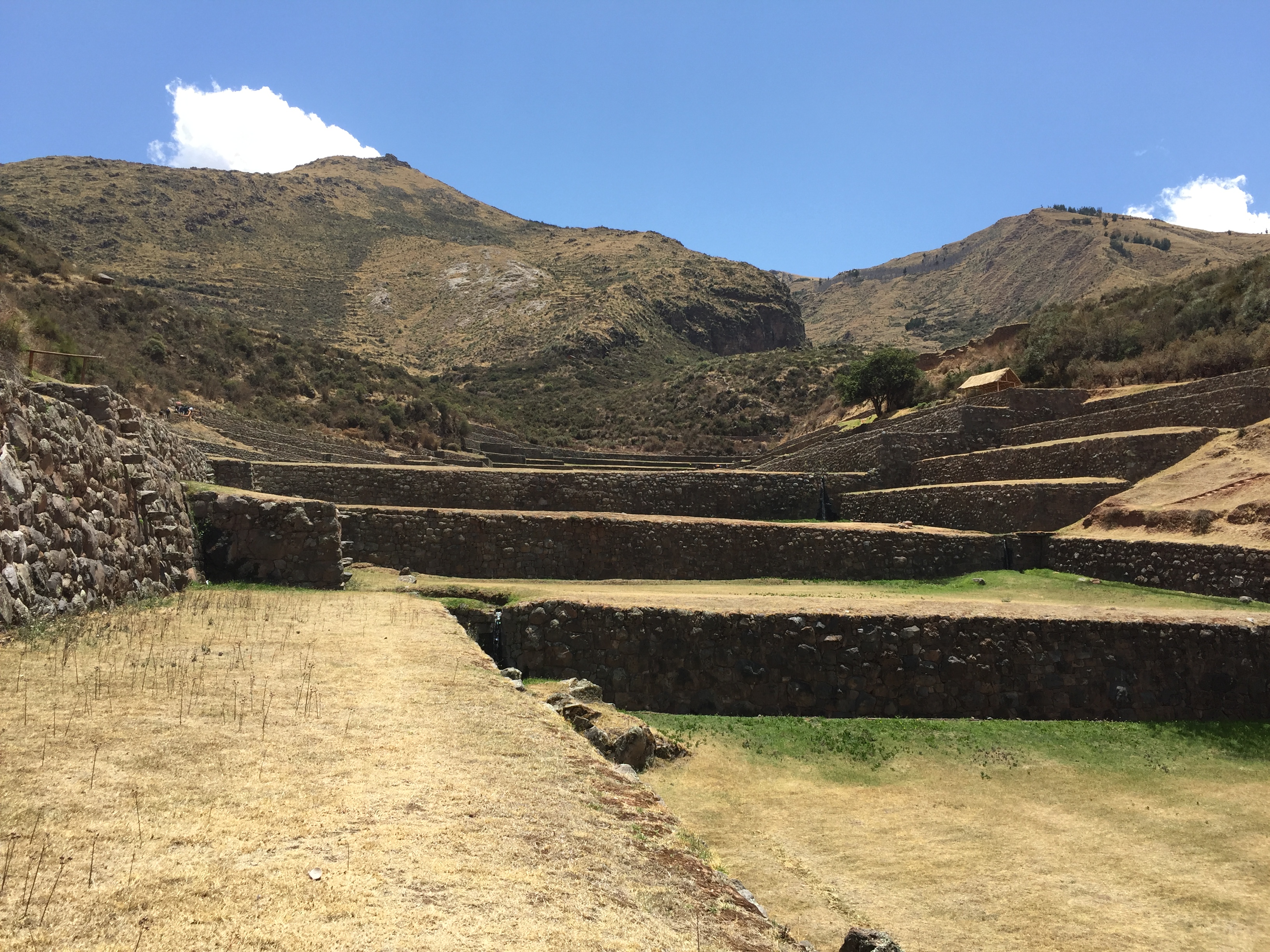
According to Gary Urton in his book El Cosmos Andino, Cusco was considered the center of the universe with a direct radial connection to the middle of the Milky Way. As the stars spread out in the sky, so too do the rays spread out across the landscape from the central axis, Cusco. Here, instead of all roads leading to Rome, they lead to and from the Incan capital. The Incans were amazing engineers, astronomers, artists and agriculturalists and they learned from the way the natural environment flowed. For the terraces that they used for agriculture, they ingeniously laid out canals fed from spring waters that surrounded the various terrace levels but placed so that there was never too much flow to cause damage.  Tipón is a site in the south valley that highlights this principle. It was both a religious site for water and used for agricultural purposes. At the origin spring there is a larger stone in the wall above what will become a singular canal that flows for a couple of meters before it separates into two canals, that then separate into three by way of two triangular stones before flowing down to the first terrace where the waters are directed both right and left.  The angle of the canals between each level is mathematically calculated to keep a steady flow. The engineering system, while amazing in itself, is also symbolic of the belief system. From one major source, comes duality, which flows into the three worlds, which again are subject to duality creating life.
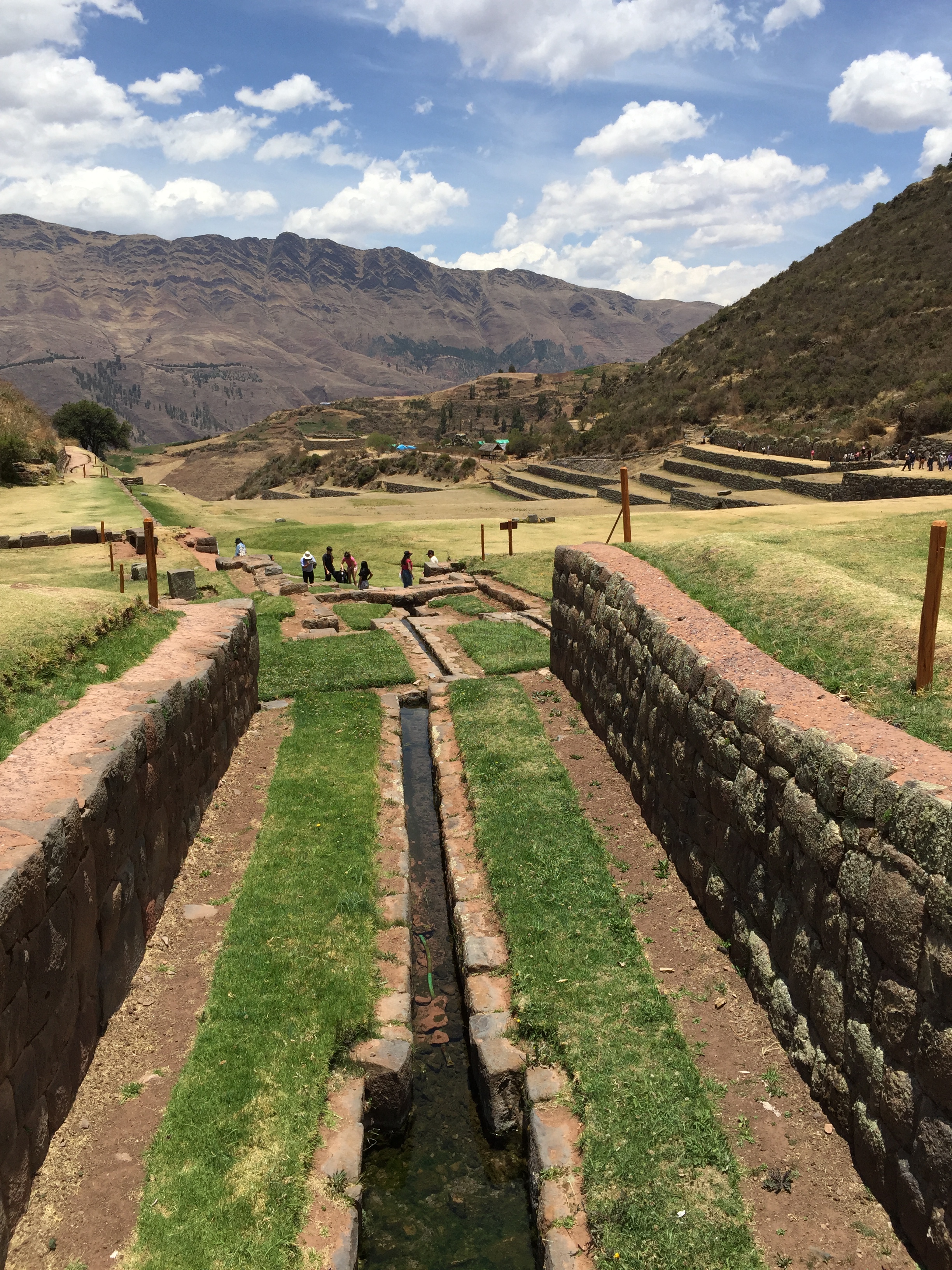
Tipón canalization

Tipón terraces

Ollantaytambo is another very well-known site as it is one of the oldest continuously populated Incan sites and is also the beginning of the train to Agua Calientes and Machu Picchu. The terraces here lead up to a major Sun Temple, which was constructed sometime between 1438-1470 by Pachacutec, one of the great rulers of the Incan Empire.
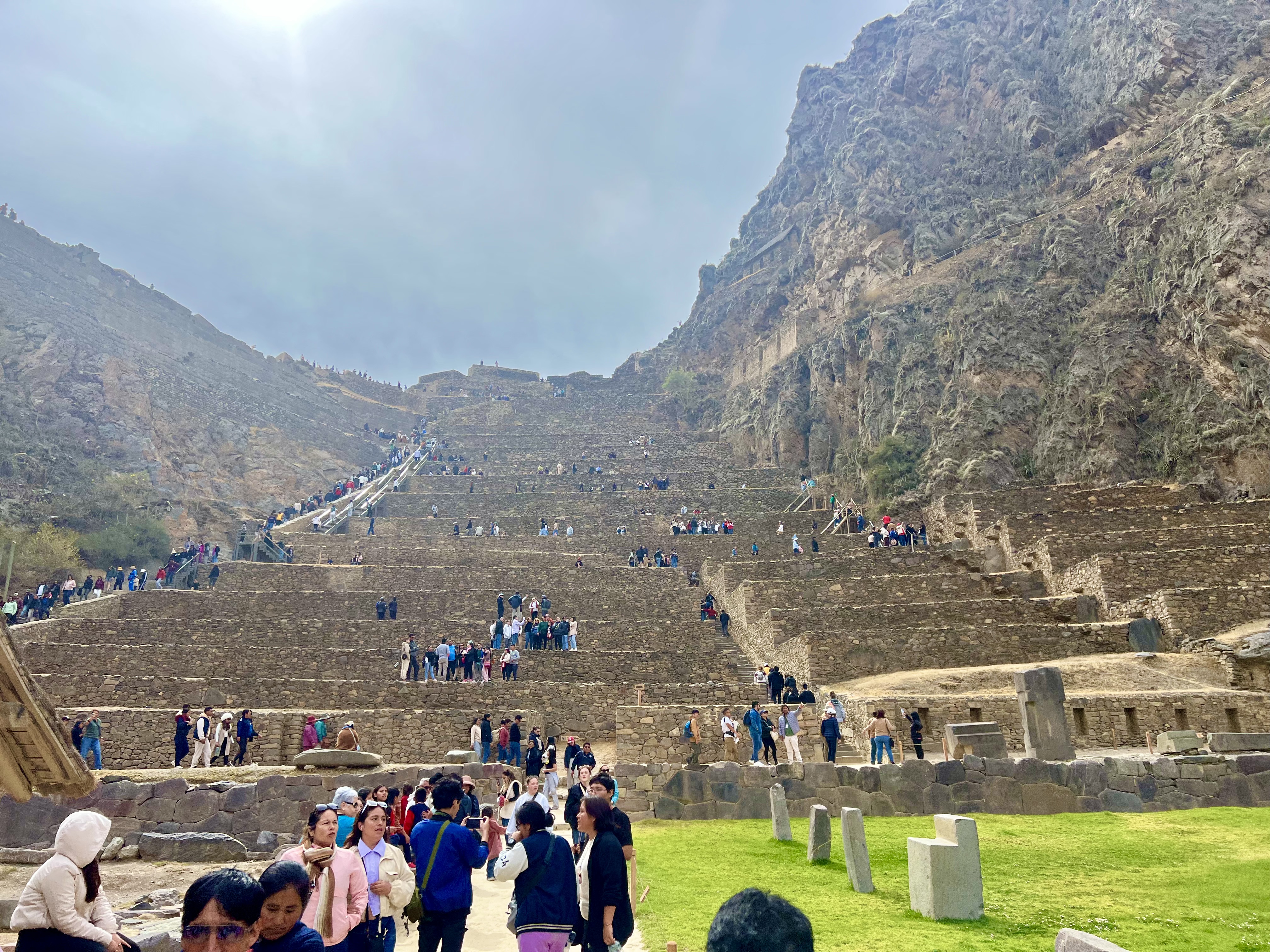
Ollantaytambo    
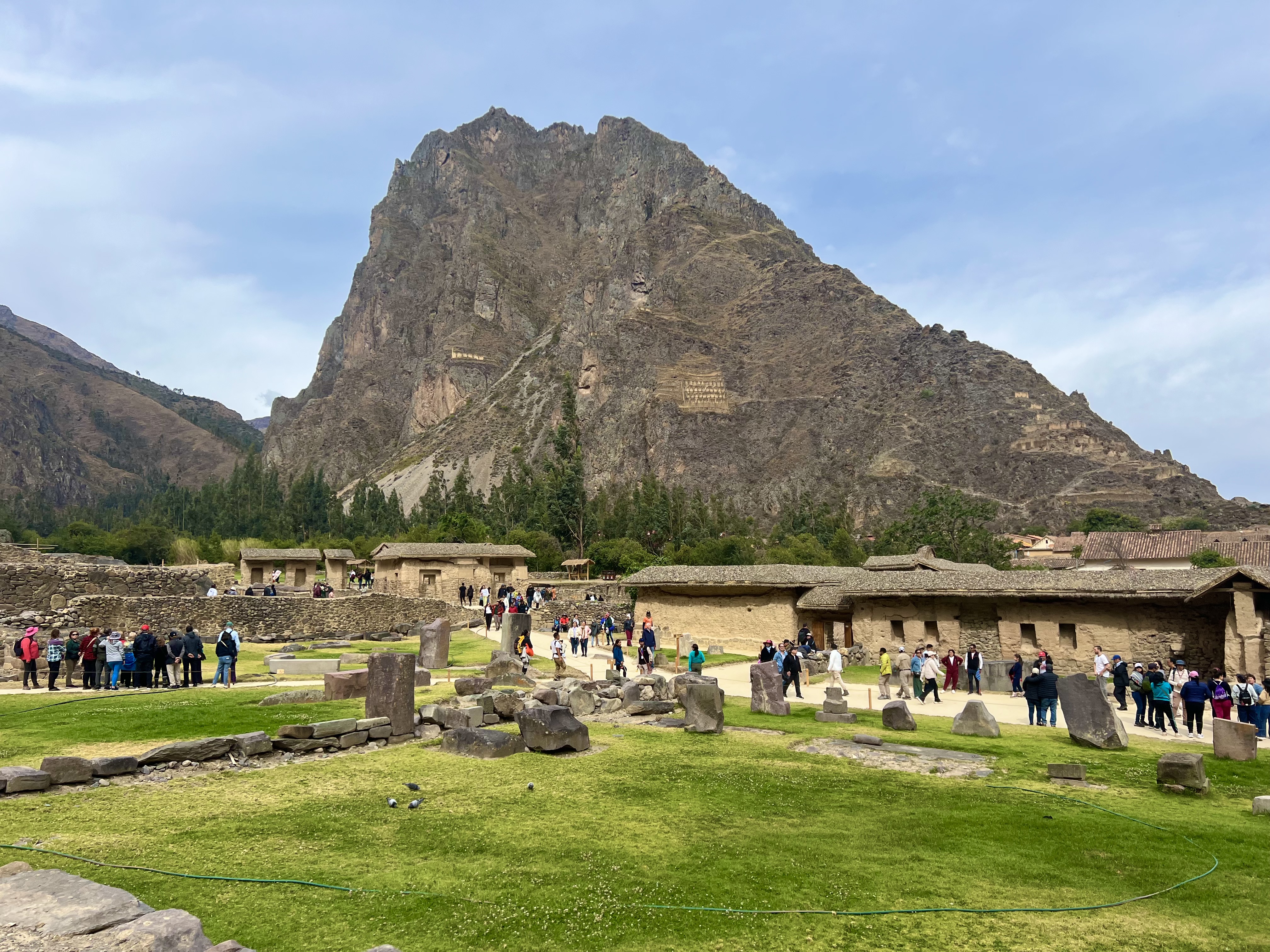
Granaries/Storage on the hillside
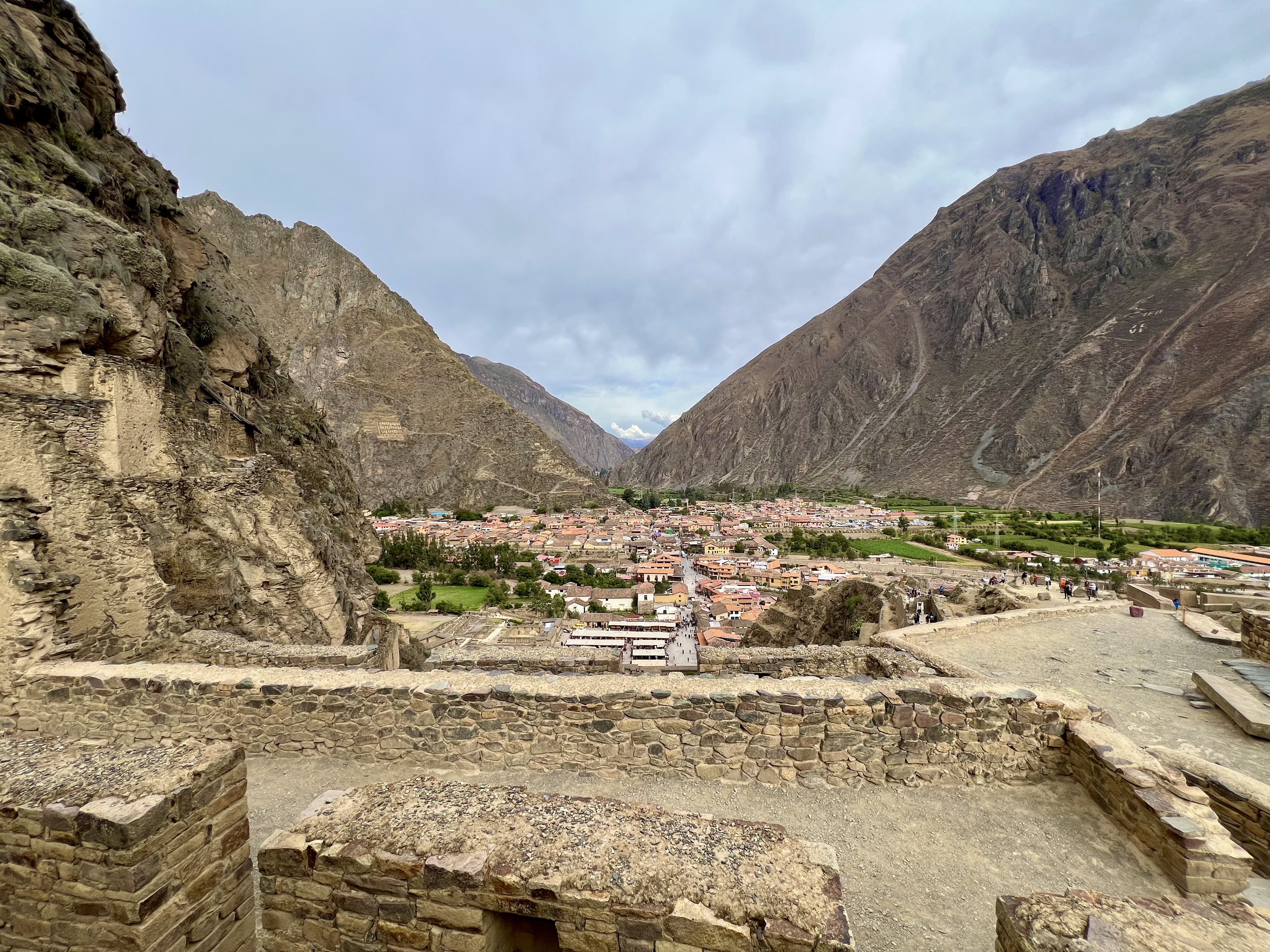
View from the Sun Temple

In the Sun Temple, as elsewhere in the Incan sites, there are niches in many of the rooms where gold and silver votive figures would be placed. Gold represents the sun, while silver represents the moon, i.e., male and female. In the granaries the votive figures protected the food. On the hill across from the main site, there are a series of granaries/storehouses. The Incans had a sense about changing climatic patterns and were smart enough to build storage units high on the hills that would preserve food for up to seven years.  Due to the way they managed the terraces, they were also able to plant and harvest foods that were not native to the area, along with the essential multiple corn and potato varieties. The construction of the Sun Temple is a perfect example of how the Incan’s built seismically resistant buildings, by having a slight inward angle rather than the perfectly straight right angles of the earlier Wari civilization buildings.  Naturally, the Sun Temple and other Incan edifices didn’t survive until now, but that was due to the destruction caused by the Spanish who felt the need to eradicate Incan beliefs and convert everyone to Christianity.  Even Pachamama became sometimes known as “Pachamama Sancta Tierra”.    
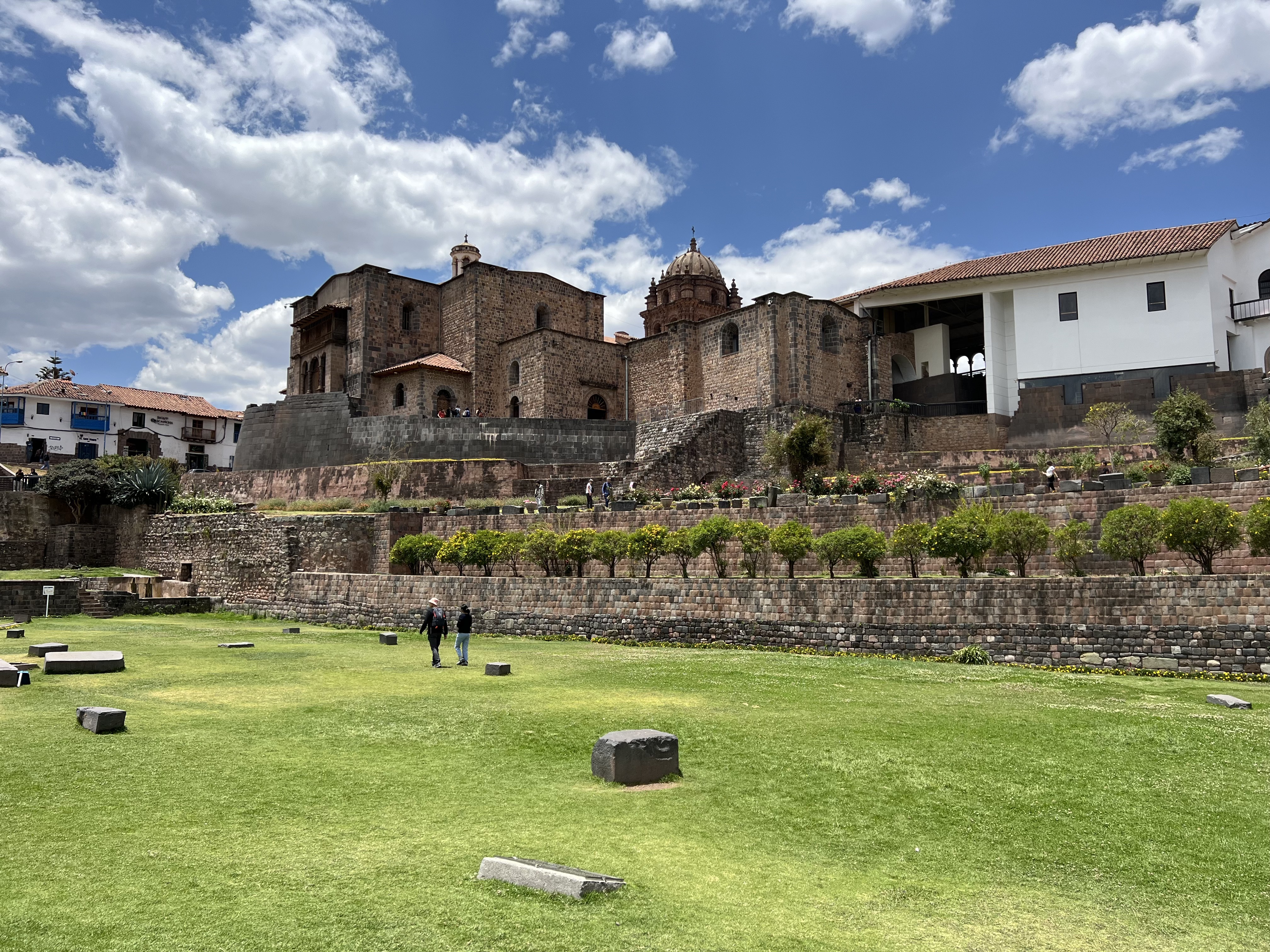
Quoricancha in the heart of Cusco, the main Incan religious site overtaken by the Church

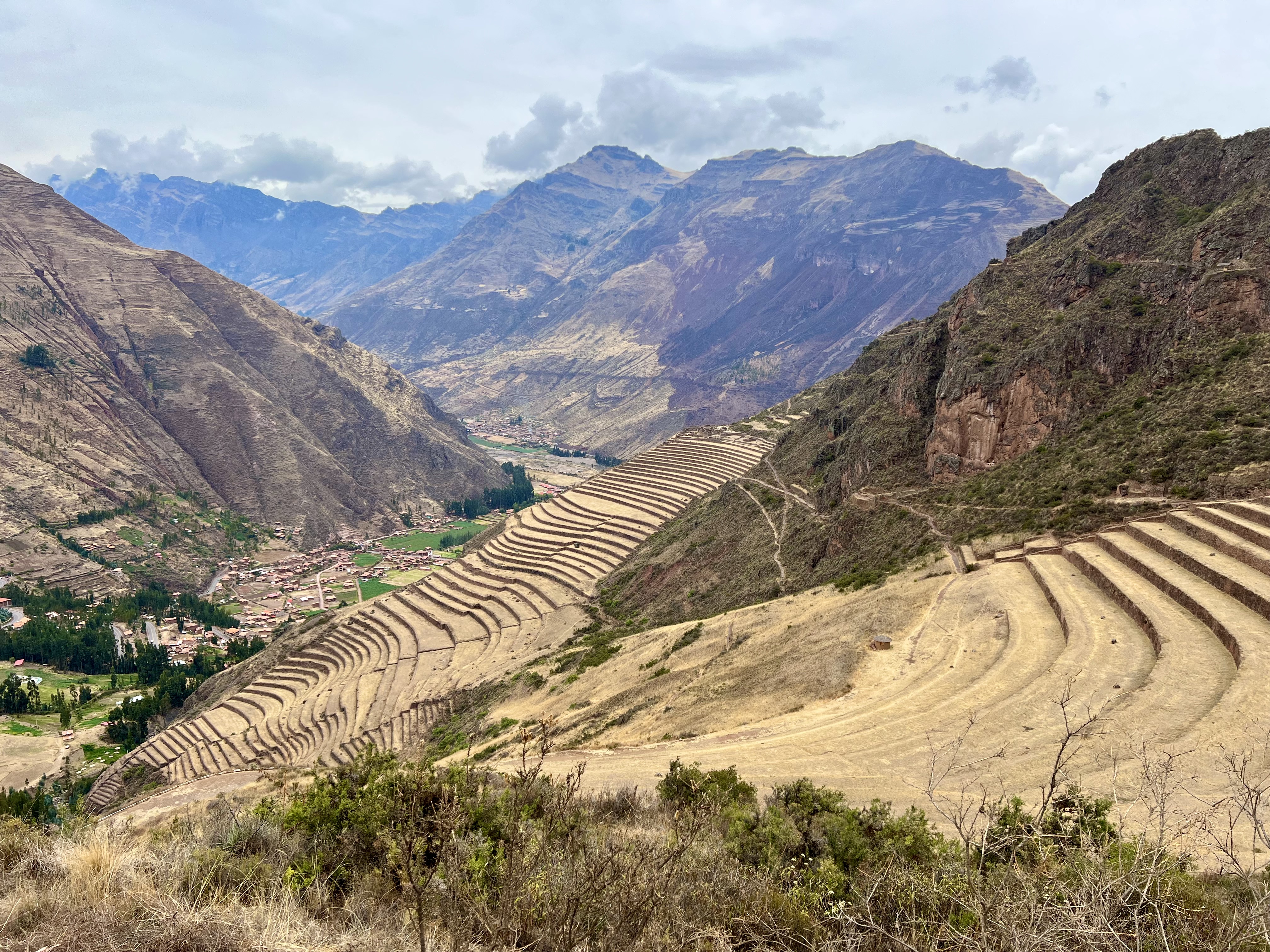
The archeological site at Pisac was also constructed by Pachacutec at about the same time as Ollantaytambo. It is the first of the archeological sites in the Sacred Valley. The name “Pisac” means partridge in Quechua, the language of the Incan people and still today the main language of the local rural peoples, and the site follows the form of the bird. The archeological site is divided into two areas surrounded by cascading rounded terraces. At the top where all the tours go there is a viewpoint, which was supposedly part of the old palace.  Off to the side, there is a path that undulates up and down to another viewpoint that is somewhat higher, ca. 3500m, offering undisturbed views of the surrounding hills and town below.   On one side of the mountain, away from the terraces, are little caves scattered across the mountain face.  These are burial caves and there is actually a white skull that can be seen from the path. The Incans didn’t believe in death as a finality; they buried their kin in a fetal position for rebirth, not the same as a Hindu or Buddhist reincarnation, but not a final death as the dead go to the underworld to become ancestors, who are then worshipped. The leaders may also become deities after they pass from this world. Small votive figures called canopas are placed in the gravesites and in the fields after they had been blessed to ensure Pachamama’s protection and a good rebirth/harvest.  

Views from Pisac archeological site

The archeological site is up a steep hill from the town, where the famous Pisac artisan market is.  On the map there is a regular Artisan Market designated as well as a new one. The old one no longer exists.  The new one offers all the regular tourist souvenirs, but I found that the alpaca sweaters were of a better quality and less expensive here than in Cusco.  Bargaining is naturally a must throughout the country.  

One of the pre-Incan sites I was able to visit was Pikillaqta, an ancient Wari settlement. The Waris were active between 900 CE until conquered by the Incans ca. 1400CE. The Incas often built their structures with reference animals that related to their belief system; the Waris were more strait-laced in their architecture, although their pottery has quite intricate designs. Pikillaqta was fortified town in the form of a square, with the religious sites in the center. The walls were up to 12m high with narrow paths connecting the various areas. To build their walls they used a form of cement, unlike the Incas who used no adhesive whatsoever, allowing the stones to naturally fit with one another, thereby allowing for movement in case of an earthquake.  The Andes have always been seismically active.
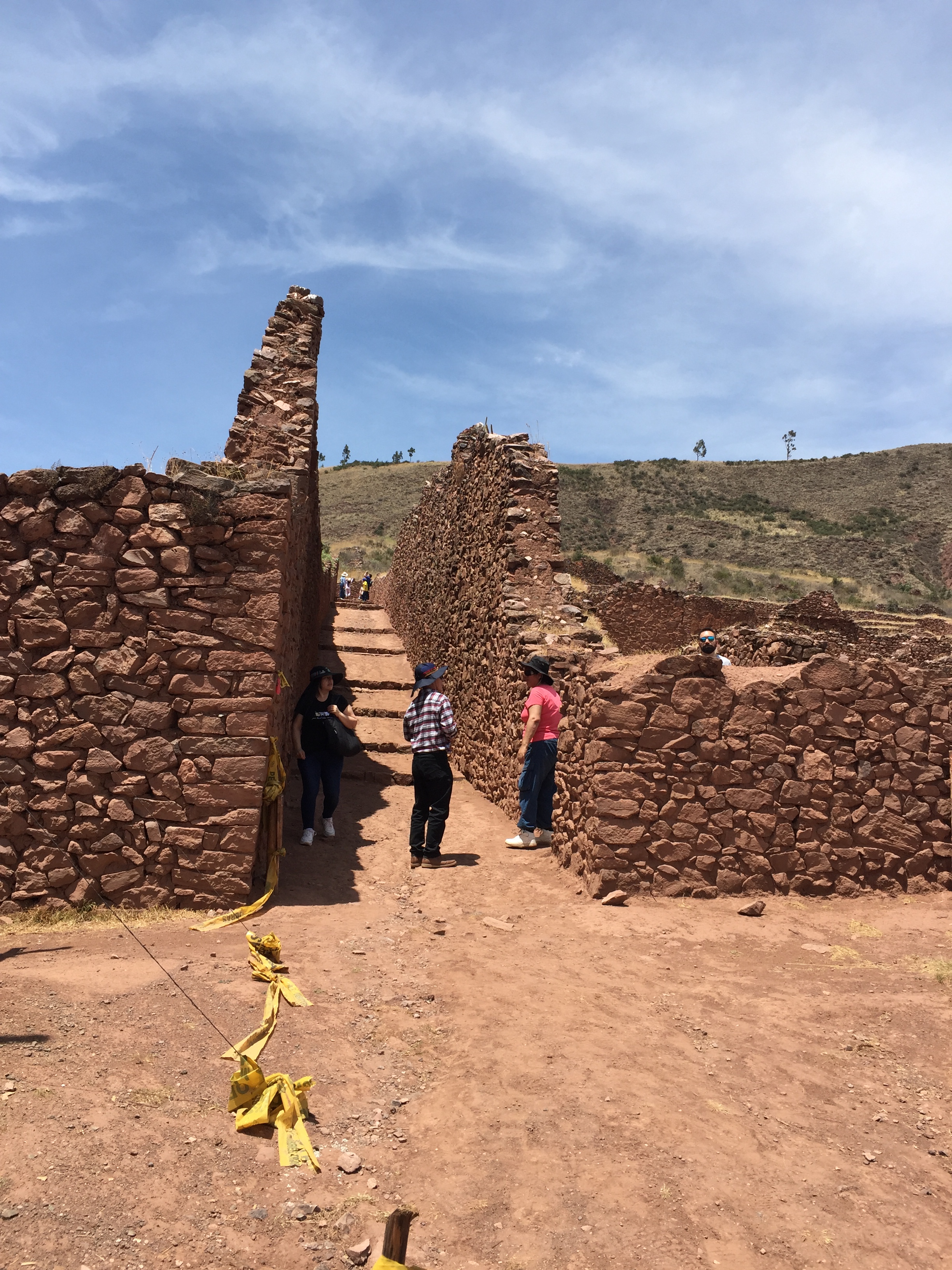
Wari walls, Pikillaqta
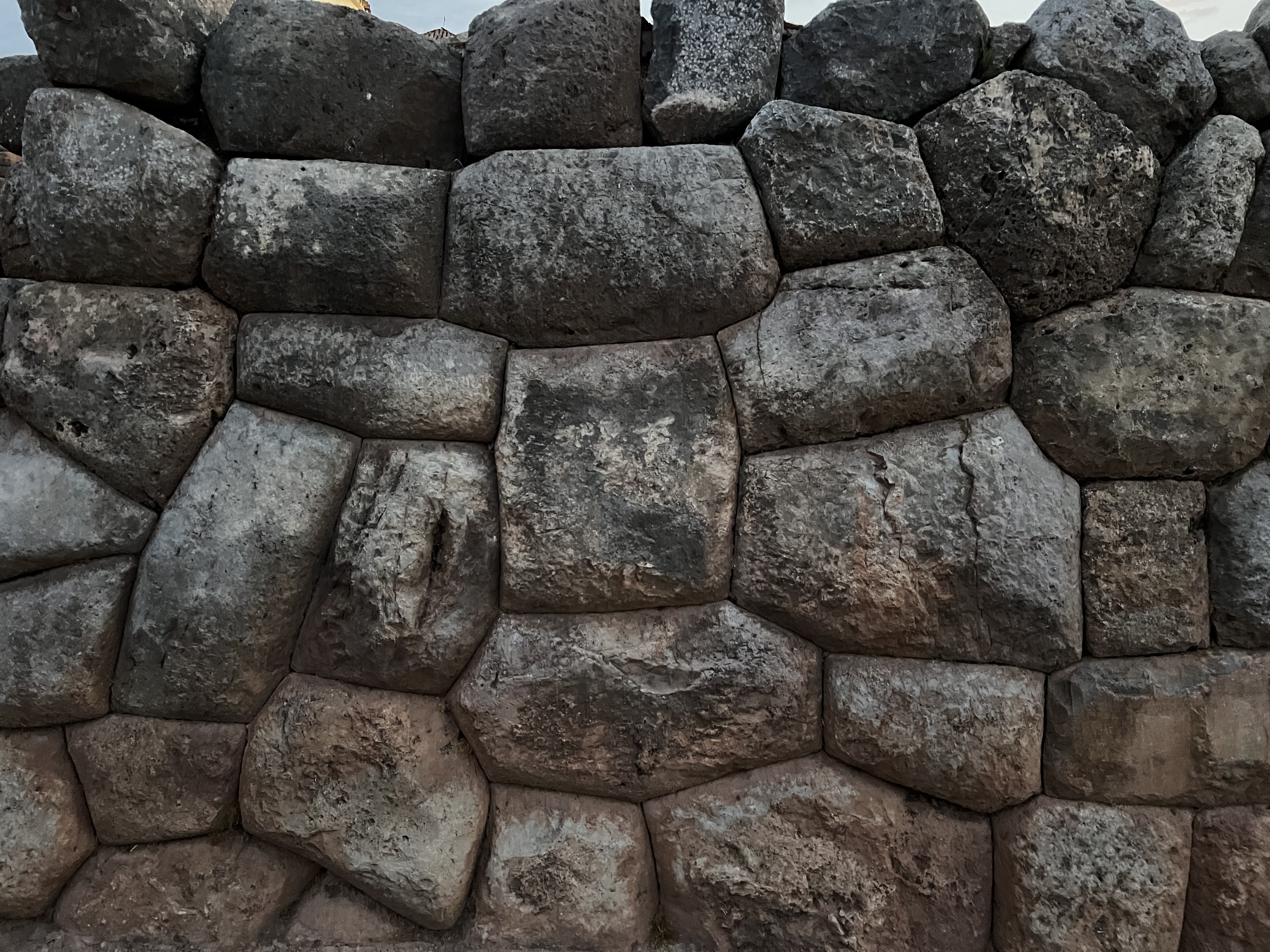
Incan stones on the wall in the form of a flower at Chinchero

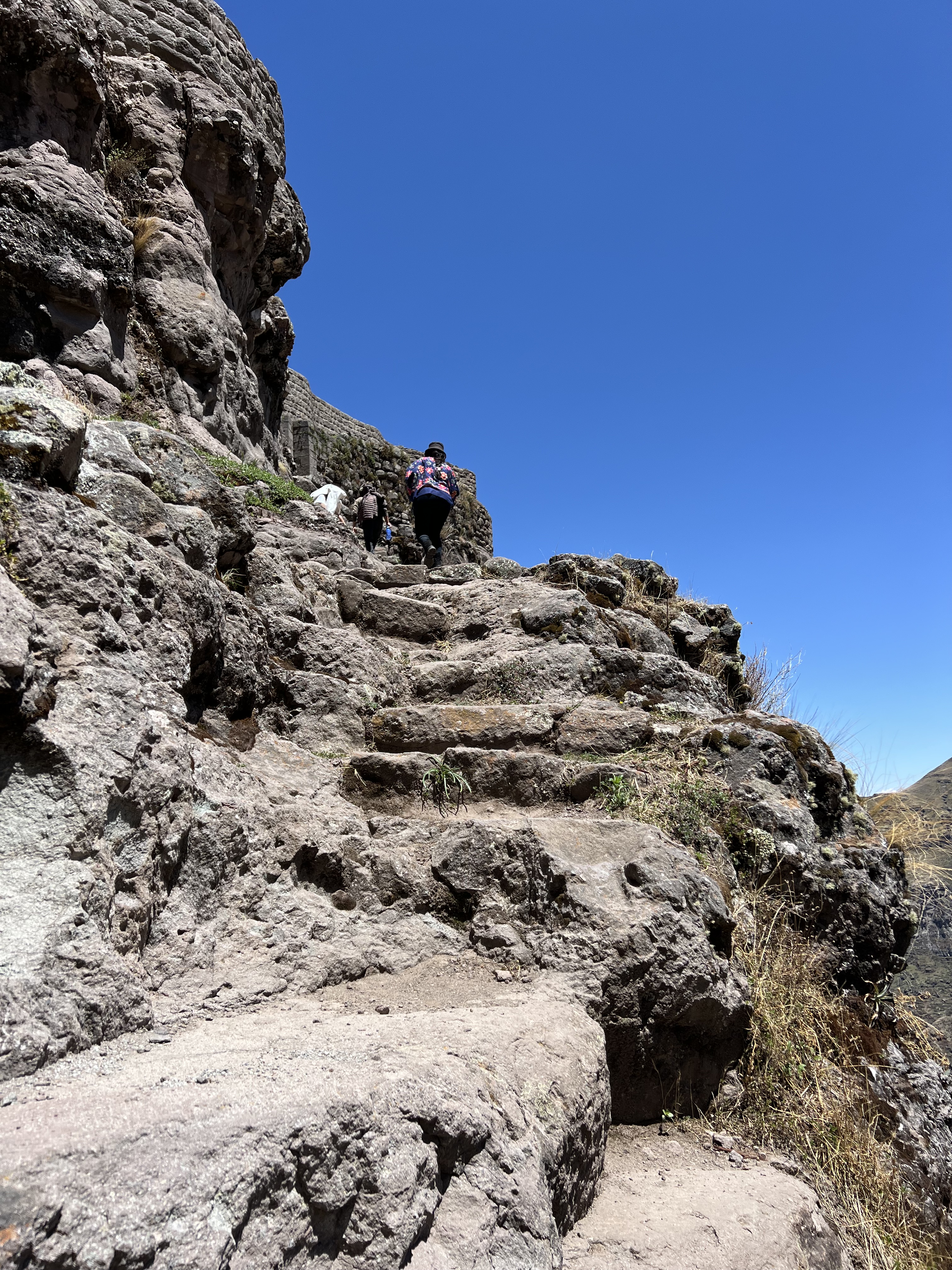
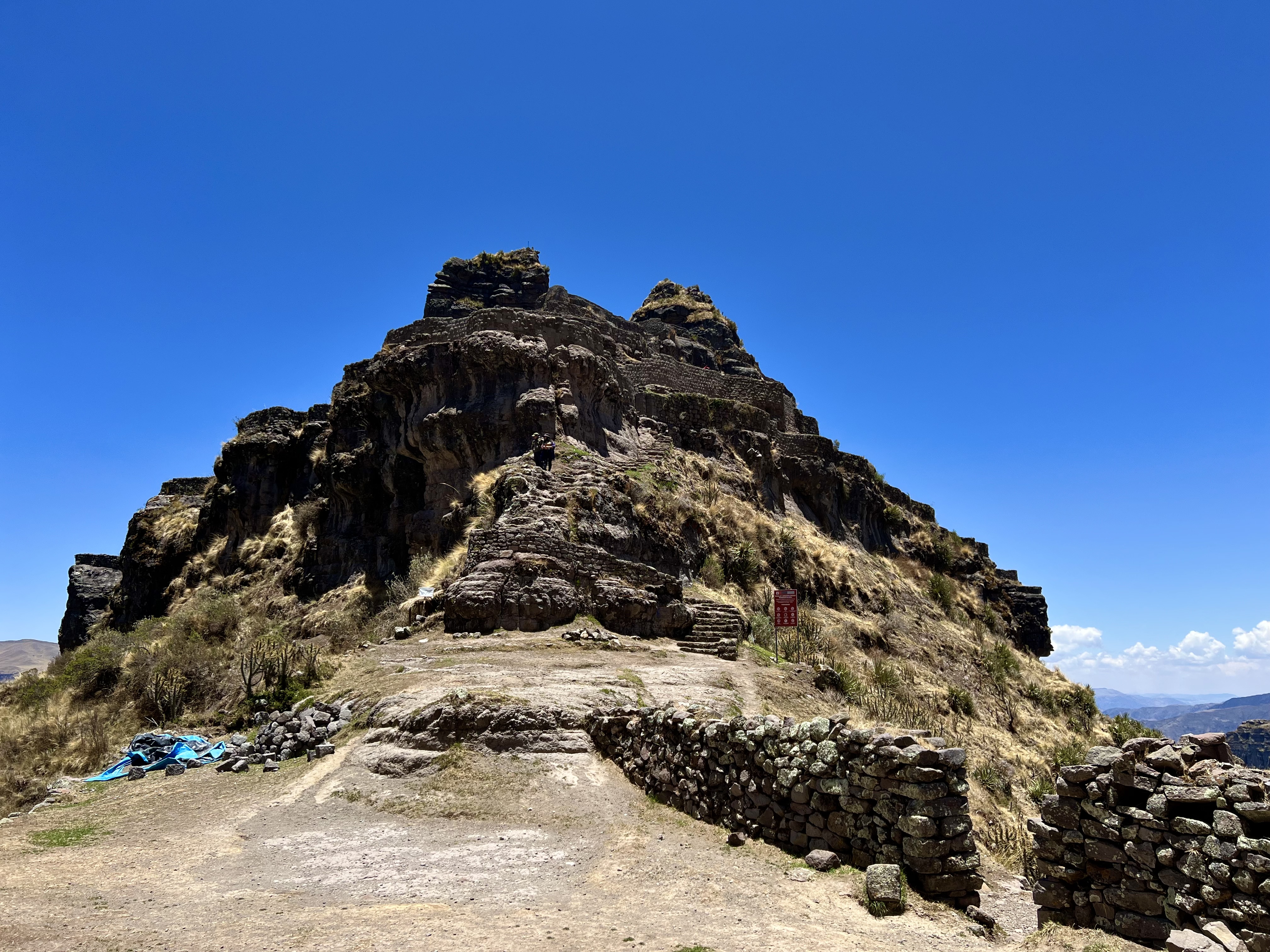
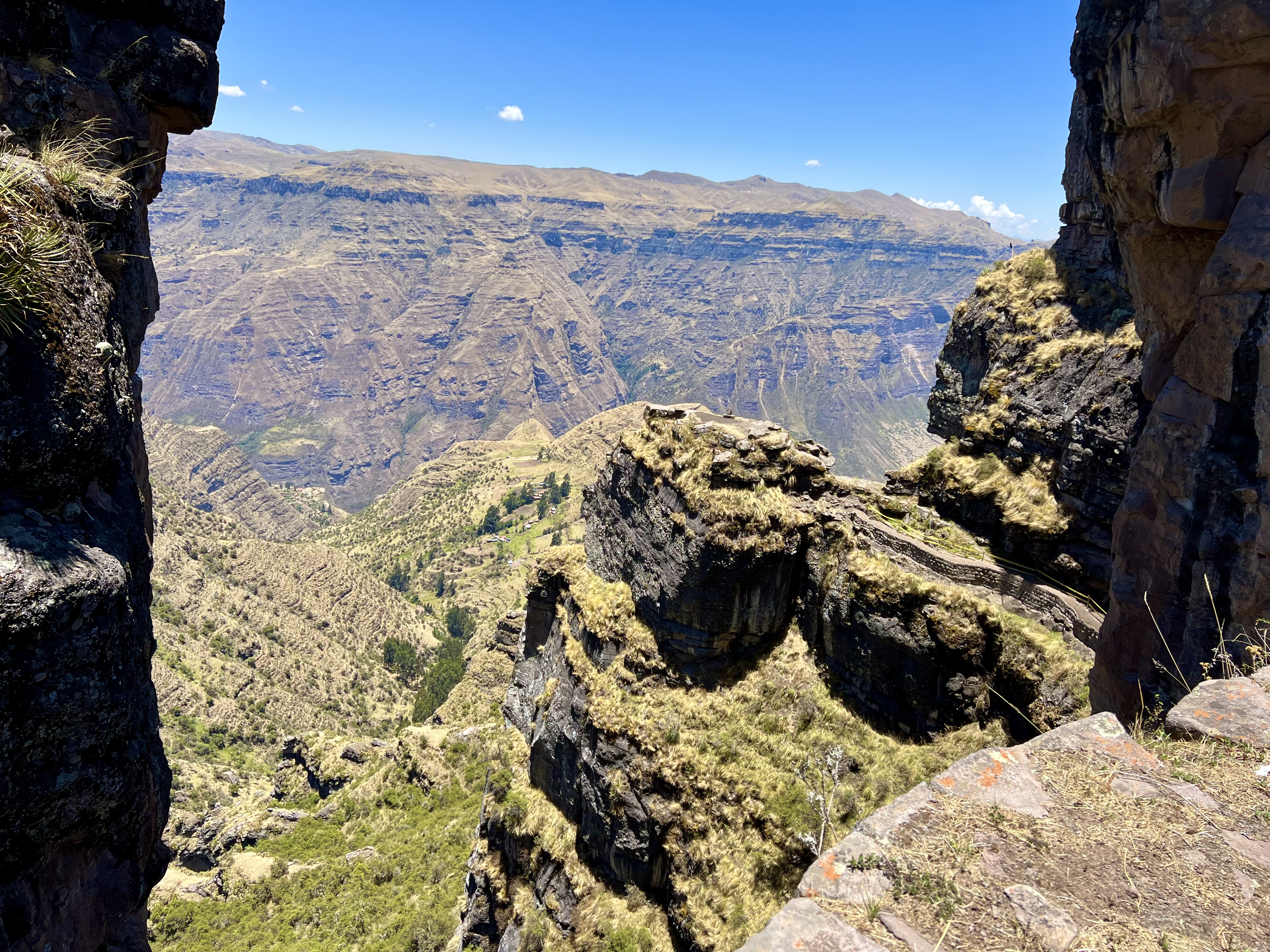
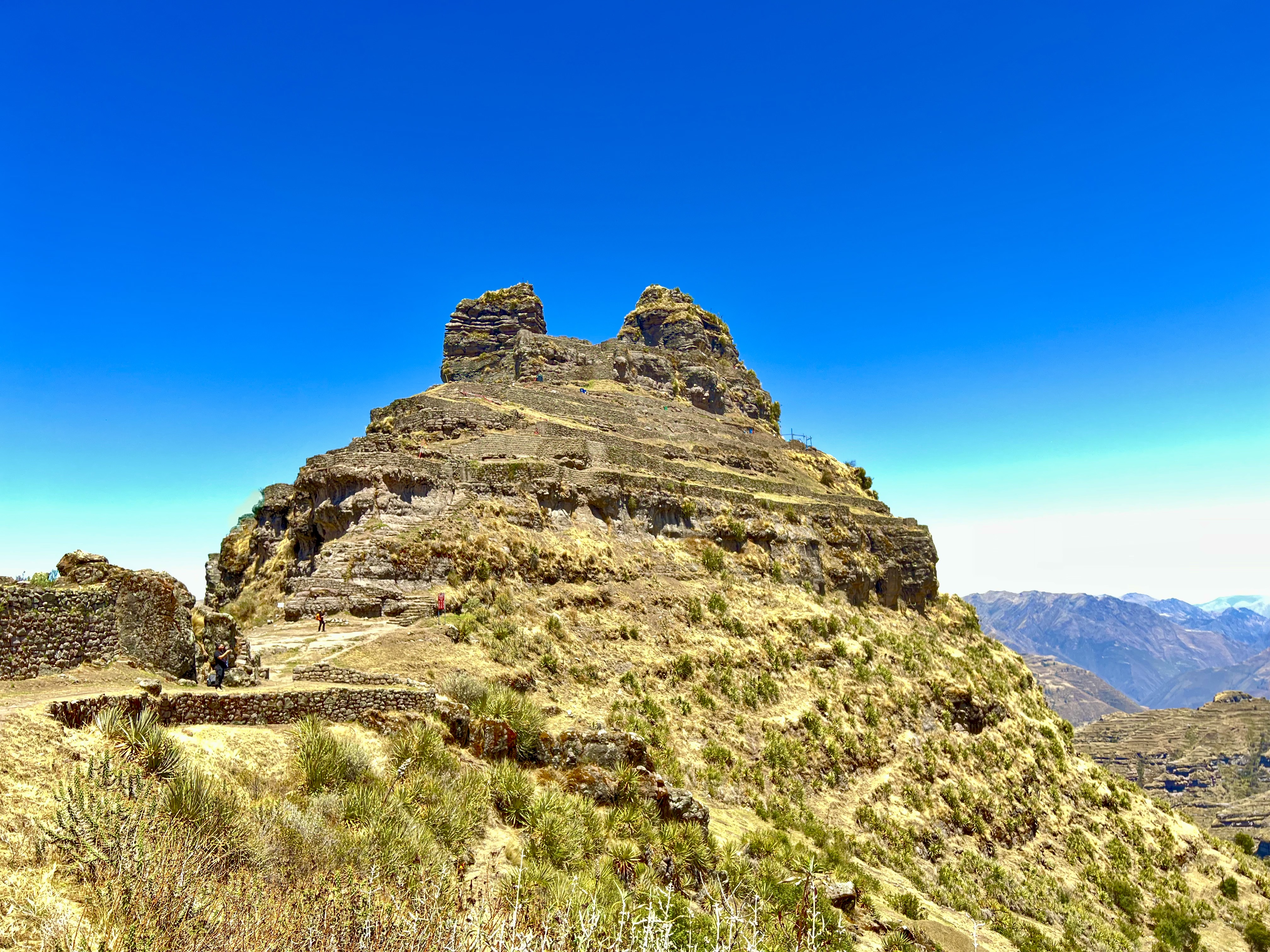
Even though I did not want to go back to Machu Picchu, I did want to visit an undisturbed Incan cult site in the mountains.  Waqrapukara opened up to tourism fairly recently and is  only a day trip from Cusco, unlike Choquequirao, which is a three to four day trek. Waqrapukara was called by two names, the horned mountain or the ears of the llama mountain. The name comes from two rock protrubances that shoot up from the plateau like horns or ears depending on the perspective. This site is amazing. It was used as a religious as well as astronomical observatory as the sun falls directly in the middle of the platform on the equinoxes.  The horns/ears also create a tunnel between surrounding mountains. The walls were formed directly from the rock face in an incredible feat of engineering prowess. There are a few different paths to get to the site, and it is recommended to take a tour rather than try to figure out the paths by oneself. The tour I took had a total of eight people, mostly from Peru, and took off from the small village of Santa Lucia. This entailed about an hour and a half winding gravel road up the mountain and at least one person did get carsick. (Not me!) This route, however, had the shortest trail. The first part was relatively flat until it went quite steeply up for about 20-25 minutes to get to the bottom of the site. Then there are very steep small stone stairs to get to the three levels of the complex. Some of the stairs and paths at the top require good footing and no fear of heights. The views from the top, and our group was alone there, were breathtaking. The steep canyon below could have been a slightly more vegetated Grand Canyon, with many kinds of cacti. It is amazing to me how people construct such sites on the tops of mountains.
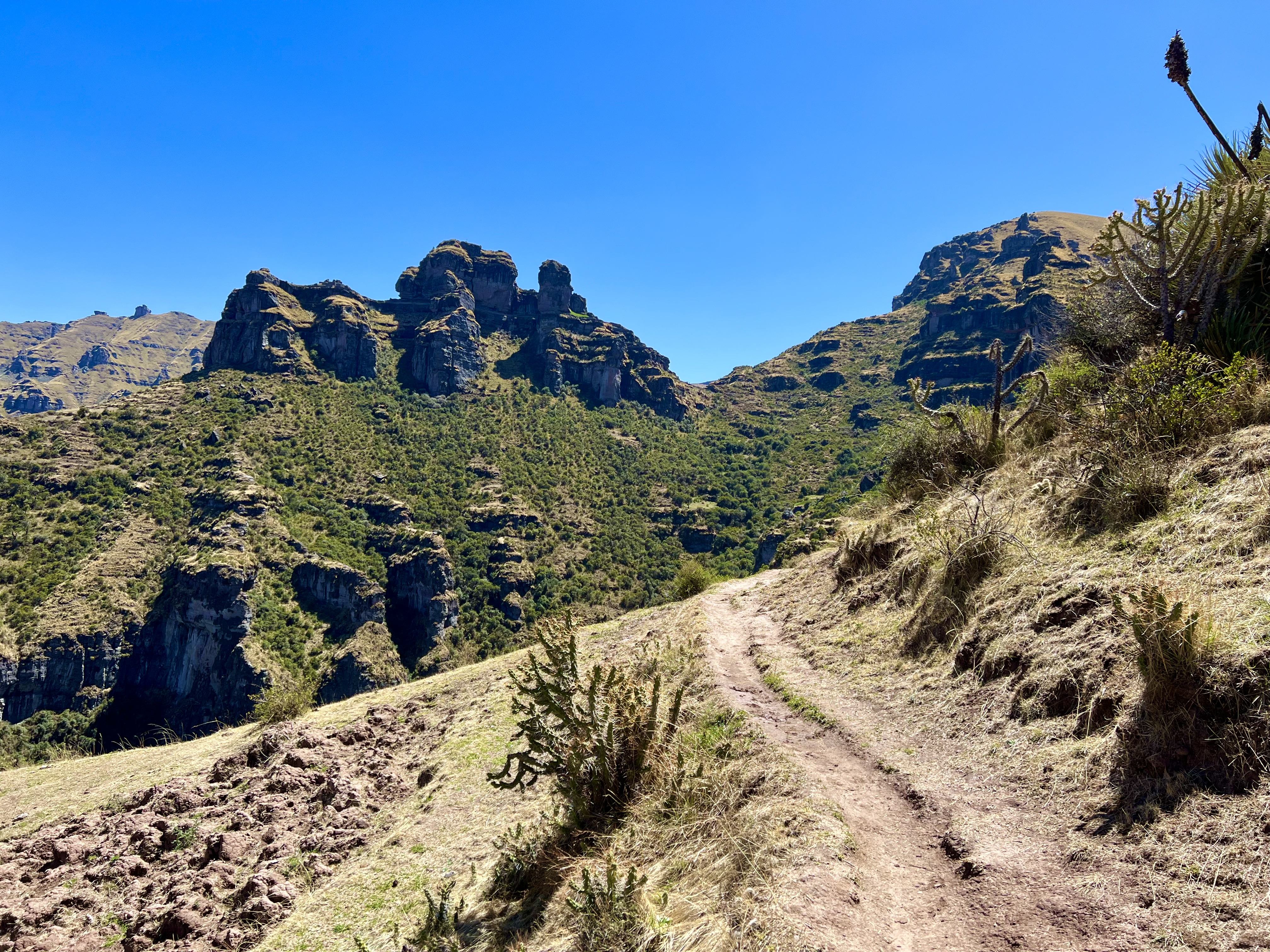
Path to Waqrapukara
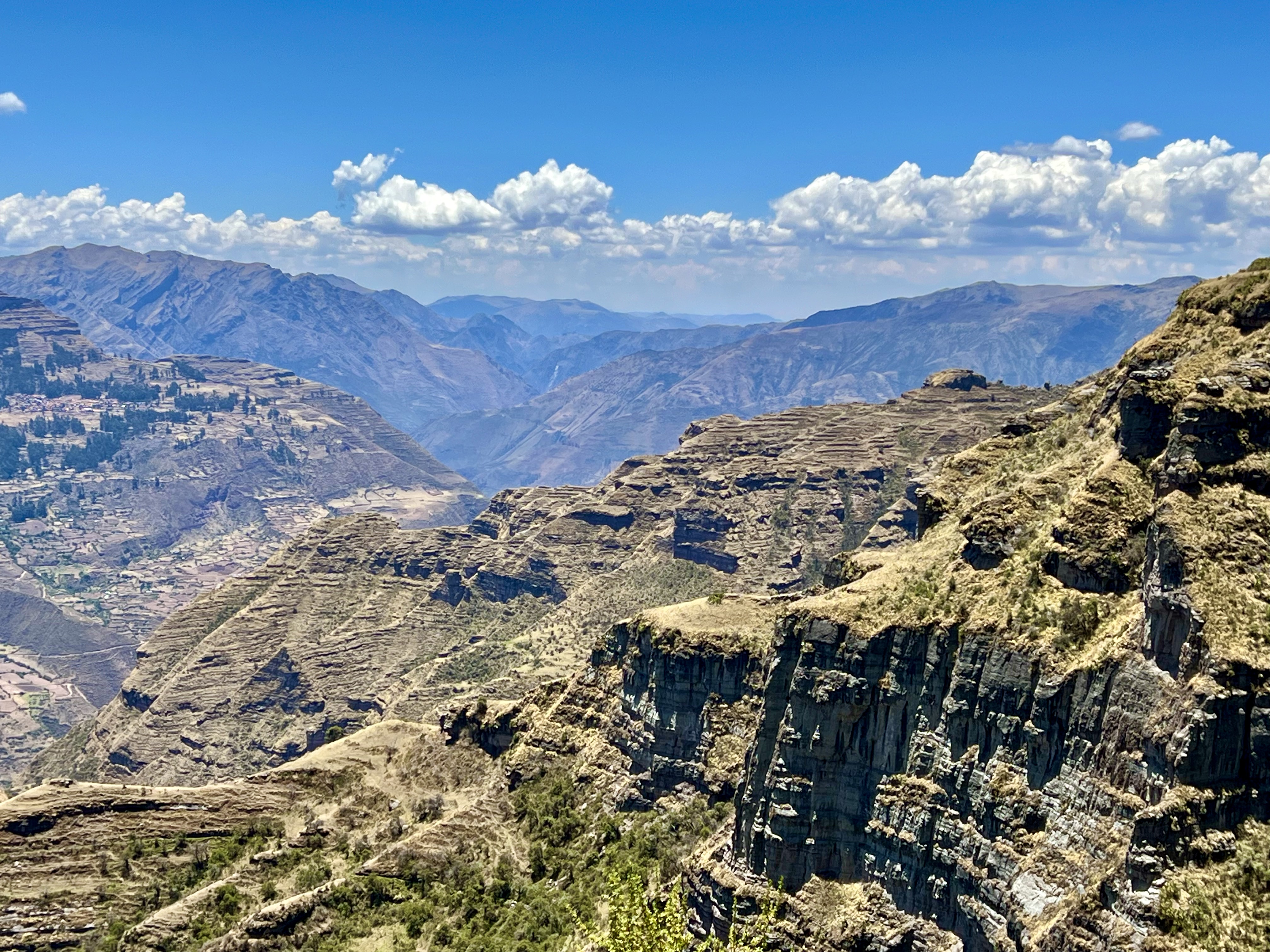
Canyon by Waqrapukara
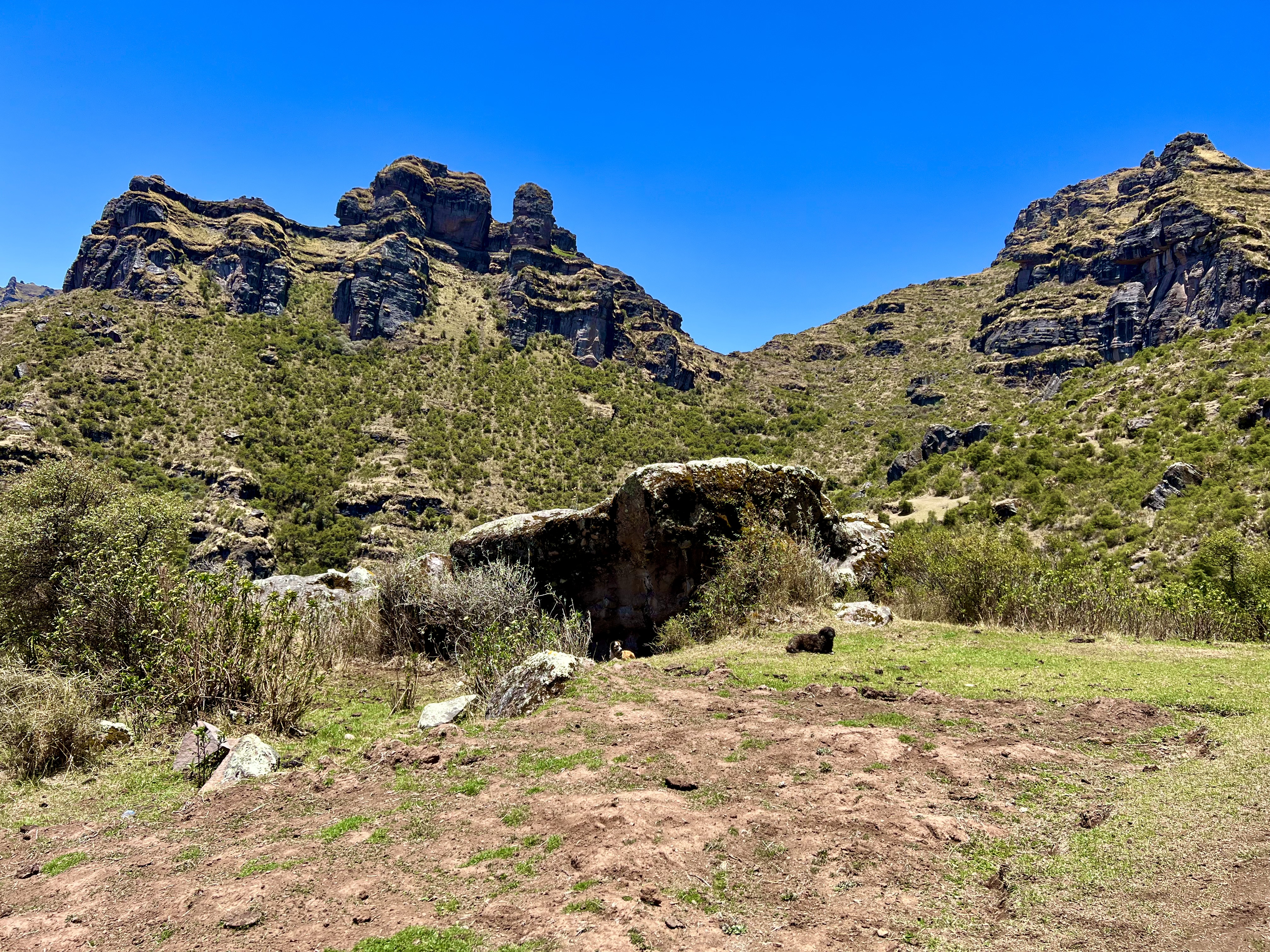
Canine protectors of the sacred site

Waqrapukara                                    

Wakrapukara and view of stone walls carved from the rockface

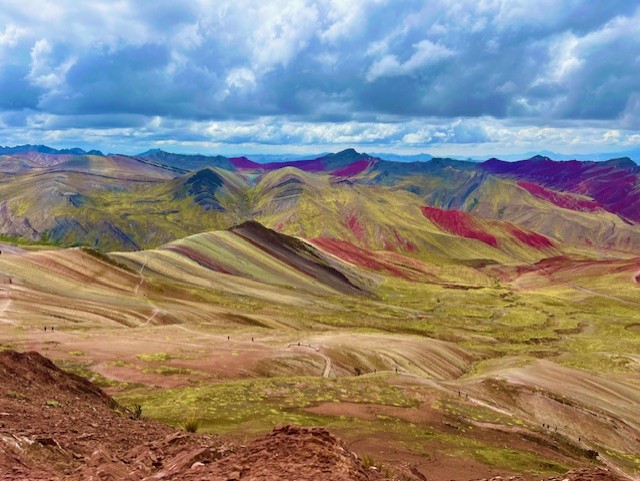
The tour that got me to Waqrapukara was my second attempt to get there. The first time, a week before the successful event, we were unable to go up the gravel section of the road as it was closed for a rally.  The tour guide suggested we go to another place across the valley as no one in the group had been there.  There are three ‘rainbow mountain’ tours in the Cusco area. The main one, has thousands of people and is almost as popular as Machu Picchu. One of the other ones, Palccoyo, has much less traffic, and this is the one we went to. It was a beautiful walk/short hike (1 ½-2 hrs) with amazing views of the different colors from the earth’s minerals shining through.  In the distance from the top, Ausungate, the sacred glaciated mountain, peaked through the clouds. The Andes around Cusco are truly beautiful.
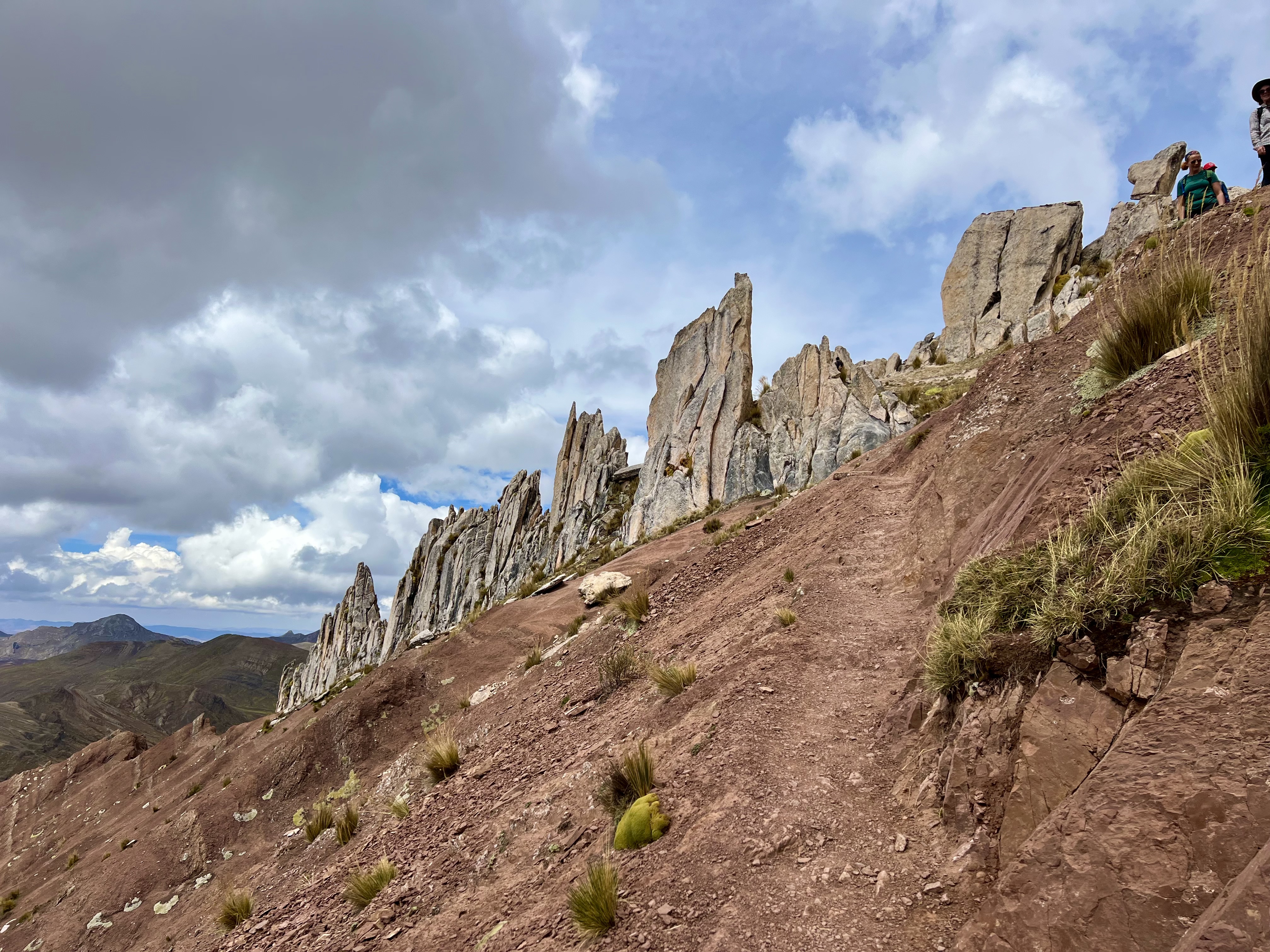
Stone forest Palccoyo
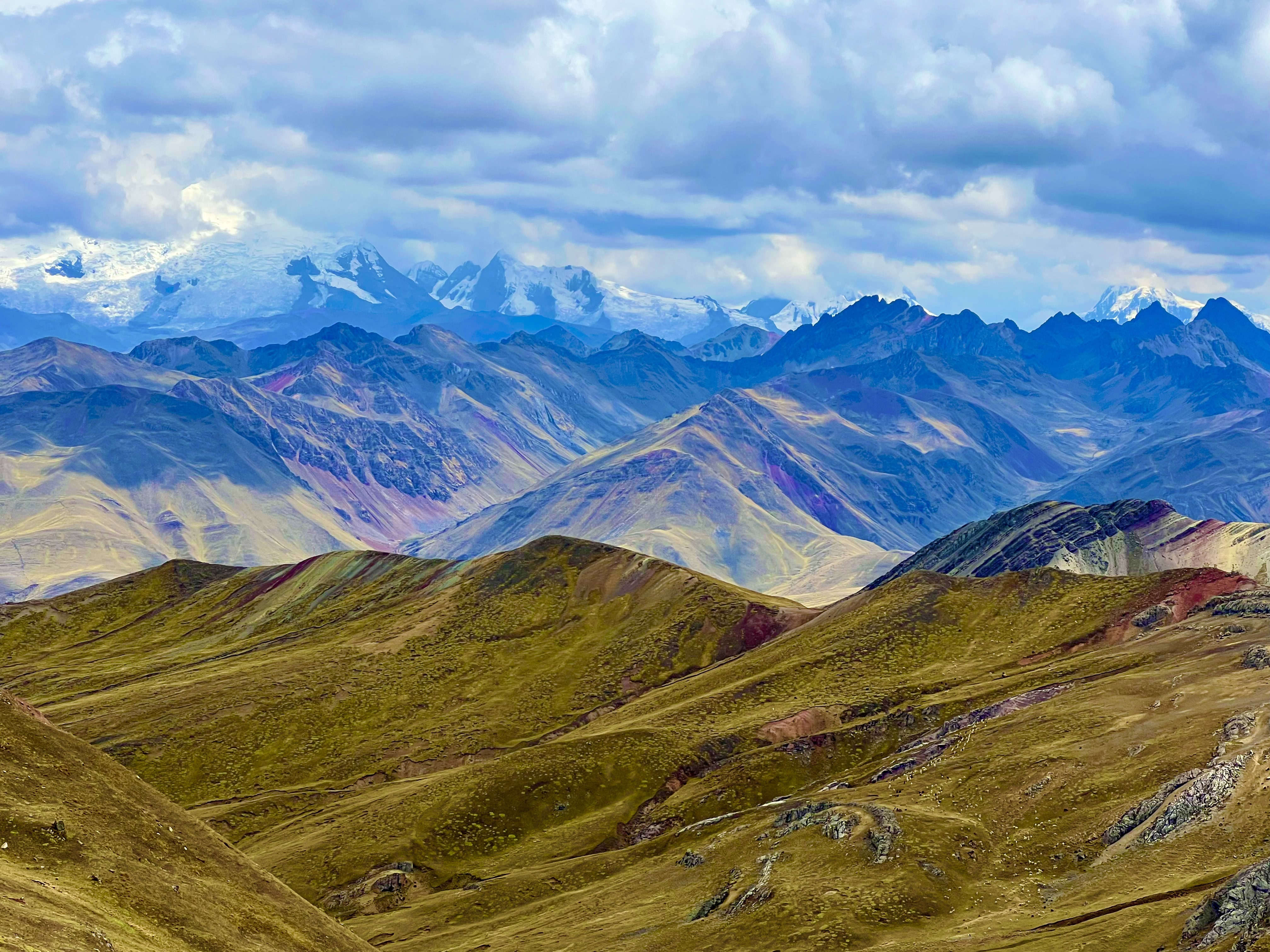
Ausungate from Palccoyo

On days when I had time between classes and wanted to get up in the hills, I took a taxi up past Sacsaywaman to wander around the various sites that aren’t part of the tourist ticket. The Tourist Ticket is required for a few museums in town, the sites in the Sacred Valley and the four major sites starting from Sacsaywaman up the mountain. There are other sites in this area, though that are just as interesting including Temple of the Moon and Zone X with its labyrinthian caves. It is easy to take colectivo for 1-2 Soles back to town or to hike down via Cristo Blanco, the large white Jesus statue on the hill below Sacaywaman and above the town.
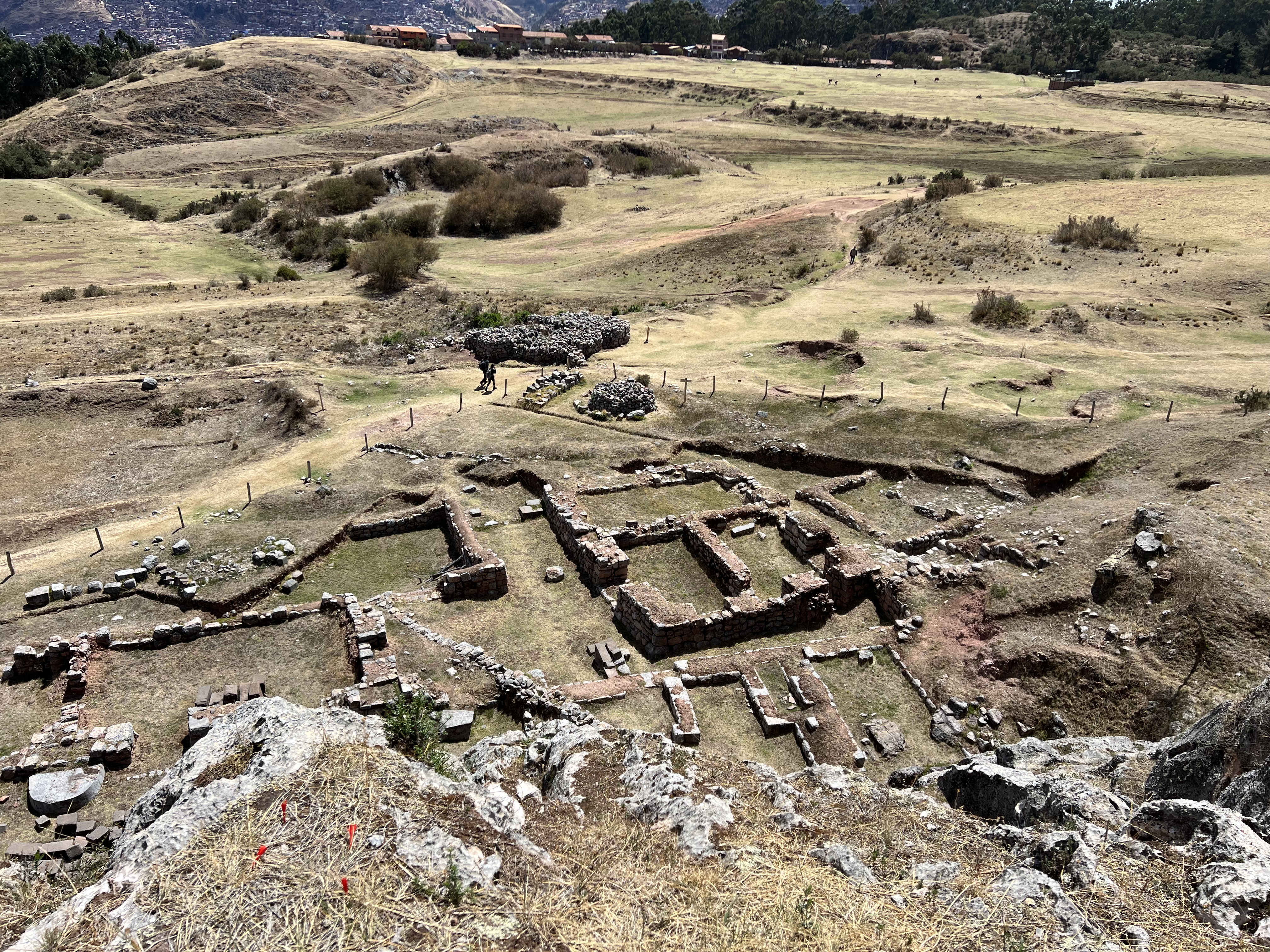
Temple of the Moon
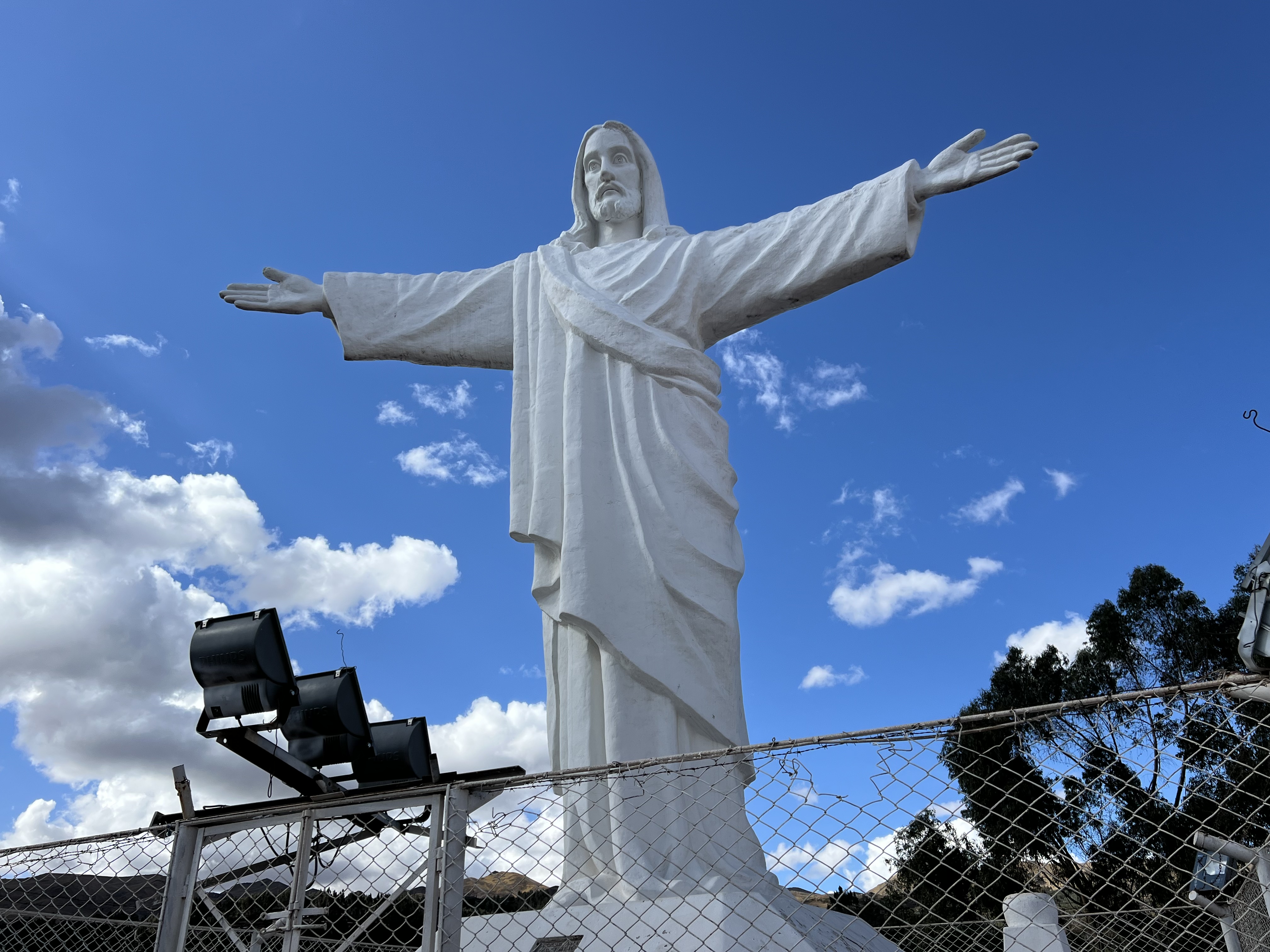
Cristo Blanco

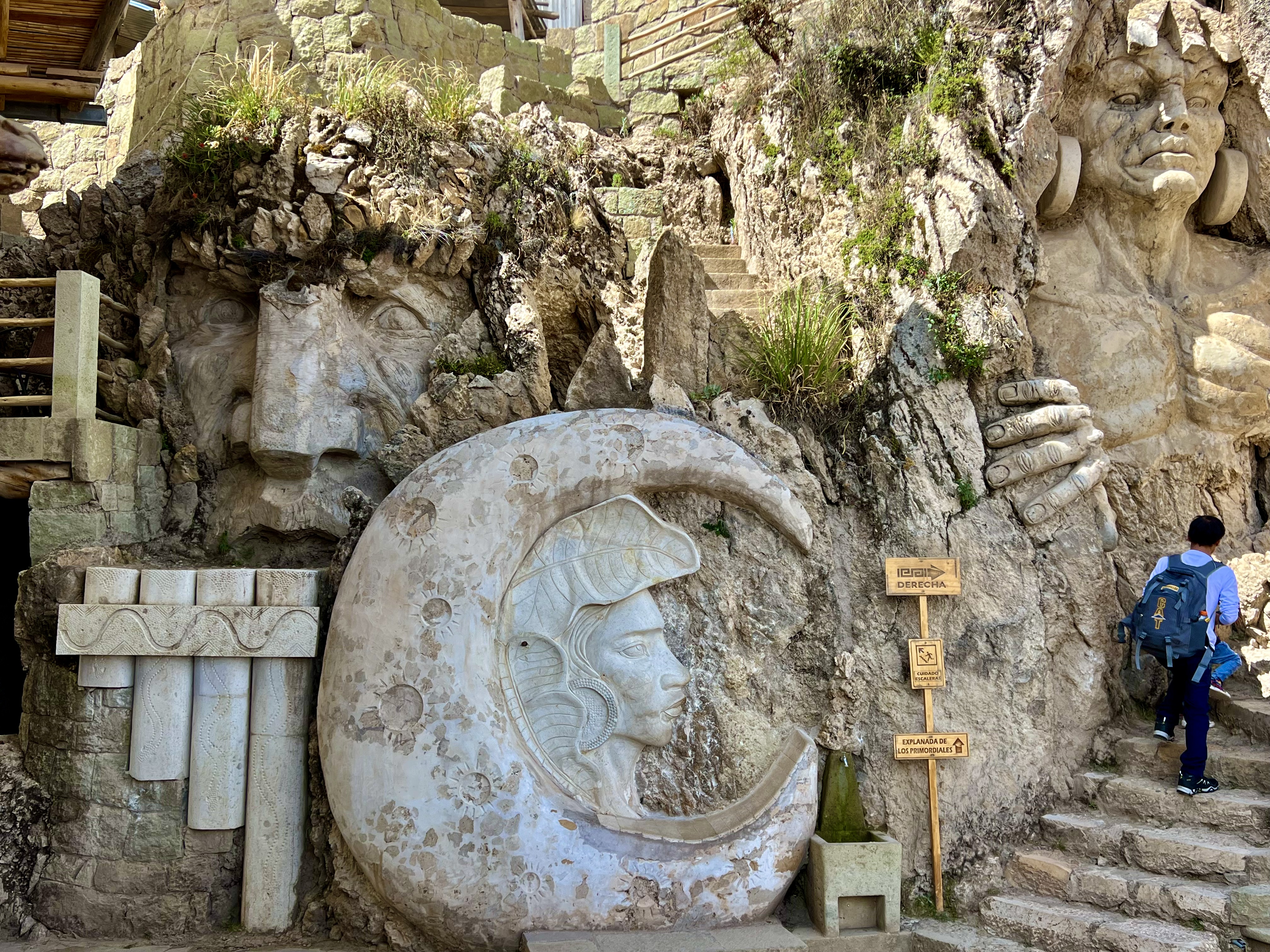
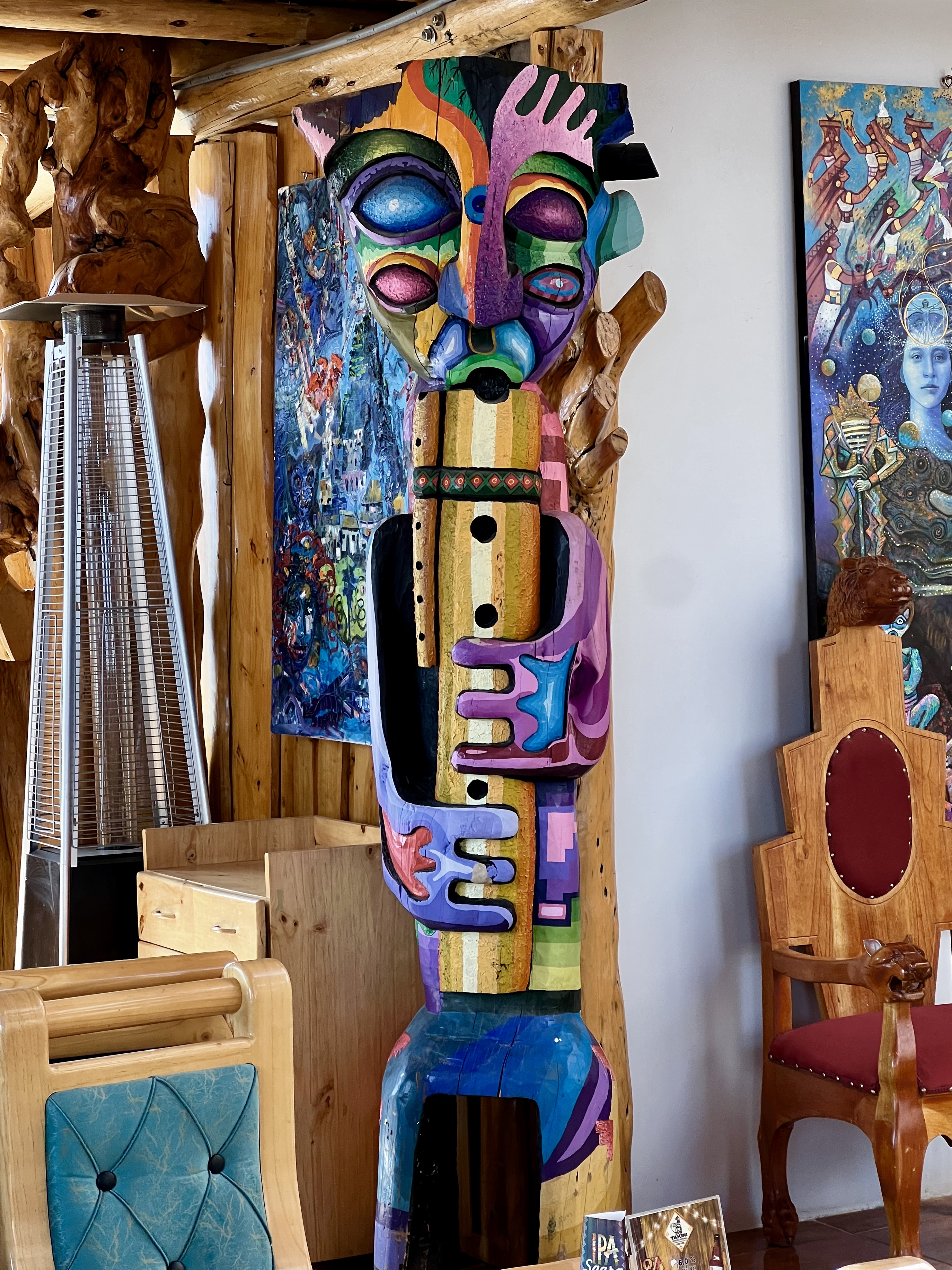
One place that did require a taxi ride was the La Morada de los Dioses/ Apukunao Tianan. A local artist, Michael de Titan, has created huge relief sculptures of various gods and goddesses out of the mountainside. The artwork is amazing and the views from the various platforms incredible. The café is made from intricately carved wood and is a work of art in itself.  I was there on a Sunday and, while there were quite a few people, I was the only foreigner.

Andean duality

Mama  Quilla, the moon goddess

Tupac Capac (pre-incan warrior), Wiracocha (main god), Mama Sara (goddess of corn and fertility) and The Puma (guardian of this world)
Morada de los Dioses cafe

Art in the Morada de los Dioses café

Art is part of the soul of the city and is apparent not only in the architecture and the many galleries in town, but also on the wall murals. Many of the murals are quite intricate; some convey both the history and beliefs of the people while others are simply beautiful paintings.
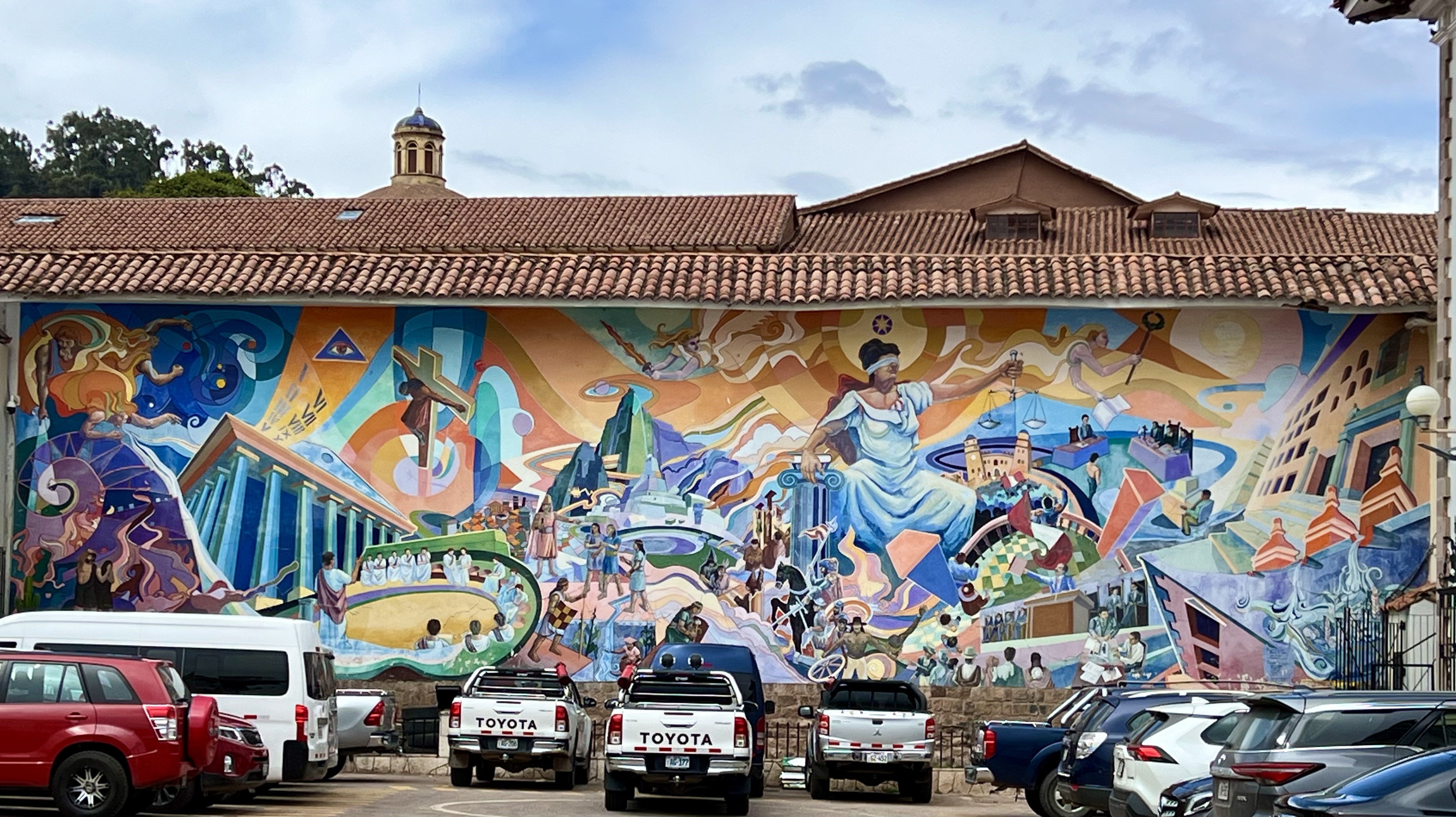
Mural at the Courthouse parking lot
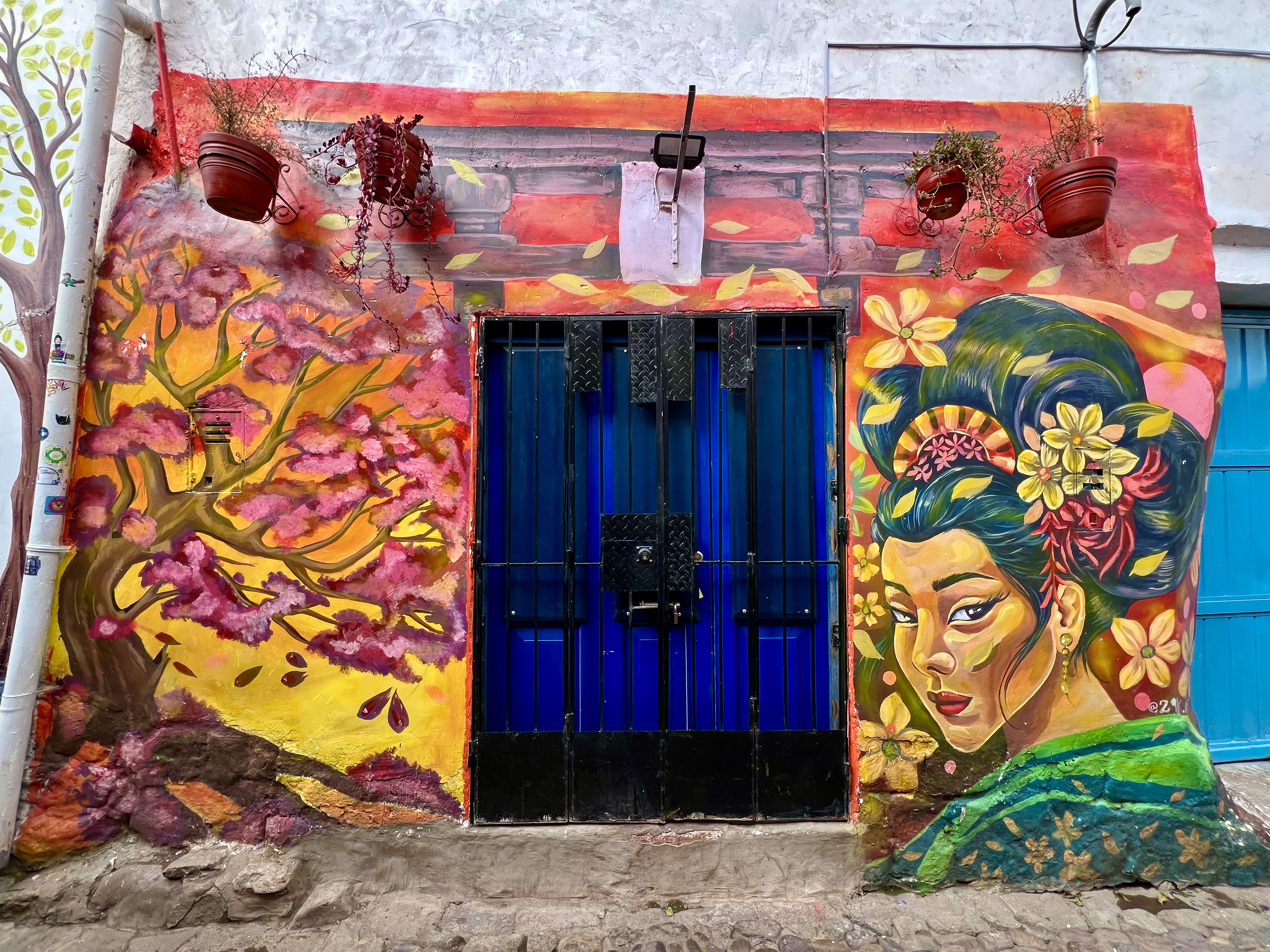
Mural in San Blas

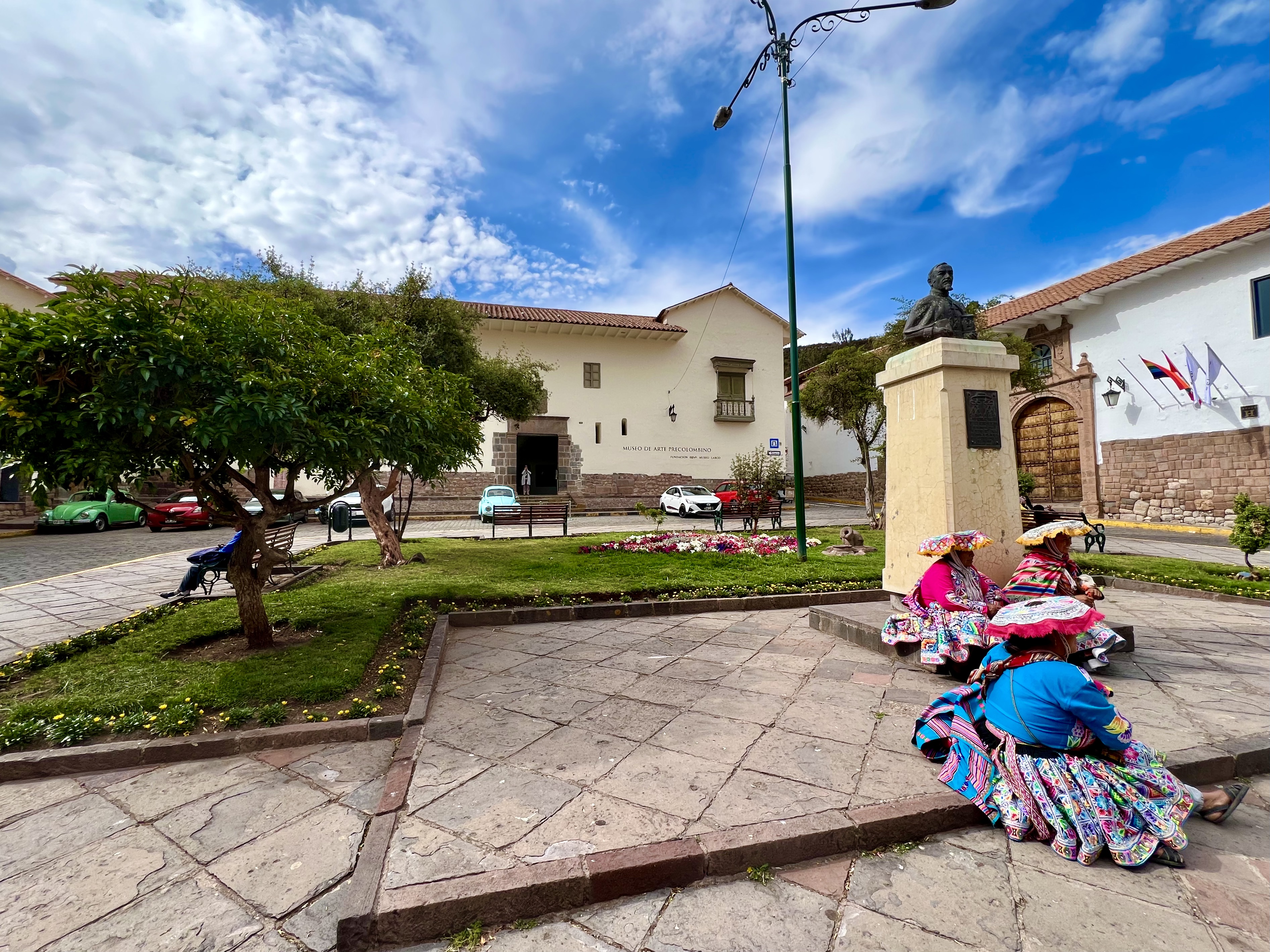
Museum of Pre-Columbian Art

I should say a word about a few of the many museums in town. My favorites were the Pre-Columbian and Incan Museums. Both had excellent signage that explained the pre-Incan as well as Incan cultures.  The Museum of Popular Culture has lots of cult dolls that gave me the creeps, but they also had a very good video explaining the history of Cusco from its earliest habitants. The Incan and Popular Museum were part of the Tourist Ticket. It costs Soles 130 and is good for 10 days.

For those who are curious about food and drink, roasted guinea pig and alpaca are traditional dishes – neither of which I tried as I had guinea pigs as pets when I was a kid, and I like alpacas. Chicheron, a pork dish is a local favorite and is quite tasty.  There are two drinks that are traditional to the area, Pisco Sour, which is actually from Arequipa, and Chicha, a fermented purple corn beverage. Chicha was considered to be a sacred drink, but now it is available almost everywhere. It too is quite good.

My time in Cusco has come to an end. I wish my brain was somewhat more agile and that the time in the school had made me fluent, but although I can read almost everything, I still cannot get this language to come out of my mouth correctly.  Hopefully, over the next couple of months this will improve.

Tomorrow it is on to Lima and the Lorca Museum before heading to Huaraz and the Cordilla Blanca for a few days of hiking and ancient archeological sites, including Chavin de Huantar.

Just a few more photos:

San Blas street

         Qapaq Colla dance of the alpacan shepards in Plaza San Blas                               
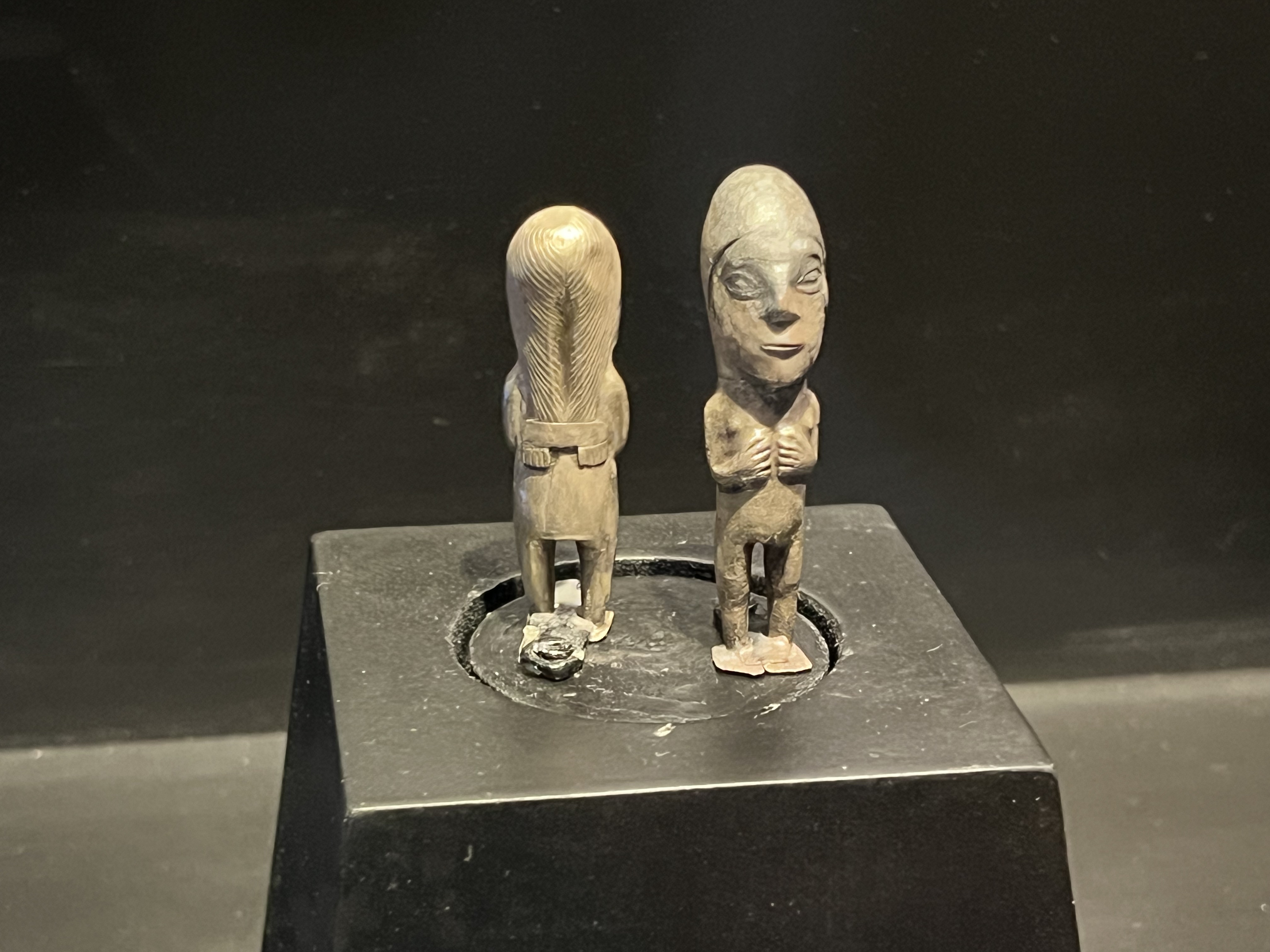
Canopas
    

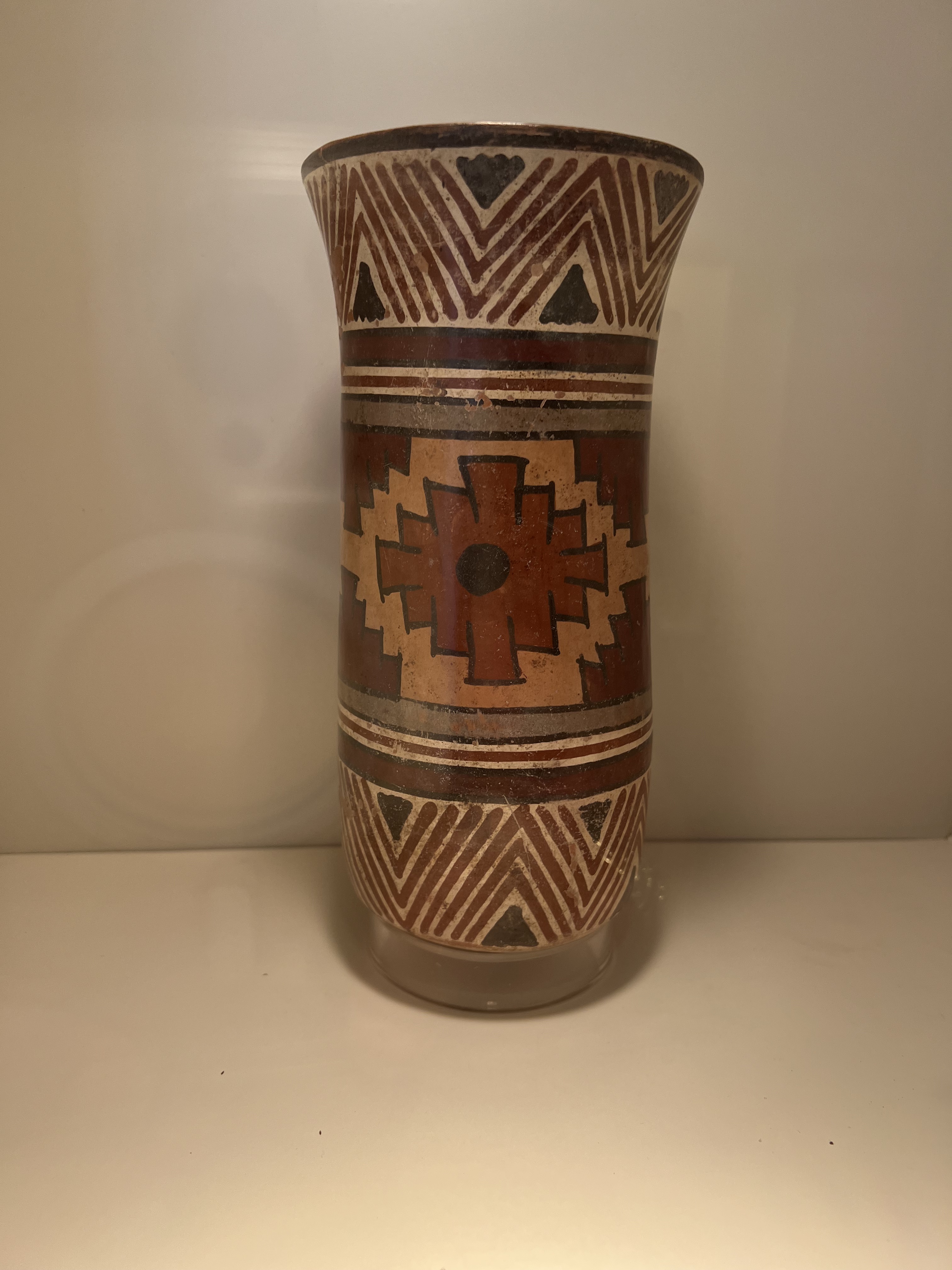
Nazca Andean Cross on Chicha Vase 100-600 CE     
Palccoyo

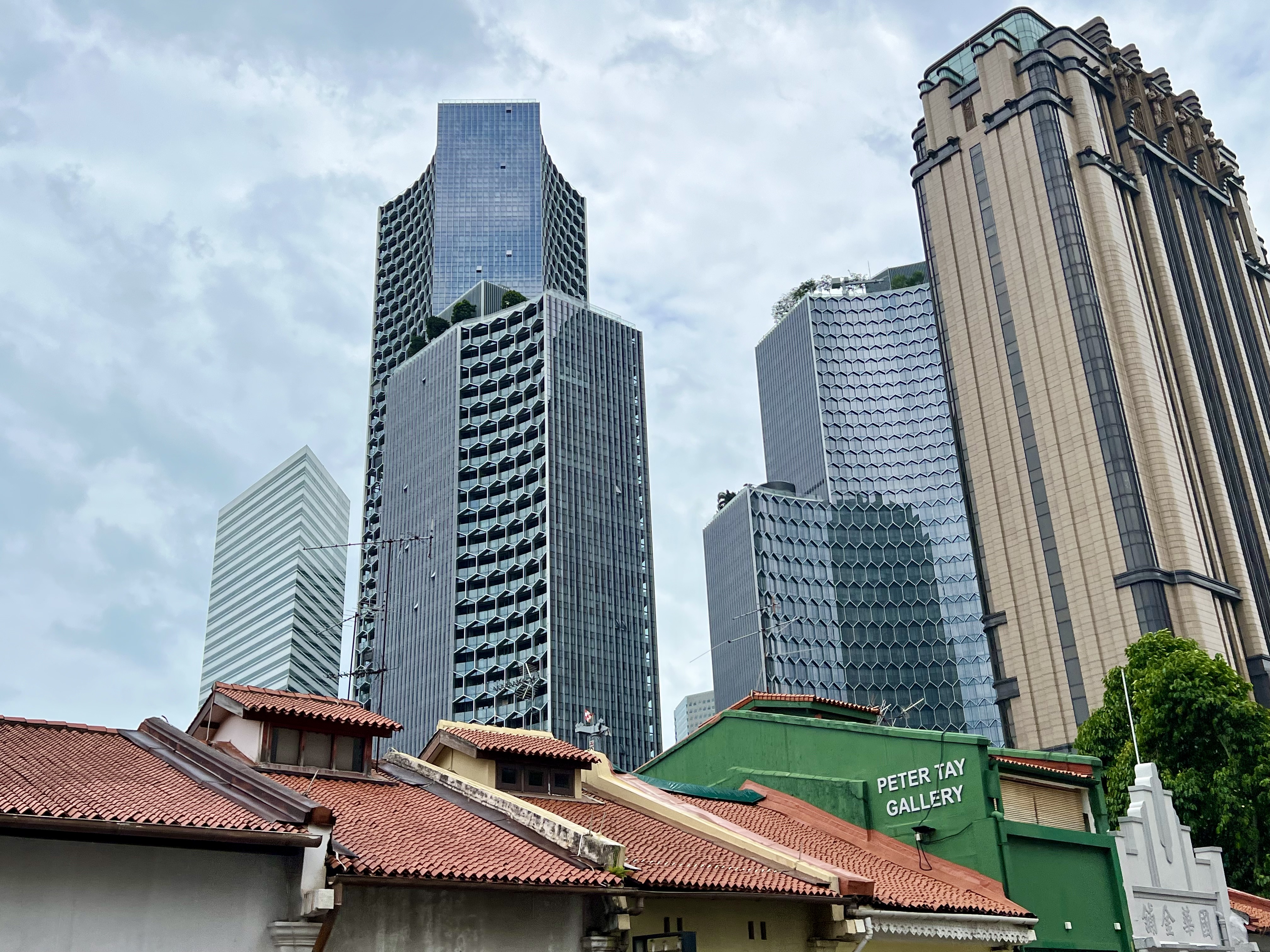
Singapore: A City of Temples and Art

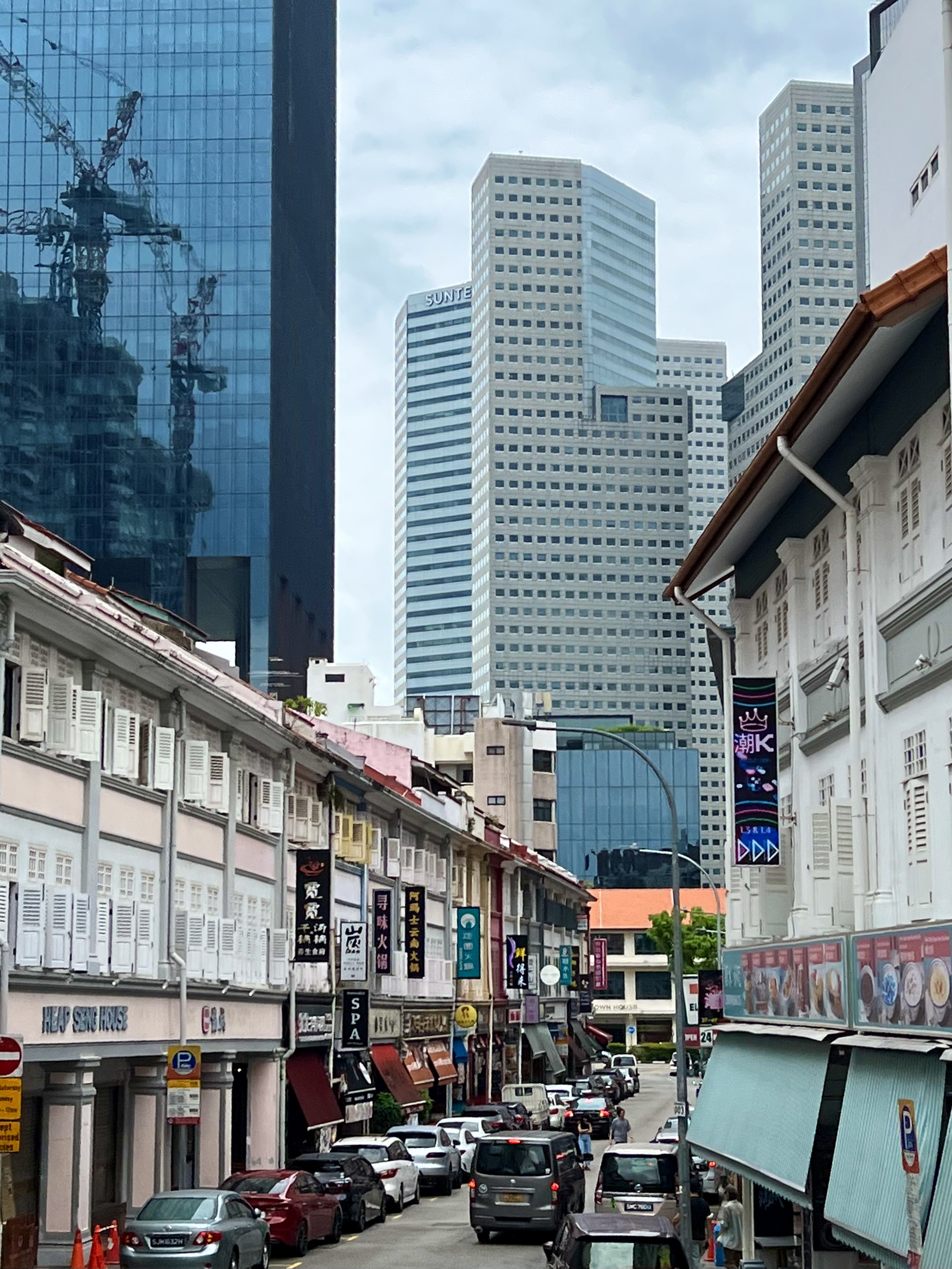
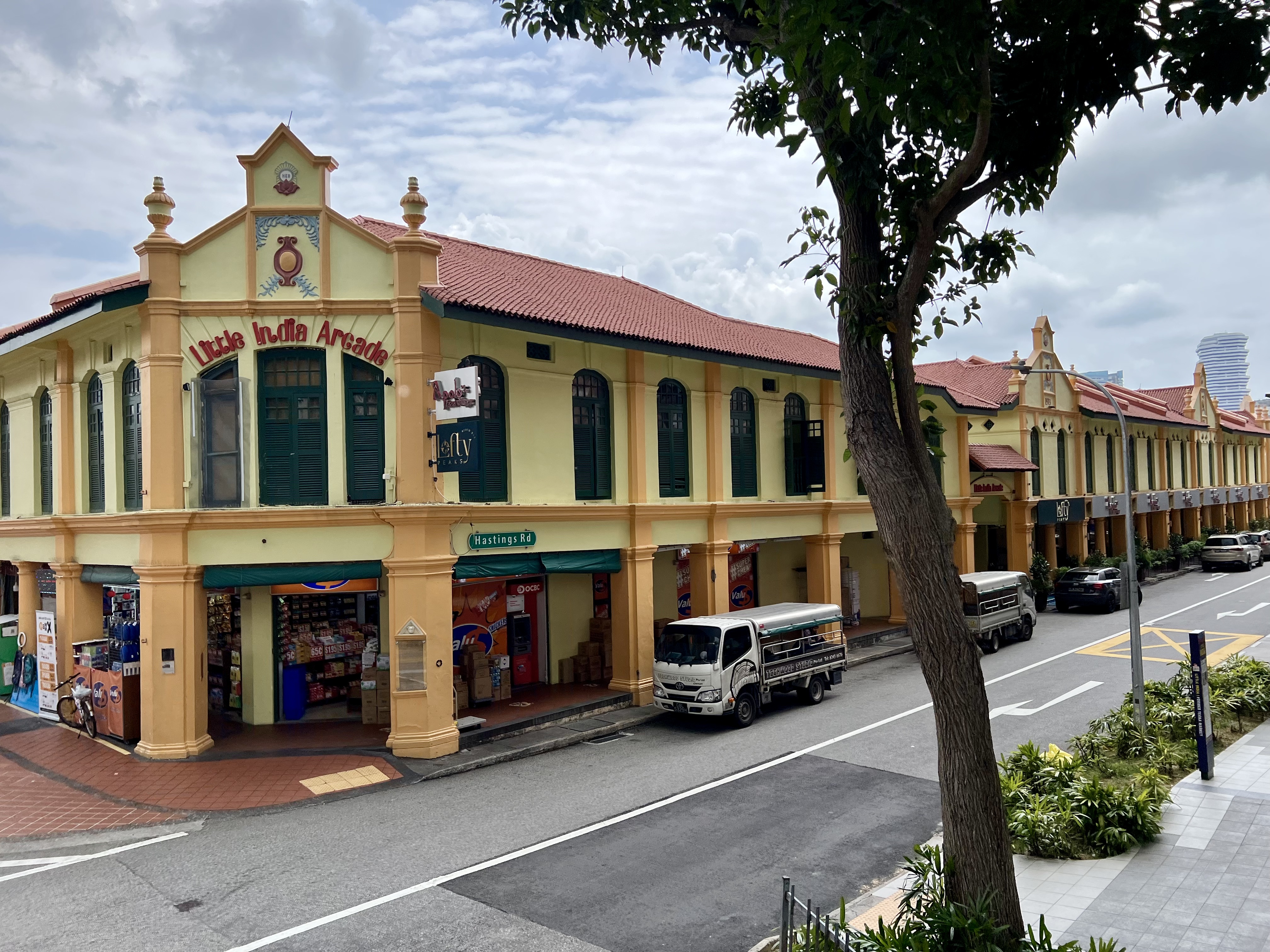
As always, I try to make my first stop in a new country to the National Museum. In addition to the history of the city-state, in Singapore this season there were two special exhibits; one on the Story of the Forest and the other on A World of Plastics. Both showcased Singapore’s commitment to sustainability, which I could witness from the plane coming in with solar panels lining some of the major gardens in the region. The National Museum of Singapore differs from most others in that it concentrates primarily on the last 400 years of conquests and occupations by sultans, the Portuguese, the Dutch, the English and then the brief Malaysian Federation interlude prior to independence in 1965. What was most interesting beyond the pottery from an ancient shipwreck and the two special exhibits, was a video of a press conference the first Prime Minister gave when Singapore was forced to split from Malaysia as the Singaporeans insisted on valuing the multi-cultural heritage of the population, whereas the Malaysian Federation only wanted to promote Malay culture and Islam as the nation’s religion.  The video showed how this split was not at all what Prime Minister Lee Kuan Yew wanted for his populace, and he wasn’t at all sure how the small city-state was going to function on its own.  The determination of the people and the government demonstrated how far Singapore has come in a relatively short time. The city fathers (I’m not sure how many mothers were involved) set a far-sighted course to promote trade and tourism by making the city attractive to both groups. The multi-cultural heritage is at the heart of the city and is demonstrated in the various ethnic districts which have at least partially retained their 19th and early 20th c architecture. 

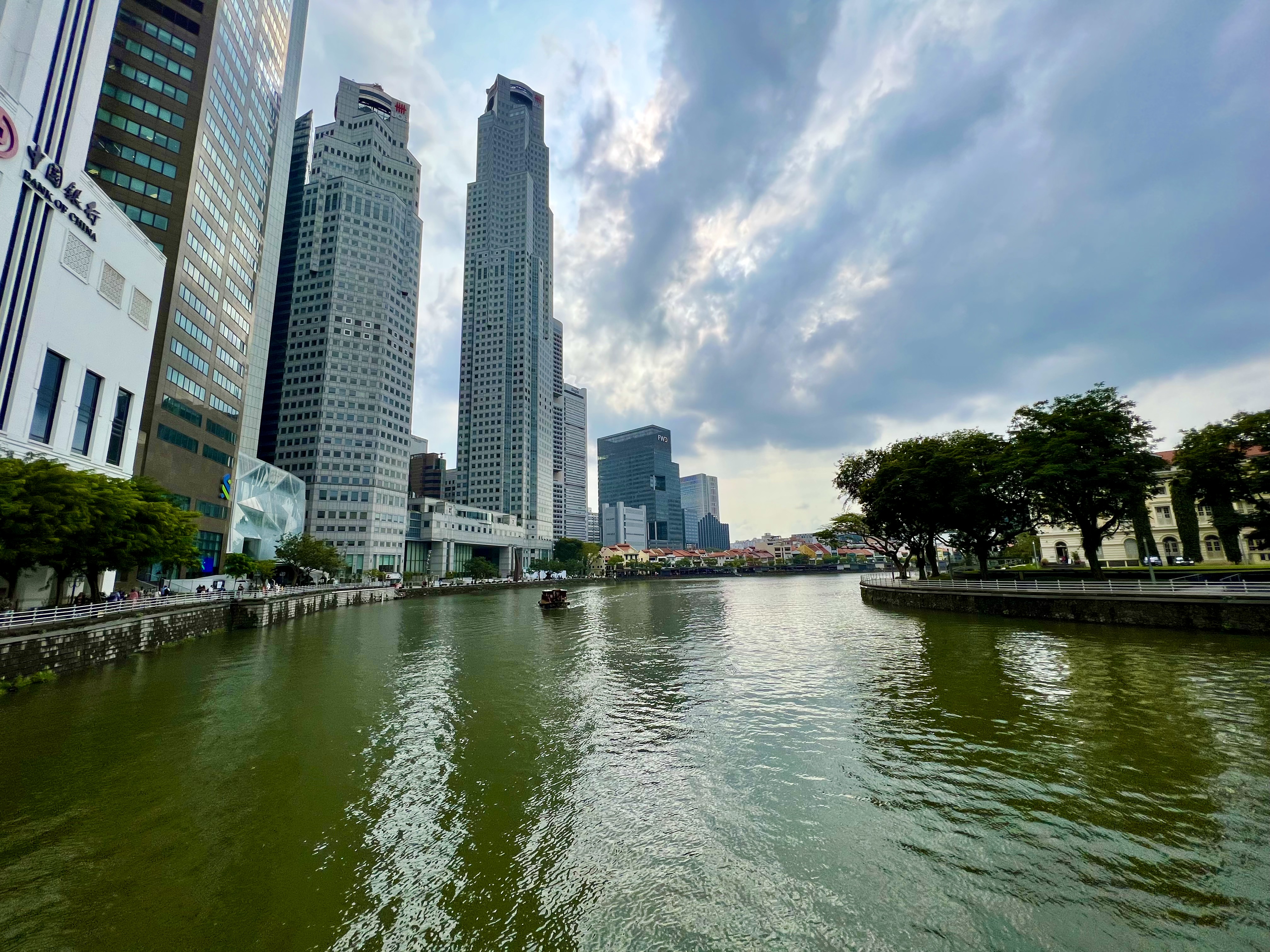
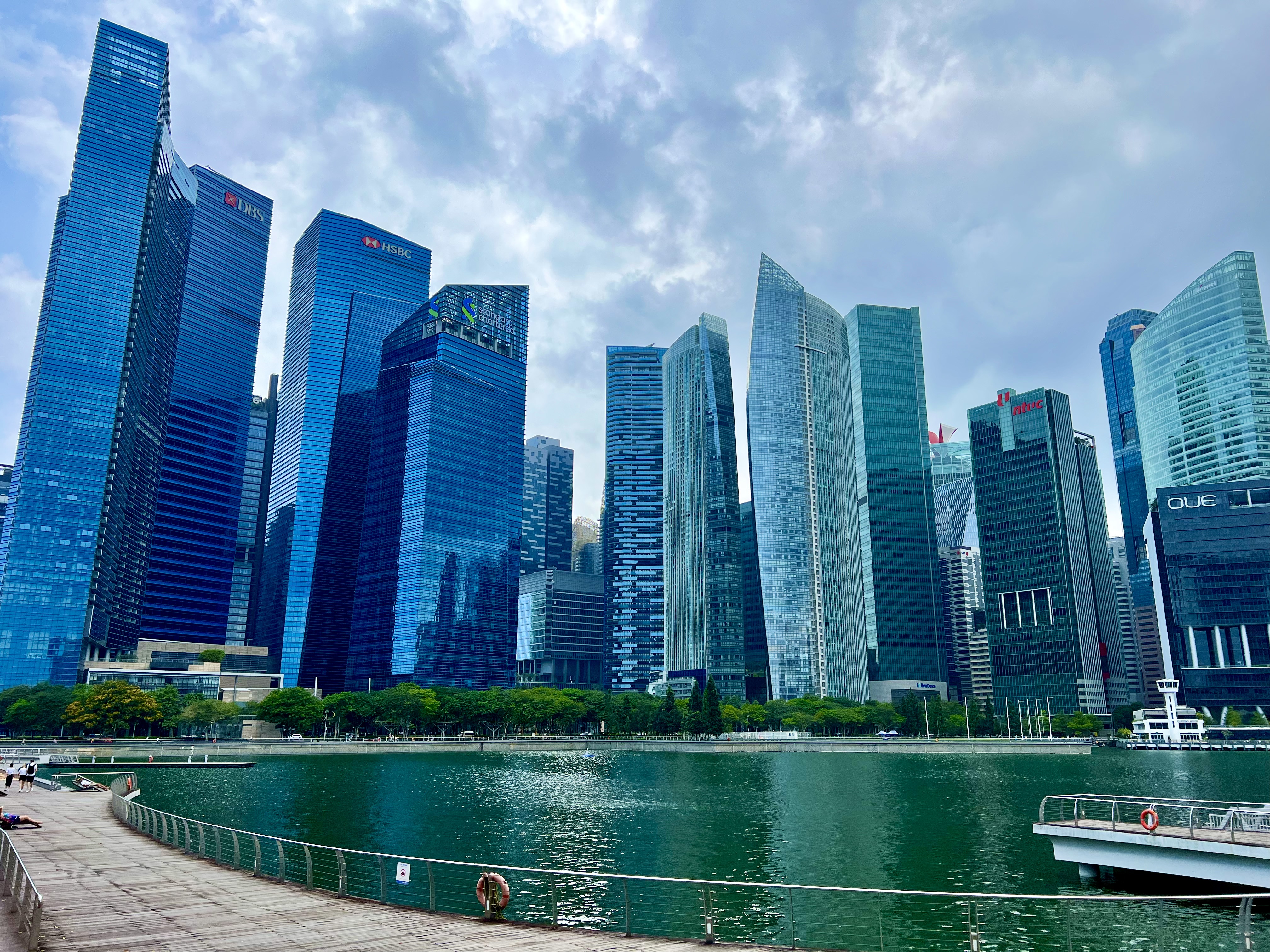
This complements the very modern and futuristic architecture in the center business district.

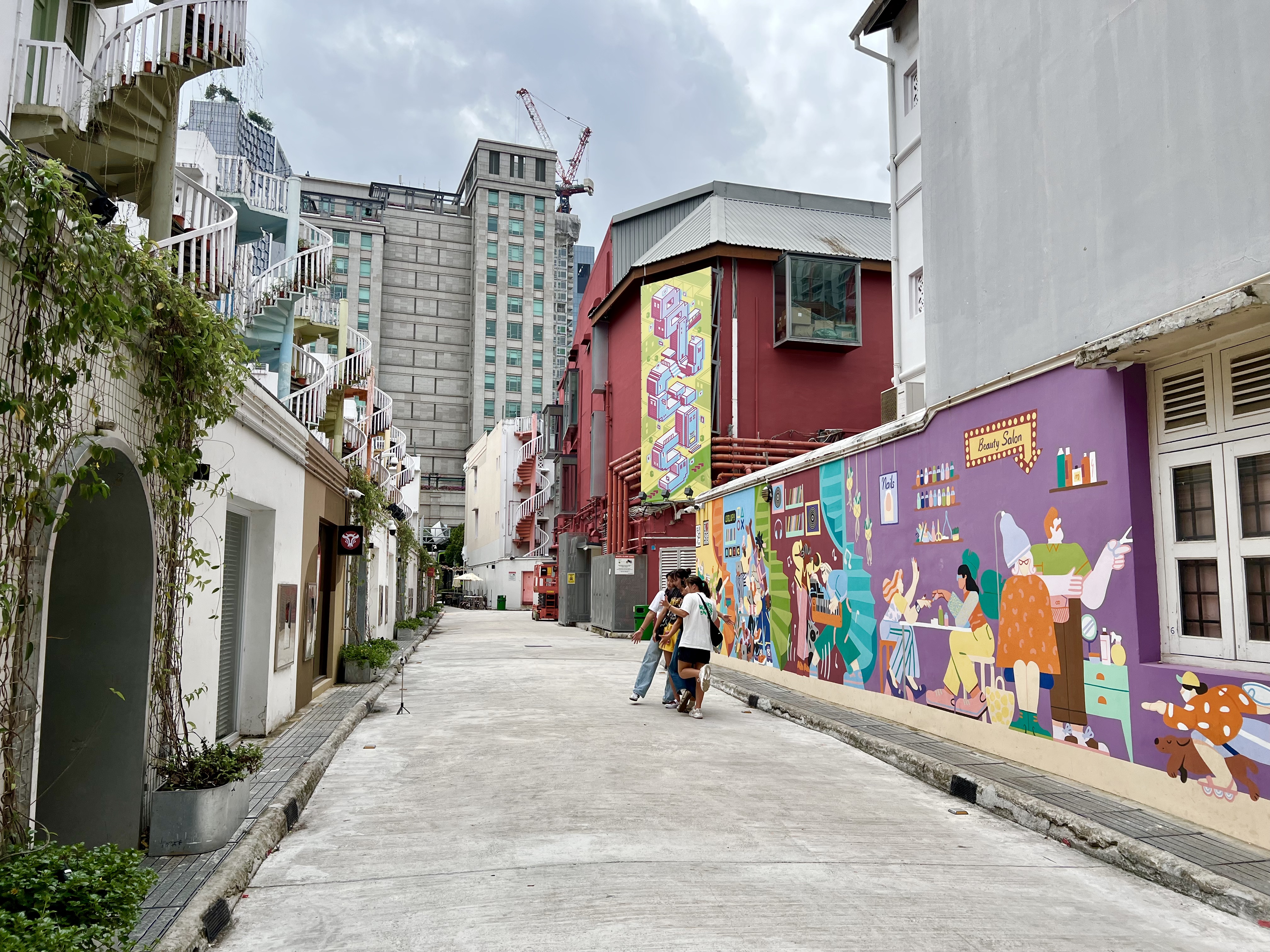
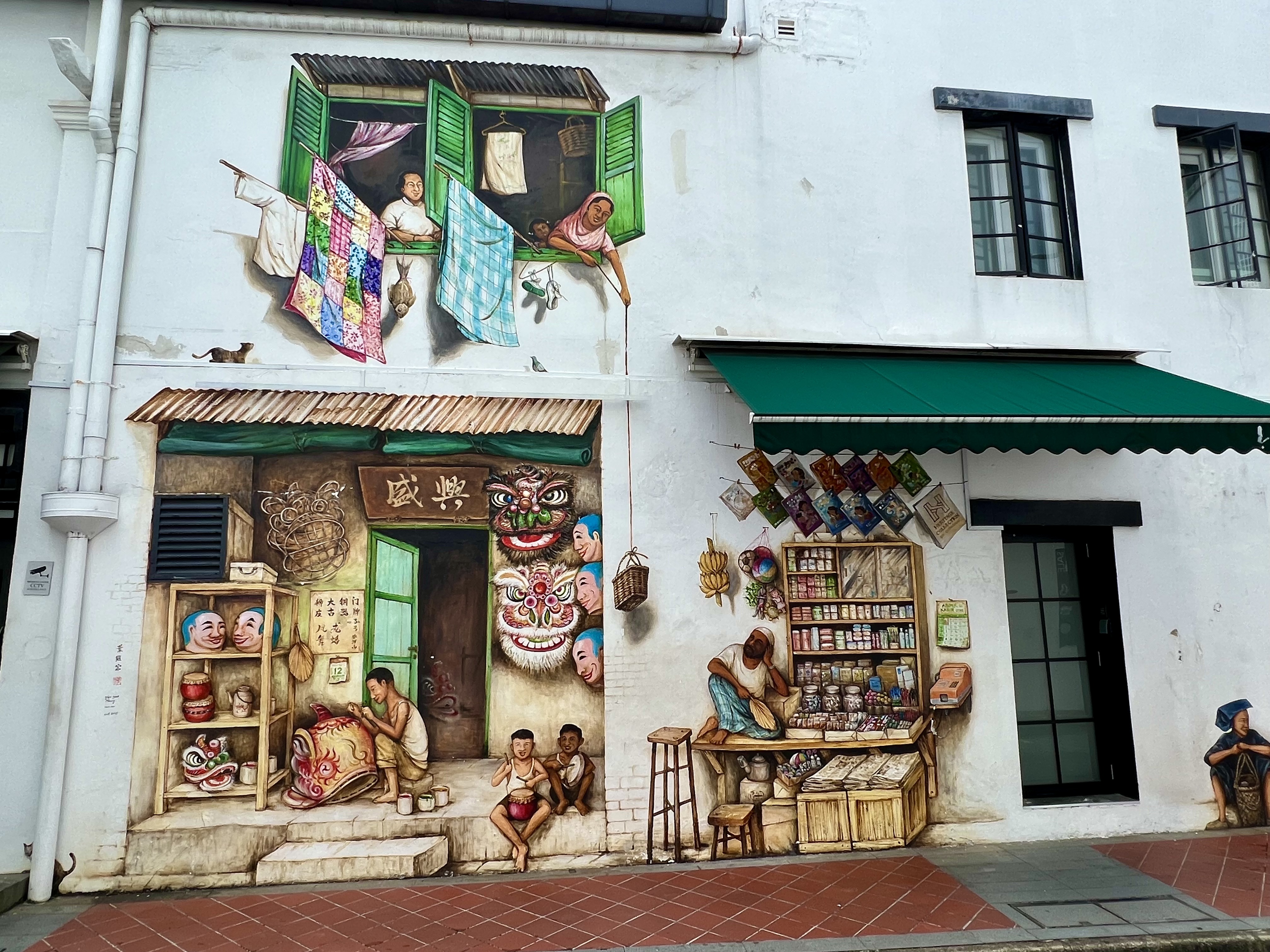
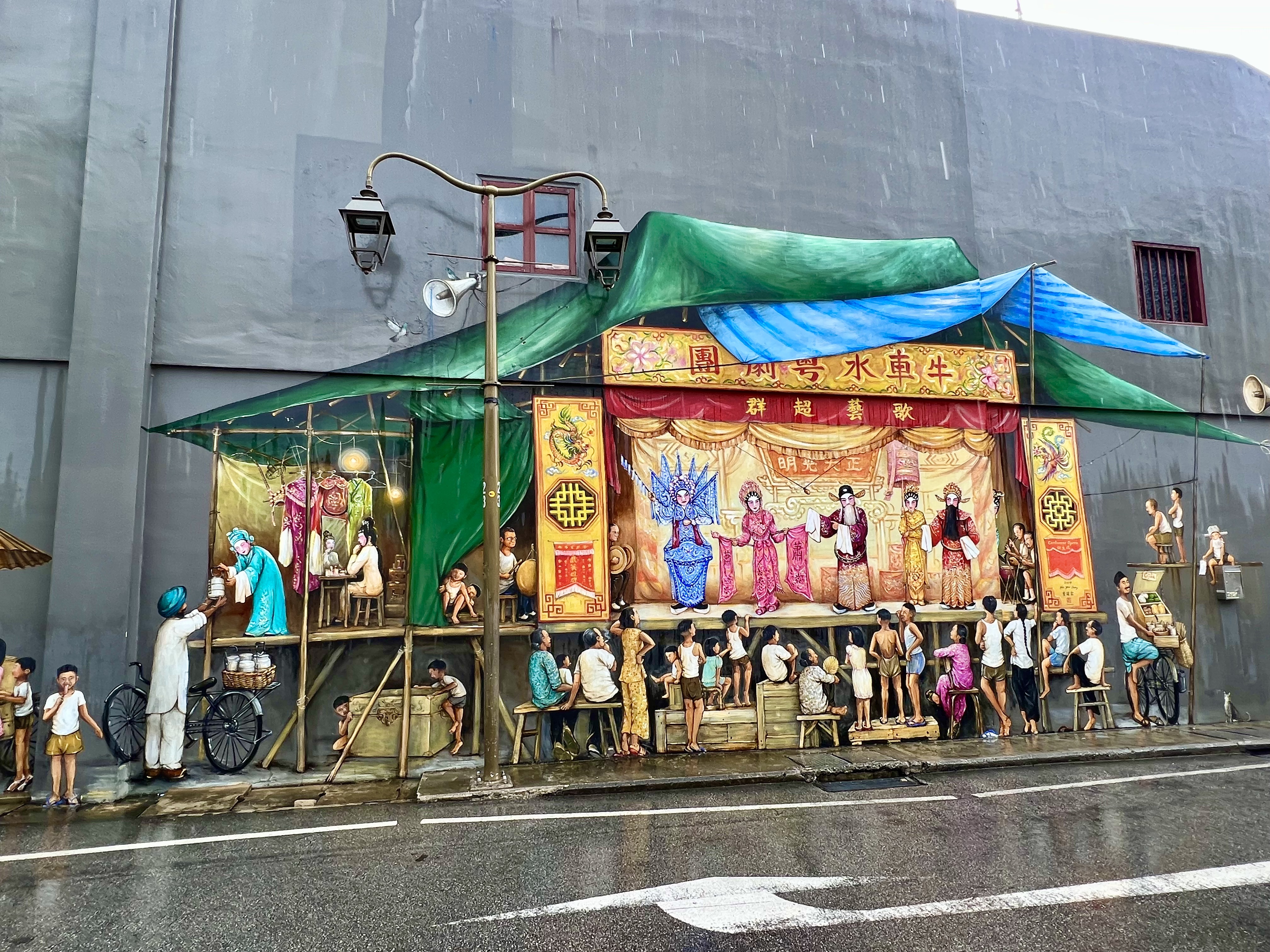
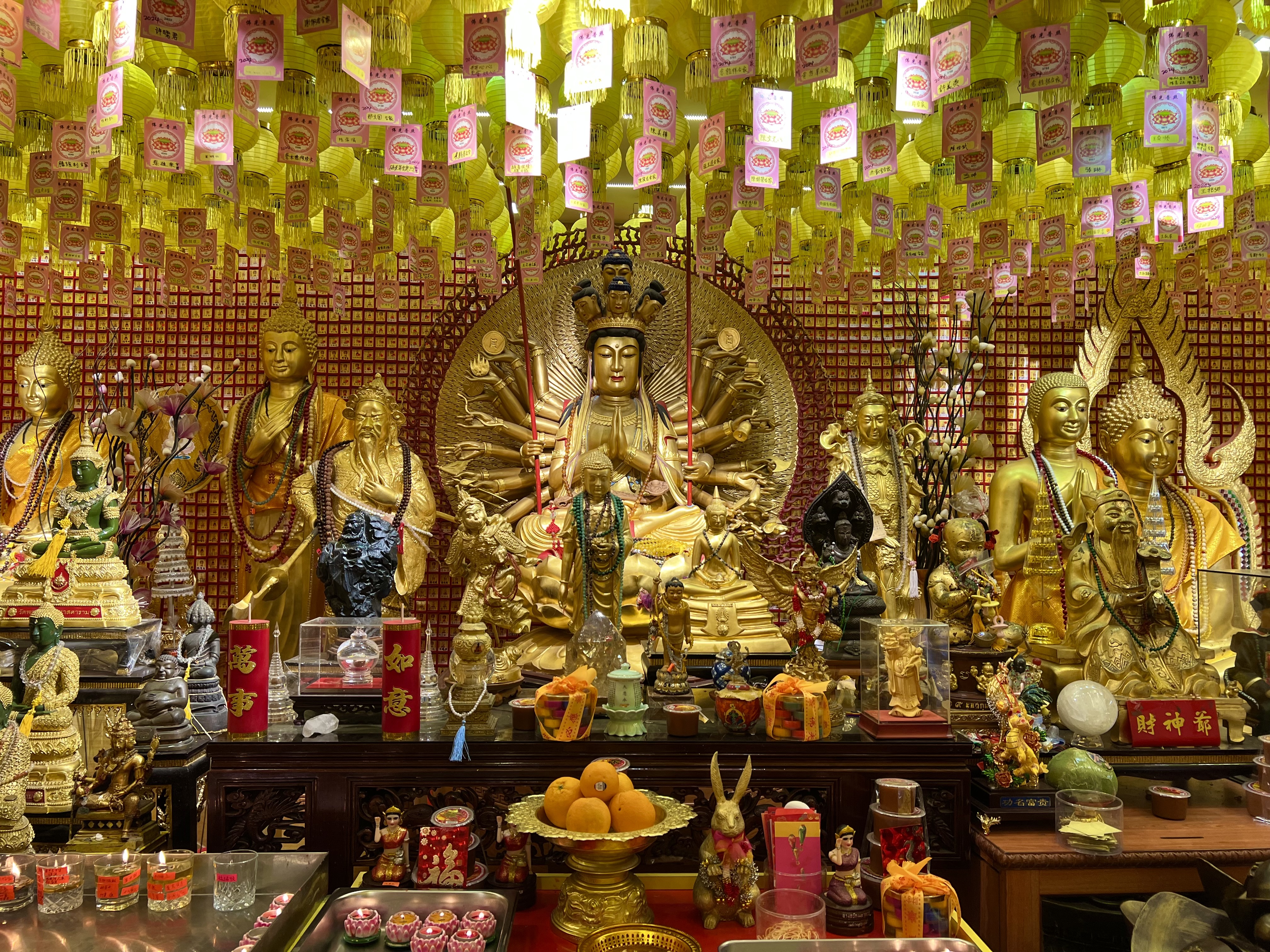
Each district has their own religious sanctuaries, although Hindu and Buddhist temples as well as churches and mosques are scattered throughout the geographical area. I was surprised to learn that Singapore is mostly Buddhist and Christian with a little over 13% Hindu – primarily Tamil from Southern India, and only a bit over 7% Muslim. This is very different from its neighbor to the north as Malaysia is almost entirely Muslim. Both the Hindu and Chinese Buddhist temples are filled floor to ceiling with beautiful sacred artworks, and I suspect this has had an influence, along with the city’s architecture, in the promotion of fine arts throughout the region.  Public art in the form of street sculptures and wall/mural paintings are everywhere.  It is a joy to wander aimlessly around and come across them.

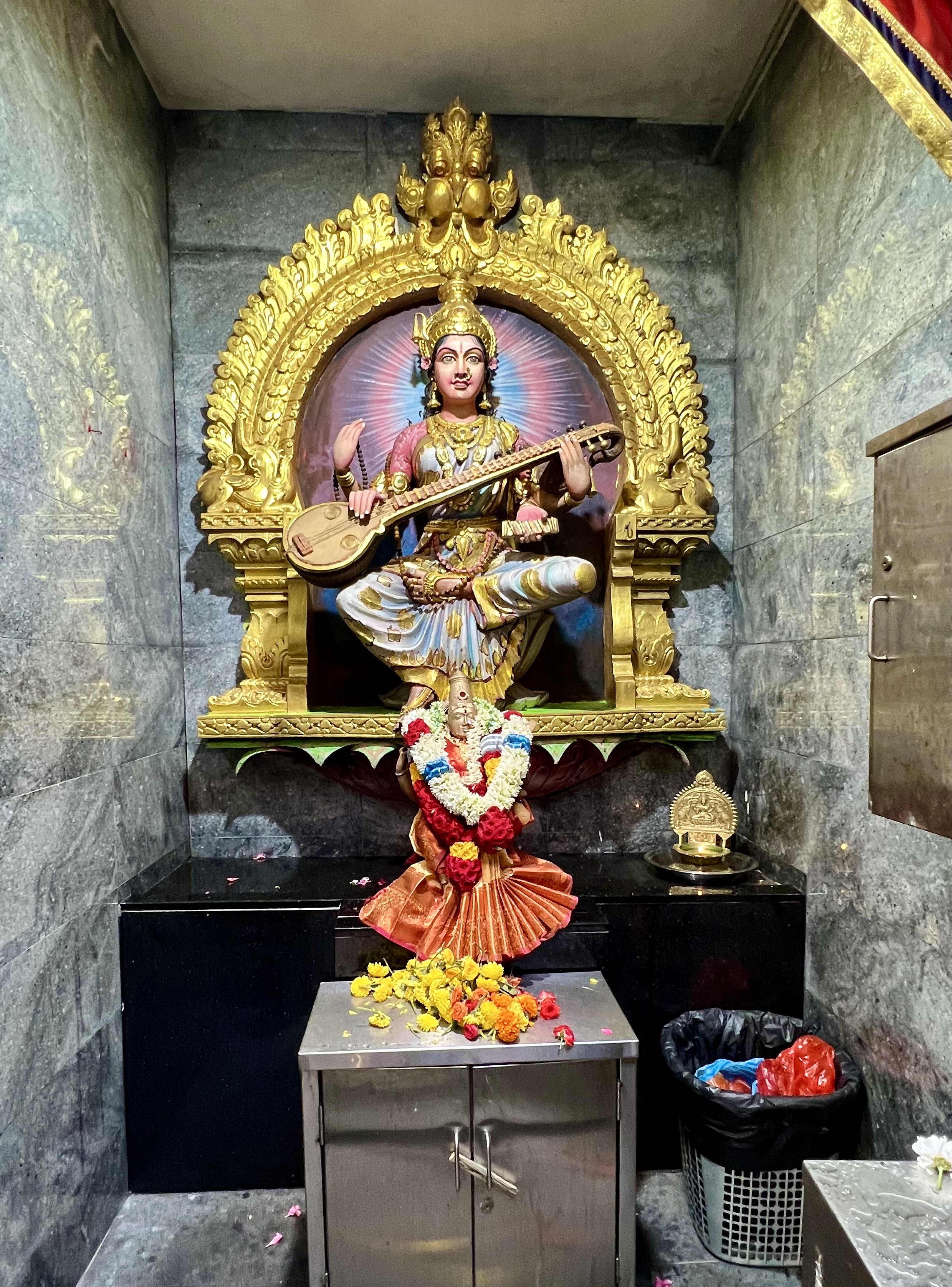
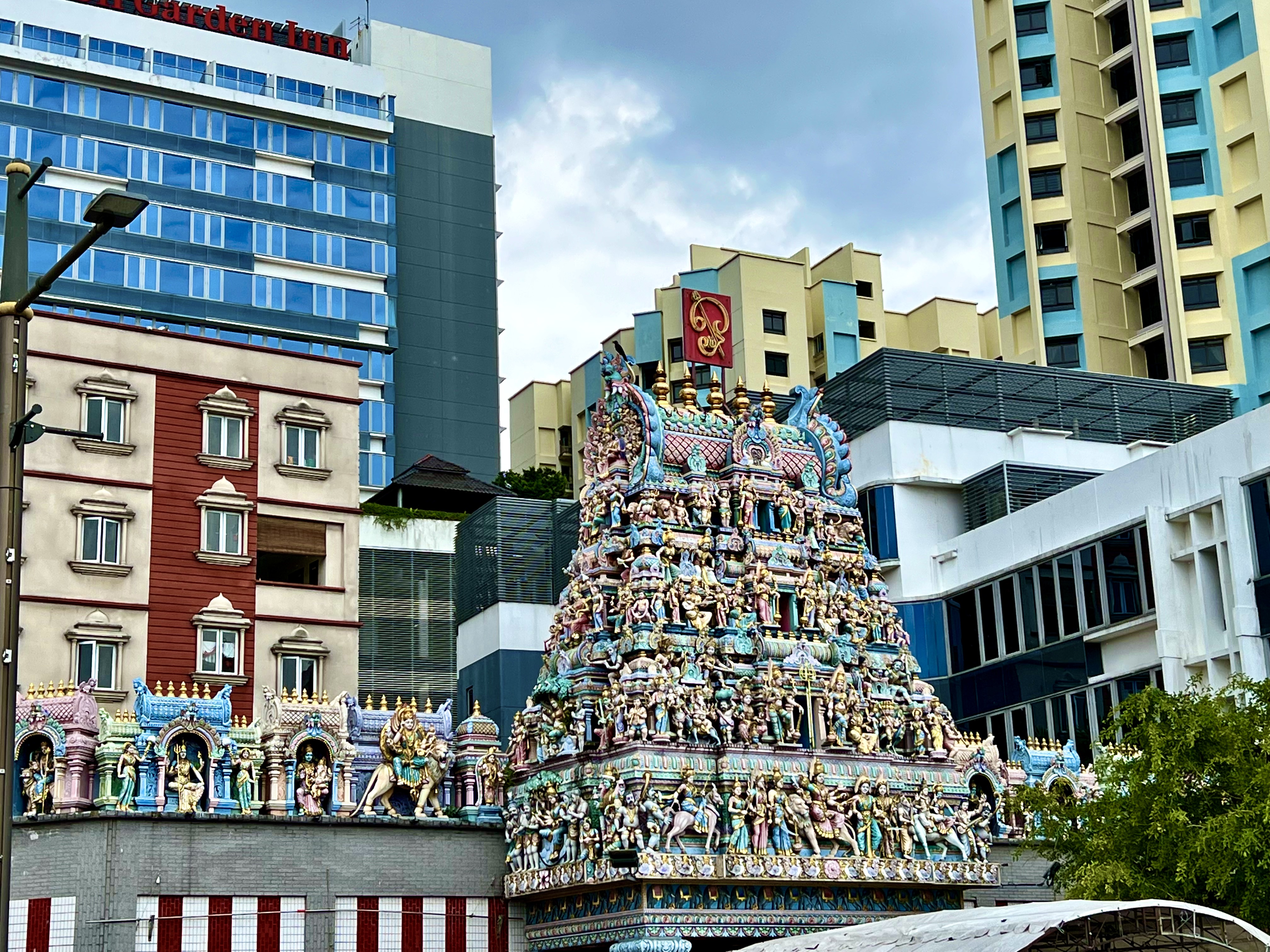
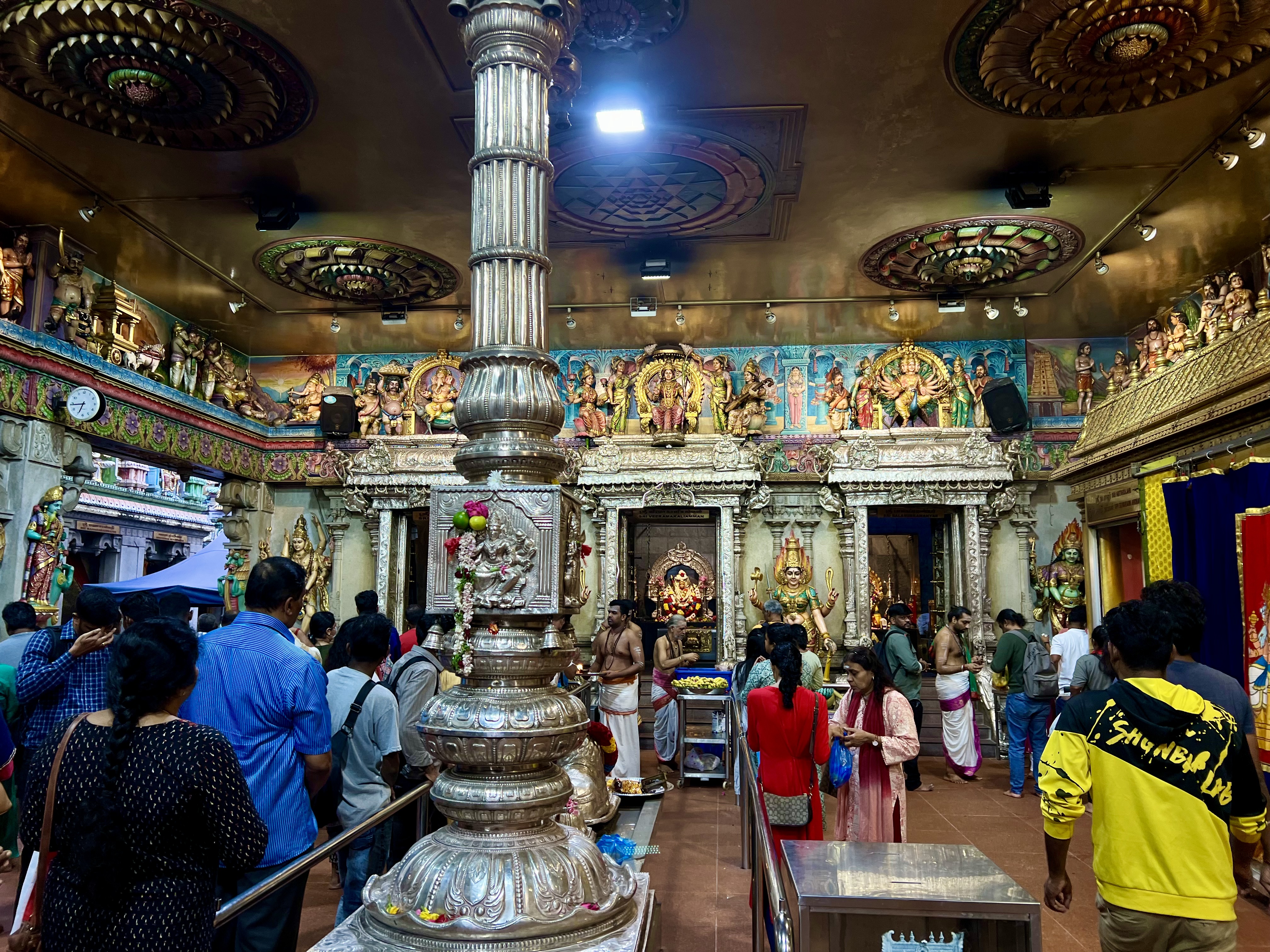
There are also a number of art schools and universities, more than one would normally see in such a small space.I wasn’t expecting to find so many amazing temples and clearly did not see even most of them, but I did get to some of the most popular. I started my temple journey with the main Kali temple in Little India, Sri Veeramakaliamman, which is one of the oldest Hindu temples in the city. It has a prominent gopuram, the heavily ornamented cap above the entrance. It is in a Dravidian style, which is quite different from that of northern India.  Tamils make up a large percentage of the Indian-Singaporean population. When I was there, priests were performing pujas and the hall was full of worshippers. 

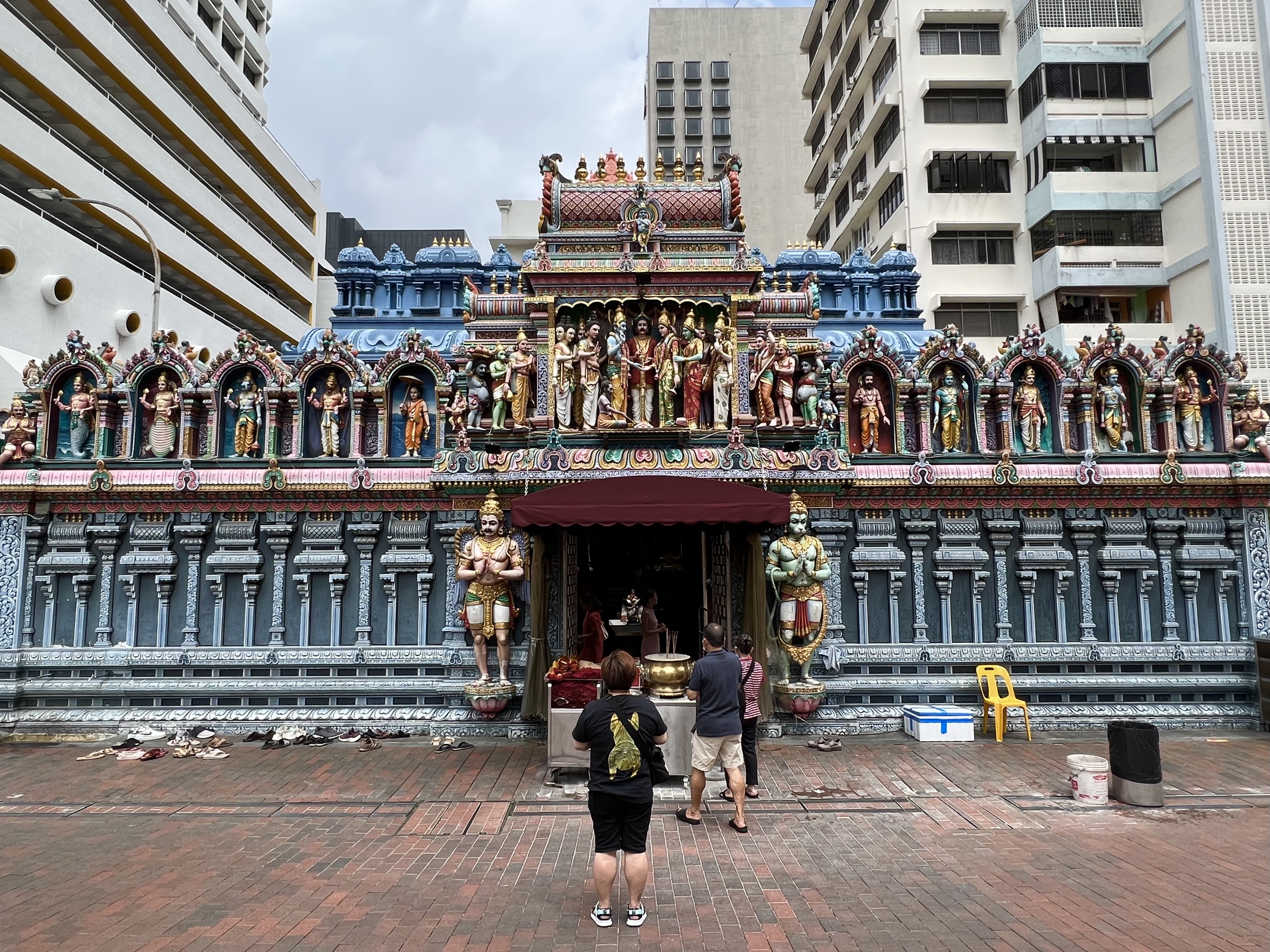
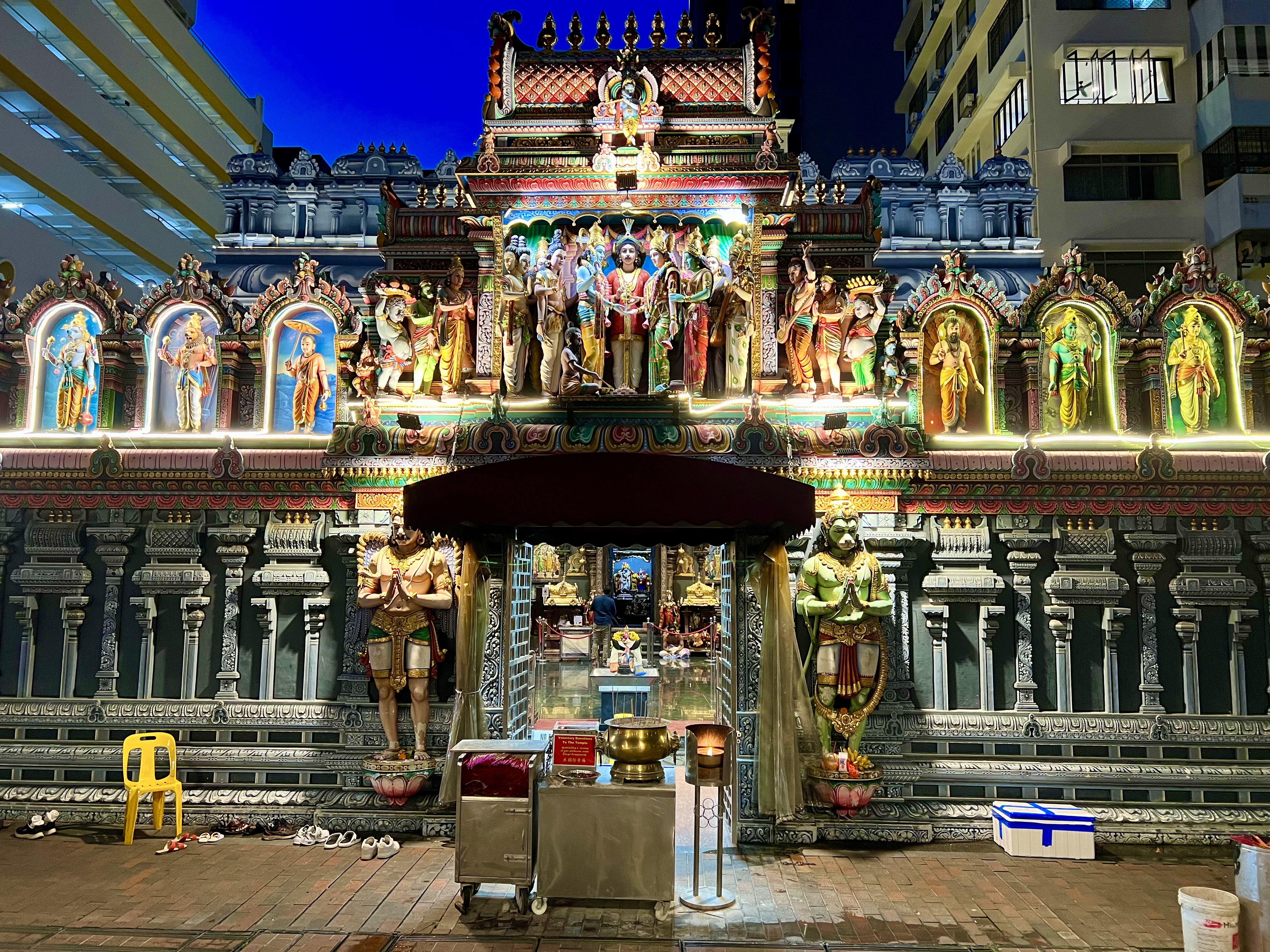
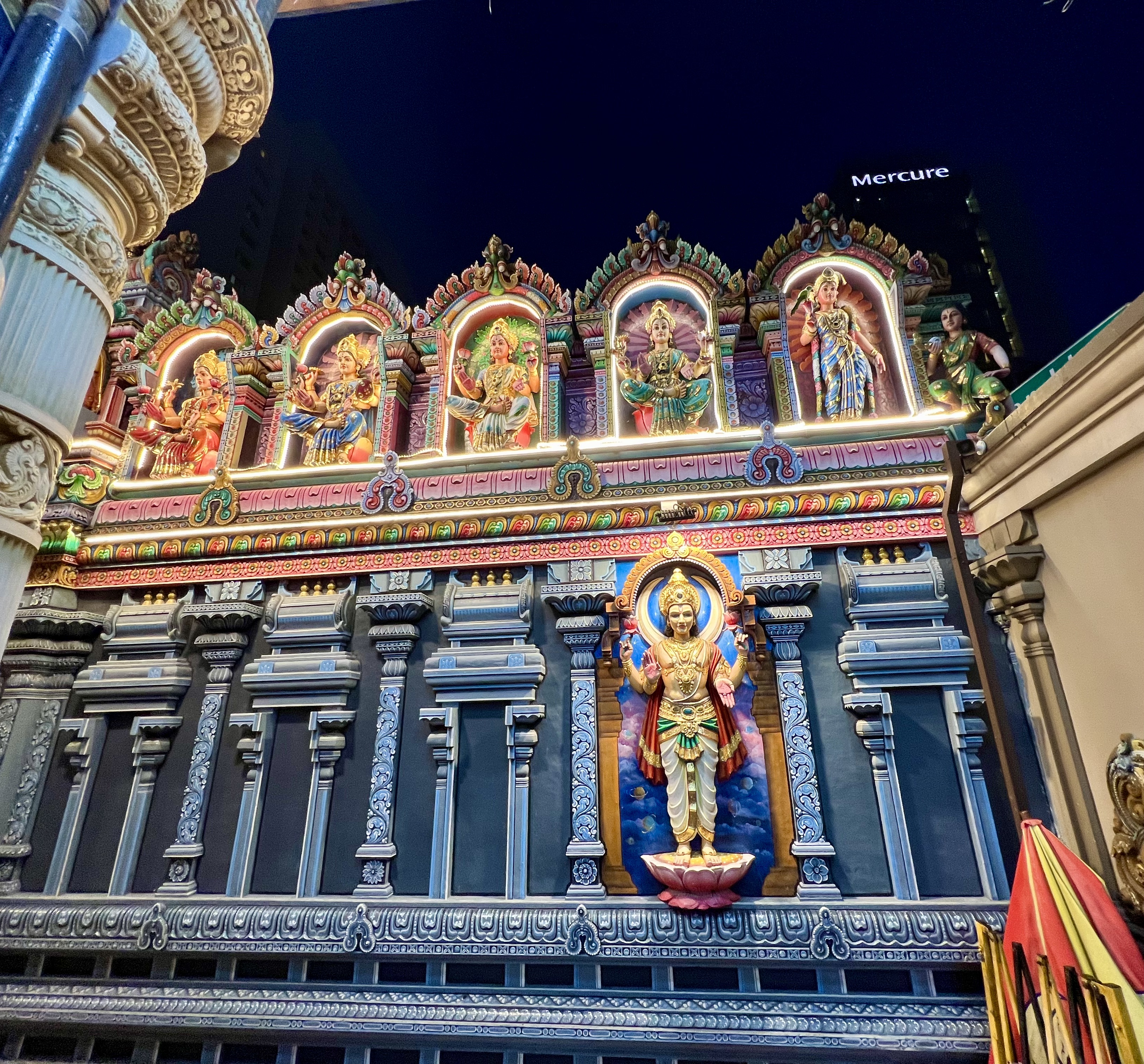
Not too far away is a Lakshmi Temple. On Waterloo St. right near my hotel, was a Sri Krishna/Vishnu Temple.

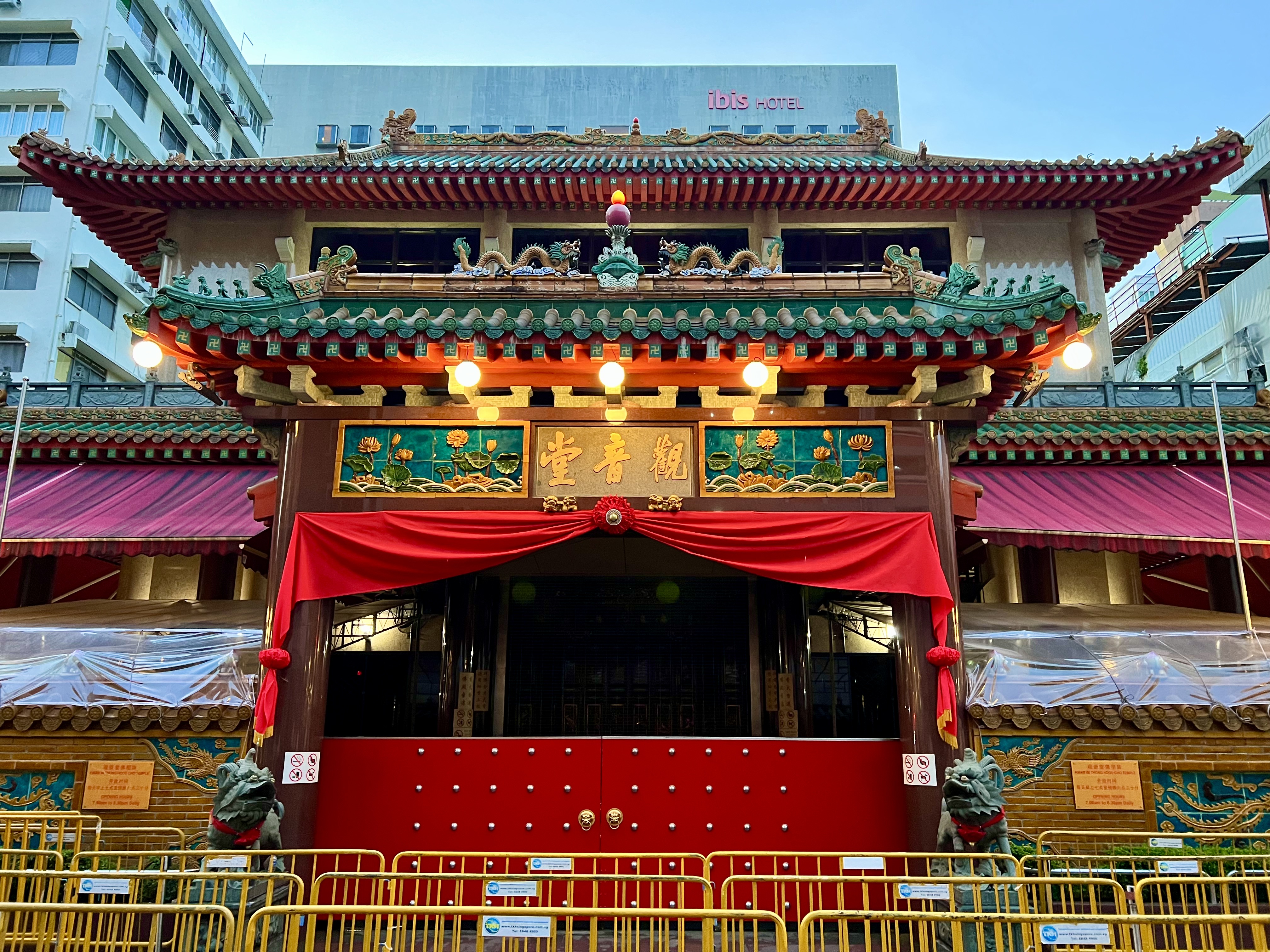
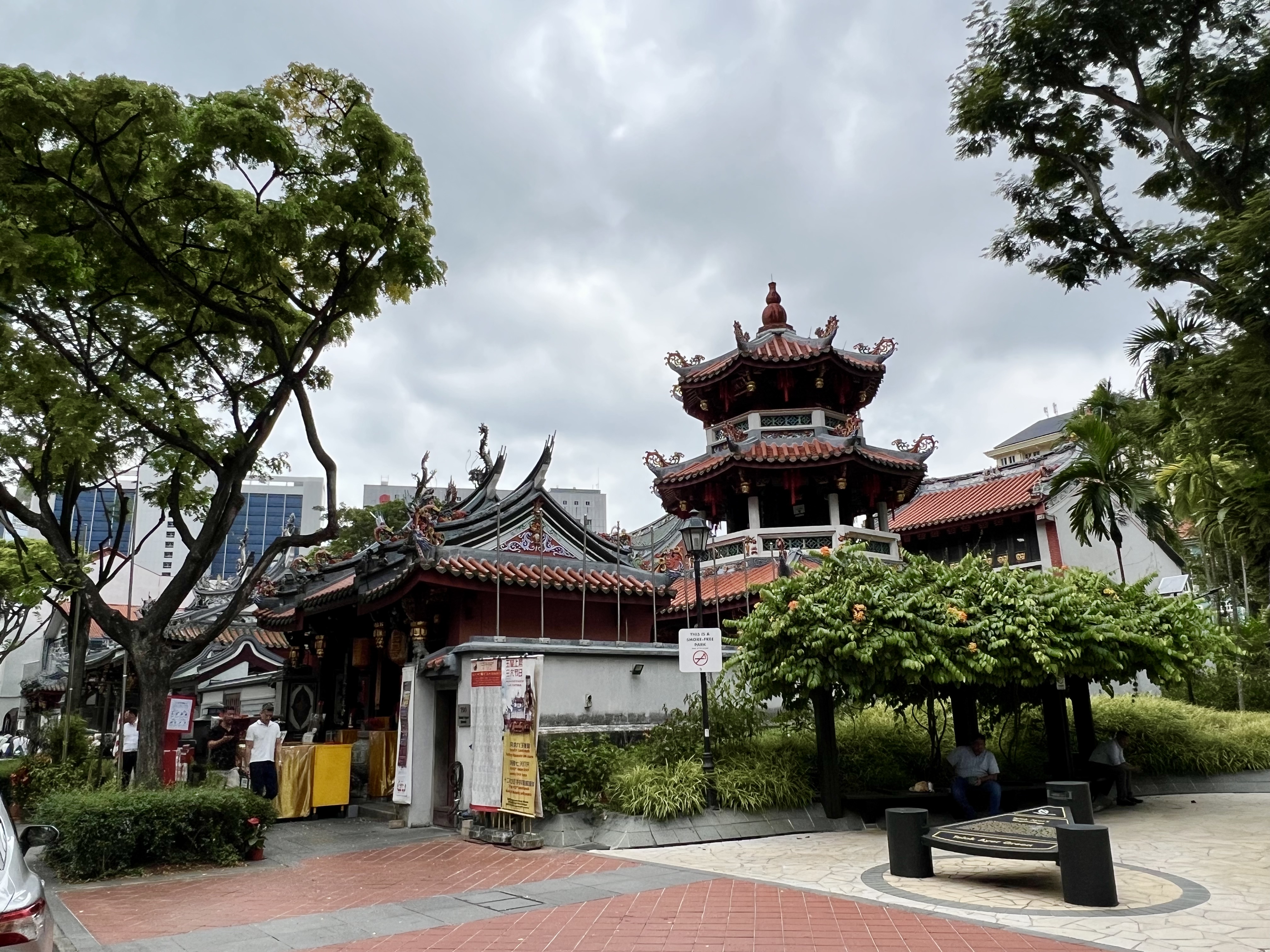
This one was almost adjacent to the Chinese Buddhist Kwan Im Thong Hood Cho Temple near Fu Lu Shou commercial complex that houses stores selling Buddhist trinkets and offering materials. It also has shrines right in the complex and people reading palms, tarot cards and other divination methods. I was tempted to have my astrological chart done, but in the end decided against it.

In Little India there is a mosque as well as the Leong San See Temple Chinese temple dedicated to Kwan Yin/Avalokiteshvara, who appears in both his male and female forms, and an altar honoring Confucius. The Vishnu temple has incredibly ornate ceiling carvings.

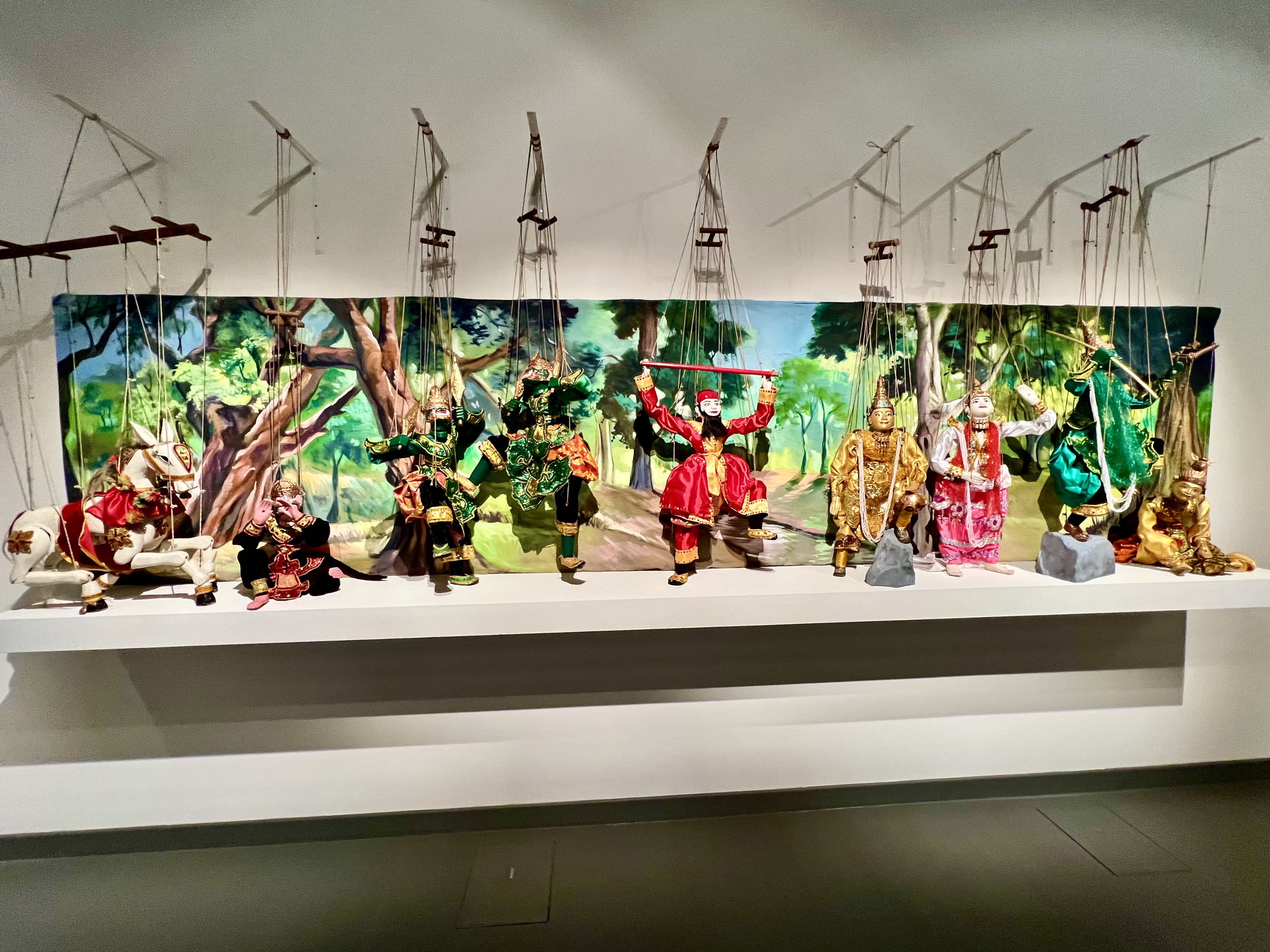
The presence of so many different religious traditions within just a few meters of one another demonstrates the deep-seated multi-cultural aspects of the city.The next day, on my way to Chinatown, I detoured as I saw a poster for “Heroic Tales: Puppetry Across Southeastern Asian” in the Lim Hak Tai Gallery at Nanying Academy of Fine Arts, which is part of the University of the Arts Singapore. Posters with photos explained a few puppetry traditions, including those from Cambodia, Thailand, Sri Lanka and Myanmar. Actual puppets from Myanmar were on display. 

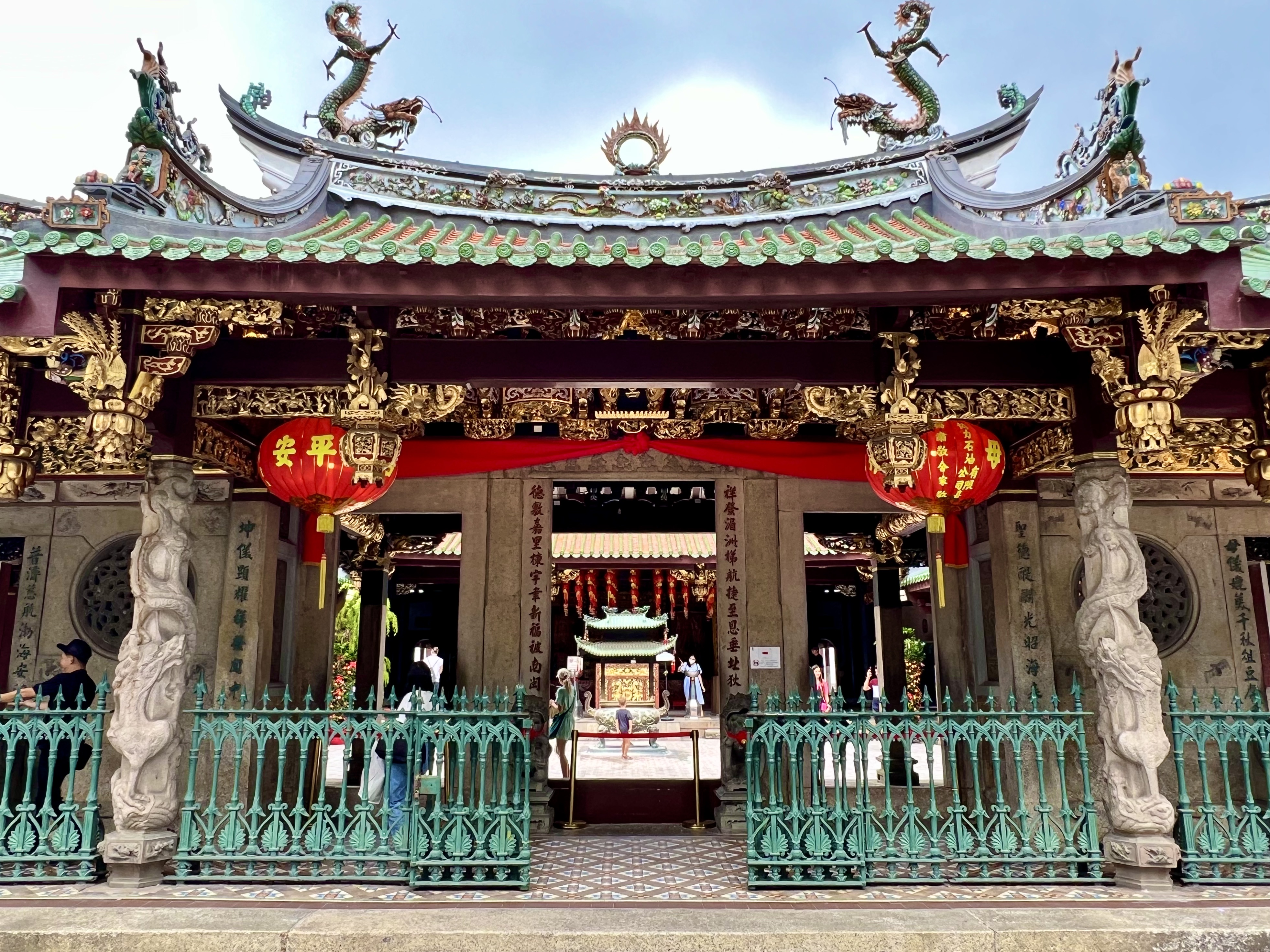
  From there I made my way through a variety of street art to the Chinese Thian Hock Kang Temple, which is supposed to be the Palace of Heavenly Happiness, dedicated to the goddess Mazu, the goddess of the Sea.

From the Chinese Buddhist site, I walked over to the oldest Hindu temple, Sri Mariamman dedicated the goddess. It was pouring rain, so I couldn’t get a good photo of the outside but am including one from the interior.

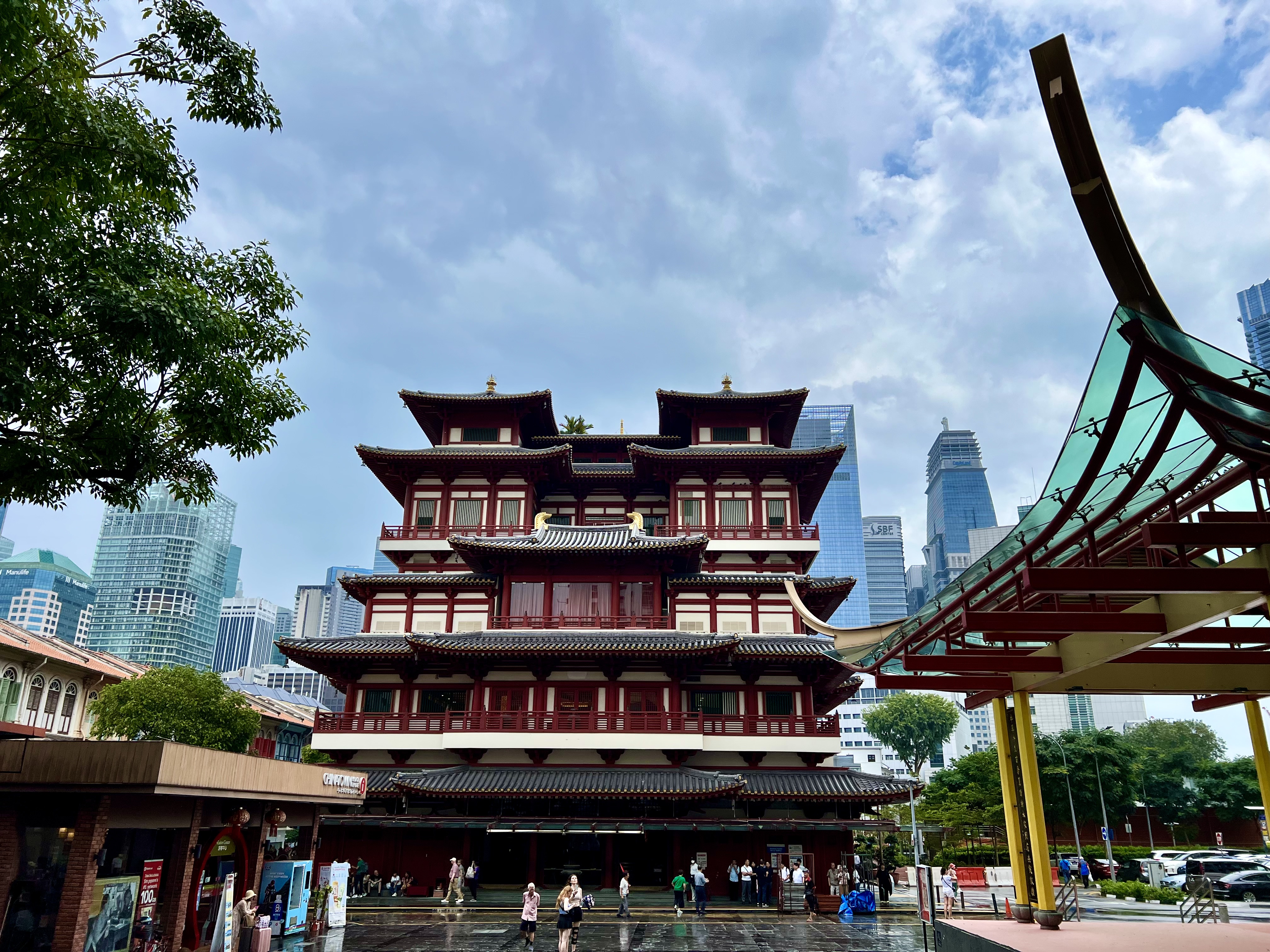
Very near the Hindu temple, is the Buddha Tooth Relic temple. This surprised me as I wasn’t aware that there was a tooth relic in Singapore. It is supposed to house the Buddha’s left canine tooth. The last tooth relic I saw was in Sri Lanka, and it was difficult to get near to the case, which was never opened. Here one just took an elevator to the fourth floor and could view the gold casing without any line or obstacle! While I was there, priests were celebrating a service in the main floor’s central shrine, and Buddhist chants filled the sacred site along with the scent of incense.

 One thing that I noticed that was different from that which I am used to, is that the circumambulation in the Singaporean Chinese Buddhist temples is counter-clockwise. Elsewhere it is clockwise. The Hindu temples had the clockwise version. 

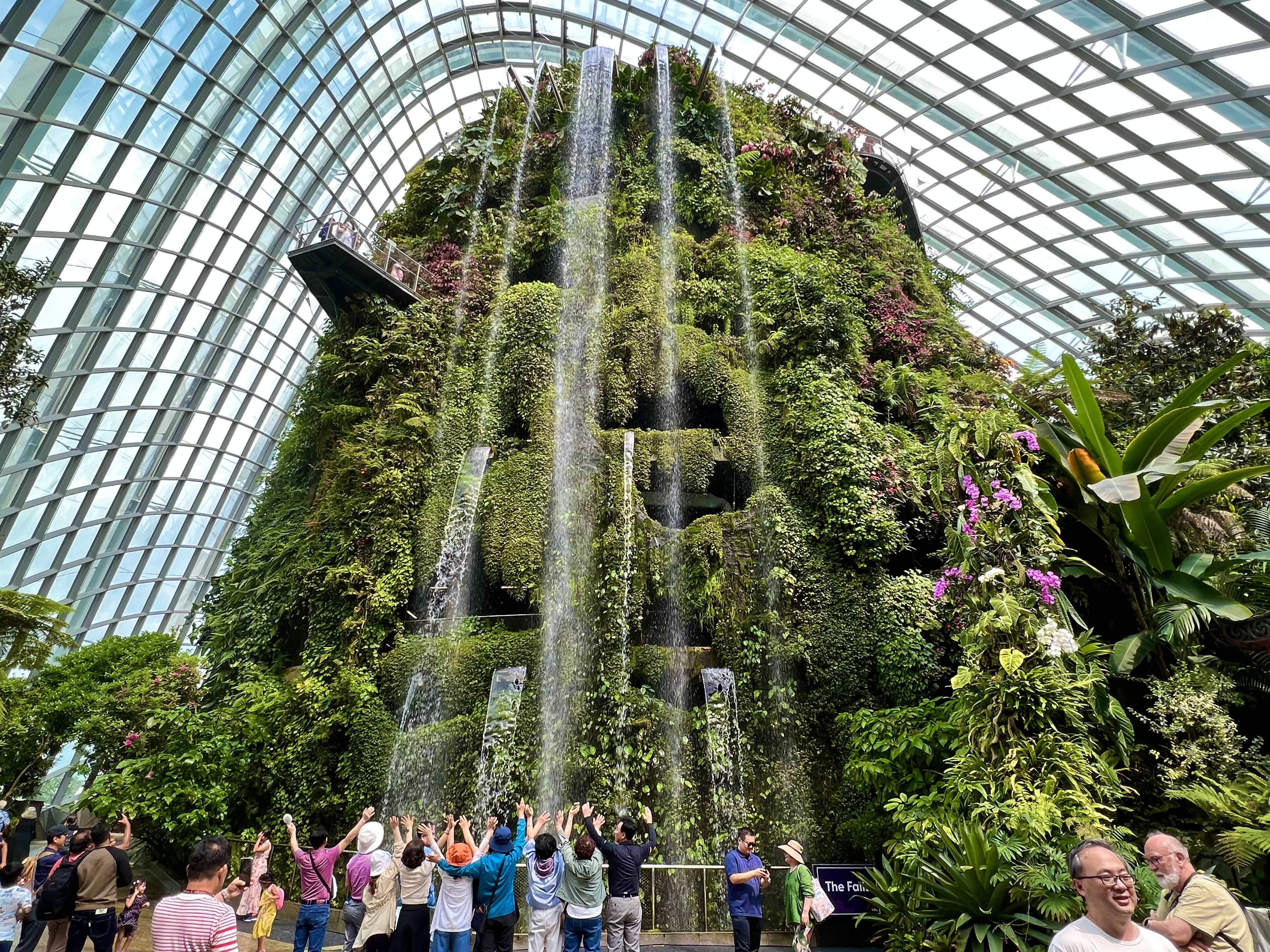
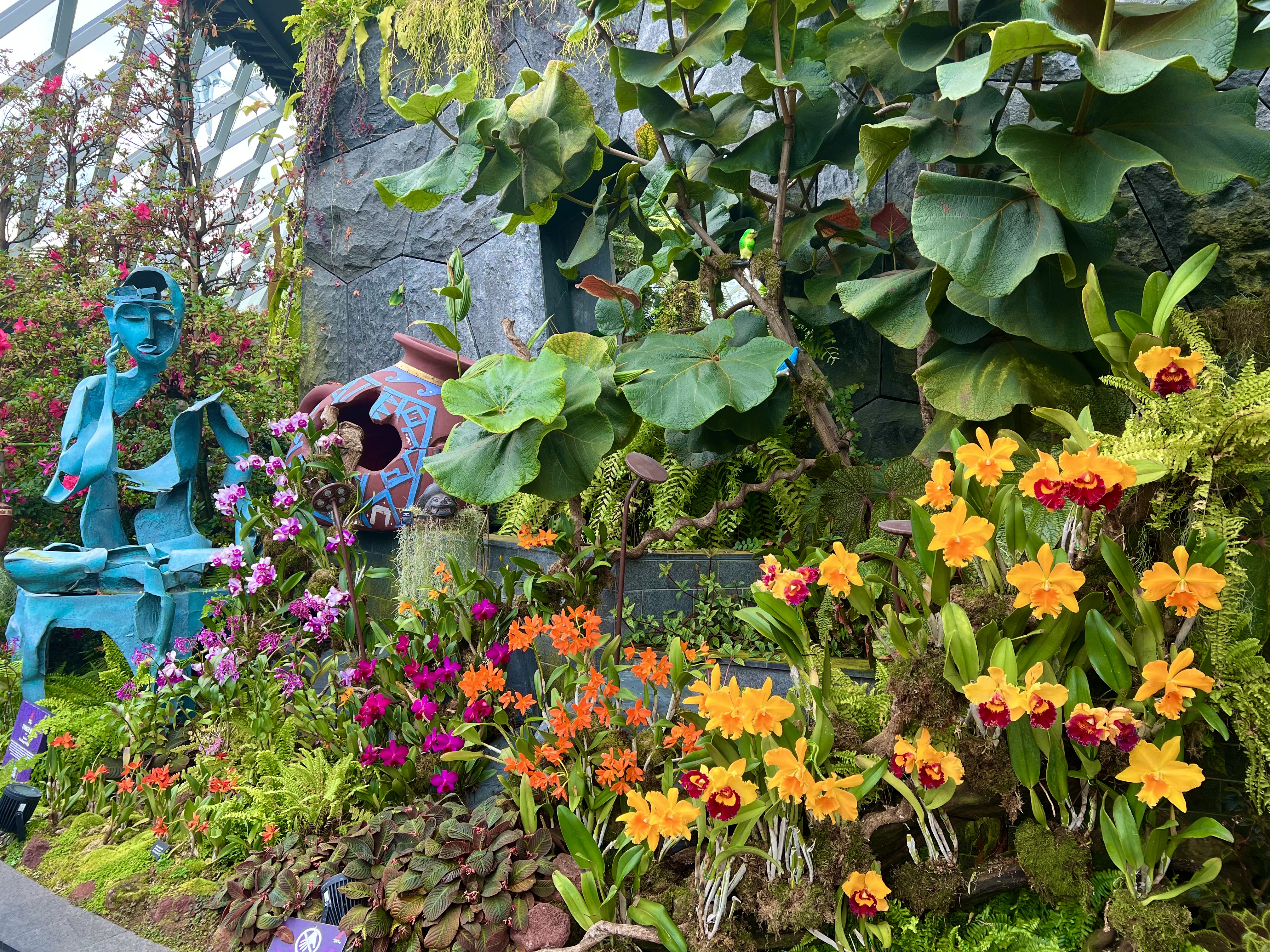
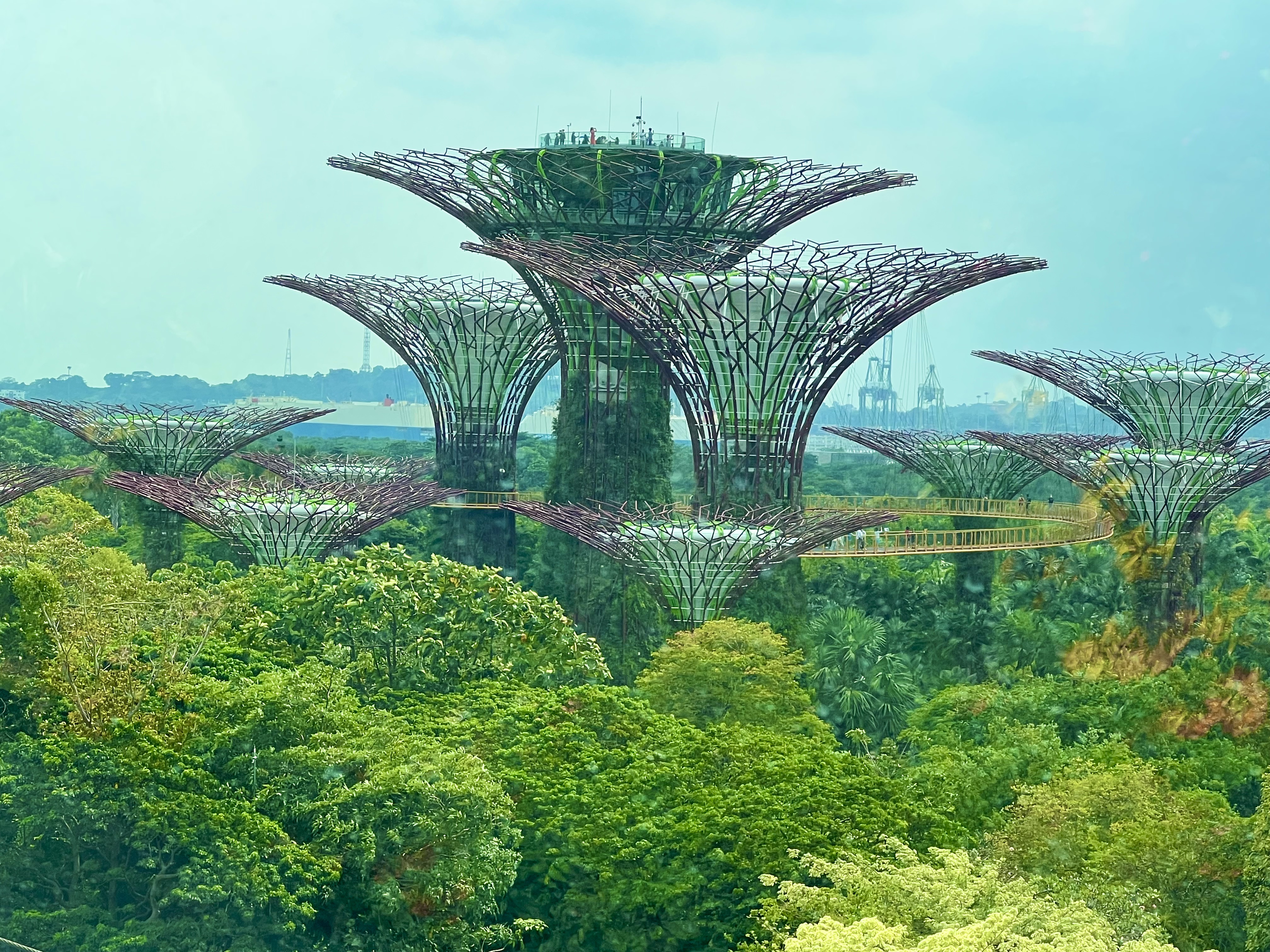
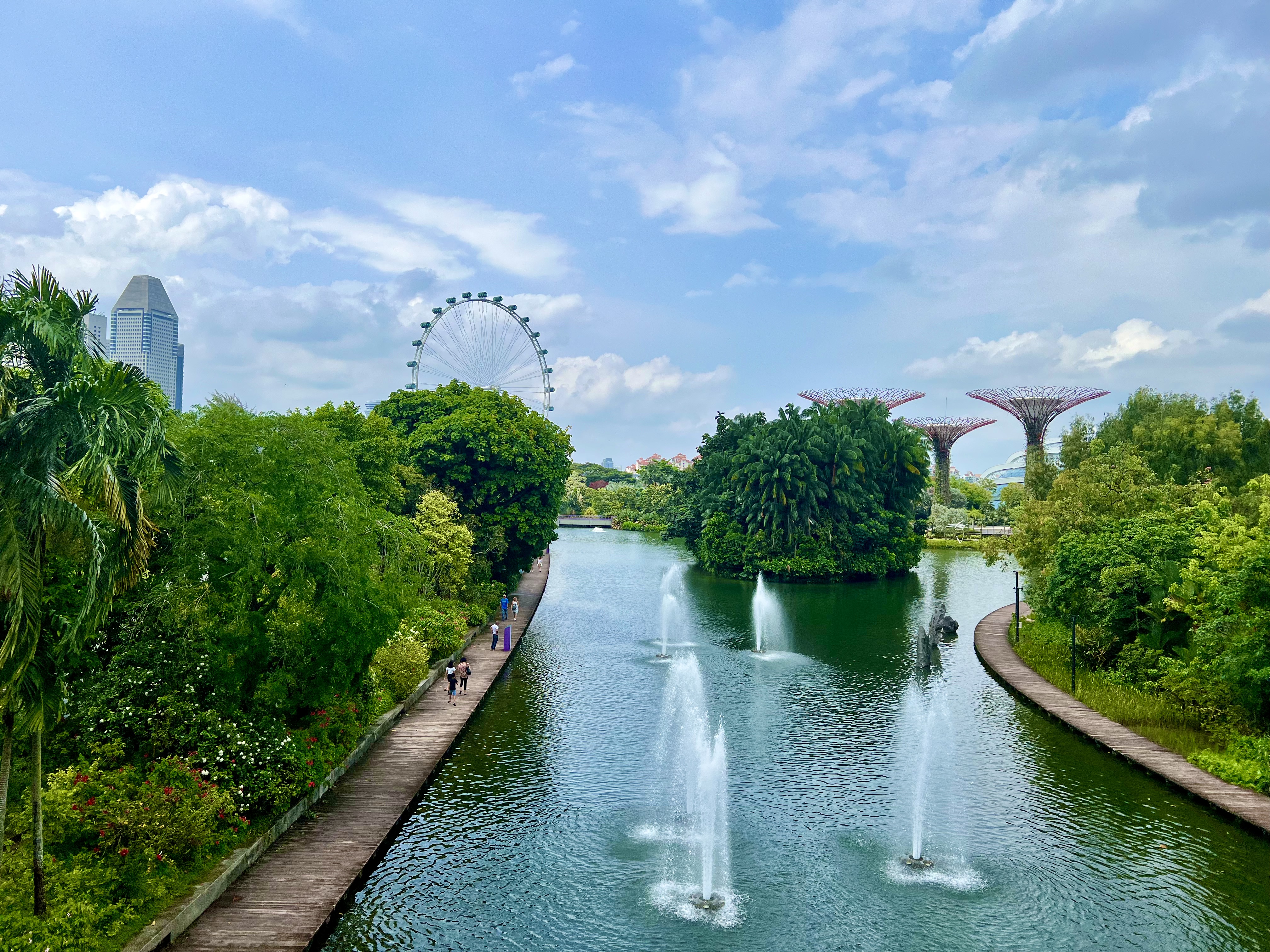
After visiting the temples, and wandering around looking at street art, some of which is truly amazing, I headed over to the Gardens by the Bay which has different sections devoted to various world regions, the famous wire trees, the flower dome, and a separate cloud forest building with interior waterfall.  The skywalk and some of the other attractions were closed due to the rain, but the Flower Dome and Cloud Forest were spectacular and a must see for all who like flowers and gardens.

My last stop was at the Asian Civilizations Museum, which had a couple of rooms on ancient religious art. There were Buddhist sculptures across many centuries from 1st C BCE Gandharan art to 19th century Nepal as well as Hindu and Buddhist sculptures from Cambodia, Thailand, Sri Lanka, India, Myanmar, and Bangladesh. One room was dedicated solely to Islamic art and another to Christian art.  The museum isn’t particularly large, but it is well laid out and the artifacts presented an historical view of their respective religions sacred art. The museum is located on the river in a parklike setting, which also makes it a good place for a relaxing break. 

My time in Singapore came to an end.  I went back to the hotel to collect the luggage before heading to the airport and had a delightful surprise. The staff at the Mi Bencoolen Hotel offered me a free room to take a shower and clean up from the rain and humidity before the very long flight to Melbourne and on to Adelaide. I think Lee Kuan Yew would be proud of how his city-state has developed.

As an addendum – on March 19, 2024, the WSJ posted a video on the military capacity of Singapore. It seems that they spend more money per capita on defense than any other nation.  All men must do two years of service in the army, and the building codes for residences include that there must be a bomb shelter in the structure.  The government walks a tightrope with China in the background and various forces trying to control the Straits of Malacca, which is the lifeblood of Singapore’s trade system. The video was informative, and the information came as a complete surprise to me. I can recommend the video to all who are interested.

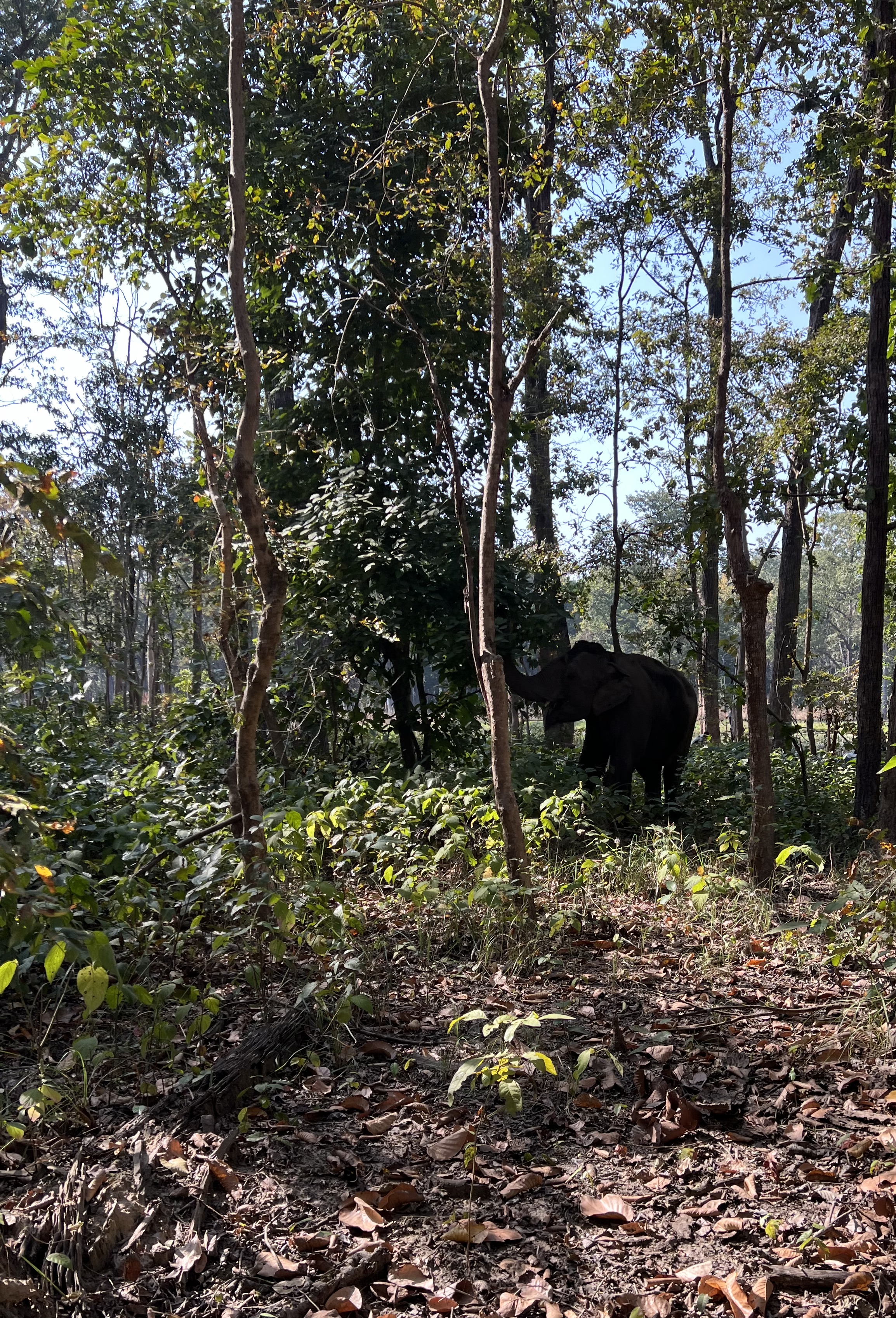
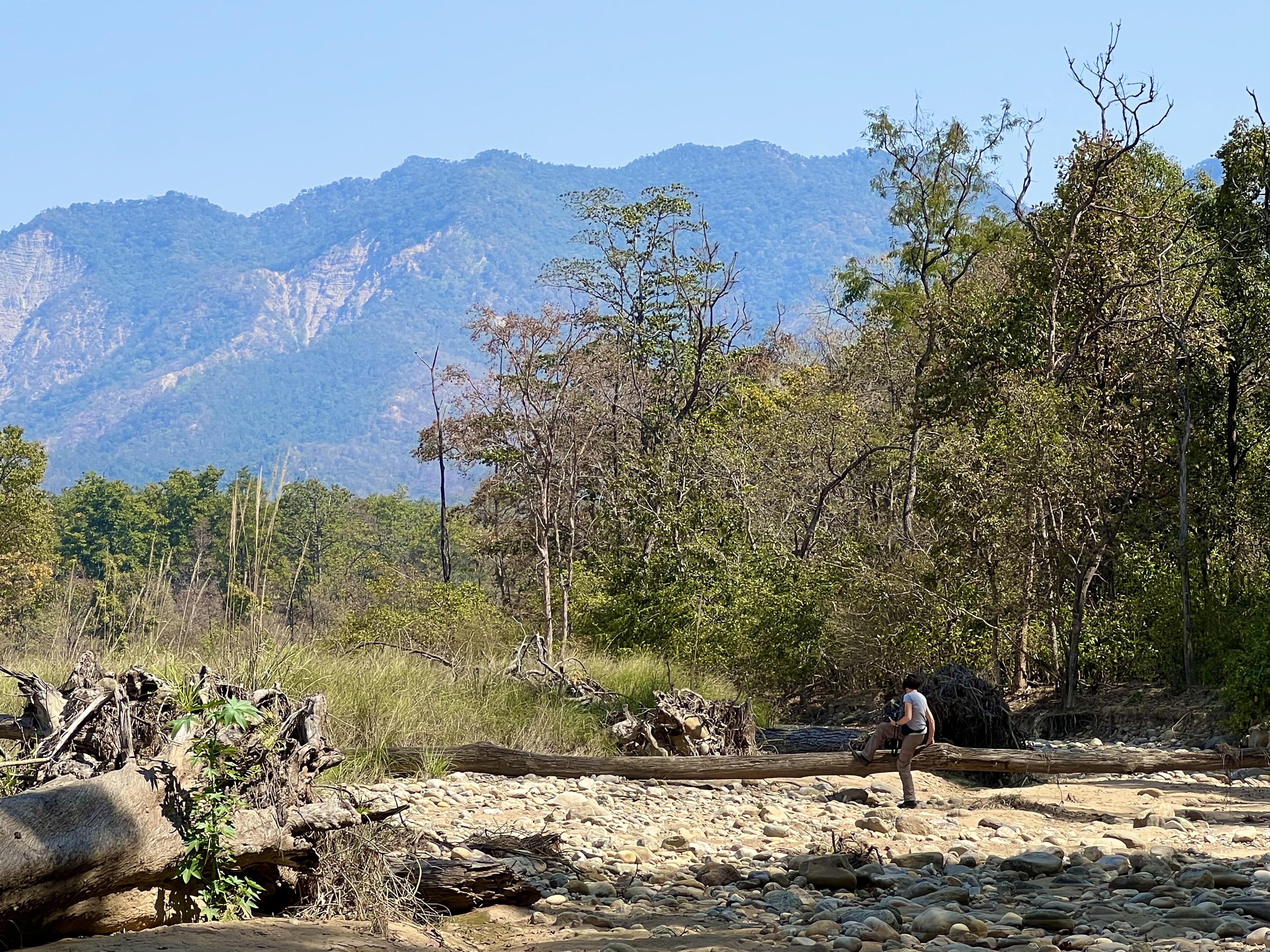
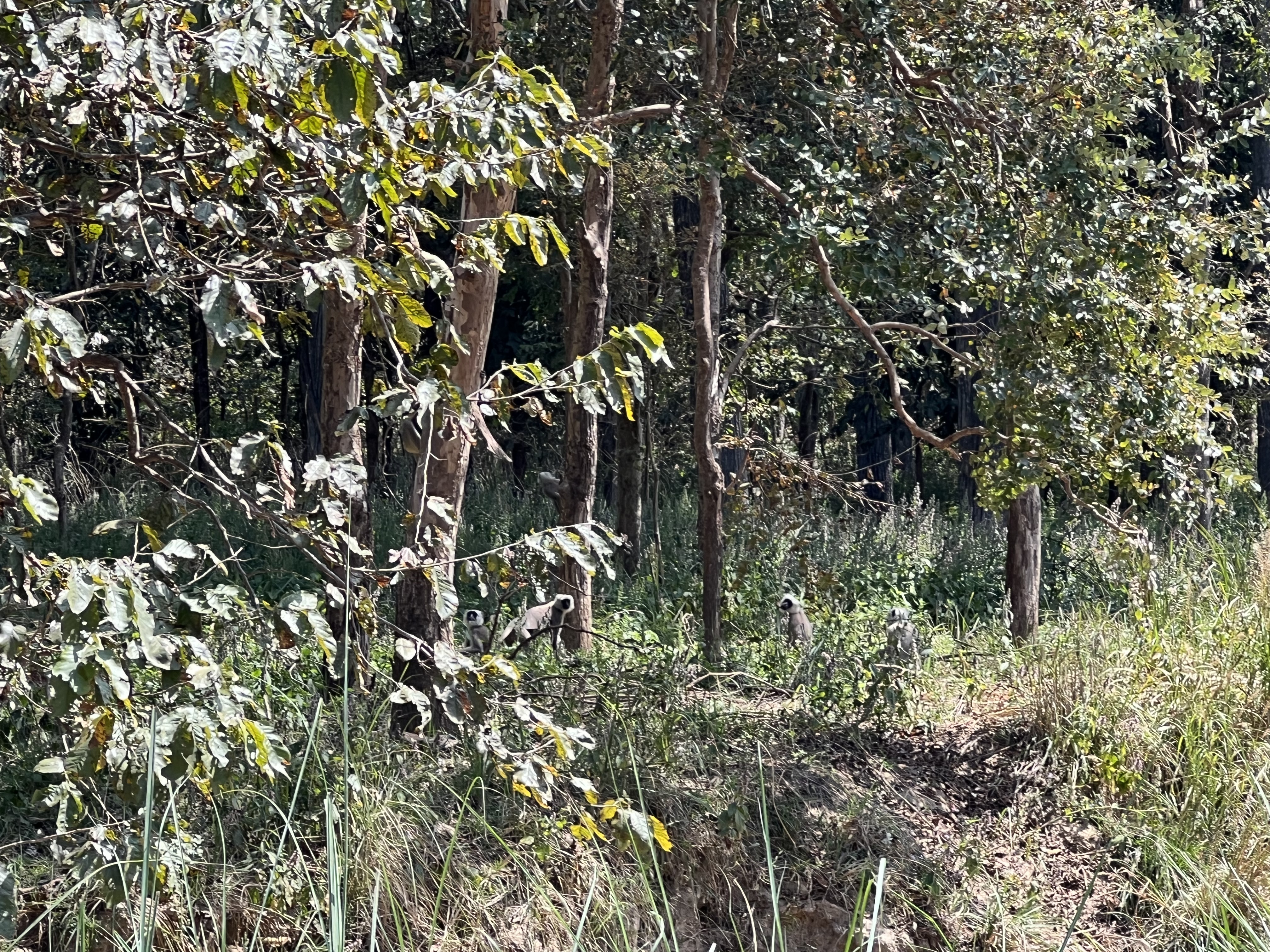
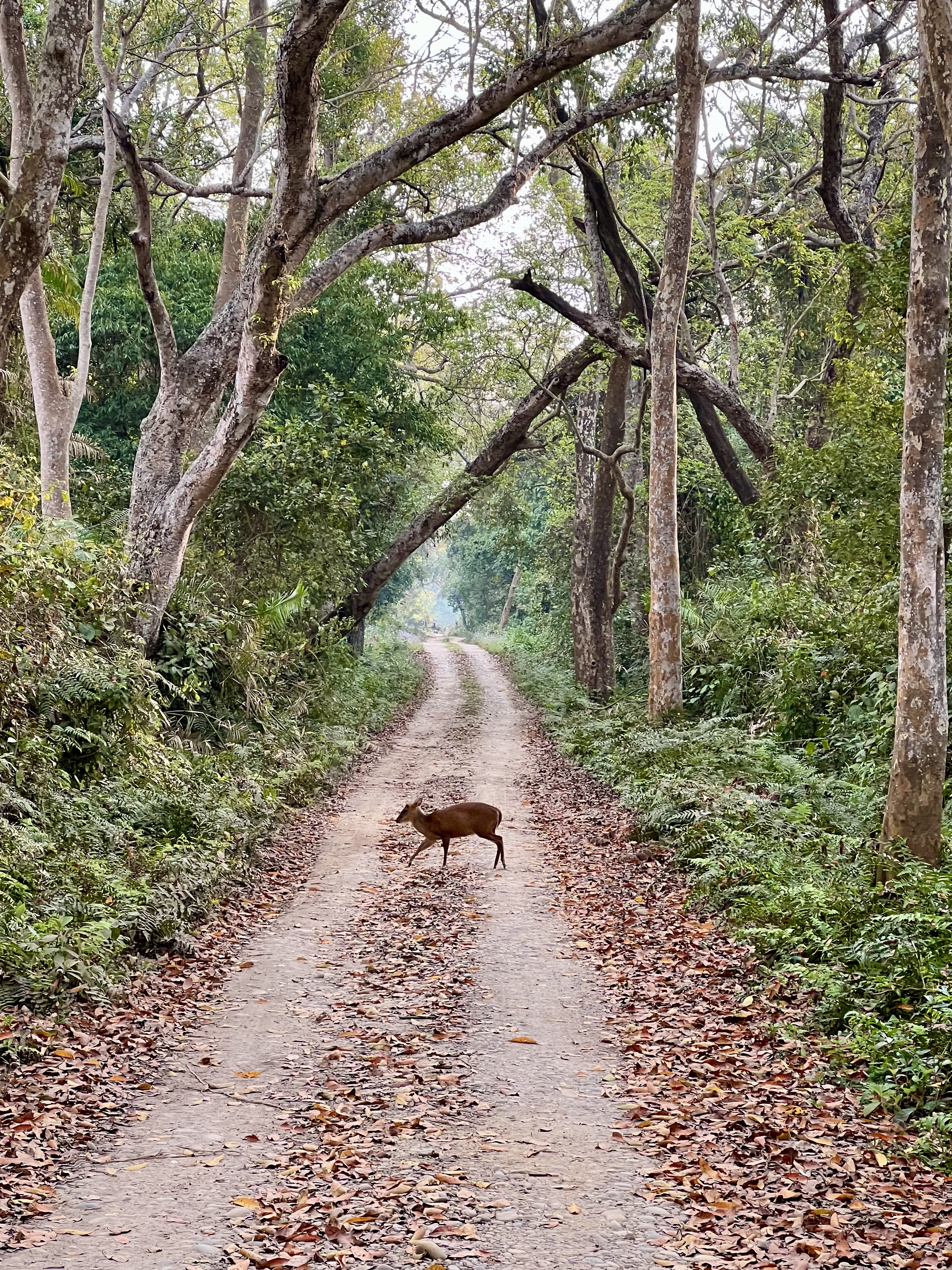
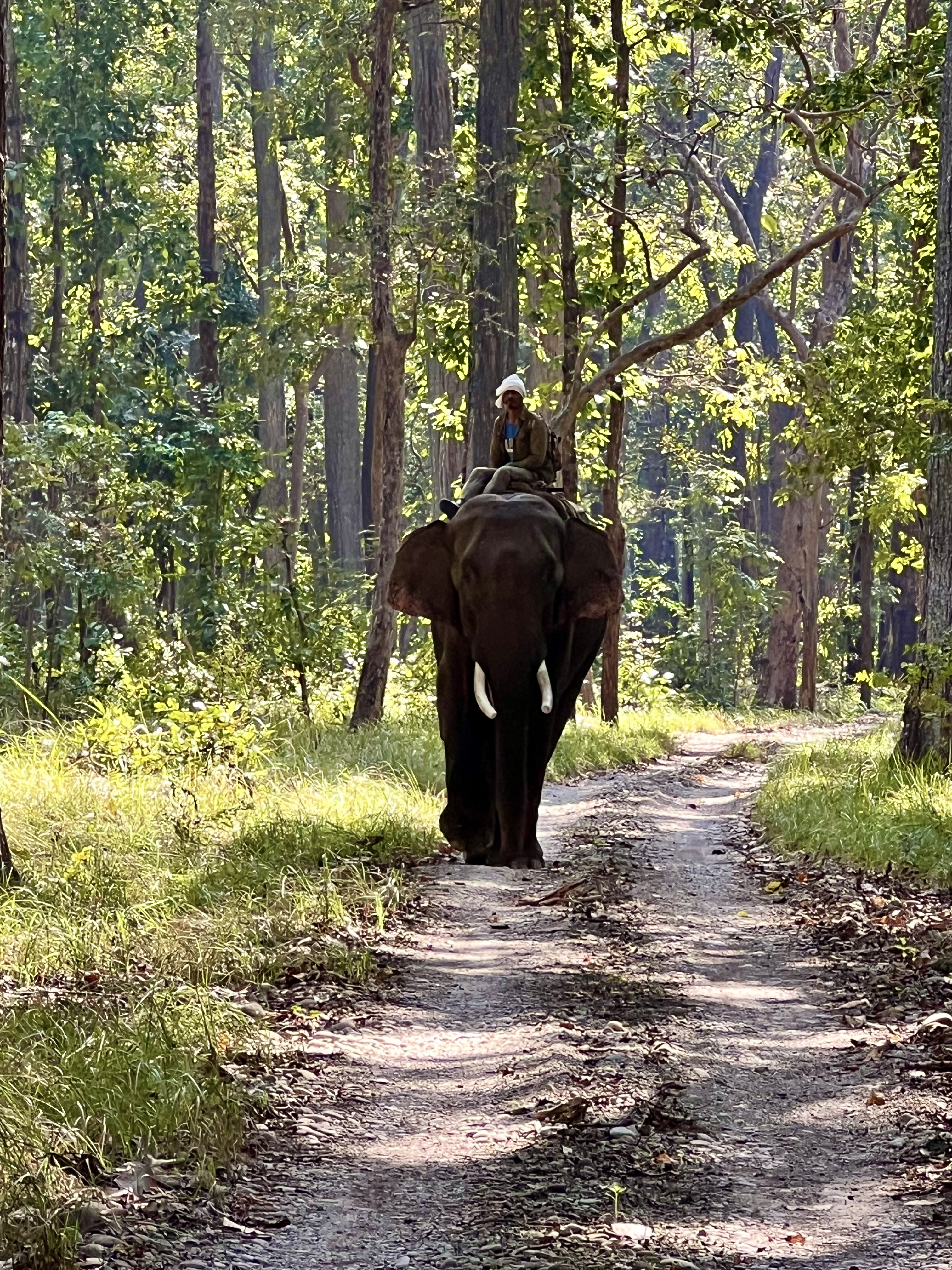
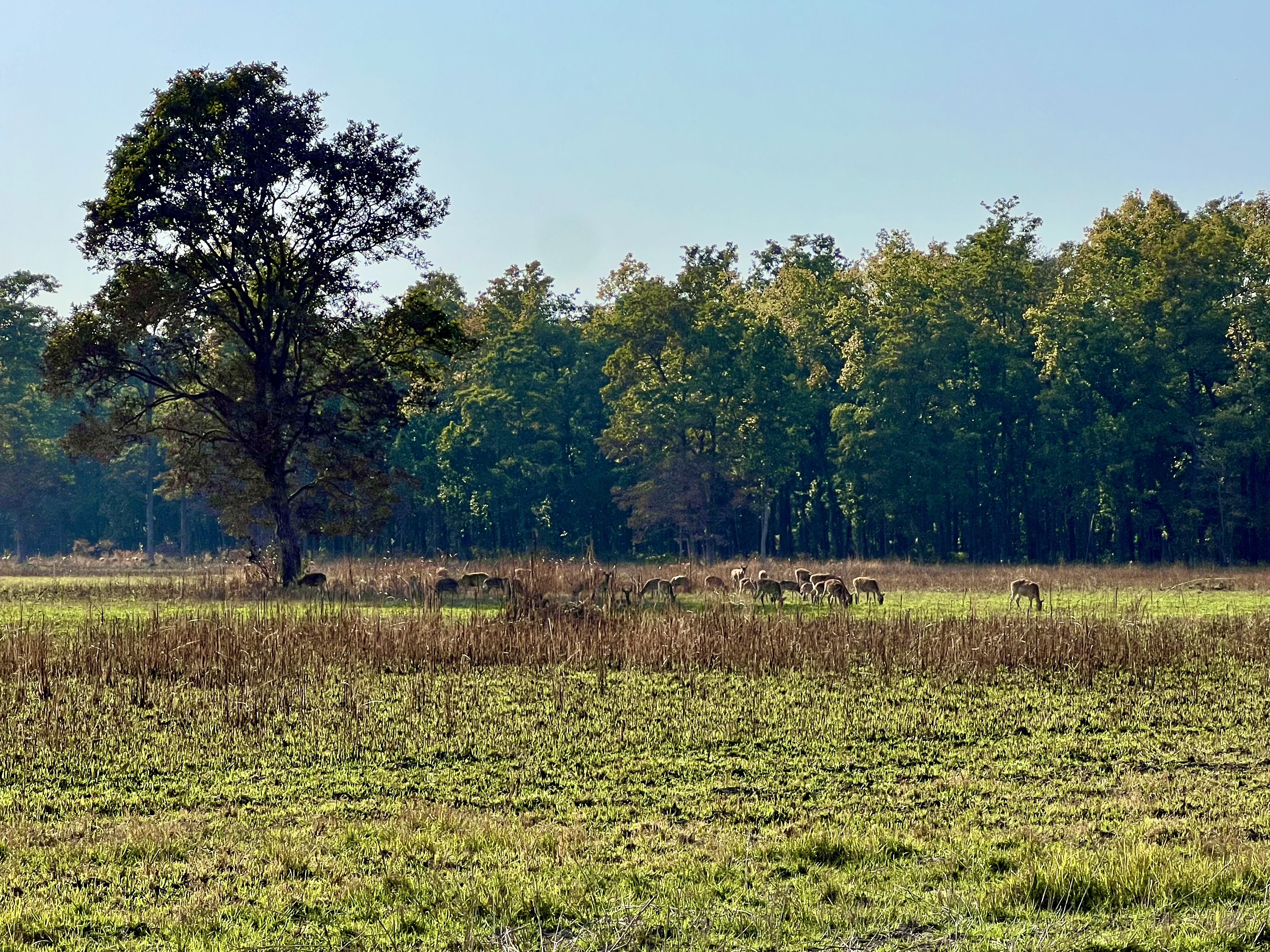
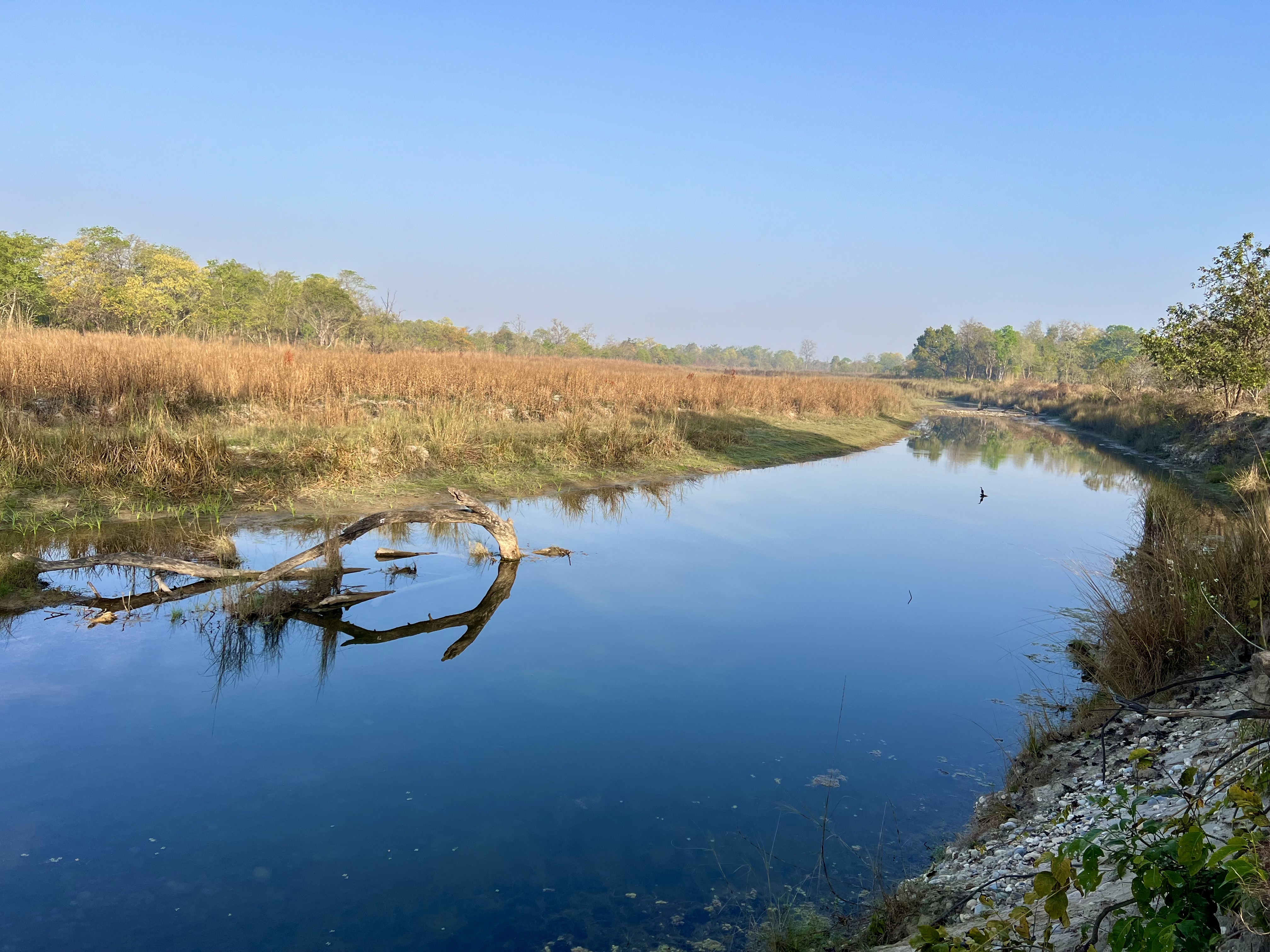
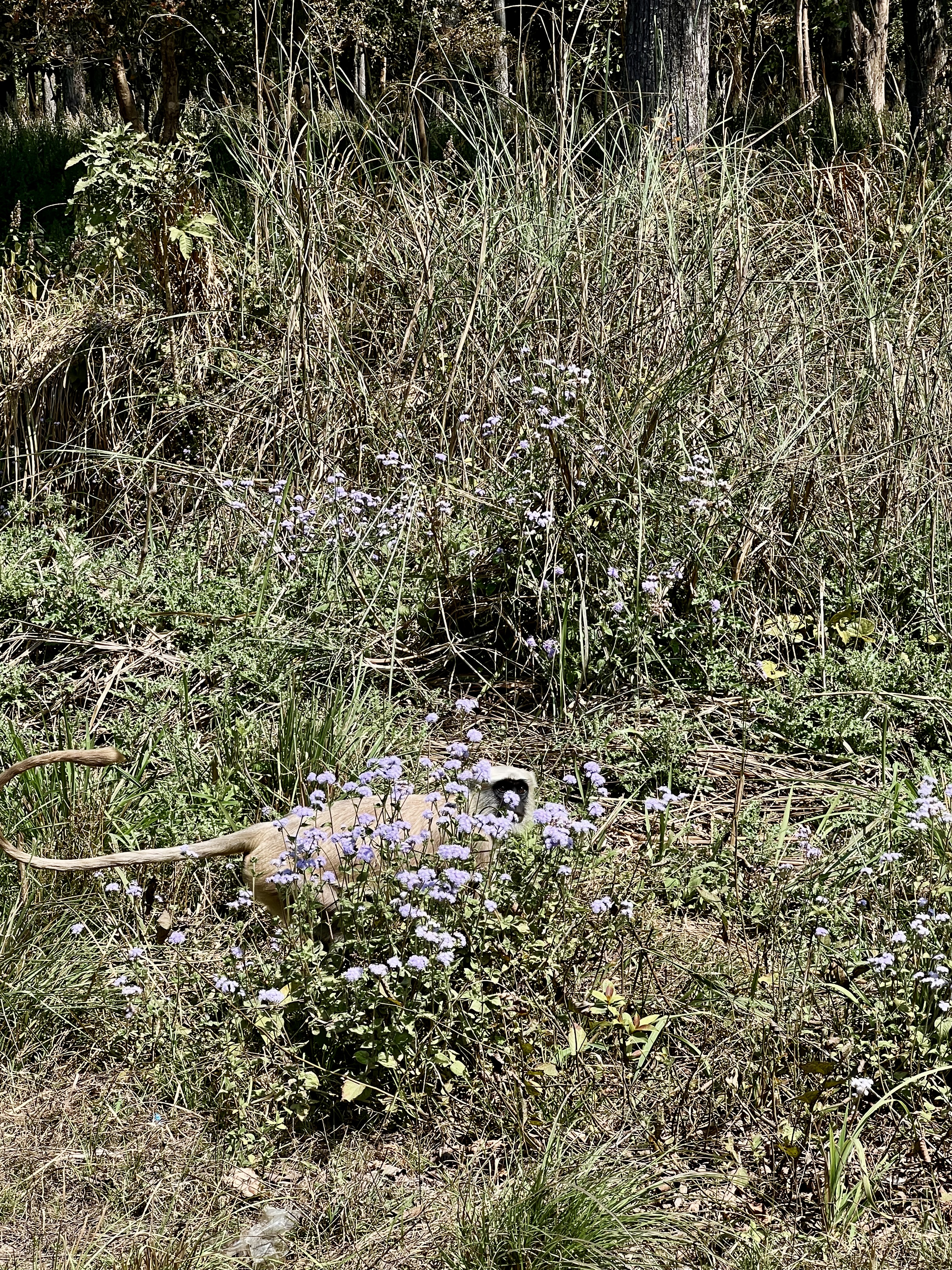
Wildlife in Bardia National Park

Bardia

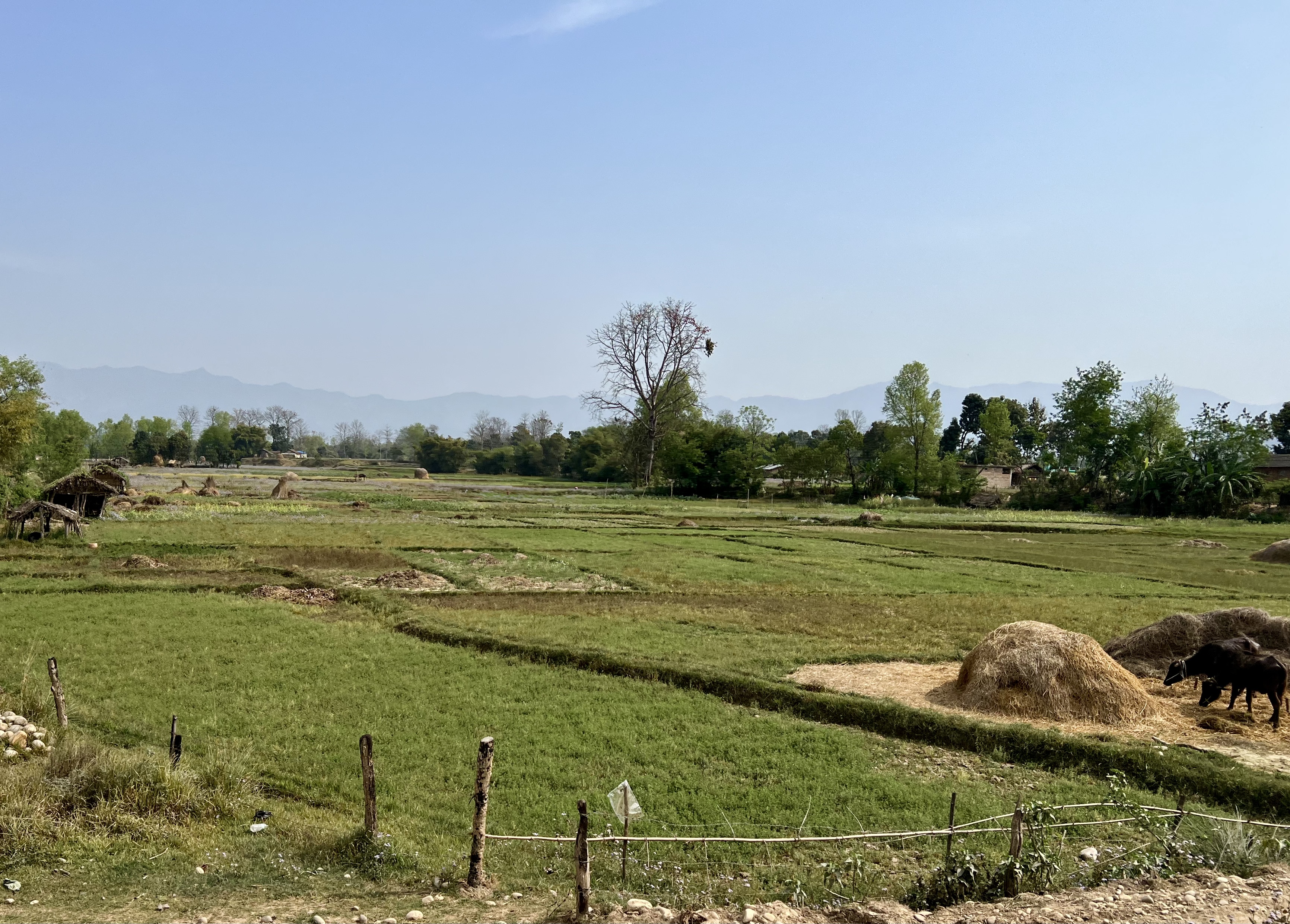
The Terai is completely different from the rest of Nepal.  Nepal is a country where, within 130 miles of each other, the jungle meets the highest peaks on the planet. The close geographical distance, however, does not mean that it is easy to get from one eco-system to another. The roads are generally bad and the travel distances quite long.  When possible, it is better to fly from Kathmandu to a nearby local airport and then drive to the place one wants to get to. The distance from Kathmandu to Bardia National Park was what had kept me from coming here in the past, but I wanted to walk in tiger country, and the only park where one is allowed to do that is Bardia.

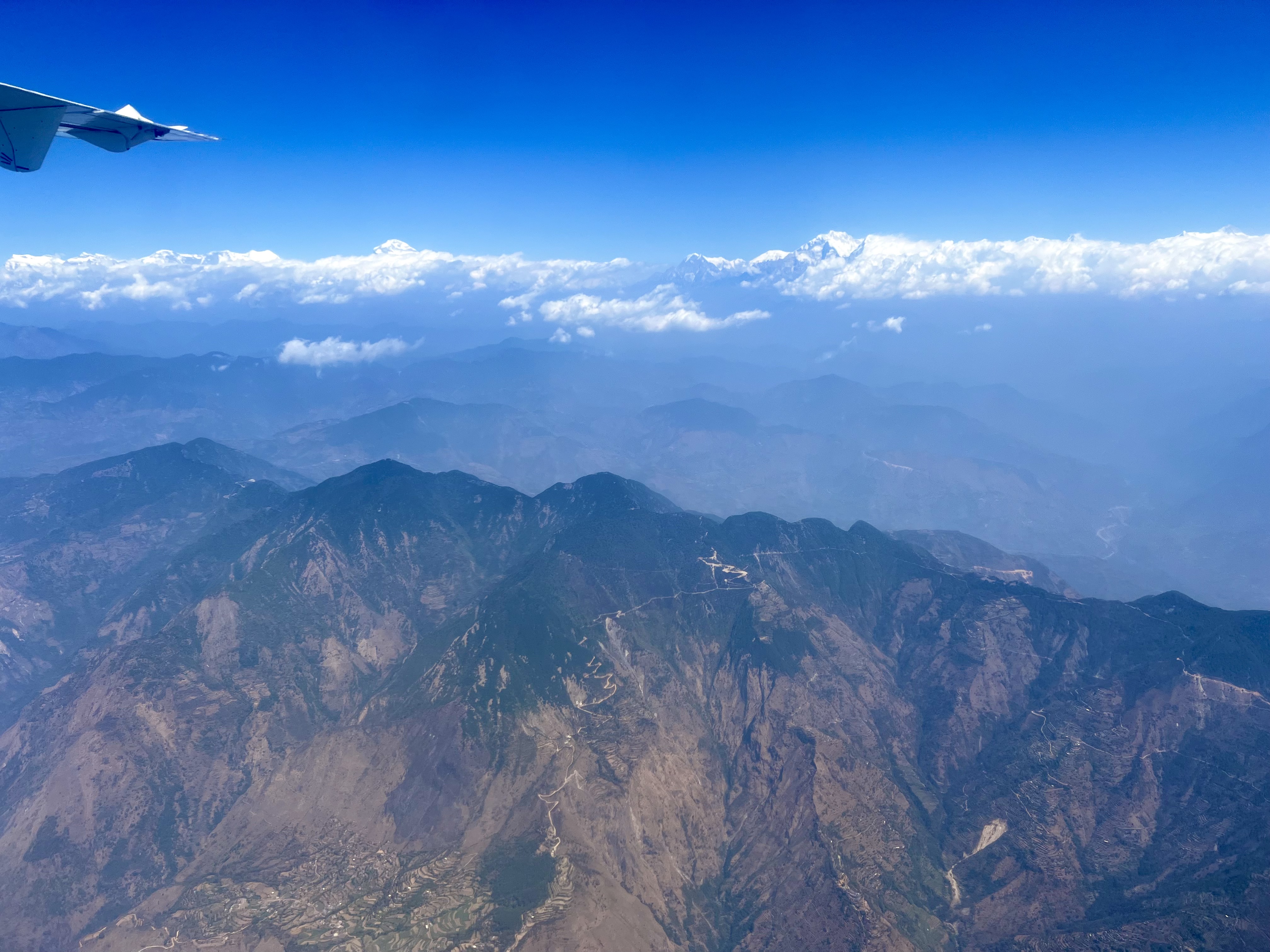
I was in Chitwan National Park in 2000 when it was still relatively quiet, and it was an amazing experience. We didn’t see a tiger but were able to get fairly close to some of the rhinos. Now it is overrun with tourists and jeep tours as it is the closest park to Kathmandu – only a 5-6 hour drive – and I didn’t want to be one of a mass of tourists.  Bardia is about 20 hours away by bus, but the flight only takes 50 minutes in the air when it actually takes off.  When I got to the airport, I found out that my Shree Air flight was cancelled – without any warning. The staff at the airport counter were very helpful and immediately booked me on an earlier flight with Yeti airlines.  In fact, we started a half hour later than the original flight was scheduled for, but we did take off and land. I was lucky to have a window seat and the Langtang and Annapurna range white glacial peaks glistened through the clouds, while the brownish hills below were covered with haze. The driver from the Wild Planet Eco Retreat met me at the airport to start the 2+ hour drive to the park. Amazingly, here on this western end of the country the roads are much better than they are elsewhere, and the trip proceeded without problems from Nepalgunj.

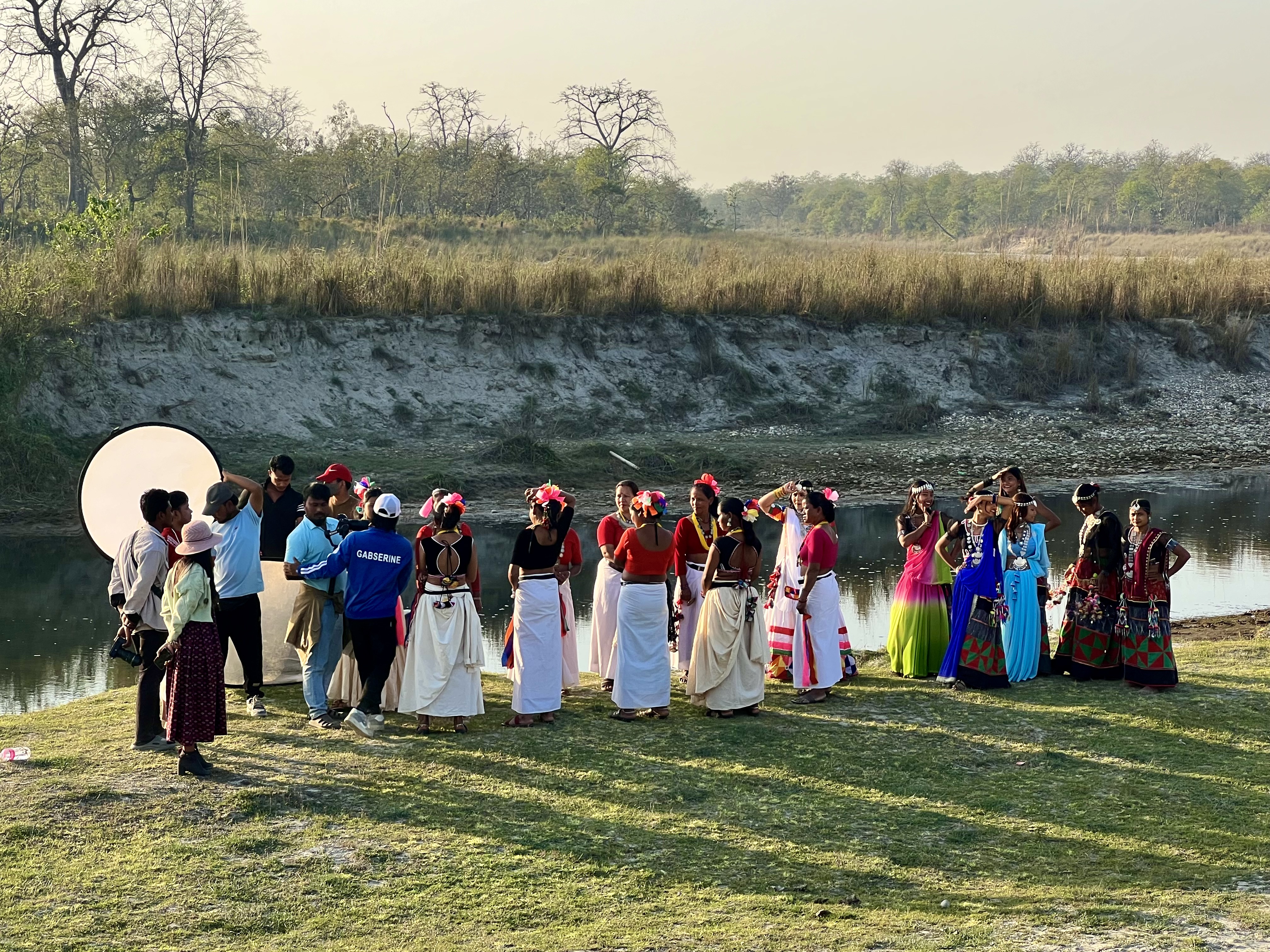
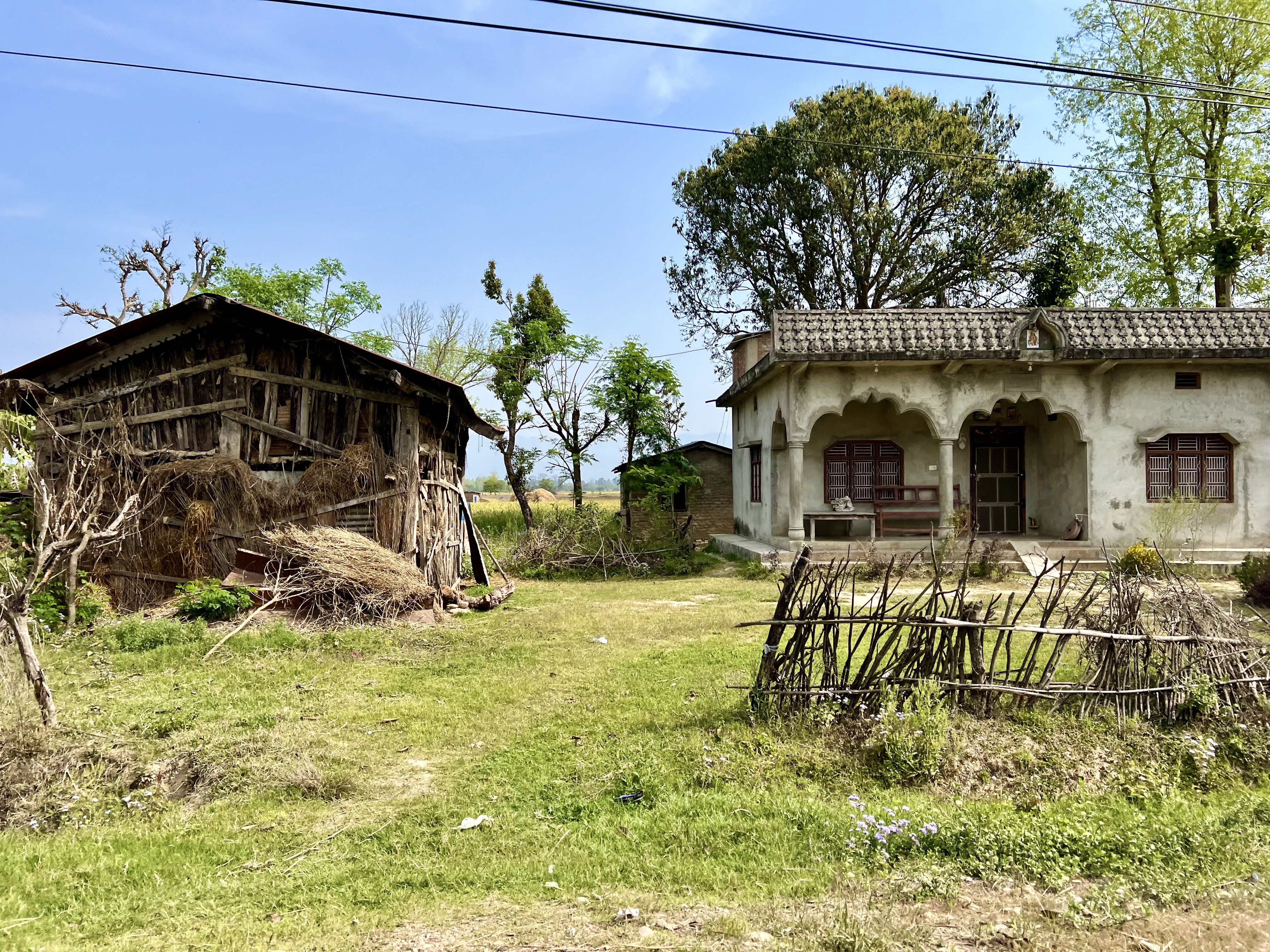
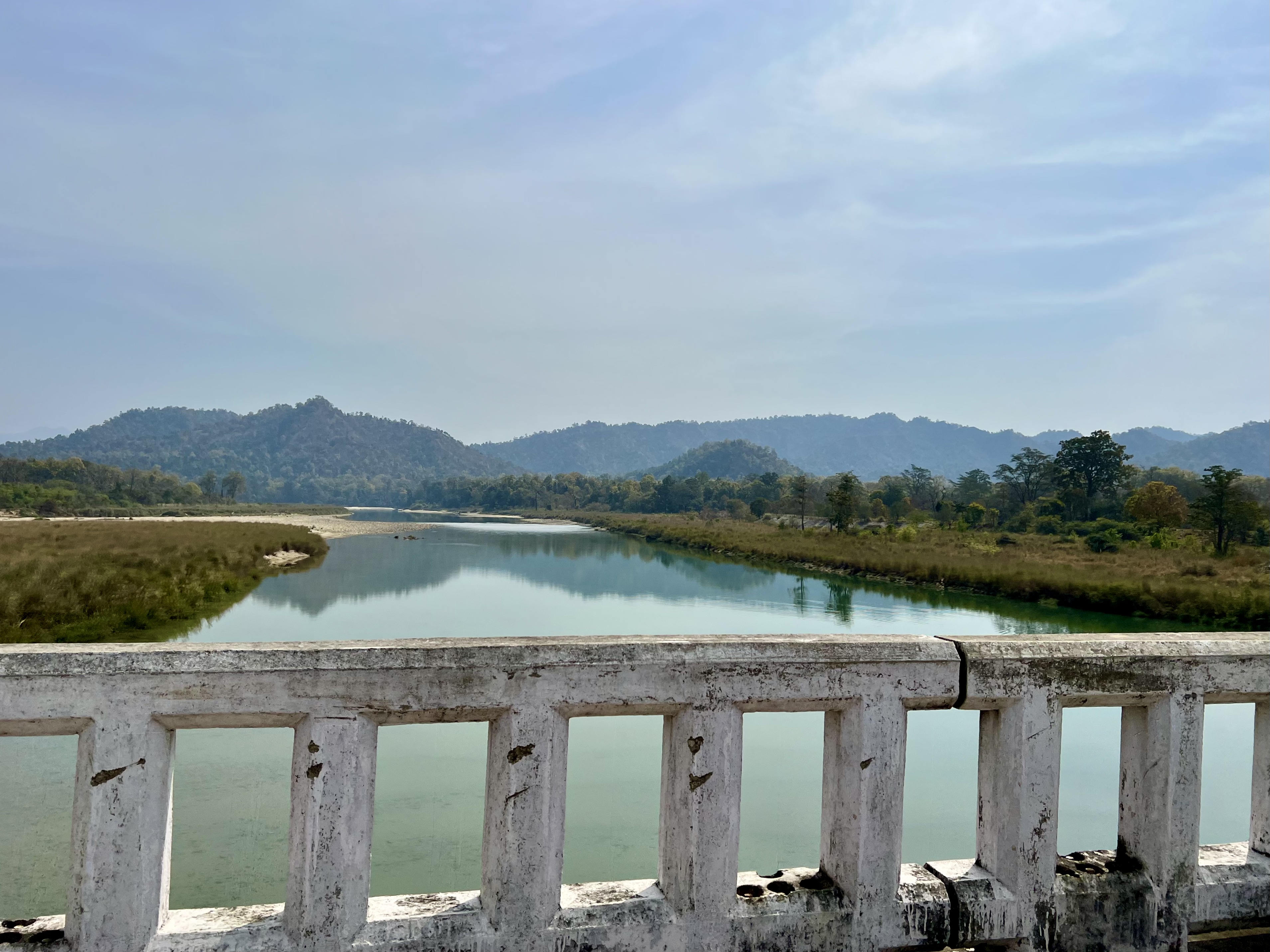
Upon arriving in the late afternoon, I was taken on a walk along the river near the village of Thakurdwara. Along the way, we came across a film crew on the shoreline preparing a video of a local dance a’ la Bollywood style. The director, a man, was showing the ‘bride’ how to dance with her hips and hands, while the ‘bridegroom’ stood there and tried to keep a straight face. The girls in the chorus practiced their moves along with the ‘bride’. The music was to a local song. It was nice introduction to a bit of local lore.

Along the way we saw a wire fence that had been installed to keep the park animals away from the village, but it was obvious where the elephants had simply ignored the wire and crashed right through it.

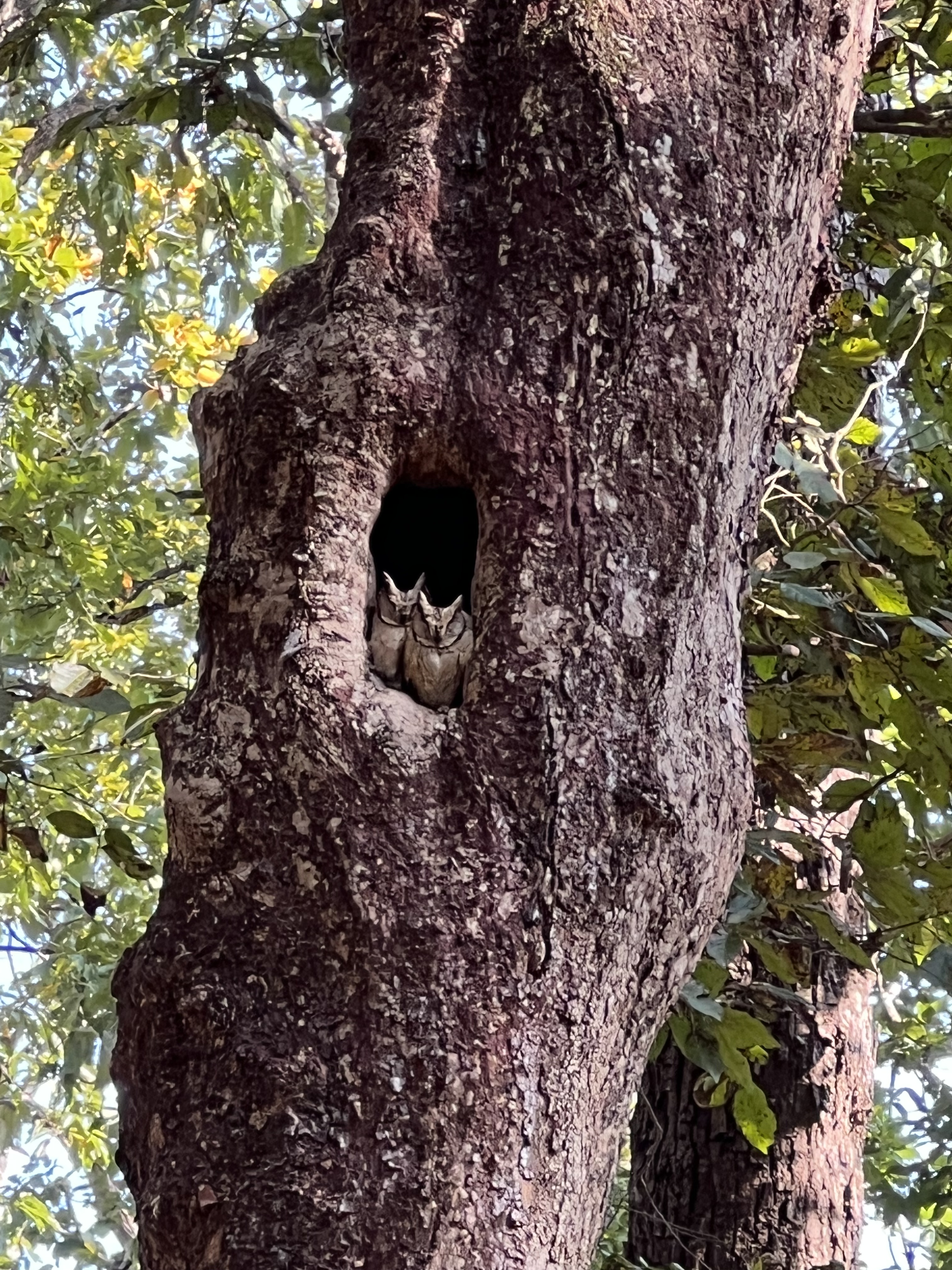
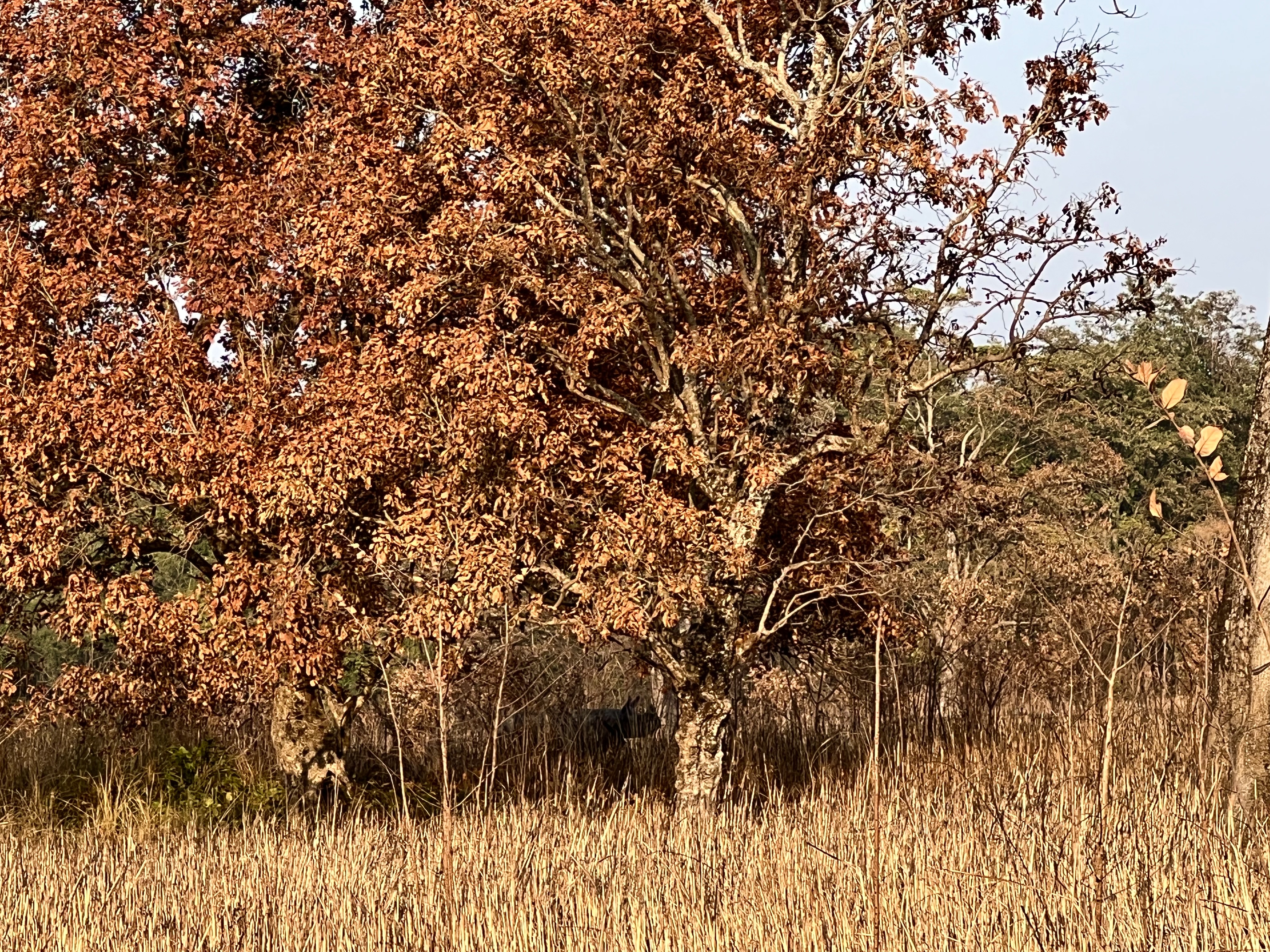
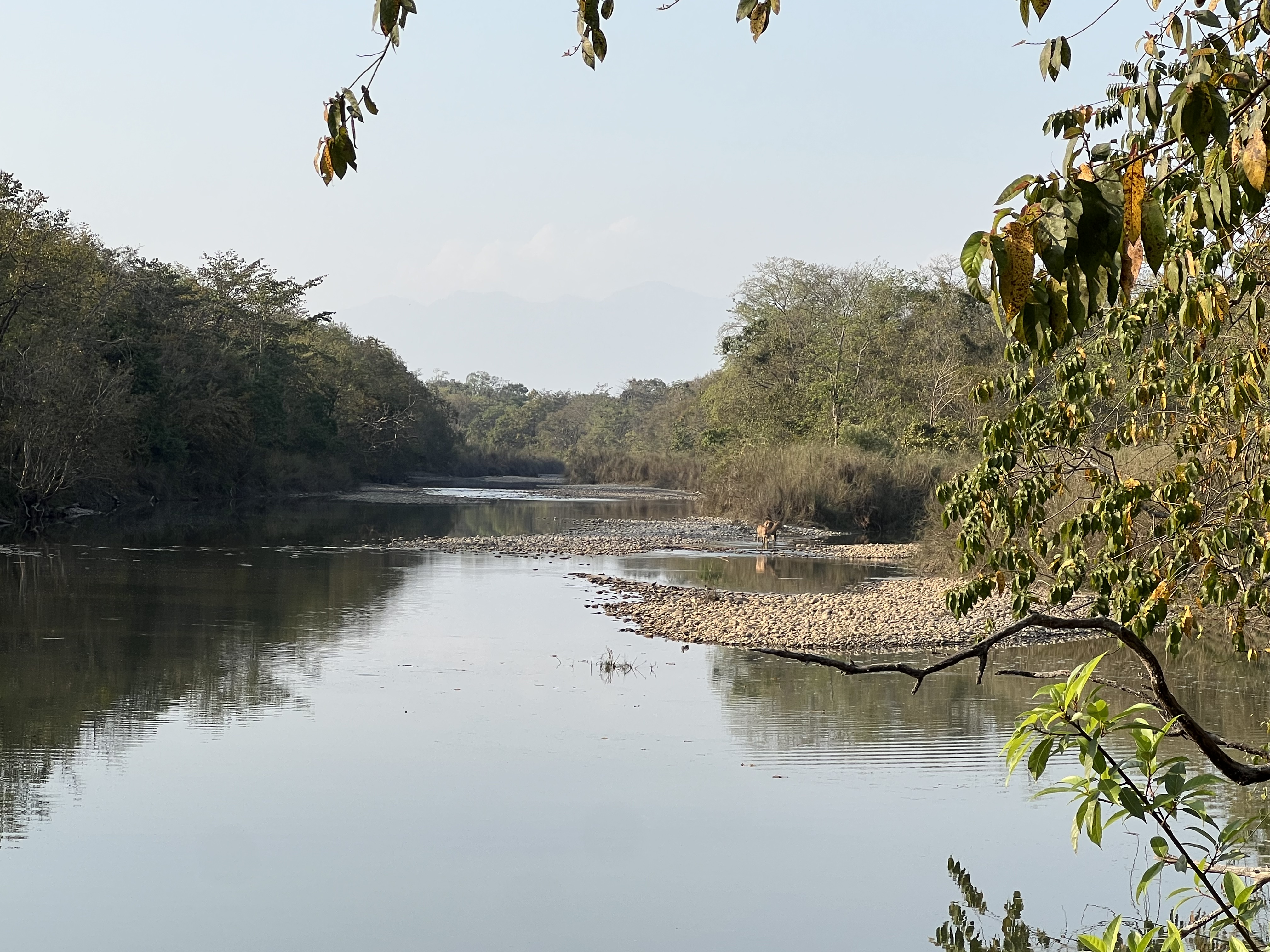
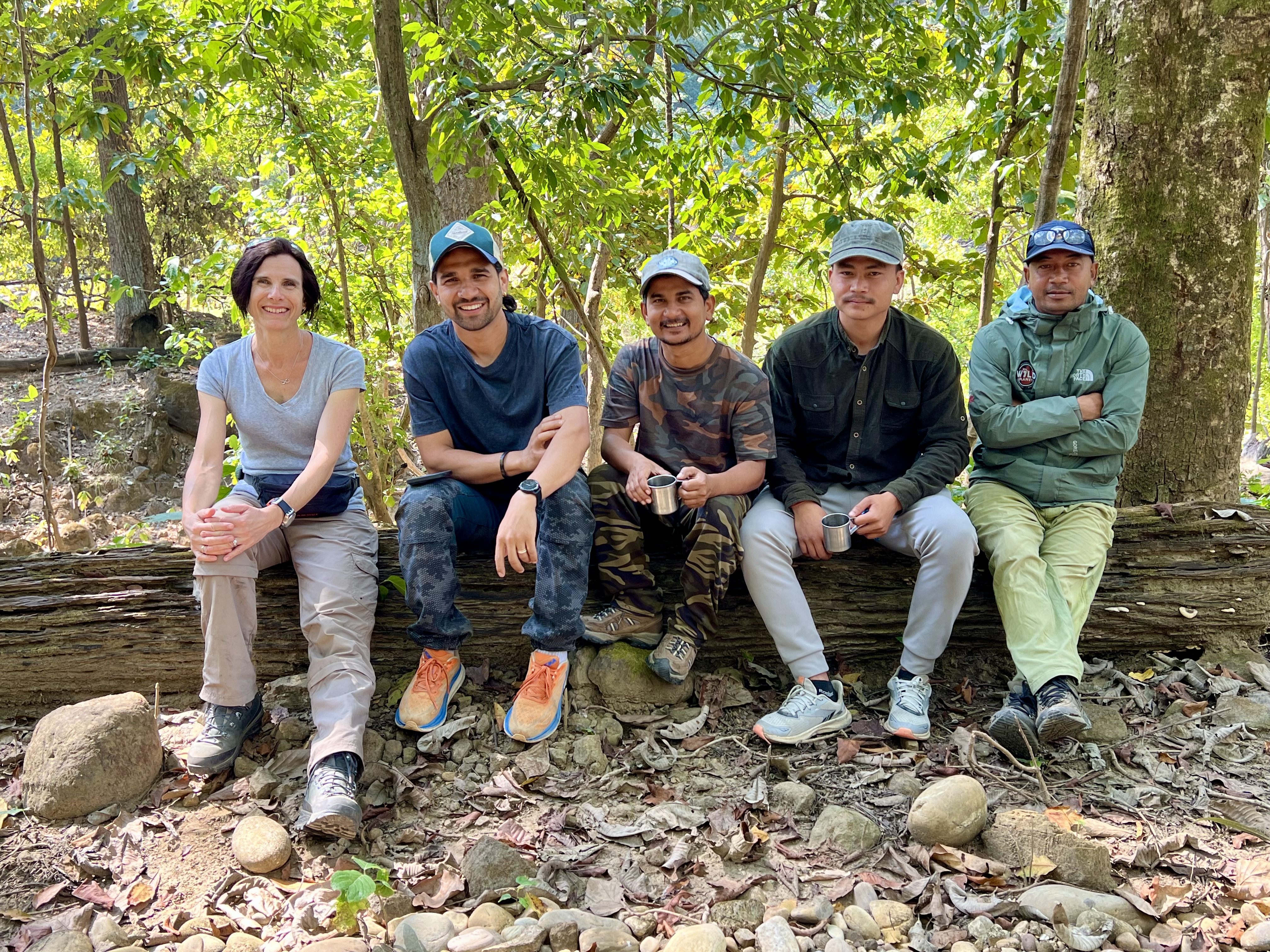
The first day at Wild Planet I went on a jeep safari that started at 7am and lasted until 6:30pm. I went on two jeep safaris and one walking tour while I was there. There were only a couple of people, Bettina from Switzerland and Brent from Canada, staying at the retreat as it was before the major tourist season. Bettina and I teamed up on the safaris making them less expensive. On the first day we saw the most wildlife, including two tigers – one female darting across the road and one male very far away sleeping on stones in the riverbed. The first tiger was too quick to photograph and the second too far away for my iphone, but Prakesh, our guide, had a very long lens on a very expensive camera and was able to capture some hazy footage. We missed seeing one other tiger because another jeep came up too loudly and the cat vanished back into the bush. We did see one wild bull, a boar that followed us around a bit, two otters, a momma rhino with baby crossing the river, a male rhino taking a bath in the river, domestic elephants grazing on tree leaves in the wild, eagles, owls, kingfishers, langur and rhesus monkeys in the fields and in the trees, barking/ spotted and chital deer.  To locate some of the larger animals, our driver, Dave, was in constant communication with the other guides and drivers.  When he heard that a tiger had been sited, he raced the jeep toward the site as if he were a Formal One race car driver.  It was a wildlife rich day and a thrilling jeep trip.

On the second day of the jeep safari Bettina and I were accompanied by Baba, Prakesh’s older brother and primary owner of the Wild Planet Eco Retreat as the main guide, as well as Madhu, who had been a guide in Bardia before he married a Swede and moved to Sweden, and Suzan, who had just passed his guide license along with Dave, who is also a guide. Even with all four of them, this day was less successful as far as the larger animals went, but we detoured to a more secluded part of the park and up into the hills. Here again, Dave proved to be an excellent driver as the jeep climbed the uneven, rocky clay path up the curves on the hillside. When we stopped for a break, it was completely still except for the wind, birds and monkeys. There were no other jeeps, nor people anywhere, just lots of langur monkeys and various kinds of deer. The forest was beautiful and serene.

In the afternoon, we headed back to the region we had been in the day before and saw many more monkeys, and a new form of deer, a hog deer, which is fatter than the barking deer but about the same height.  Others saw a sambur deer, but I didn’t. I did see a few eagles, bright blue kingfishers and a green beecatcher and a mongoose rush across the path. At the end, we saw a few domestic elephants with sikhars on their way to a site where the rangers were going to capture a tiger for collaring in a few days. They need about three days to set up the camp for the capture.  The collaring helps the rangers keep track of the tiger count as well as the individual tiger’s behaviors. I learned more about this technique and tiger behavior from “Bones of the Tiger” by Hemanta Mishra and Jim Ottaway, Jr. Penguin Books, 2013. What was clear was that the tigers really are nocturnal, they sleep most of the day in the tall grasses or bushes, which makes them difficult to see. It was only when we heard the barking deer call, a sign of danger, that we could assume a tiger was on the move.

The other book that Mishra and Ottoway Jr. wrote is called “The Soul of the Rhino” (Penguin Books, 2008). It is the counterpart to the tiger book, both of which are mostly about the animals and history of Chitwan but are also relevant to Bardia. The first explains how Chitwan changed from a royal hunting ground to a conservation park and the second how Bardia inherited rhinos from Chitwan and how their numbers were almost devastated during the Civil War with all the poaching.  There were originally 100 rhinos brought from Chitwan, but the numbers dropped to the single digits after the Civil War. Today there are 38 rhinos in the park and 123 tigers.  One of the stories in the rhino book recounted a folktale the Tharu people have about the rhinos. The Tharu are the traditional inhabitants of the Terai. The tale was told to Mishra by the lead elephant driver for the Royal Elephants, Tapsi.
“The creator was not drunk but stoned when he made the rhino. God Brahma gave life to the rhino more than ten million years ago. Brahma, who created the universe, enriched the earth with every form of plant and animal life but was still not content with his creations. He summoned Viswakarma, his master designer.

‘Viswakarma,’ commanded Brahma, ‘make me a new and perfect creature. It must not resemble any beast in this world in shape, size, or personality.’

‘Yes, my Lord,’ uttered Viswakarma. What choice did he have? His master, the creator of the world, had hit a creative impasse. Now he had to come up with something to avoid the wrath of his master. Viswakarma decided to travel across seven seas, seven mountains, and seven lands in search of an inspiration.  After wandering for eons through forests, river valleys, and mountains, Viswakarma reached Mount Kailas, the abode of Lord Shiva, God of Gods.

Shiva was in deep meditation. All of his eyes, including his third eye in the middle of his forehead, were closed.  Viswakarma then stood on one leg, folded his palms, and prayed non-stop for ten thousand years, chanting, ‘Om Namo Shivaya Om Namo Shivaya Om Namo Shivaya.’

Viwsakarma’s devotion impressed Shiva. He finally opened this third eve and roared, ‘Viswakarma! I am pleased with you.  Why are you here? What can I do for you?’

Thrilled and relieved, Viswkarma kissed the earth, folded his palms, and cried at the top of his lungs, ‘O Lord of thirty-three million gods, preserver of the truth, destroyer of the demons, I travelled through many lands, crossed many oceans, and drank from many rivers to seek your blessing. O God of Gods, my Master Lord Brahma has ordered me to make a new creature, something that has never been seen before on earth. What am I to do?’

The Almighty’s advice was short and simple: ‘Create an animal as elegant as Biphanke Ghode, the flying horse; as holy as the River Ganges; as fat, strong, and arrogant as Nandi, my bull.’

Shiva placed his right hand on Viswakarma’s forehead and blessed him. ‘Even humans shall not destroy the new animal you create, proclaimed Shiva. ‘They shall preserve your extraordinary creation forever.’

But how shall I go about creating such a beast?’ inquired Viswakarma.

‘That is your concern not mine,’ retorted Shiva, before he settled back into meditation.

‘Oh my gods,’ thought Viswakarma. ‘I’m no better off than I was when I started out.’

To stoke his mind, Viswkarma smoked marijuana non-stop for twenty-one thousand years, at which point his efforts were rewarded with visual grace. Viswakarma started hallucinating about a solution to his problem and went right to work.

He picked the best parts of many animals on earth and stitched them together. The result was beyond his expectation, a masterpiece of the art of imperfection. His creation had the skin of an elephant, the hooves of a horse, the ears of a hare, the eyes of a crocodile, the brains of a bear, the heart of a lion, and horns like Nandi, Shiva’s bull. In his zeal, Viswakarma creatively twisted, molded, and further modified these parts, even fusing two horns into one.

Viswakarma then took his invention to Brahma.

The beast was clumsy and ugly. But its clumsiness concealed a wonderful gracefulness. And its ugliness hid an elegant beauty. Brahma was pleased. He breathed into the creature the elixir of life and freed the beast into the forests of the Terai under the watchful shadows of the Himalayas, the abode of God Shiva.  He gave it the name ‘Gainda’, meaning ‘fat and stubborn’.

The author then goes on to say that: “Tapsi ended his story with a ring of high-pitched laughter. My thoughts were more sobering, however.  I was reflecting on how ironic it was that the Almighty had not foreseen the turn of events in the twentieth century. Poacher and the growing population in Nepal have destroyed the rhino and its habitat…. I thought that the fable of Viswakarma’s rhino also echoed some scientific truth. When scientists began classifying the world’s creatures in the eighteenth century, they were unable to assign the rhinoceros to any existing family in the animal kingdom. Consequently, they classified the rhinoceros as a separate and distinctive family of its own, the Rhinocerotidae, which means ‘nose horn’.  (Mishra, Ottaway 24-27) It is amazing how folktales manage to capture a truth that is often hidden from modern science.

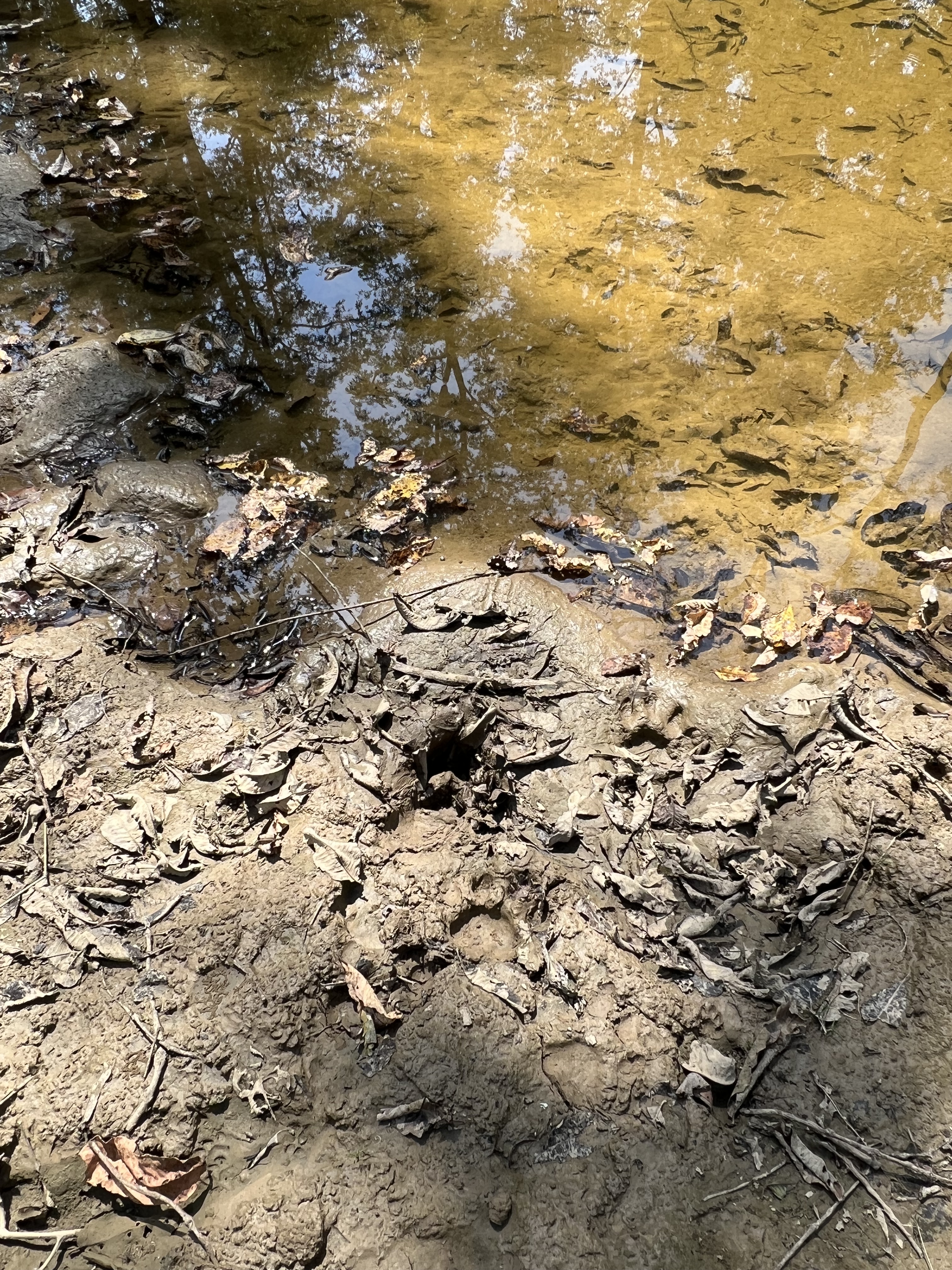
For my last full day in Bardia, I finally went on a walking safari.  This entailed far less walking than I had imagined and far more sitting waiting for a tiger to appear. While stationary, Bettina, Baba – our guide – and I saw more langur monkeys than I could count and deer of all sorts grazing together everywhere. The barking and spotted deer seemed to like to stay together, while the chital and sambur were often off to the side and the hog deer were often only in small groups. When we were on foot it was an experience to walk through the tall grasses higher than my head knowing that we were in an area with five tigers, three females and two males. Normally, the tigers are solitary and keep far away from each other, but it is mating season and there is more than enough food for all five large felines. We kept seeing fresh tracks and scratches in the sand where the tiger(s) had marked their territory along with the pungent odor of their urine, but an actual sighting was difficult.

After waiting for about five hours, Bettina, Baba and I finally saw a male tiger. He was close enough for Bettina to get a photo with her lens extended to the full extent, but far too far away for my iphone. The Eco Retreat’s binoculars, were good enough for a clear view, though, and I was happy to see him in full view. After he wandered back into the bush, we again waited for hours for him to come back out to go for a drink in the river, but he didn’t show himself and we finally gave up and went to another spot.  We didn’t see anything there after waiting again for a couple of hours, so we walked back & low and behold, his footprints were where we had been – we just didn’t wait long enough! We also saw fresh rhino prints but didn’t see the actual animals. Even though we didn’t see any more rhinos, wild elephants or leopards, we did see a tiger in the wild amid the grasses and that was a pretty amazing sight.

While we were waiting, we were sitting on the forest floor covered with brown fallen leaves, and I reflected that I wouldn’t dare do this in Central or South America as I would be eaten alive by ants and various other bugs.  There were a few ants, but there wasn’t anything that was too bitey or stingy. And during this dry season, there were only a few mosquitos! (I was told that they would come en masse during the monsoons.) As it was, it was a beautifully serene hot day in the wilds of the Terai.

There are many places to stay in Bardia, from the exclusive Tiger Tops Resort, where the clients had folding chairs, tables with snacks and drinks for sitting and waiting for a tiger at a spot near the river, to our Wild Planet Eco Retreat for $6 per night.  The wildlife experience is perhaps better with less people, like we had. The only real difference is in the accommodations themselves. We had a shower, but there were two separate hoses, one for scalding hot water and the other for freezing cold water; these two needed to be mixed in a bucket that was then used for the actual shower.  I’m sure Tiger Tops had more convenient facilities, but the Eco Retreat was probably much more fun and the difference in experience is more culturally interesting at the less costly places. The guides are determined to help their clients see wildlife and there is an abundance to offer. They also treat you as extended family, sharing personal histories and stories around a firepit in the evenings. The locals become friends, which isn’t usually the case in the larger places. Additionally, the people who migrate to the less costly quarters have often fascinating experiences to share as they are more likely to have traveled the world solo. For example, Brent, a Canadian and self-professed earthquake predictor. He monitors earthquakes worldwide and has made a very uncomfortable prediction that a major mega-quake will happen in Japan and simultaneously near Mindoro and north of New Zealand before Christmas 2024 or at the latest by the beginning of 2025.  Let’s hope he’s wrong! Nepal has had its share of earthquakes; the last major one in 2015 devastated the entire Kathmandu Valley and beyond.  Since then, however, the city has been rebuilt and modernized. On the Yeti flight back to Kathmandu from Nepalgunj, I was amazed at how even the former rural areas are now budding towns, and the Kathmandu Valley no longer seems like a valley but a metropolis. I wonder what Manjushri would say to his work if he surveyed the valley today. He is the god who drained the former lake to create the valley at the beginning of human time. Luckily, the main sites have retained their sacred spirit, but tranquil wildlife filled Bardia and the surrounding villages are worlds, not just a flight, away from the colorful lively chaos of the city.

Impressions of Muscat

For years, I have wanted to visit Oman, but the timing was never quite right.  This year I decided that waiting any longer to make my way to Australia and New Zealand was nonsense as I’m not getting any younger, and who knows what the world situation will be like in a few years. So, 2024 is a time for living for today, and that means traveling to countries that I haven’t yet been to and have long wanted to see as well as to return to old friends, like Nepal, India and Bali. My first stop on this Asian/Oceanic adventure was Muscat, Oman. 

First off, I need to confess that I made a mistake.  I understood from the Omani government website that I needed a visa to enter the country.  This is incorrect.  If one is staying for less than 14 days, a visa is not needed, so you can spare yourself that money when you arrange your visit here.

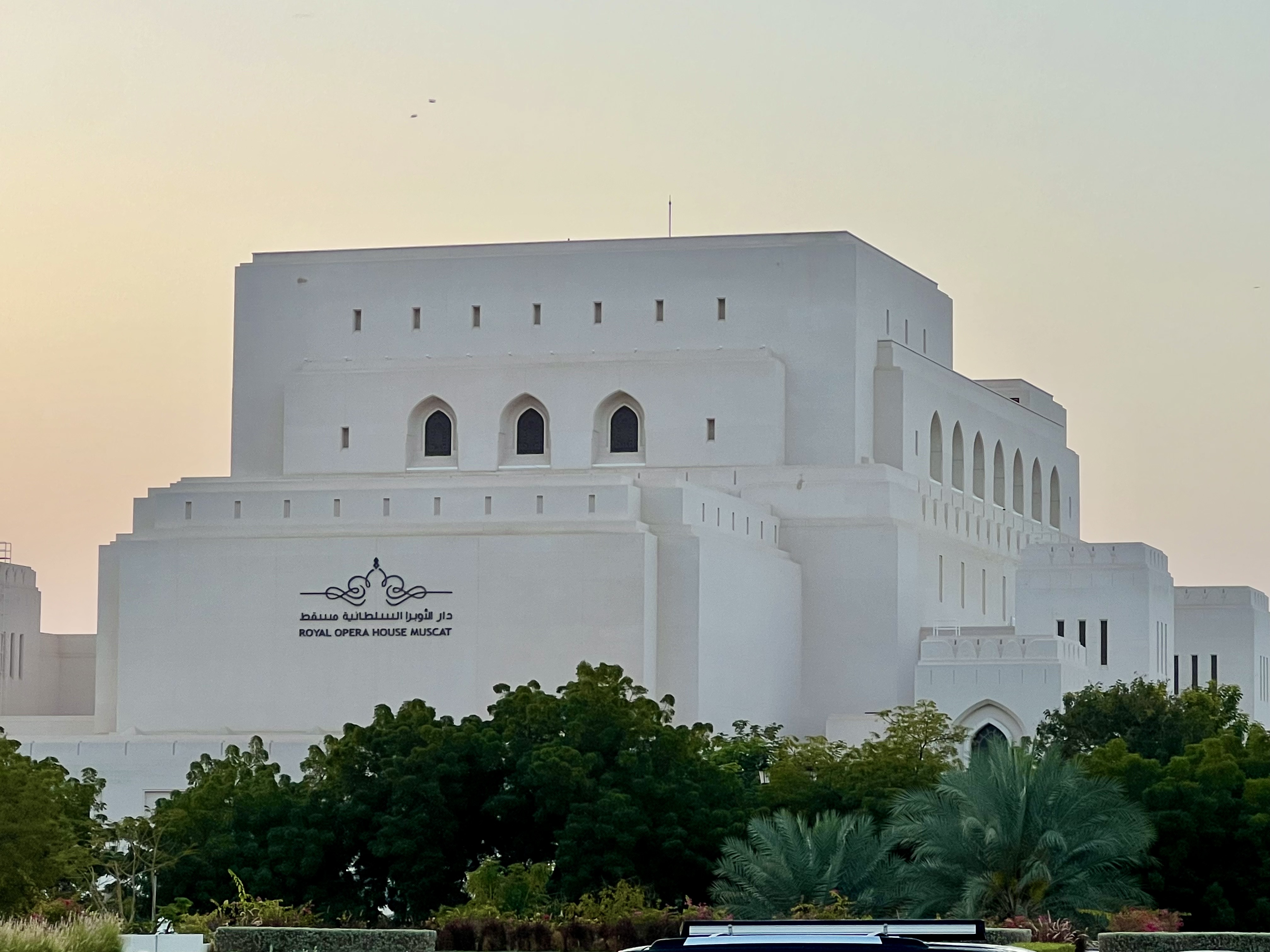
Oman is fairly expensive compared to most of the other countries I travel to, but it offers a very different view of the Arab world than the neighboring Emirates. The country came out of self-inflicted isolation only in the 1970s, when the previous Sultan, a graduate of British universities and former Sandhurst student, overthrew his very tradition-based leaning father, who ended up living his last years in England. Over the next fifty years, the country transformed itself into a thriving modern civilization while keeping the Omani spirit and customs alive. In Old Muscat and the area around the port where the cruise ships dock, the houses are not allowed to have more than eight floors, and most have only four to five. They need to be either white or cream, though they can have some reddish or greyish highlights. The white structures provide a striking contrast to the brownish mountains and hills surrounding the city. When I came in from the airport at dawn, the early morning light hit the hillsides so that as the taxi drove by the hills took on rainbow colors as the natural minerals, including copper and limestone, appeared then disappeared as the car went by. The hills, i.e. the Hajar Mountains, and the overall landscape reminded me of central Iran with the same foreboding yet mysterious crags, cliffs, and scree. Modern Muscat extends for miles and miles along the coast, and this is where all the high-rises are. I didn’t spend any time there, so can’t comment on that area other than to say that the highway from the airport into Old Muscat and the port area makes for an easy and interesting drive, passing by the Grand Mosque and the Royal Opera House, both of which are architecturally stunning.

Royal Opera House, Muscat

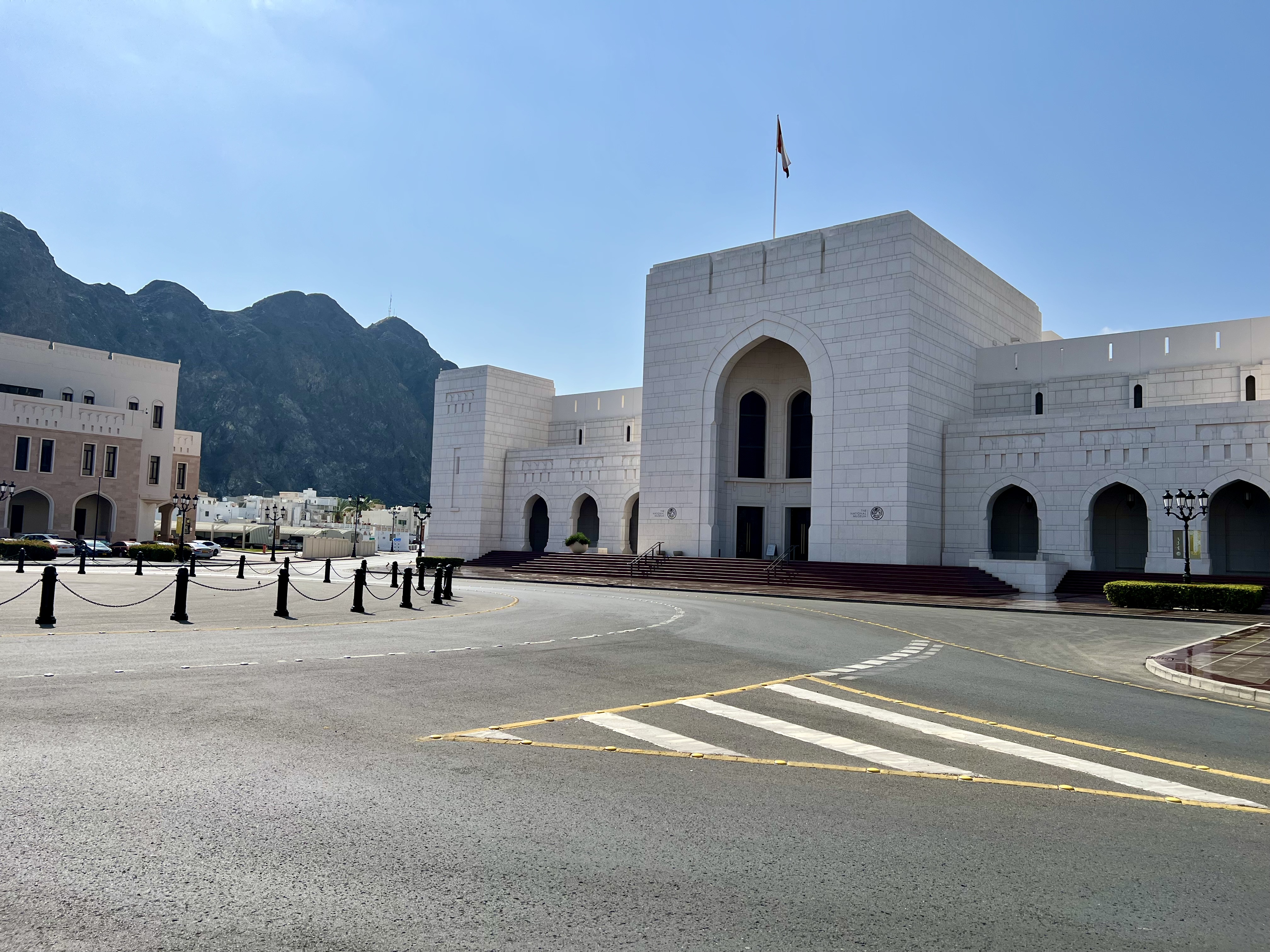
My guesthouse was in Old Muscat next to a small mosque a five-minute walk to the National Museum. It was clean and inexpensive, but there were no restaurants in the area, which meant that I needed to take a taxi at night to the Souq area for dinner. The taxis charge indiscriminately, so haggling is really a must. The National Museum is new, clean, and well-designed. There are exhibits from pre-history, for the Islamic World, Oman’s place in the World, Omani’s renaissance period (after they kicked the Portuguese out), and ethnographic collections. The informative placards are in English as well as Arabic.

National Museum Old Muscat

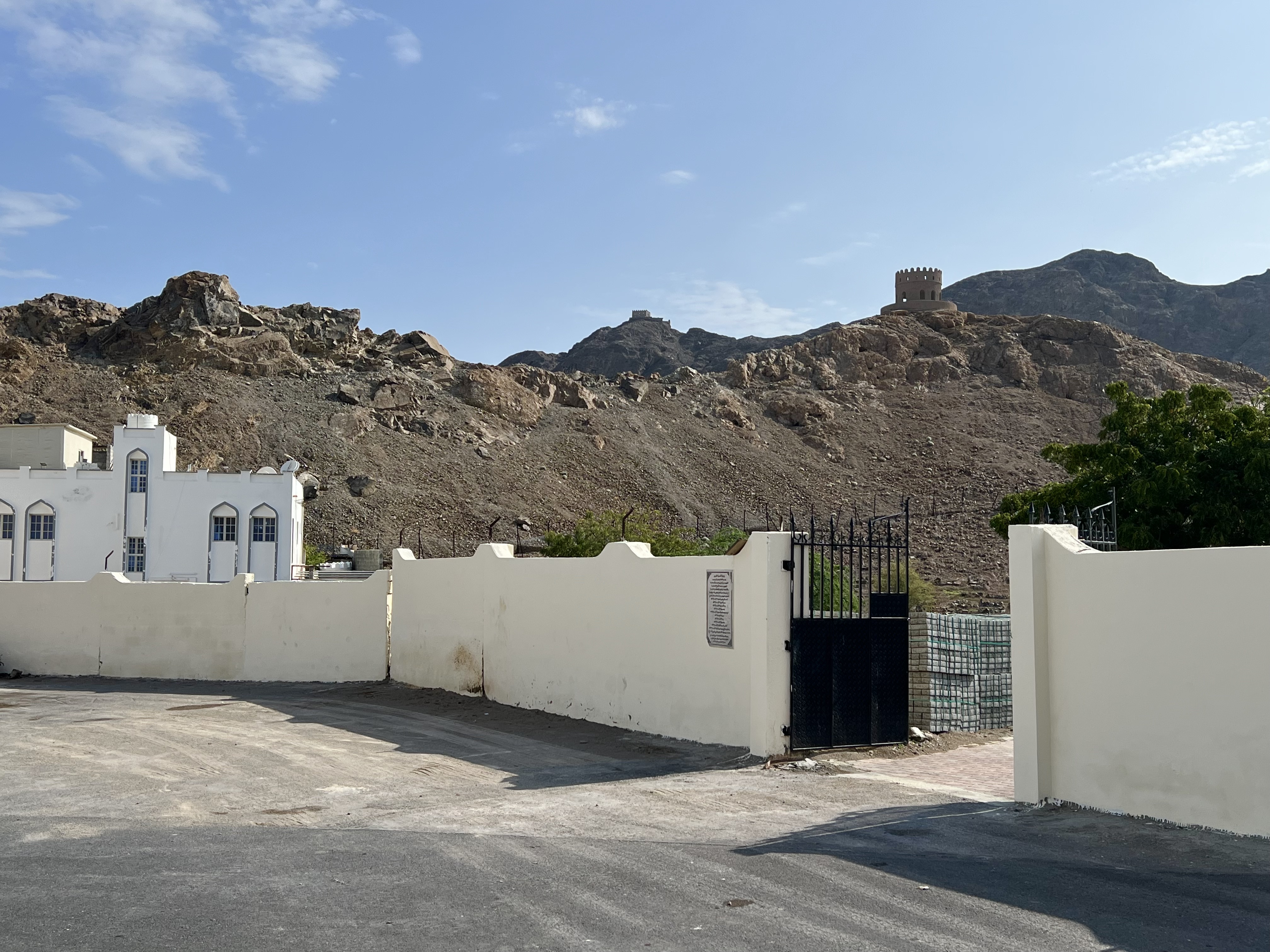
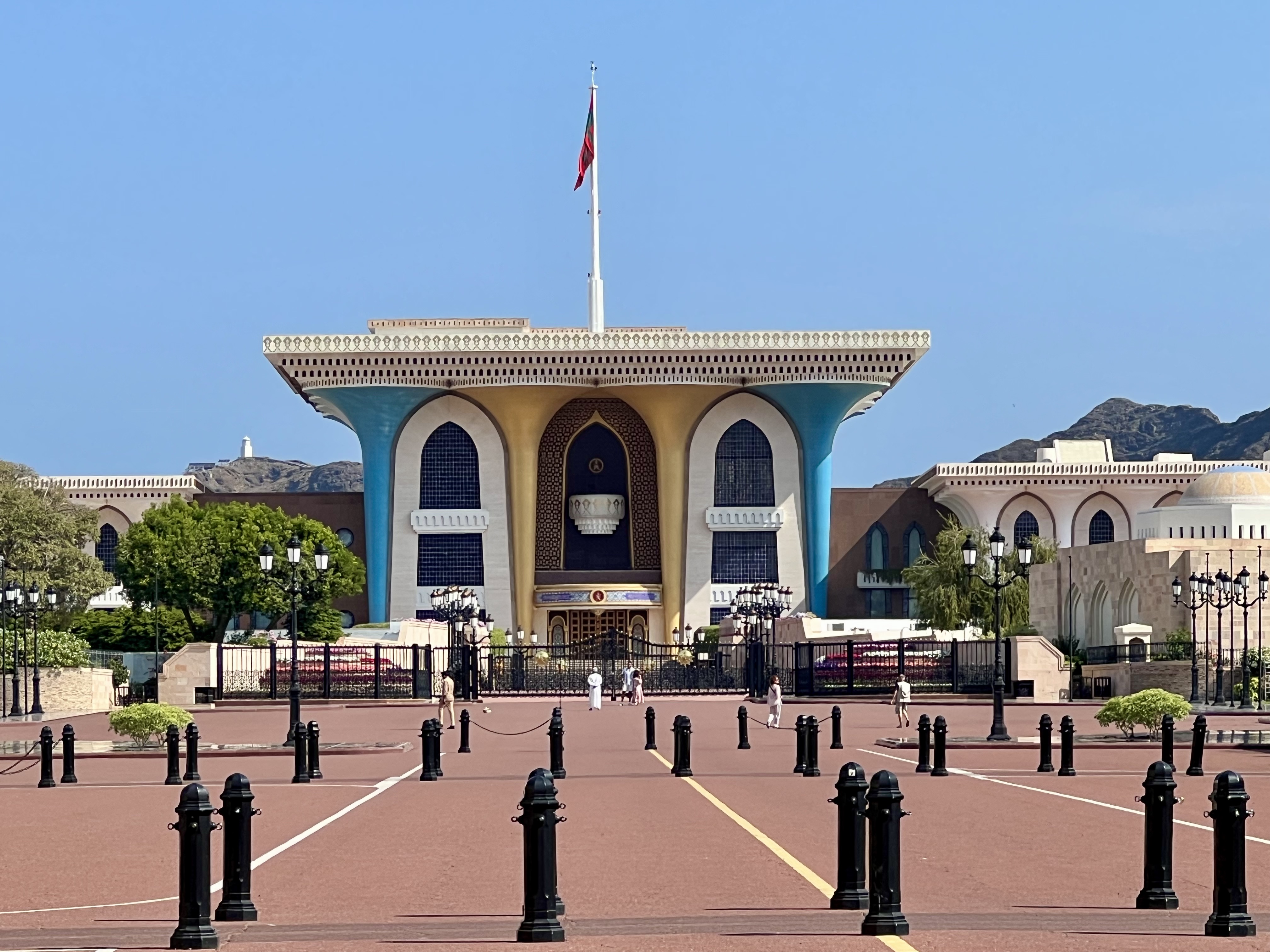
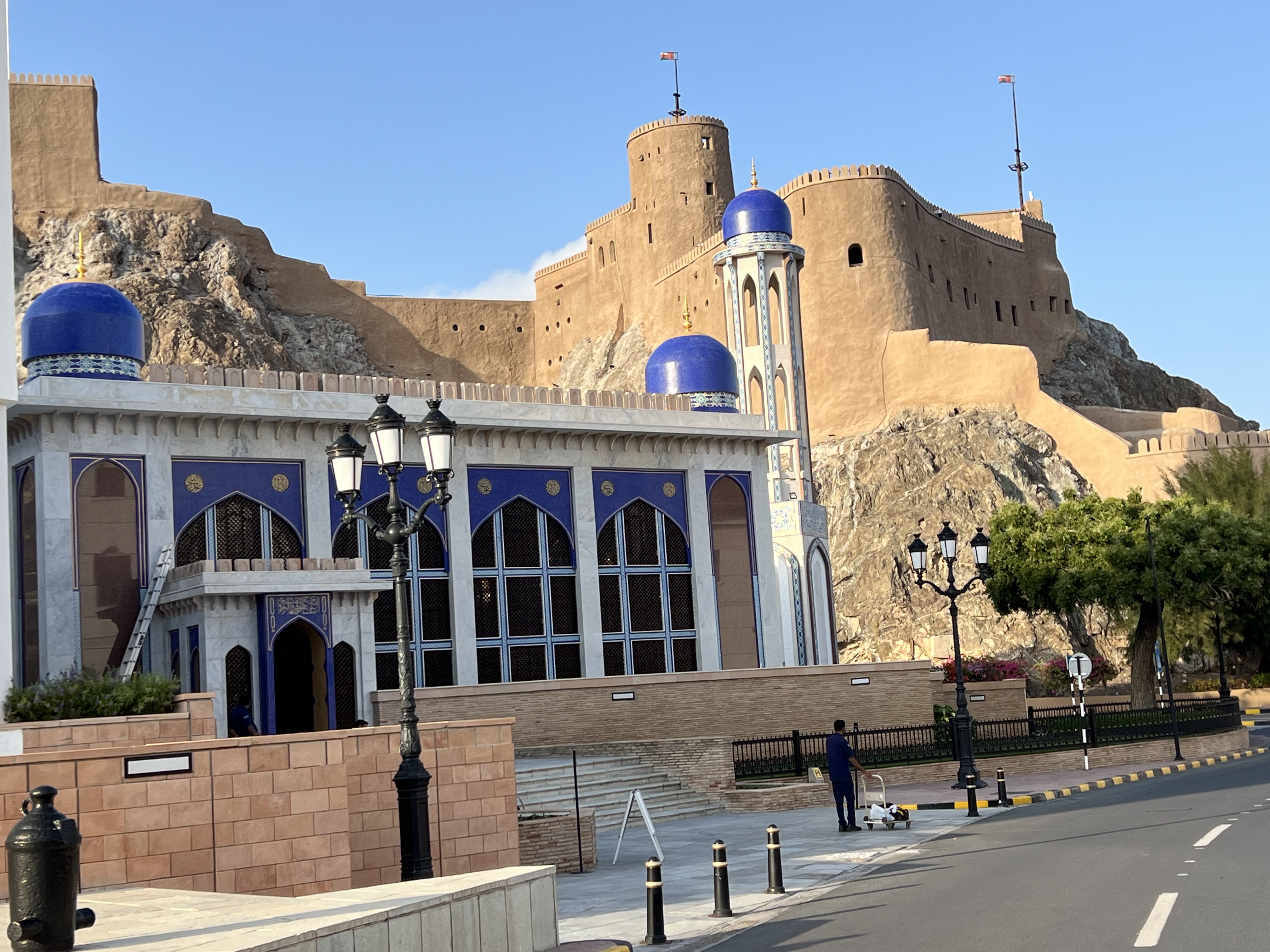
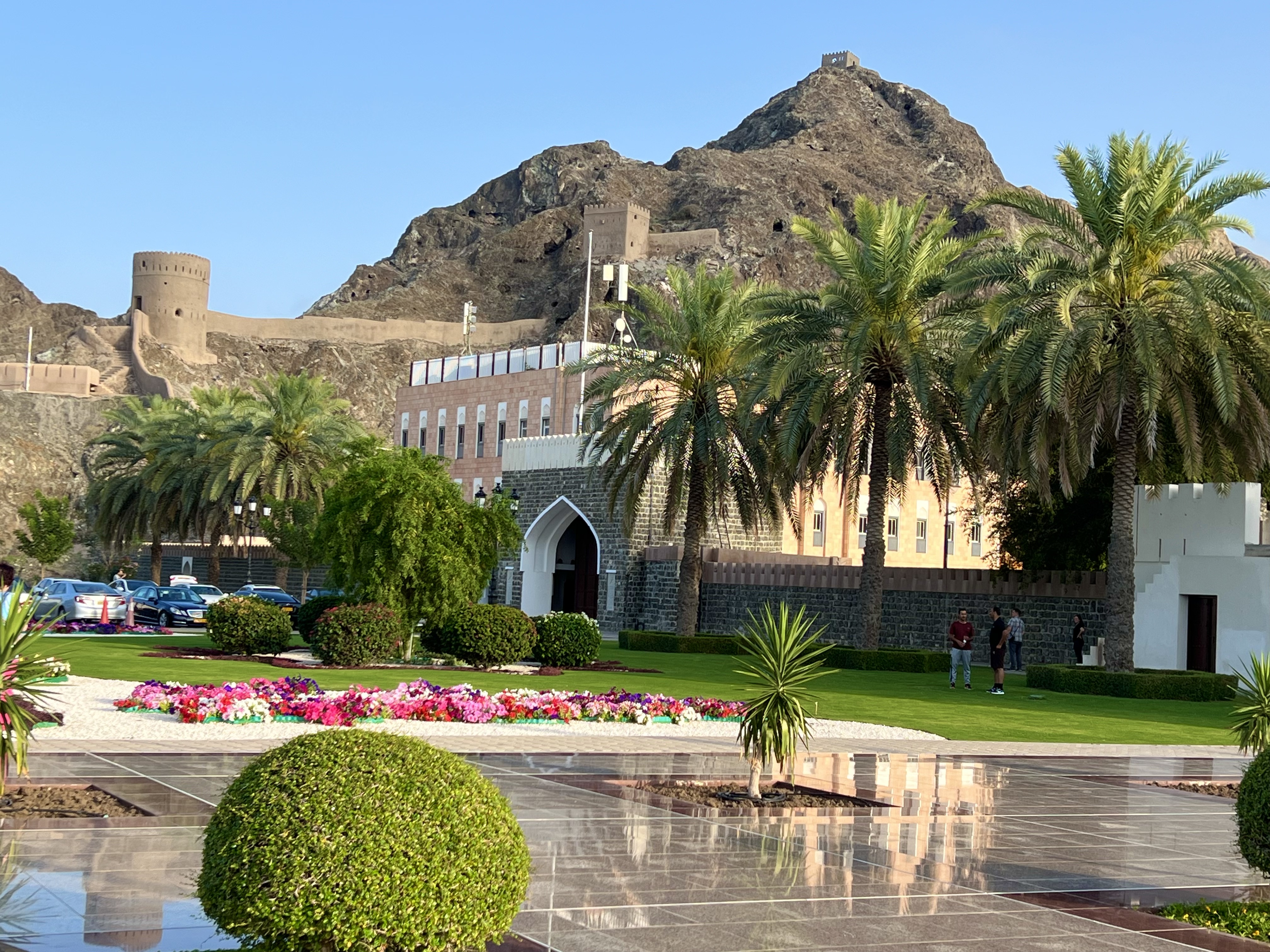
The building is at the end of a long pedestrian passage to the Royal Palace complex. The Royal Palace sticks out as it has turquoise blue and gold pillars, unlike any else in the area. The hills around the complex still have some of the Portuguese forts from the 1580s, which is both a reminder of the need to be watchful of invaders as well as a testament to the spirit of Omani independence.

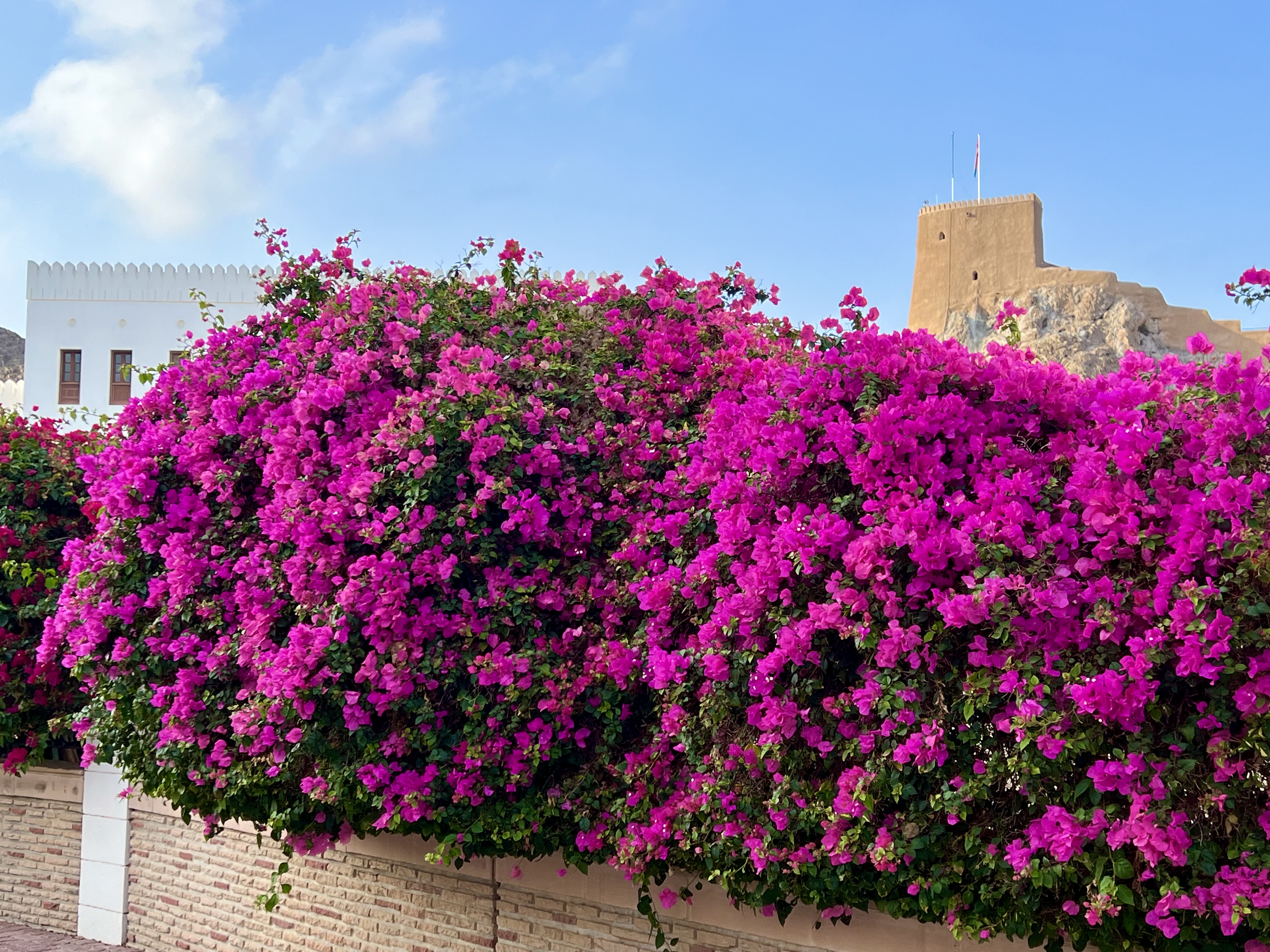
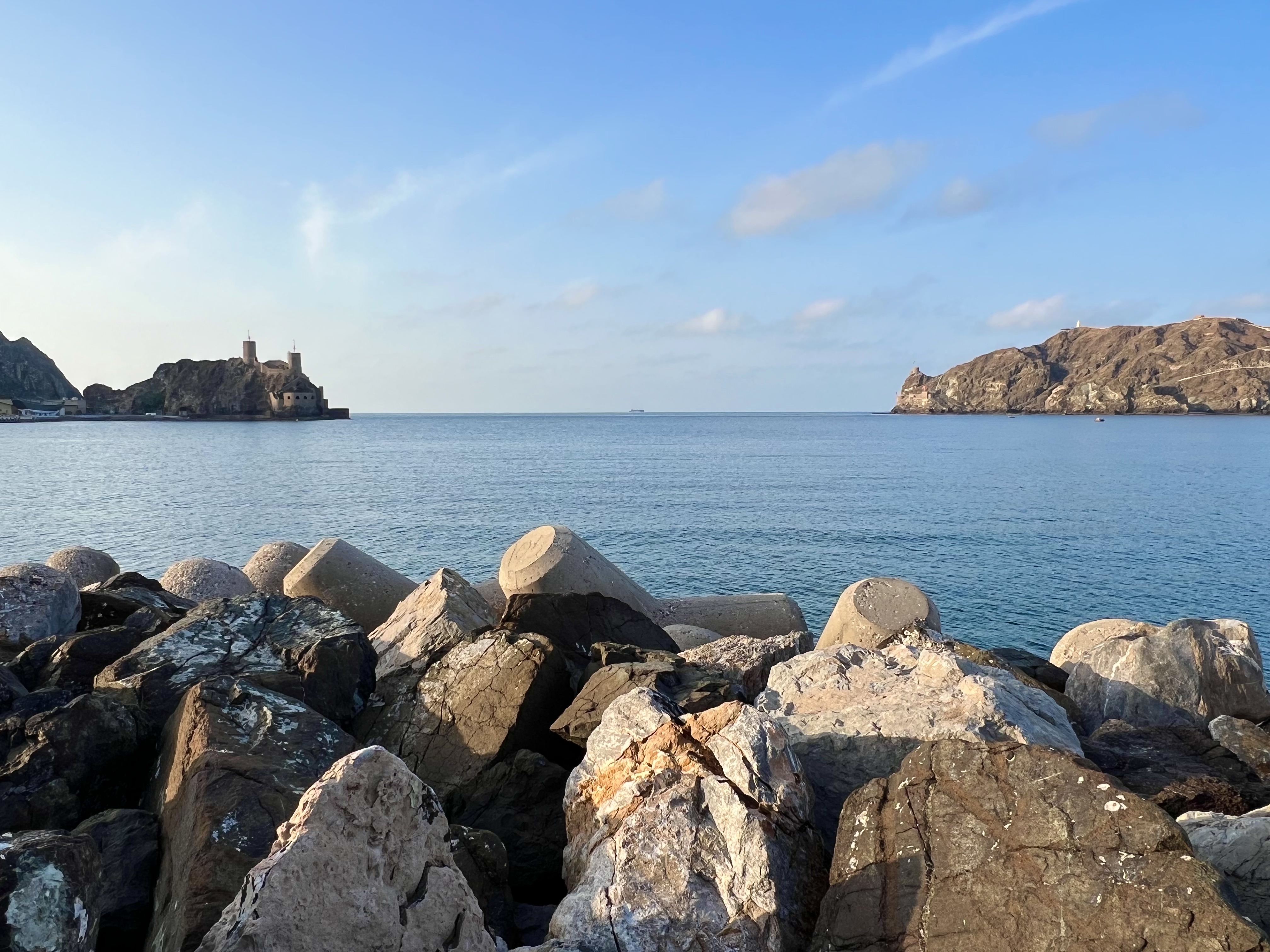
The back of the Royal Palace, from the viewer’s perspective, faces one of the many natural harbors along the coast. The Portuguese fort, Al Jalali, is on the right next to the Royal Palace complex and Al Mirami is on left side across from the harbor. Mutrah Fort is opposite the Cornish near the Muscat Port region. There are also a number of other forts dotting the hillsides, but these three are the most prominent. The forts have been restored in the same tan clay color they were originally in, so they look new while keeping the older style. Muscat also has a number of parks with fountains, lush green grasses and lots of blooming flowers – at least in March. What they would look like in August in 45+ heat, I won’t begin to guess.

Royal Palace, Old Muscat
View in Old Town Muscat
Fort and Mosque Old Town Muscat
View near Royal Palace, Old Muscat
View harbor entrance from near Royal Palace

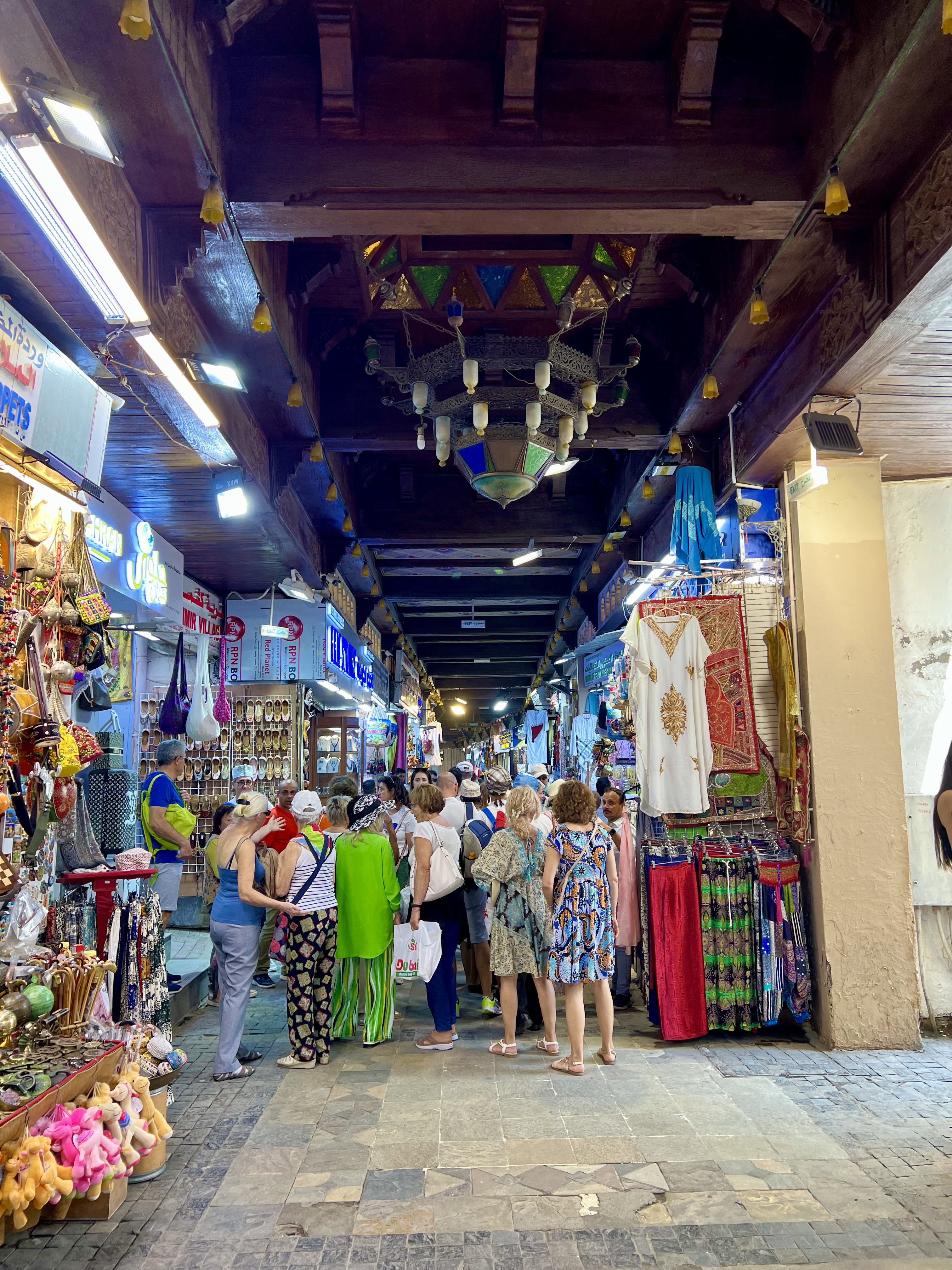
The Corniche is much nicer than the one in Beirut. It follows the harbor from near Old Muscat to the fish market by the cruise ship docking area. There are small parks along the way for picnicking and the locals make good use of them on Fridays, Saturdays and in the evening. The main Muscat Souq is at the top of the harbor and is a haven for tourists from the cruise ships. The Souq is actually a couple of separate bazaars; there is the main one with every imaginable trinket, perfume, spices and general souvenirs, and then there is one just called the Gold Souq next to the main one.  The two local products that are most in demand are palm dates and frankincense, both of which have been major Omani trading commodities for centuries. To highlight the importance of the incense, there is a large white incense-burner sculpture on the hill above one of the parks along the Corniche.

Crusie ship tourists at Muscat Souq

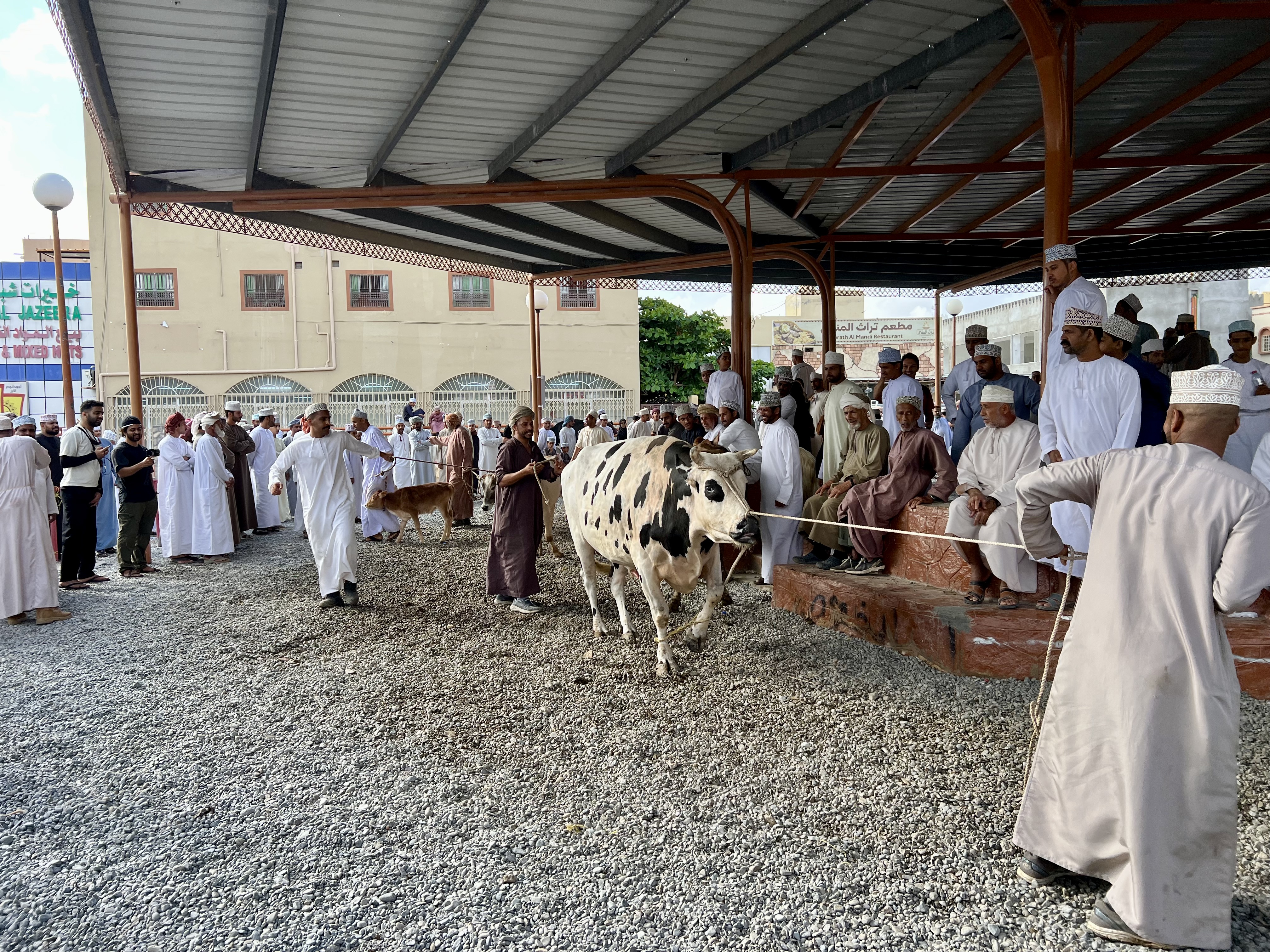
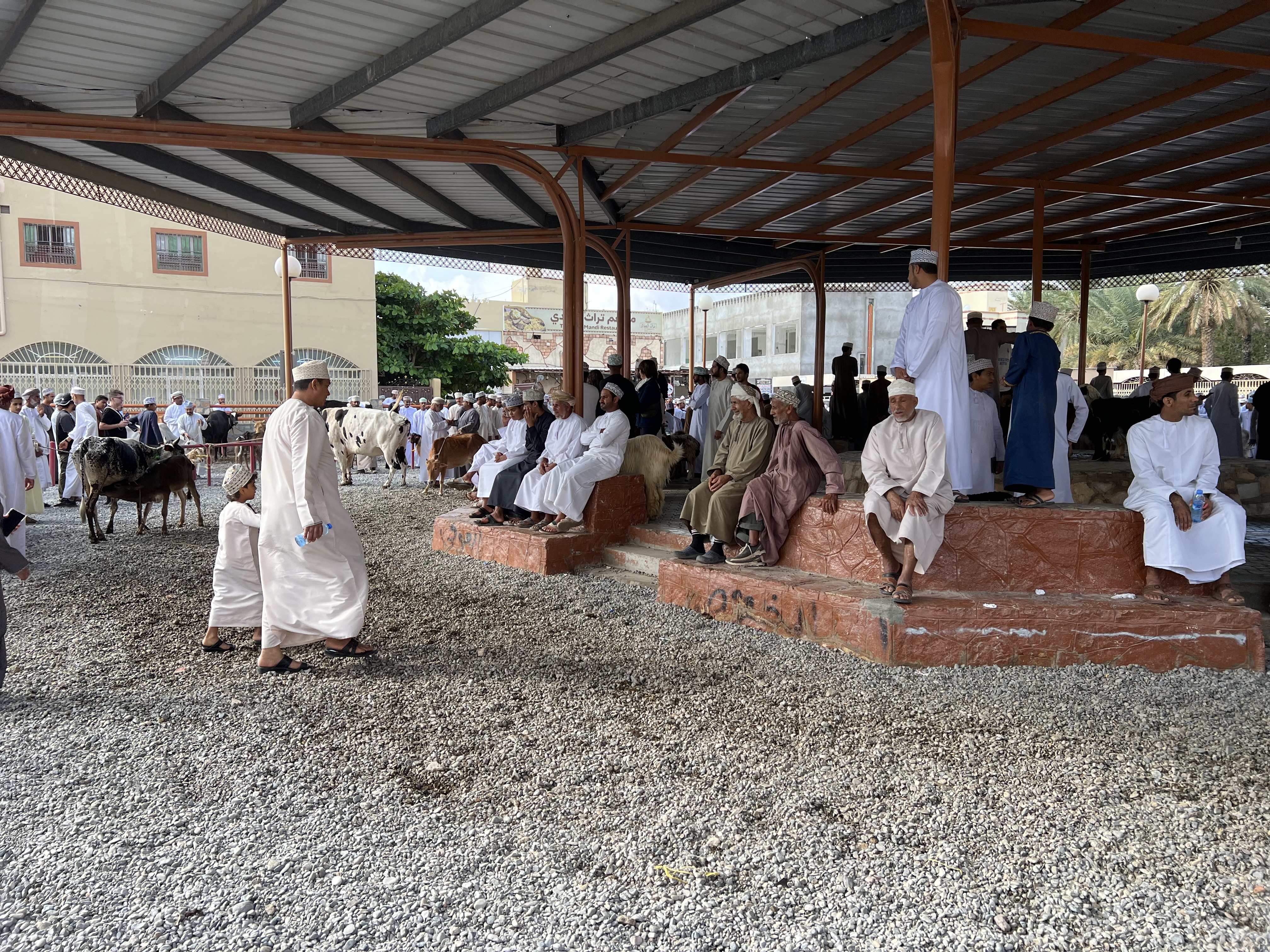
On Friday, I took a tour to Nizwa Fort and Al Hamra, two of the oldest cities in Oman. Nizwa was the old capital in the 6th and 7th centuries and Al Hamra, while newer – it is only about 400 years old, is a living museum. On Friday mornings, there is an animal market near the Nizwa Souq. Goats and cattle of various species were dragged around a circle from where potential buyers could see them. The prices are supposed to be fixed, but if the animal isn’t purchased immediately, it goes into a holding coral and the bargaining can begin. None of the animals I saw were in the least bit happy to be there, and most were avidly balking at their leaders.

This cow doesn’t want to go
Taking his son to Friday Animal Market
Friday Animal Market Nizwa

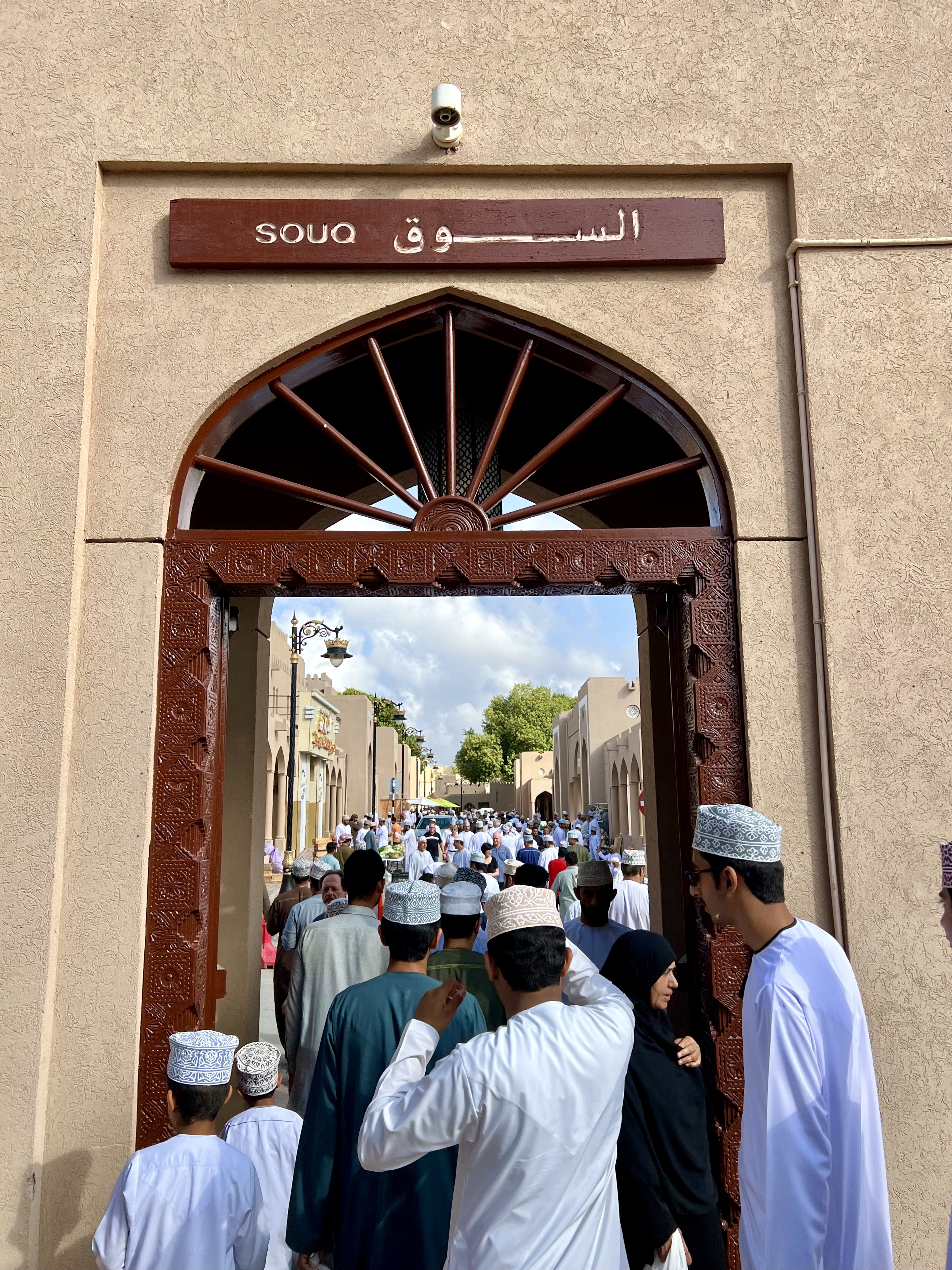
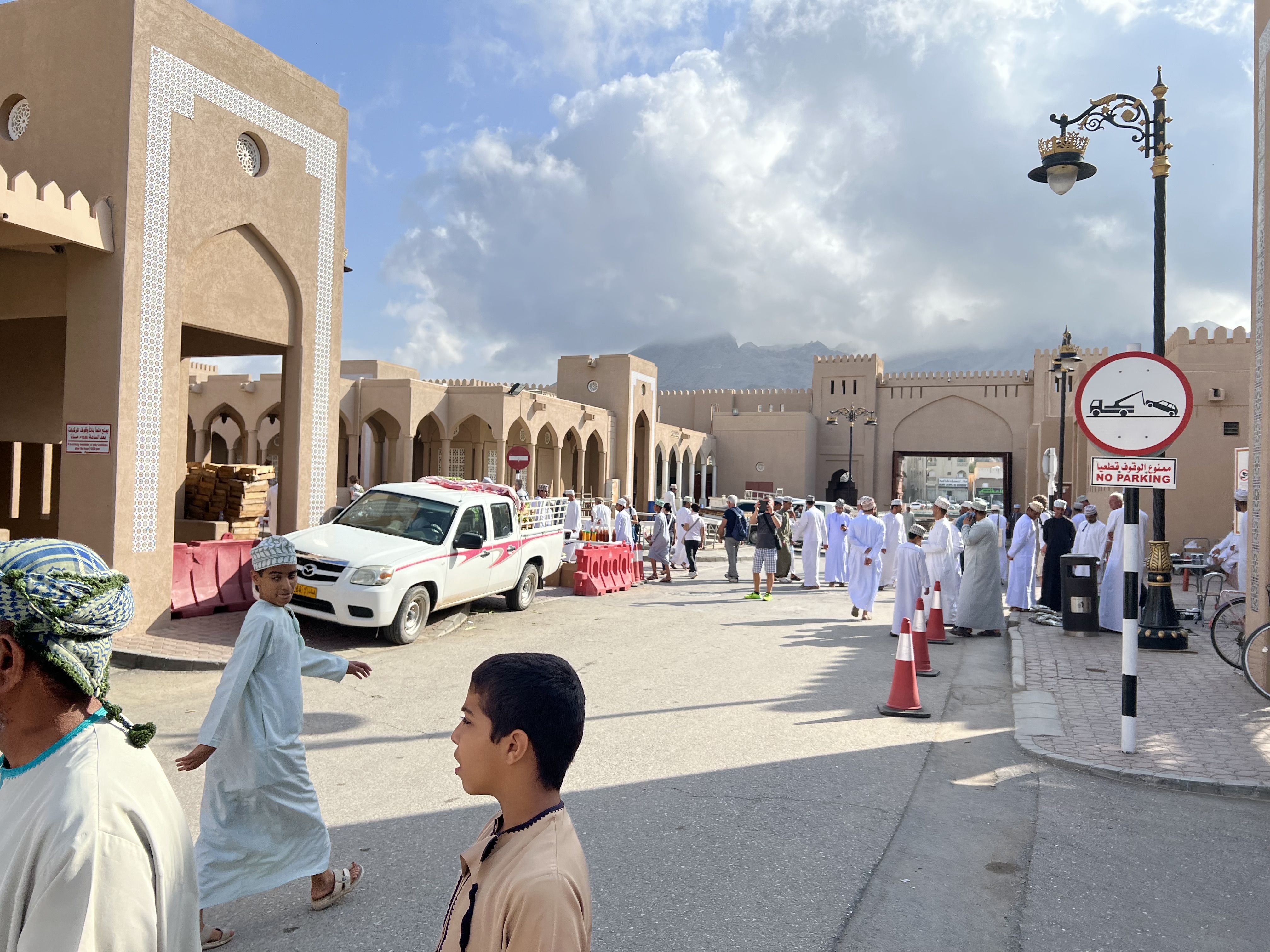
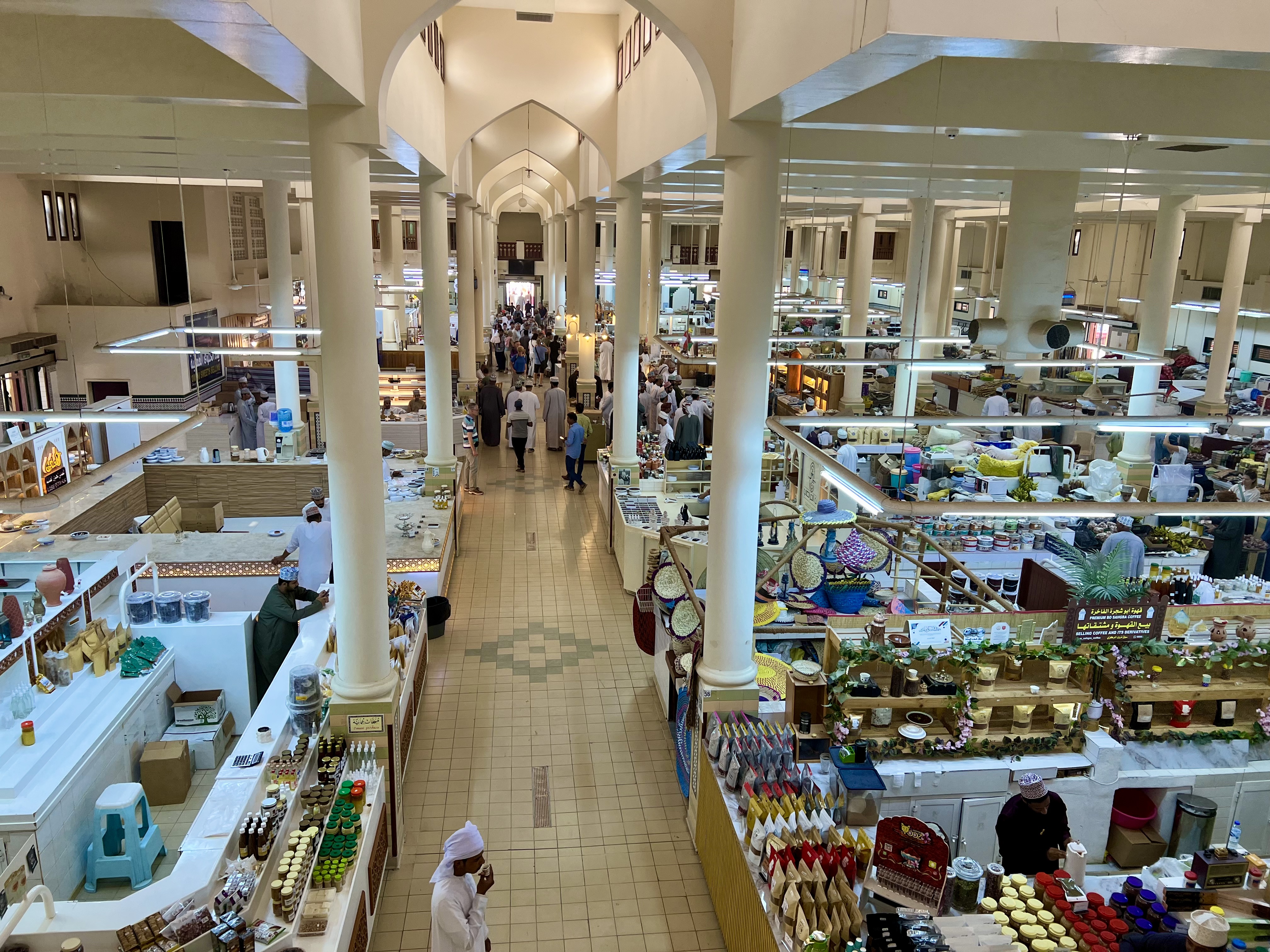
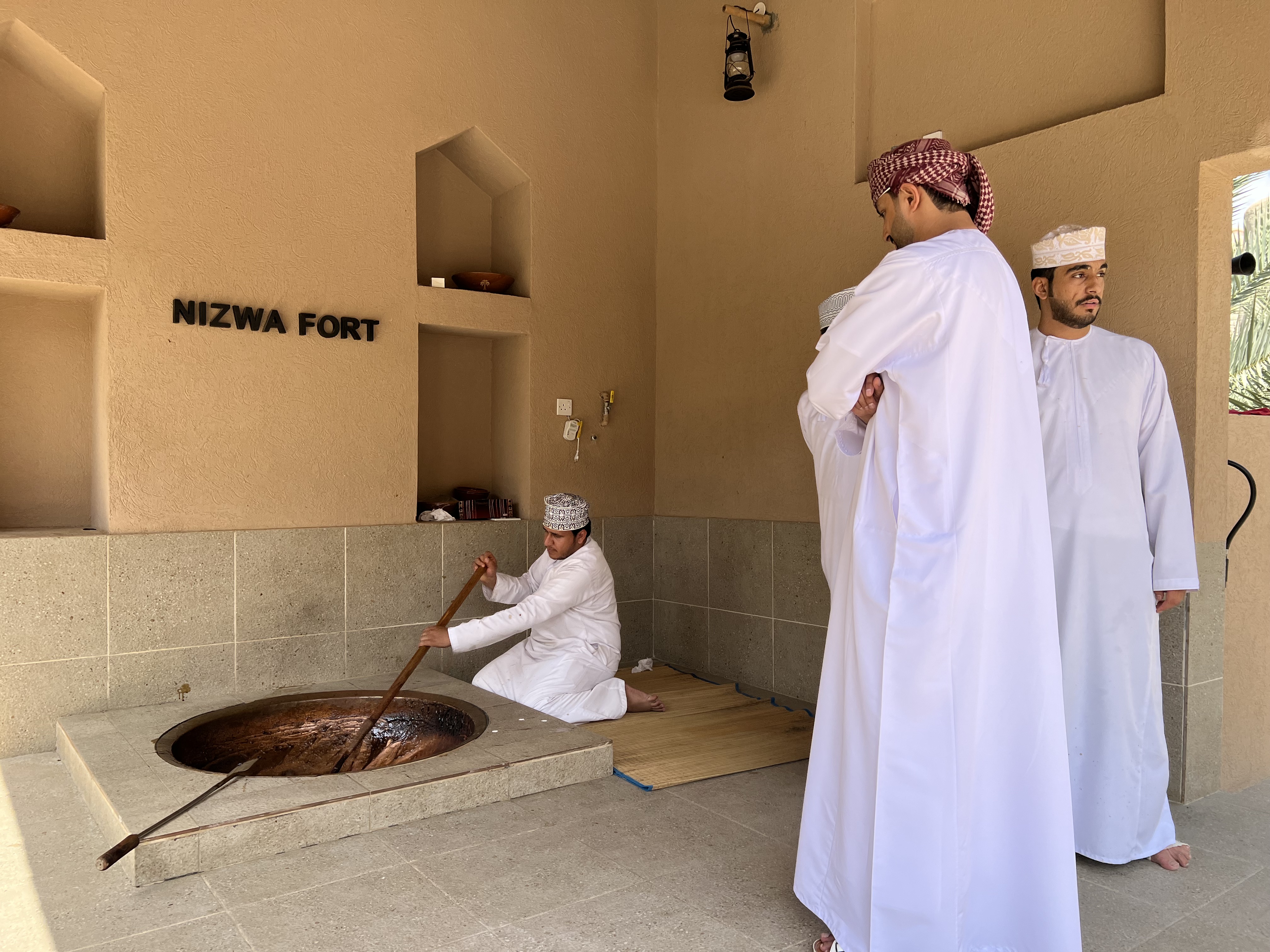
The Nizwa Souq was very different from the one in Muscat. It still had lots of items for tourists, but there were also stalls geared toward the local population with mostly clay vases and incense burners along with other items for daily cooking use. Inside the main hall there were a number of vendors selling Omani sweets, which are almost pure sugar.

Entering Nizwa Friday Market Souq
Friday market, Nizwa
View of the Souq hall, Nizwa

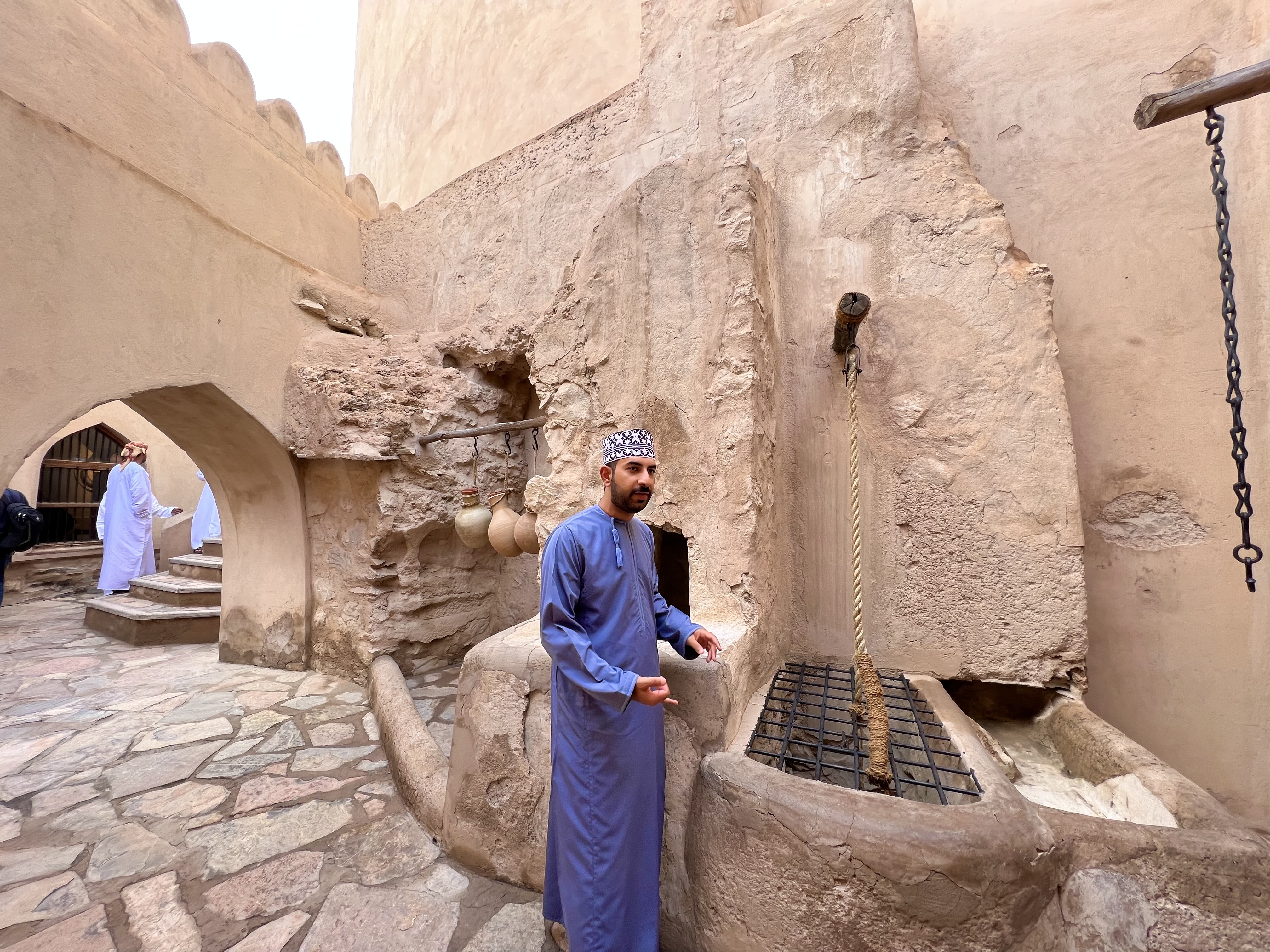
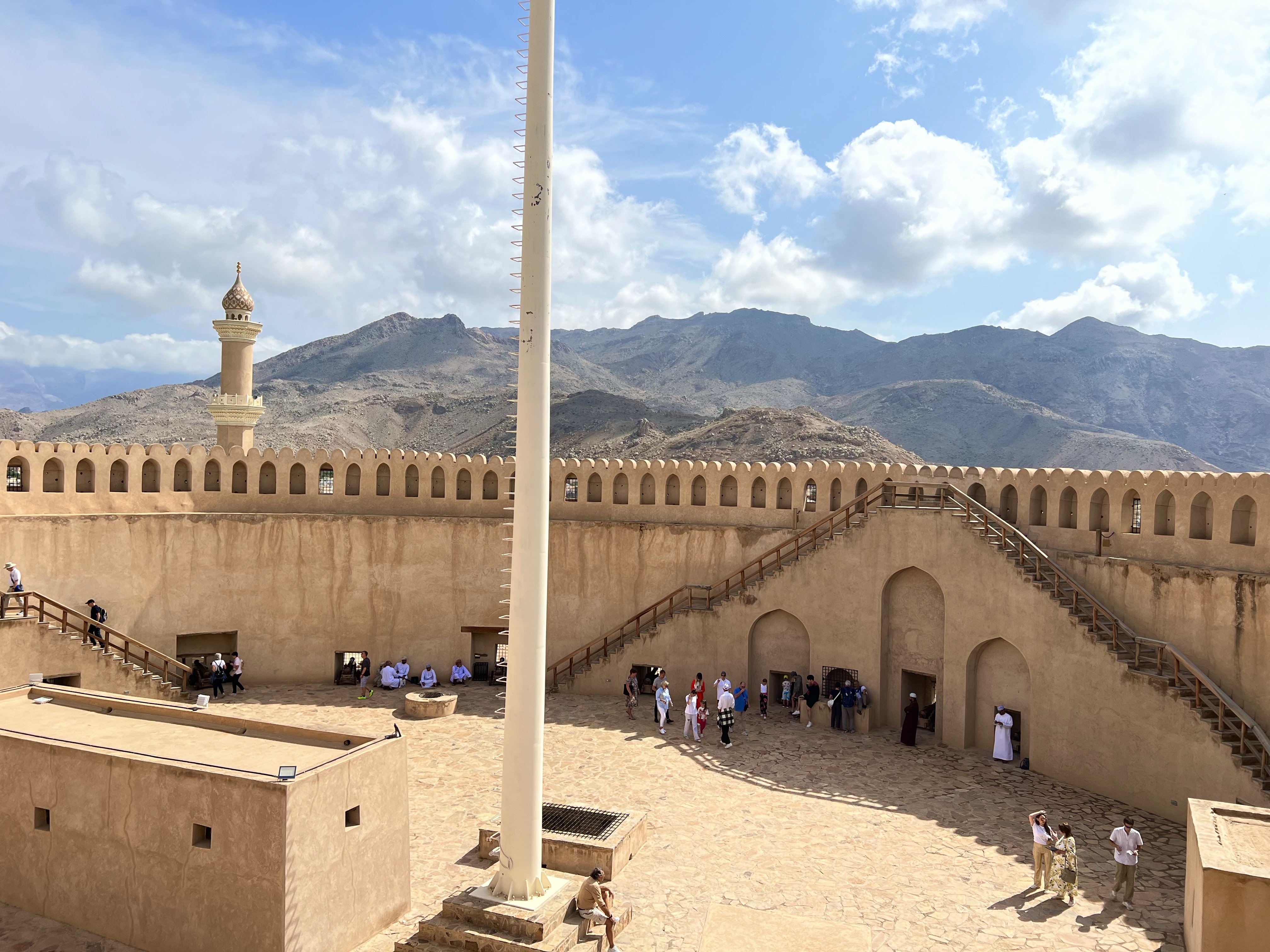
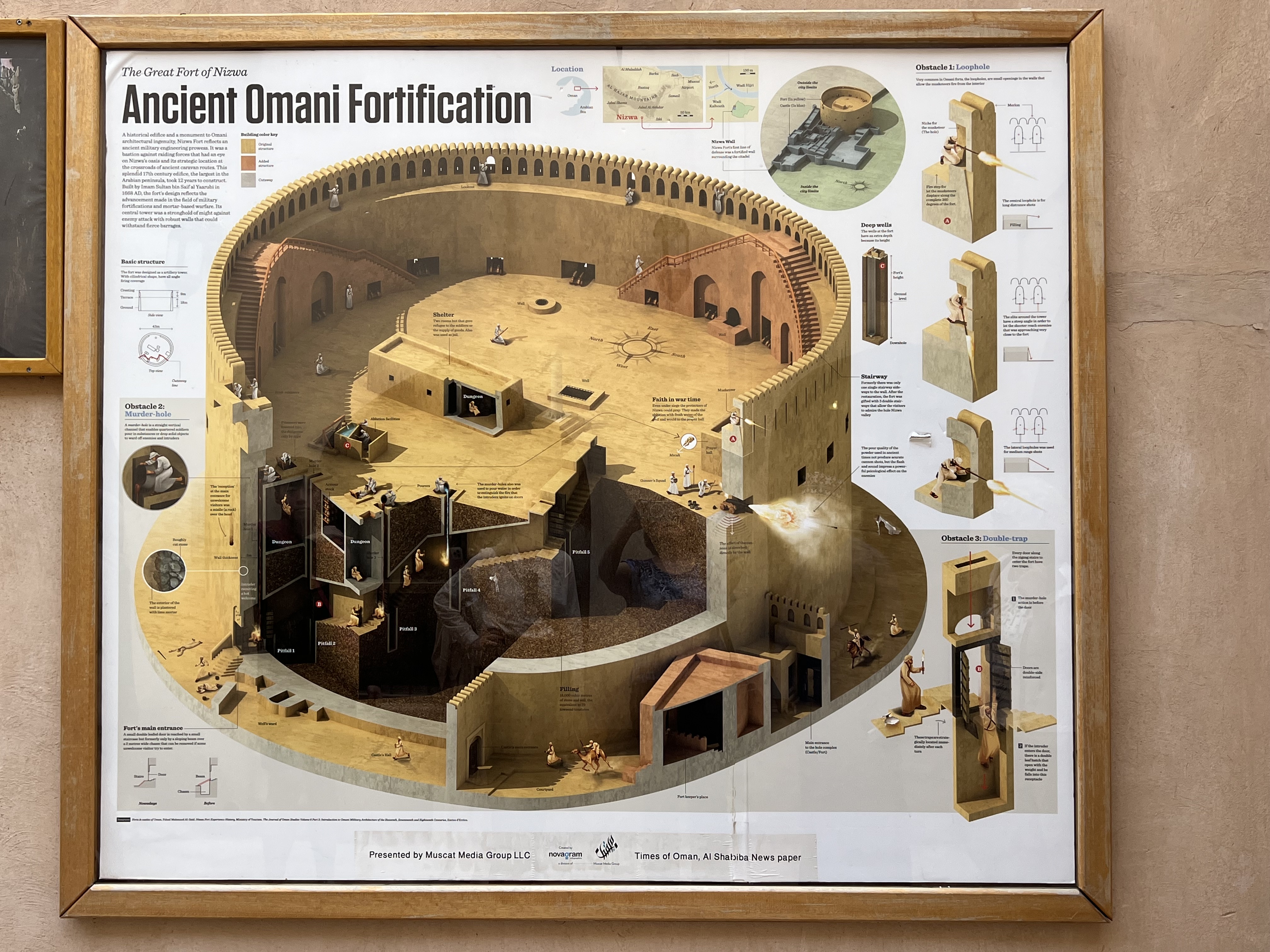
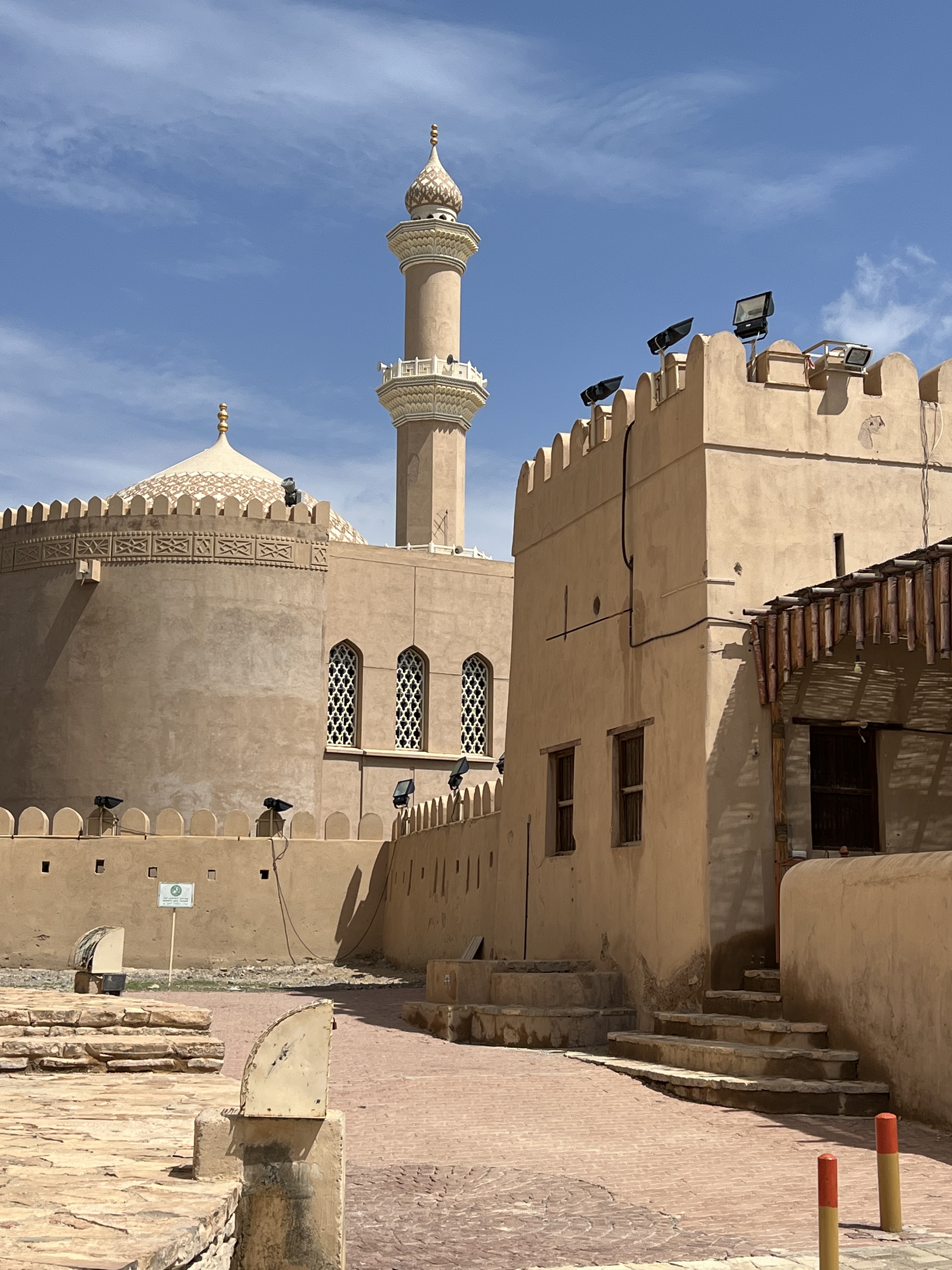
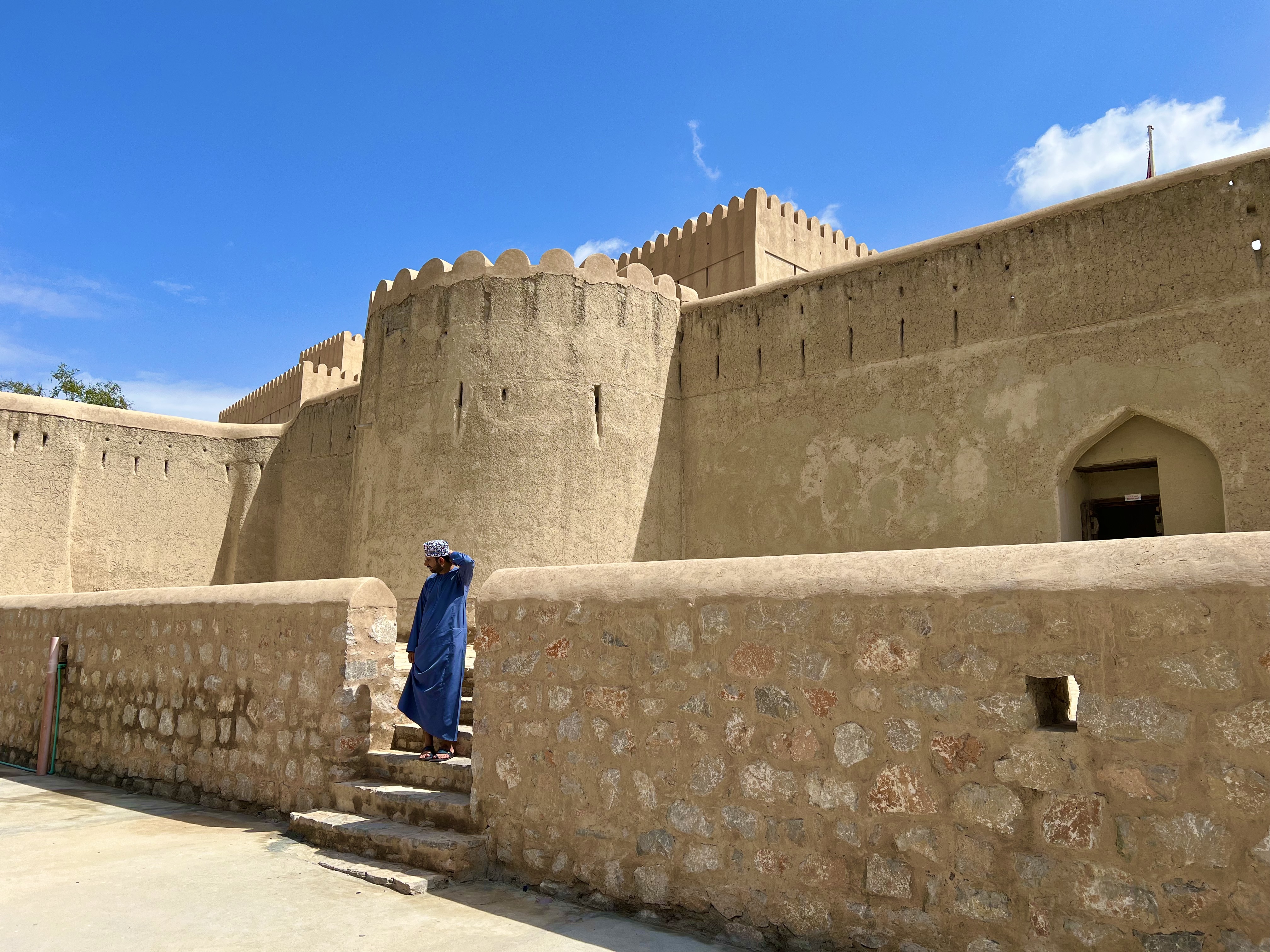
From the Souq, the nine of us on the tour (including people from Russia, NYC, Paris, Cologne, So. Korea, and England), walked over to the Fort, following Abdullah our excellent guide/driver for the day. Nizwa Fort is on the UNESCO World Heritage List. It was built in 1648 and took about 20 years to complete. It is surrounded by an older wall from about the 9th C. There is also a small archeological site, Harat Al-Aqer, next door that is reputed to be around 1400 years old. From the ramparts the views extend as far as the eye can see.  The Fort and town are surrounded by palm date trees, providing a sea of green amid the cream and brown colored hills.

Abdullah explaining the well at the Fort
View from ramparts at Nizwa Fort
View within Nizwa Fort
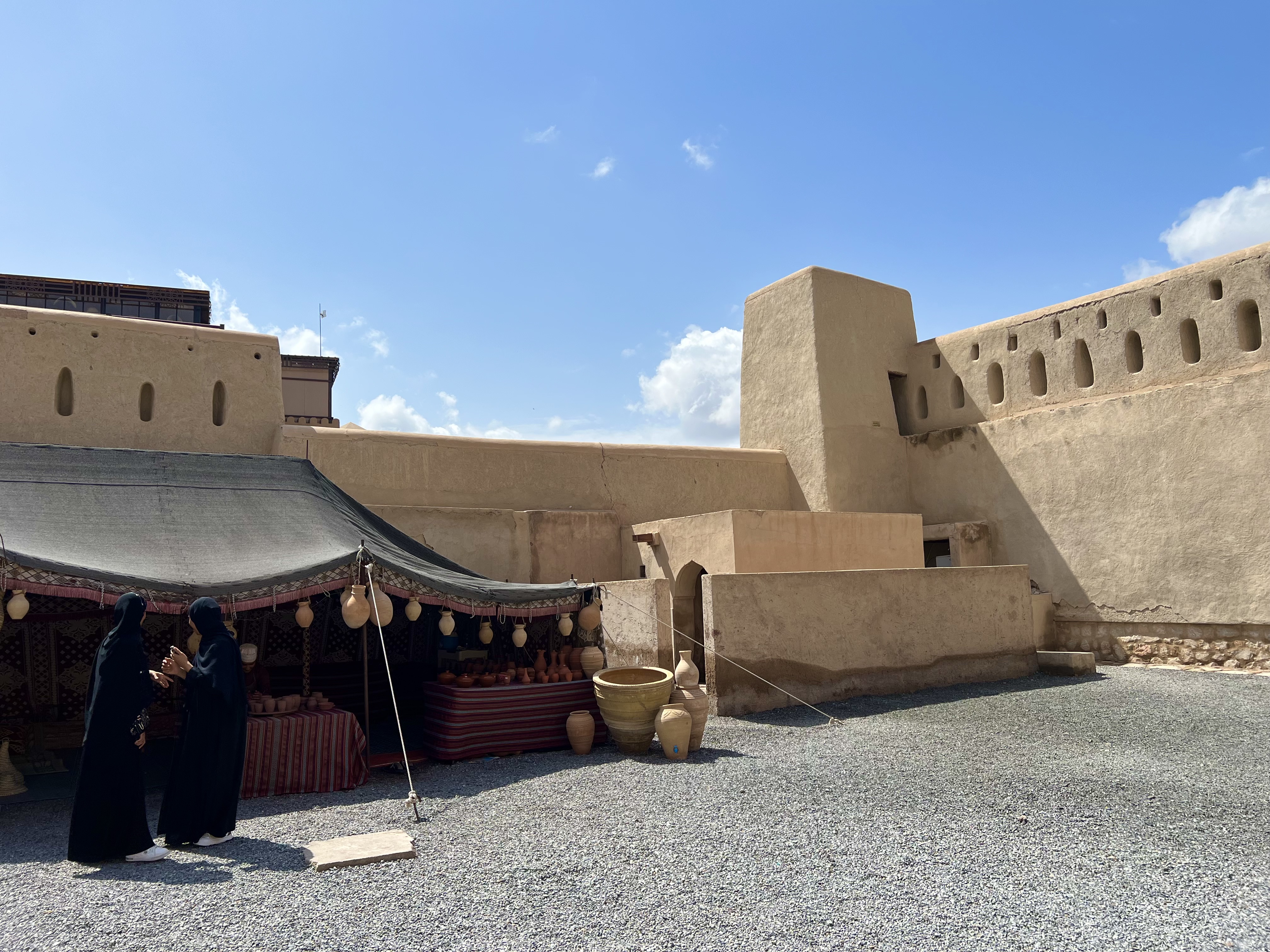
Women discussing products at Nizwa Fort
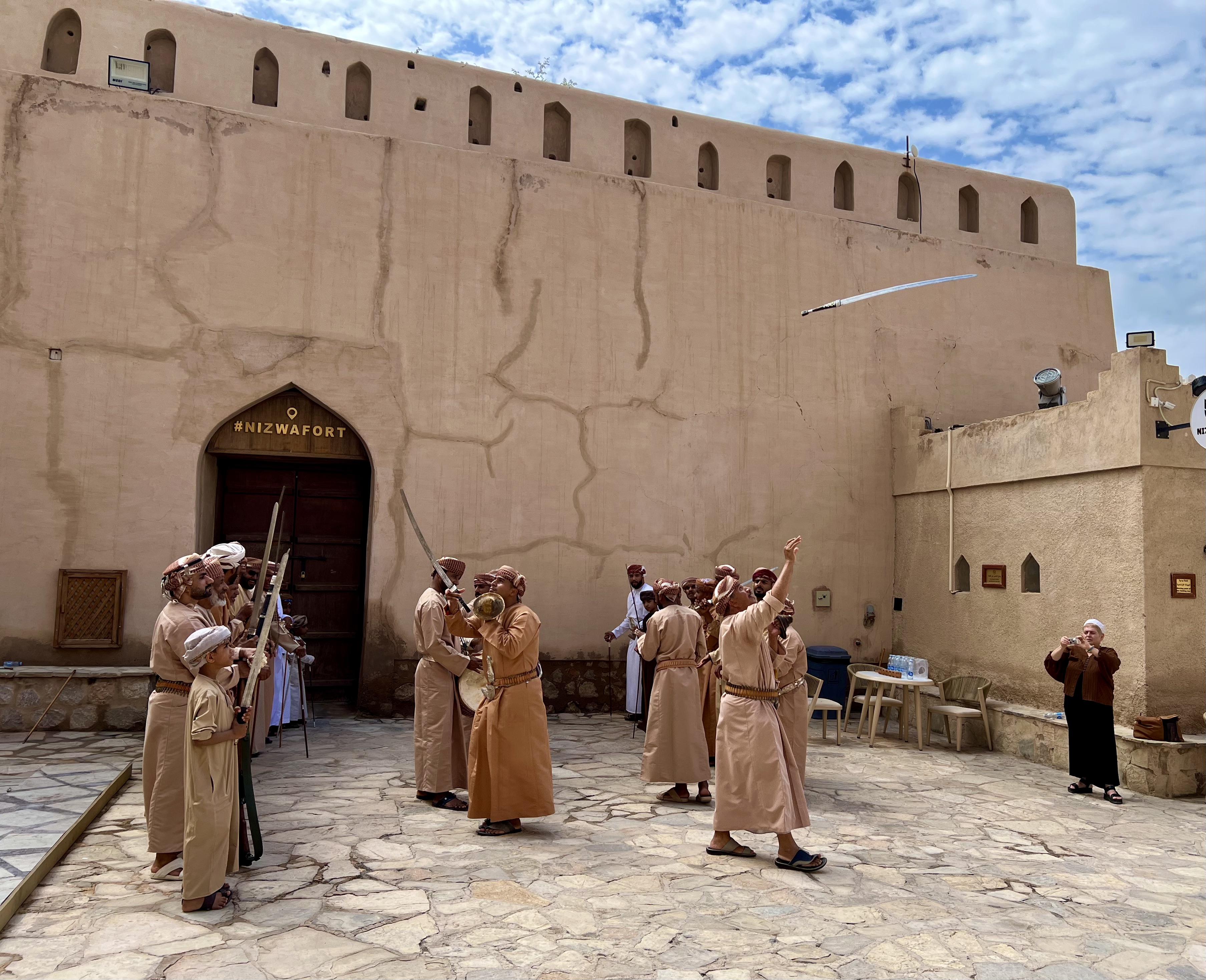
Traditional Sword Dance at Nizwa Fort
Men making Omani sweets at Nizwa Fort

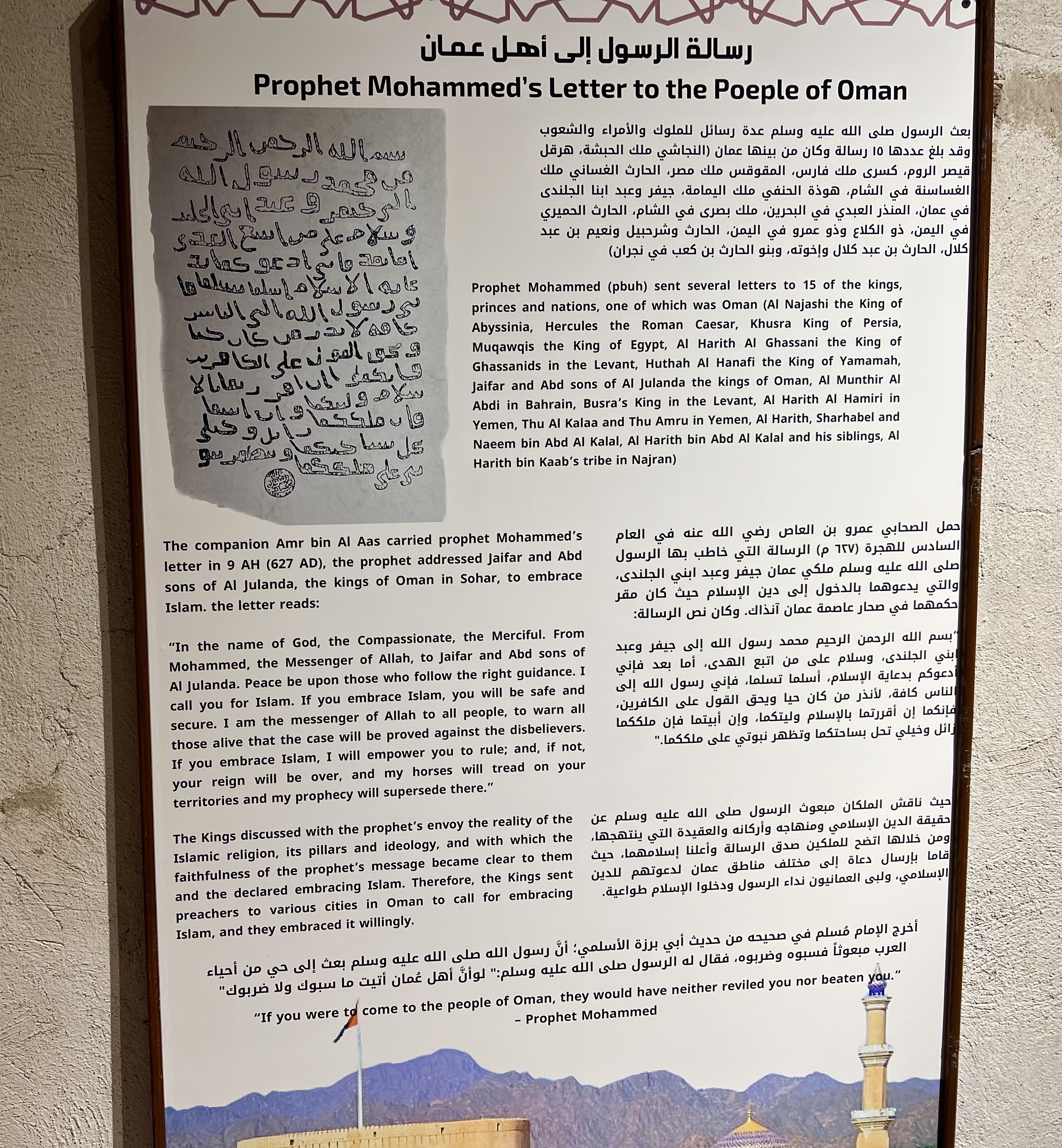
There is a small museum in the Fort which has a timeline of events and a poster of the “Letter the Prophet Mohammed wrote to the Omani People.” Omanis have a form of Islam that is unique to them; it is neither Sunni nor Shia, but Ibadi. It seems that the original Omani Imam/Sultan didn’t want to get caught in the hereditary controversy after the Prophet’s passing and formed his own version based on the teachings in the Koran. To this day, Oman tries to stay out of the conflicts of neighboring countries. At the museum, I asked Abdullah about the lack of pre-Islamic figurines. They weren’t visible in the National Museum, nor here. He said that he knows there were idols in pre-Islamic times, but that in order to covert the people all the idols were destroyed. It would be near impossible to conduct research on ancient worship practices here.

Letter posted in Nizwa Fort

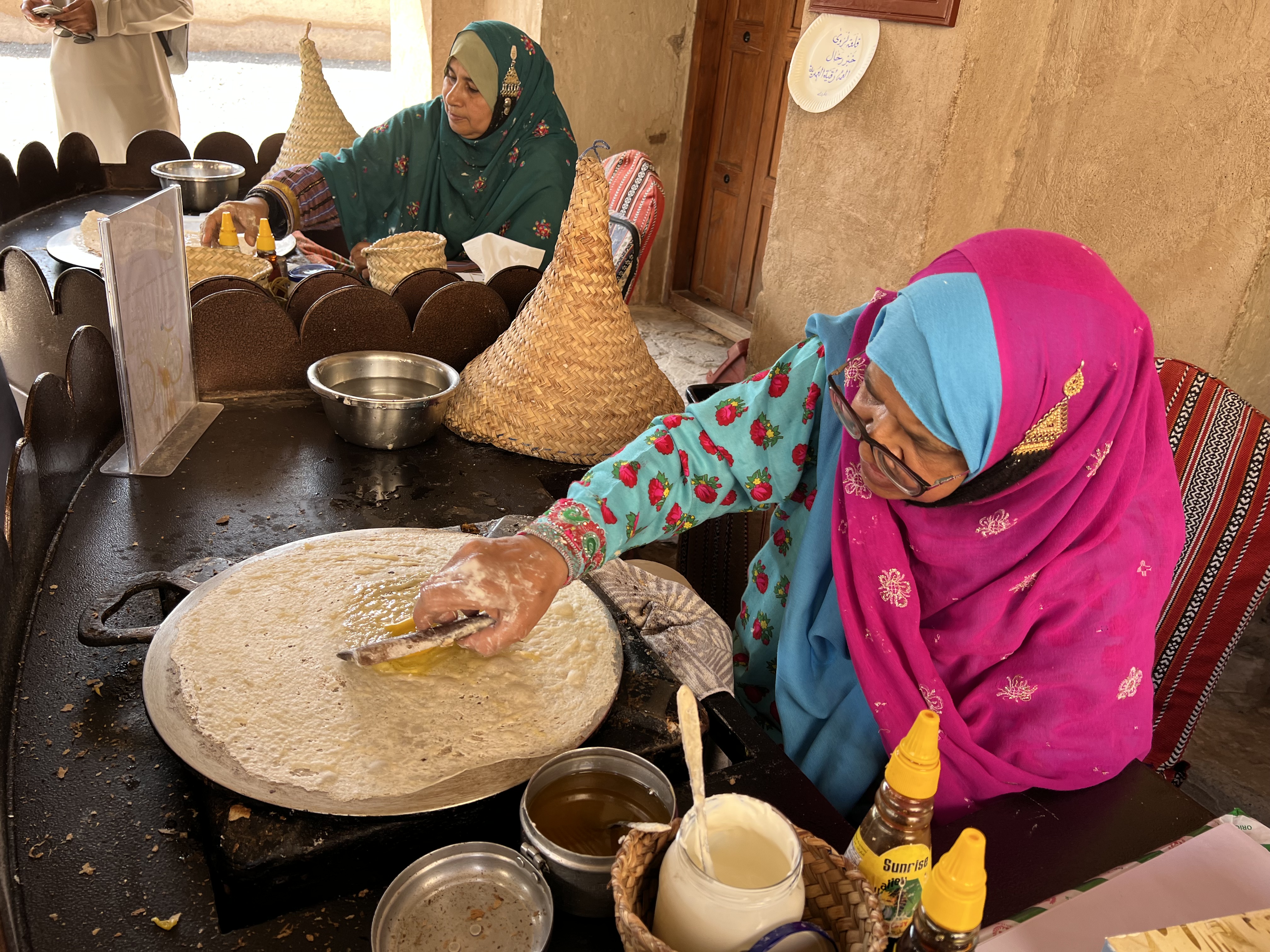
After leaving the museum we headed back to the main square, where there was a traditional sword dance being performed and two women making Omani bread.  The sword dance rhythm sounded like O Hani Hani Oh and was about a young man looking at a young woman commenting on her appearance. Omani bread is made from flour, water, and salt and is fried like a very thin crepe, then filled with either cheese and honey or cheese and egg.  I tried the cheese and egg, and it was delicious. Omni food is quite good. The traditional meal is rice and chicken or rice and fish. For breakfast I was served roti with fried eggs, tomatoes, and sliced cucumbers. Traditionally, when guests arrive, they are served coffee and dates. In Al Hamra’s house museum, Bait-Al Safah, I learned that if a guest only eats two dates, not three, then he wants to discuss something. It is an unspoken sign that something is worrying the guest, and the host needs to get him to talk. (I’m assuming this is true for women as well, but that wasn’t specifically stated.)

Women making omani bread at Nizwa Fort
Entrance to fort from the old town
Archeological site at Nizwa Fort

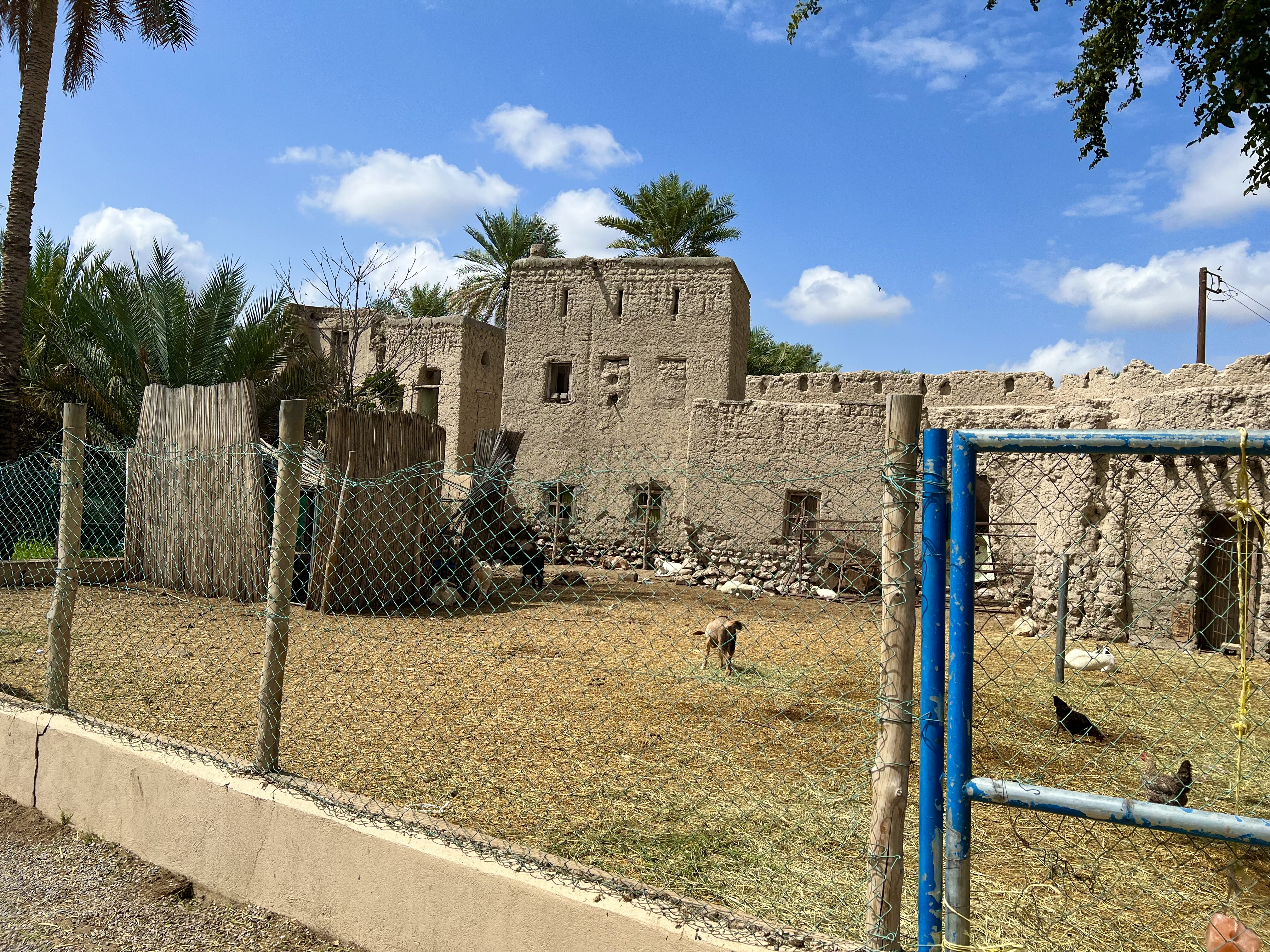
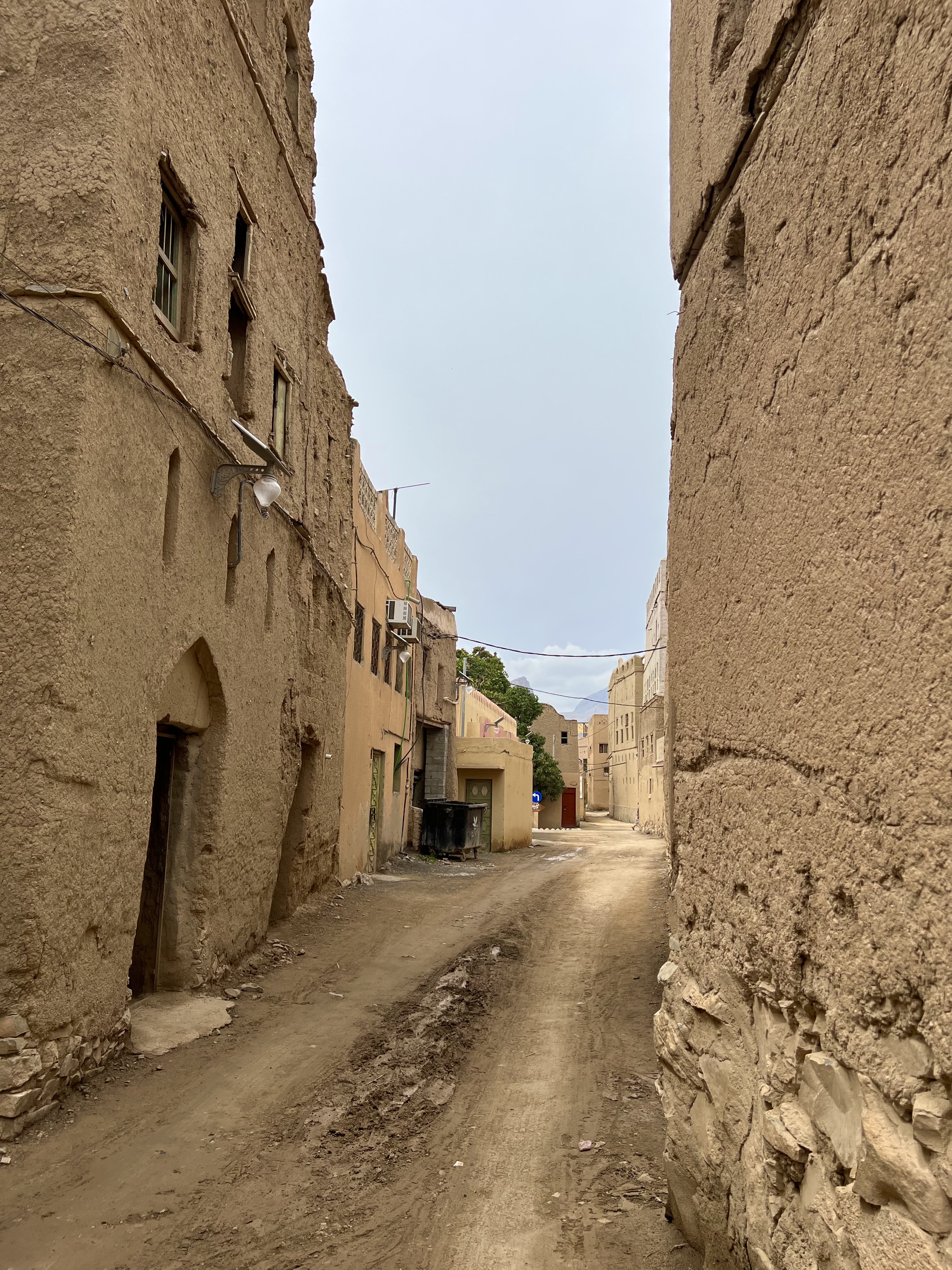
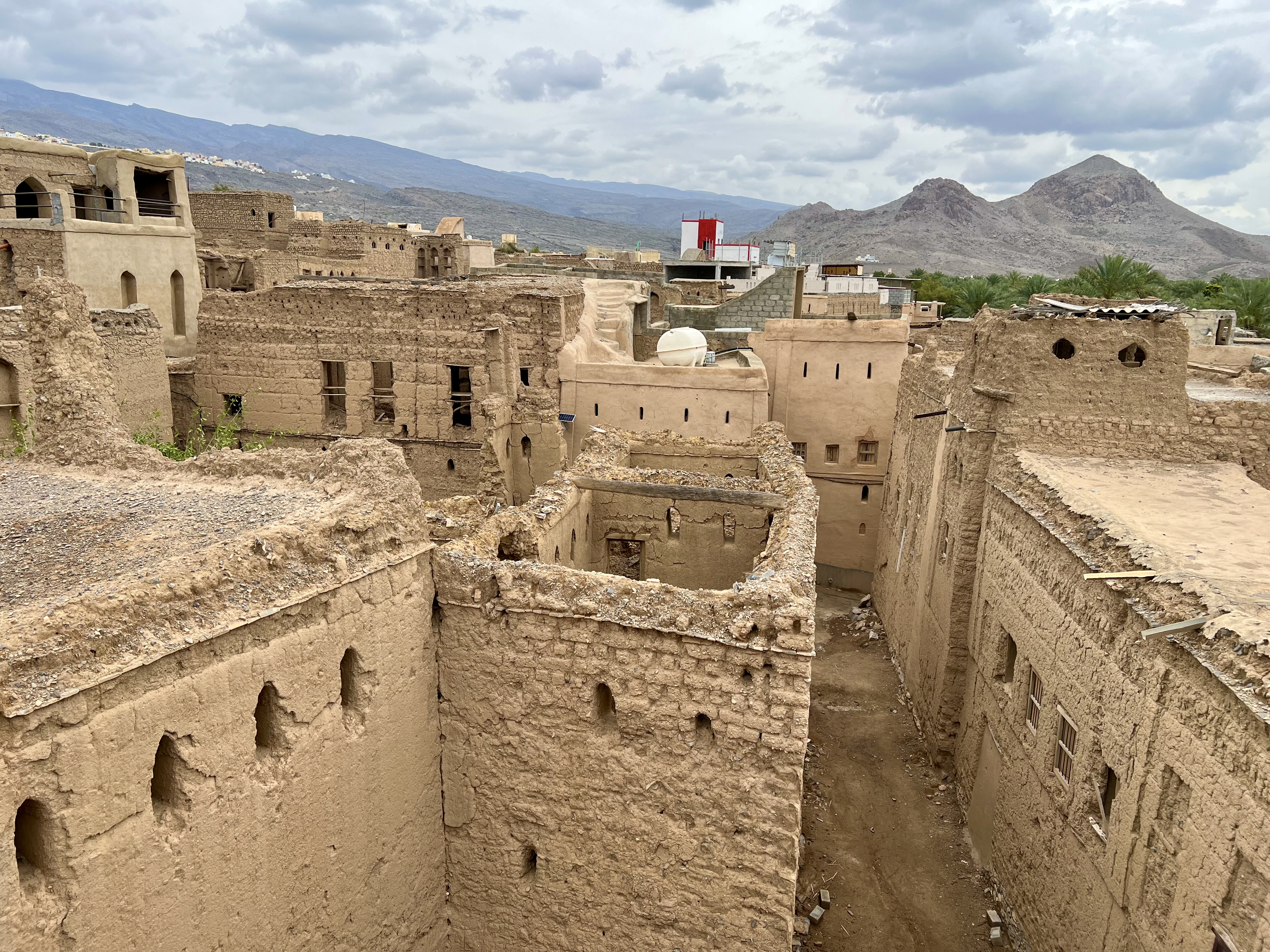
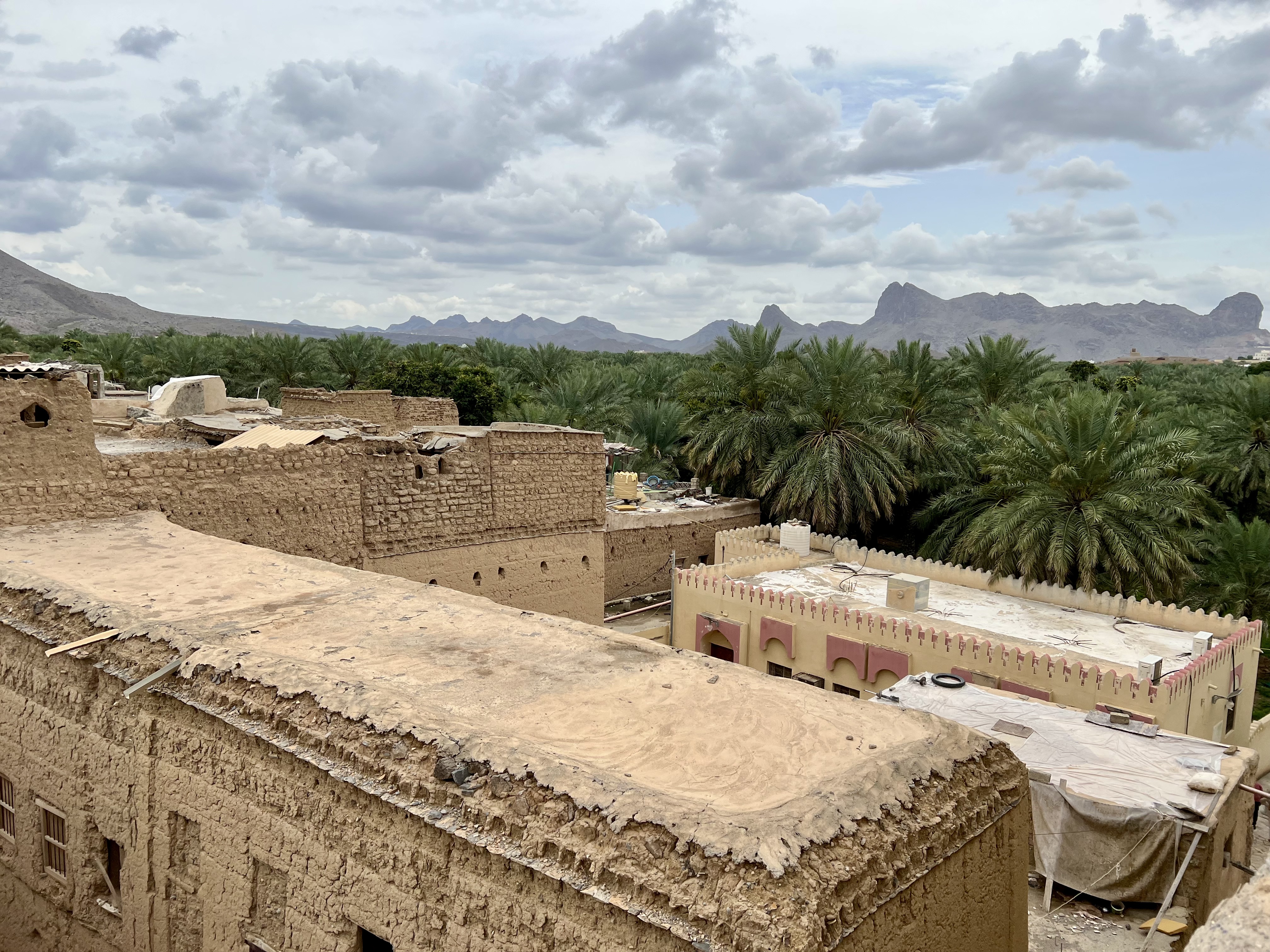
Al Hamra is approximately 40 minutes’ drive from Nizwa further into the interior. It is a small old village where most of the houses are falling apart. The costs to renovate are extensive, electricity is difficult to access, and there are no places to park a car, so people build outside of the old town. It was interesting, however, to see the old construction and go through the house museum. All in all, I can recommend this day trip from Muscat as it gives insights into Omani history.

View of Al Hamra street
Al Hamra

On Saturday, I was planning on going on a dolphin watching excursion, but rain was forecast, and they cancelled the trip.  There are a number of day excursions from Muscat, but because of the pending rains the ones to the Wadis were also cancelled.  It turned out to be a good day to just walk around. Muscat is fascinating, safe, and the people I met here very friendly. Just remember to bargain with the taxicab drivers!