Osa Peninsula Notes
In 1998, I took my daughter to Costa Rica for what proved to be our first of many trips to the rainforests of Central and South America. At that time, I rented a car and we drove throughout the country. We spent time in the Cahuita National Park on the Caribbean side, where we visited a wildlife refuge center. At the Center the resident sloth, Emily, let people hold her. Both Alexis and I fell in love with these creatures at that moment, and I have tried to locate them whenever I am near their habitats. In Manuel Antonio, the white-faced capuchin monkeys greeted us for breakfast and a three-toed sloth hung out on a tree near our room. We got caught in the rain getting to the Arenal volcano, and in Monteverdi I woke up in the middle of the night to see a column of black army ants climbing over the white bedsheet covering my daughter, making their way from the floor to the ceiling. I wanted to scream but figured that by doing so I would irritate them and so just waited, watched, and prayed that Alexis didn’t wake up. They finally departed, and the next morning so did we. Sleeping in the Costa Rican rainforest was my first experience of the extremely loud noise of the insects and frogs at night, which was at first unnerving, and then later became somewhat addicting. One part of the country that we couldn’t get to was the Osa Peninsula with the Corcovado National Park, which was closed to tourists at that time as it was considered too dangerous with venomous snakes and other wildlife. When we were at the airport for the return to the US, I hoped that one day I would be able to come back to this wildlife rich and beautiful country. It took twenty-eight years, but I have now made it. Rather than returning to where I had been, having learned from my Bali experience that overtourism has ruined places I love, I made a beeline for the now open Osa Peninsula.
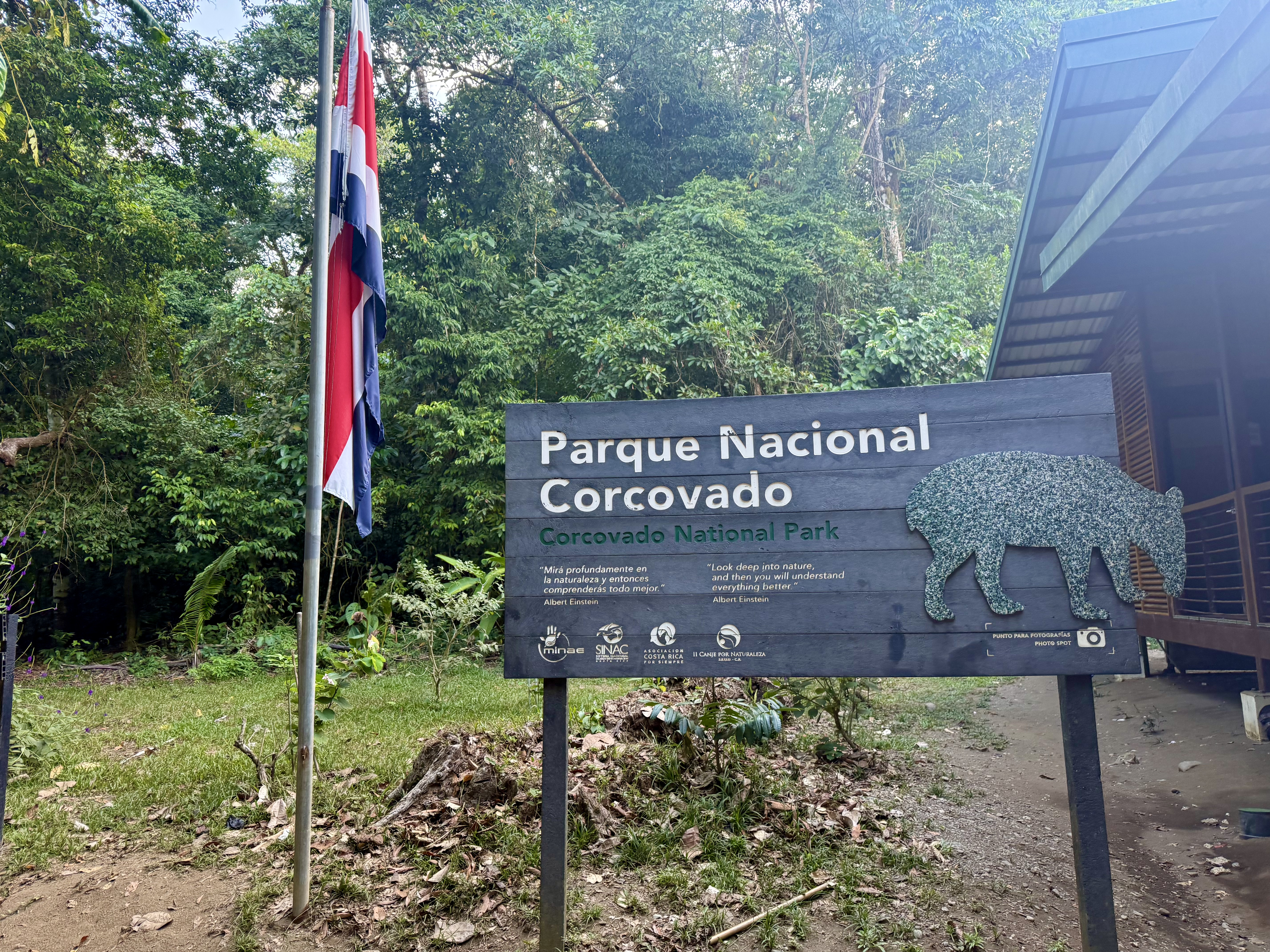
Corcovado National Park on the Osa Peninsula was formed in 1975 by taking land that had been used for agriculture and repurposing it as a nature reserve. Up until 2004 the people who lived on the peninsula didn’t have electricity and the internet only arrived in a few villages in 2010. Prior to that time it was very dangerous to get the Drake Bay side from Sierpe as the mouth of the river formed a channel that was considered one of the most dangerous in the world to cross. The waves came with tremendous force and would capsize the wooden boats the people used. Today, one crosses in powerful speedboats that can ride on top of the waves rather than being pulled under. It is now also possible to drive or to take a plane, which is what I did.
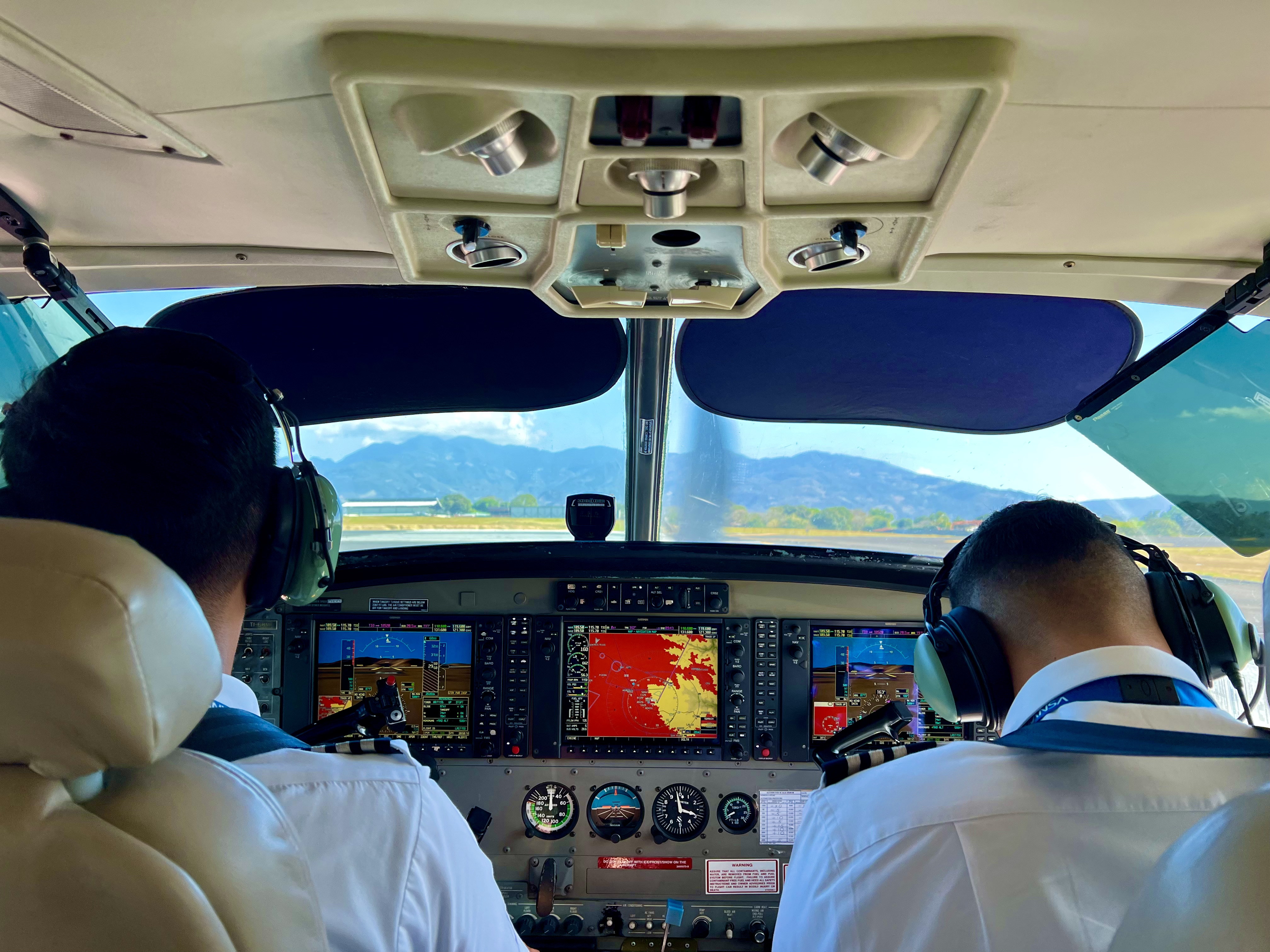
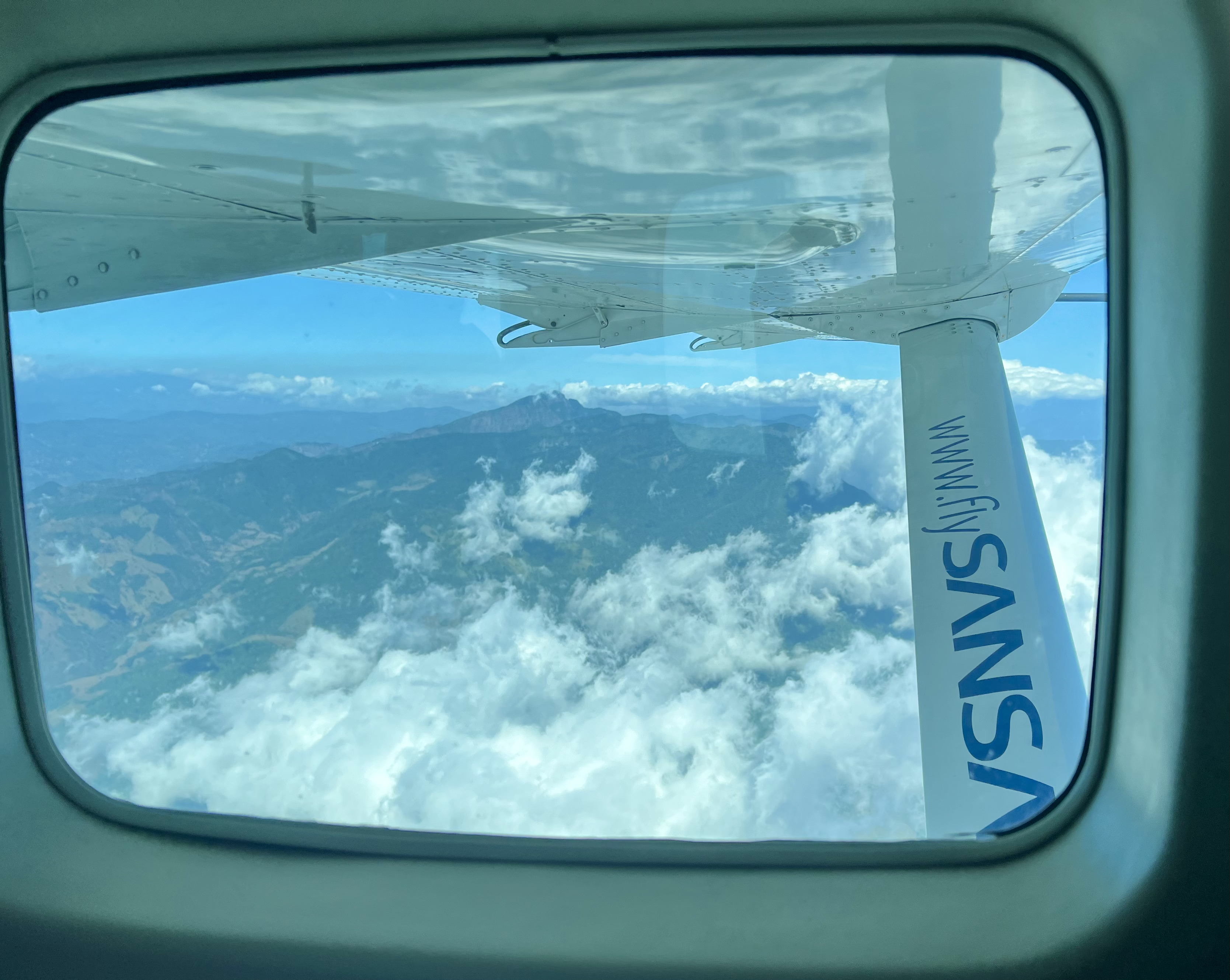
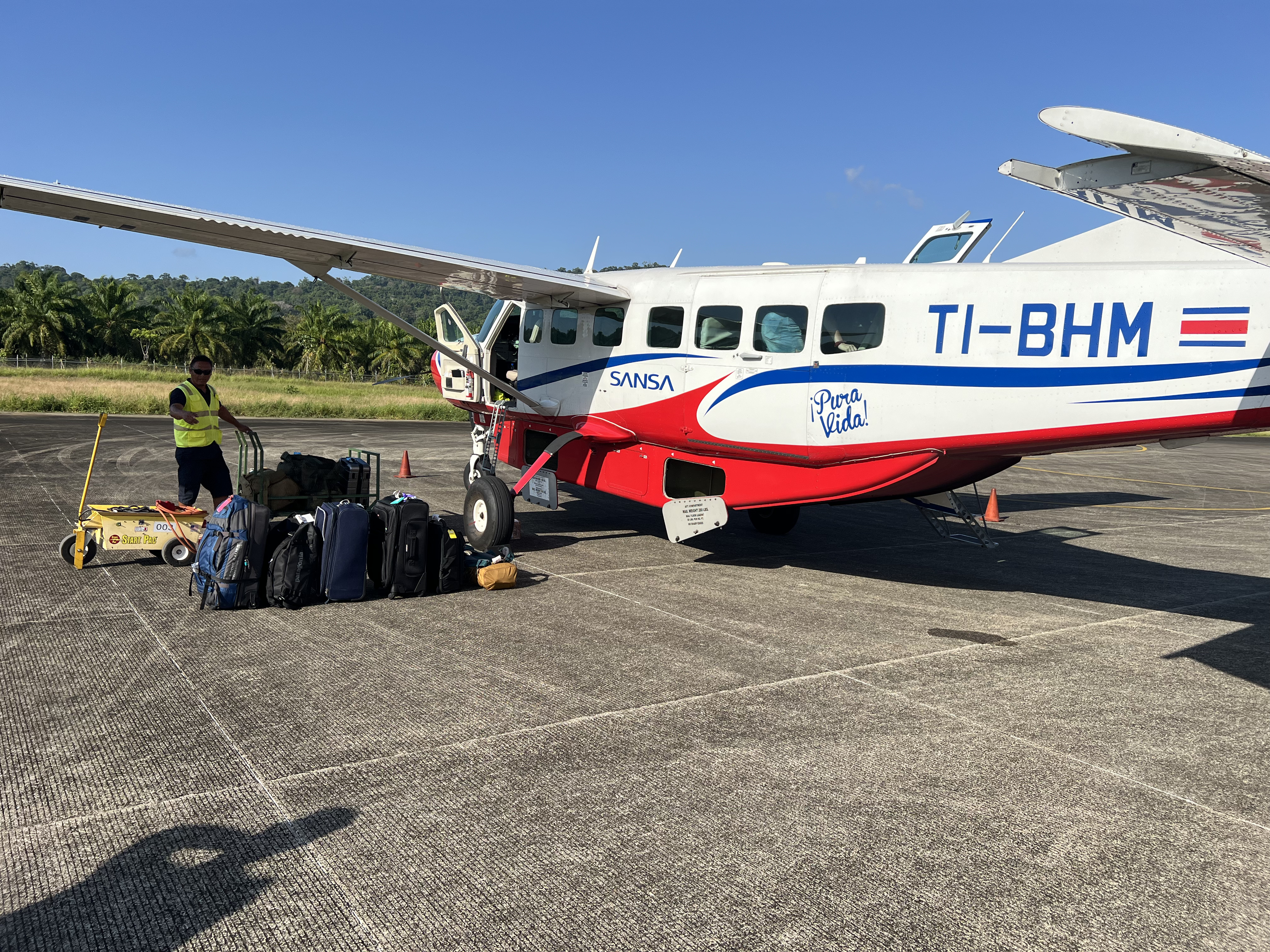
I flew from Managua to SJO on Sansa Airlines, a small Costa Rican enterprise, and then on to Drake Bay. I managed to snag a front seat in the plane from where I could see the instrument panel and see what the pilots saw. From the airport – a small one room affair where the checked-in luggage is picked up directly on the tarmac by the single engine prop plane – I was met by the owner of the Pura Vida B&B where I was staying for the following two nights.
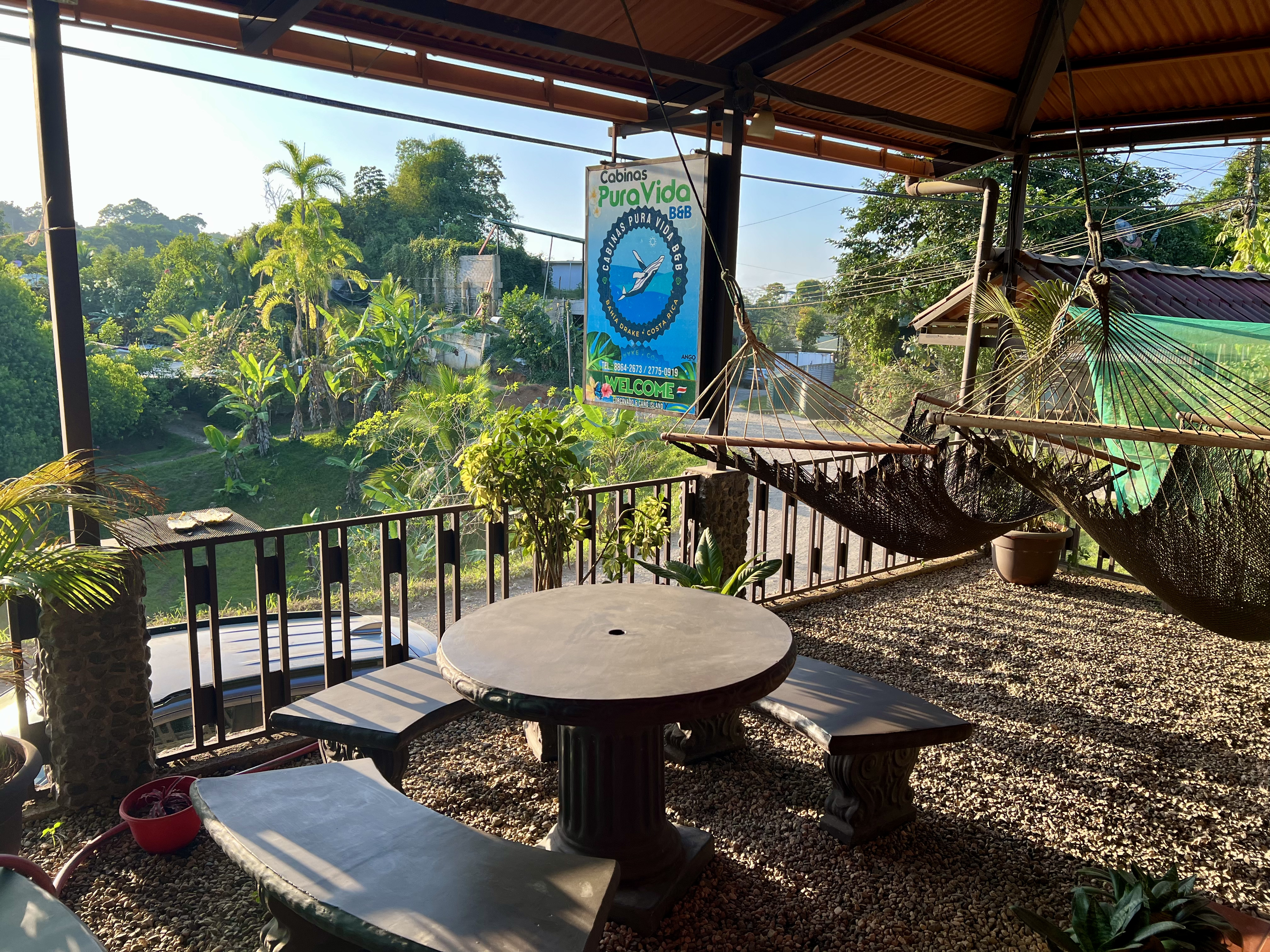
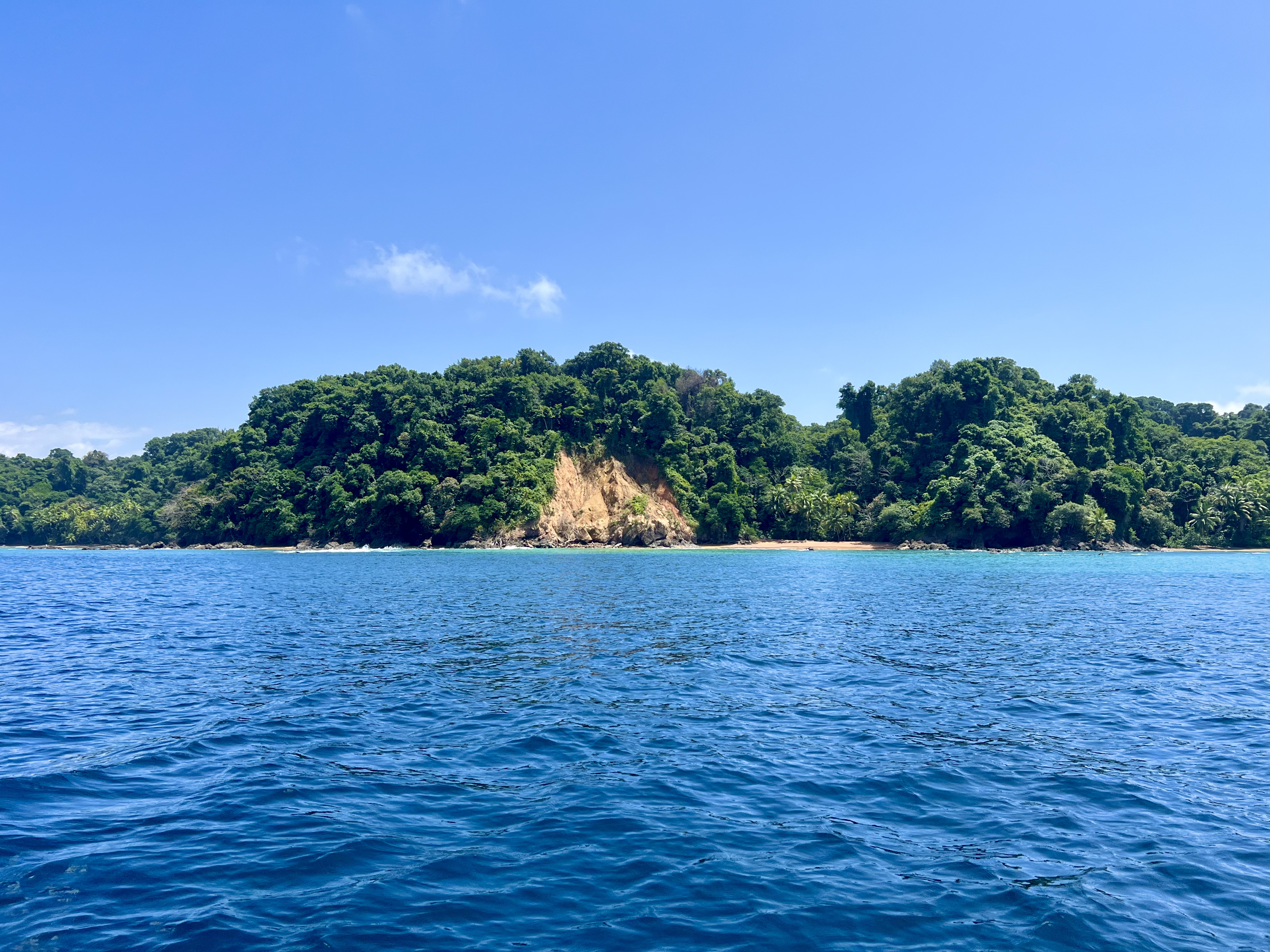
Nubia is originally from Columbia and is delightful. She helped arrange a snorkeling tour to Caño Island for the following day. I didn’t take my phone/camera with me because I didn’t want it to get soaked getting in and out of the boat, so I only have photos from the boat trip there and back, although none of the ones of the spotted tropical dolphins came out. There was a whole school of them gently curving their bodies over the waterline to dive back down. The excursion was well organized, but the water was fairly murky, not at all clear the way it is touted to be, but the Pacific here is bathtub warm, and it was wonderful to swim around and above the coral. We did see two green Tortugas and various kinds of fish, but after the Great Barrier and the state park in Kona, Hawaii, I guess I’m spoiled for sea life. The boat, which leaves around 7:30 am, takes off from the main beach, which involves jumping the waves to get on board. There are two sets of 45-minute times allowed for snorkeling on the north side of Caño Island, which is a nature reserve. There are only a few spots where the boats can let people off and they must stay right by the beach. Tourists aren’t permitted inland. There are supposed to be petroglyphs on the island, but they weren’t viewable. It seems the island was used as a sacred site and cemetery for the pre-Hispanic indigenous peoples of the region. The tour ended with lunch on a beach, where I had a bit of a scare getting off the boat. I fell and was swept up in the waves and current; it was only with the help of a couple of strong arms from another passenger that I was able to stand up to reach the shore.
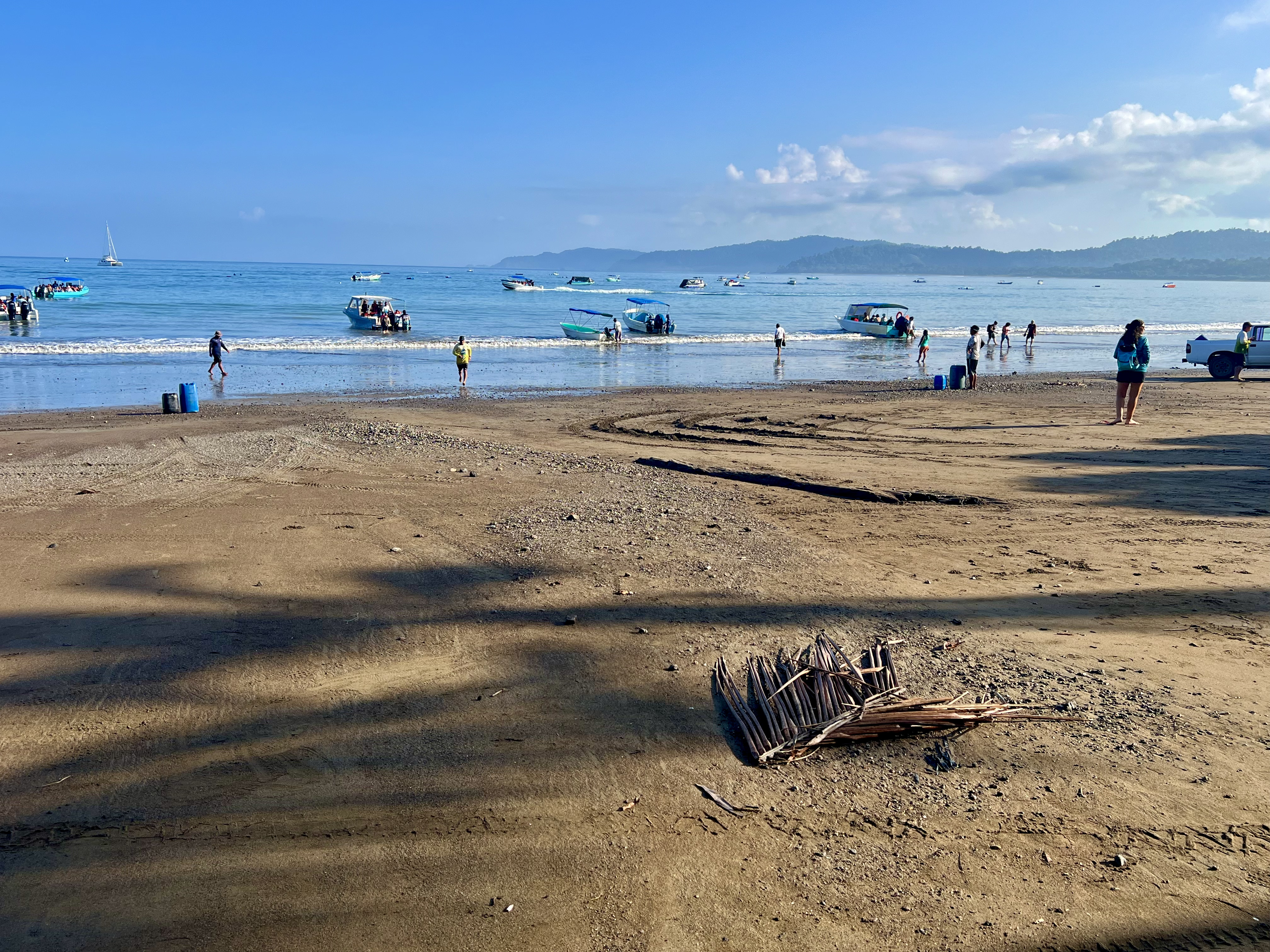
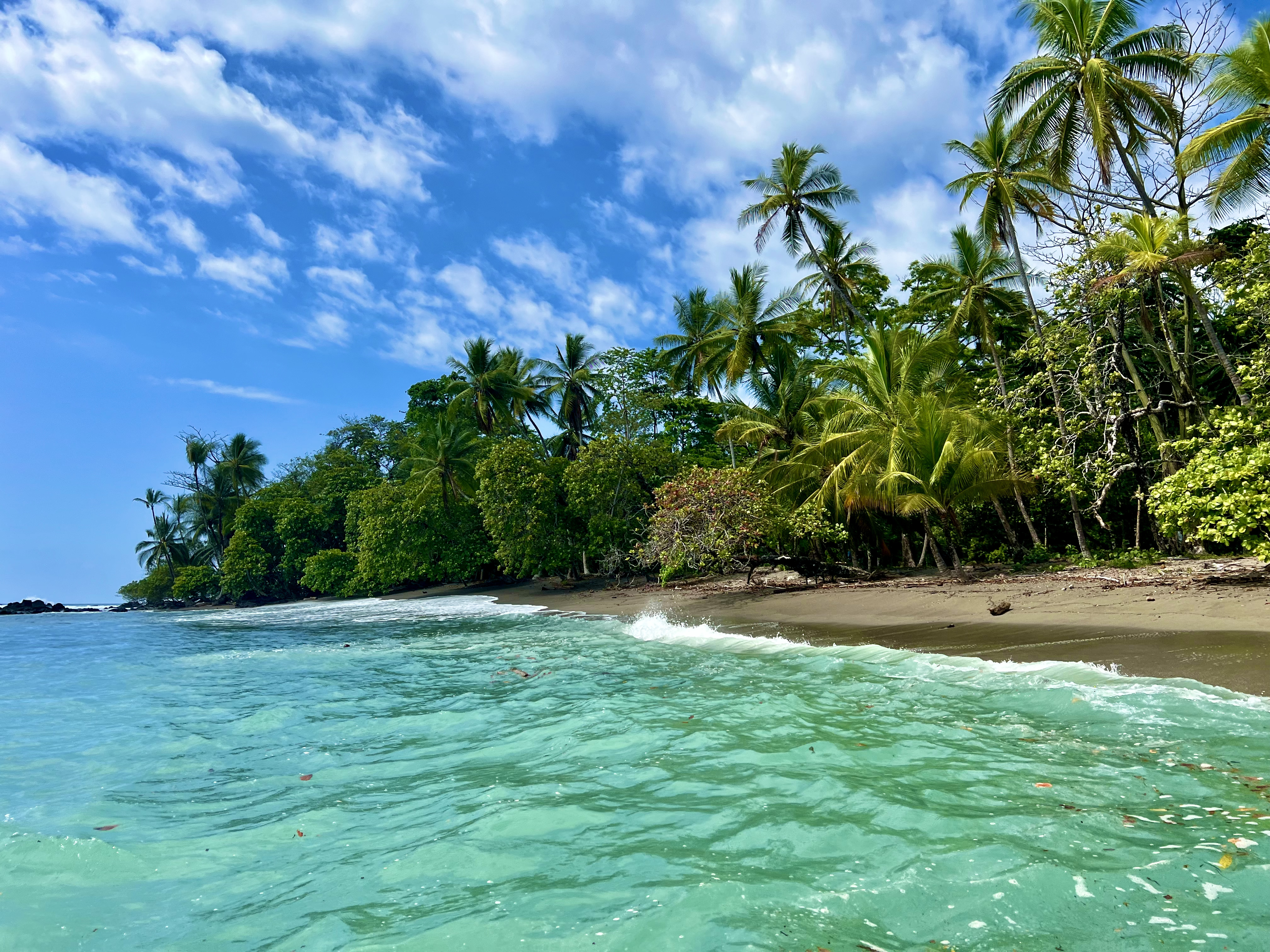
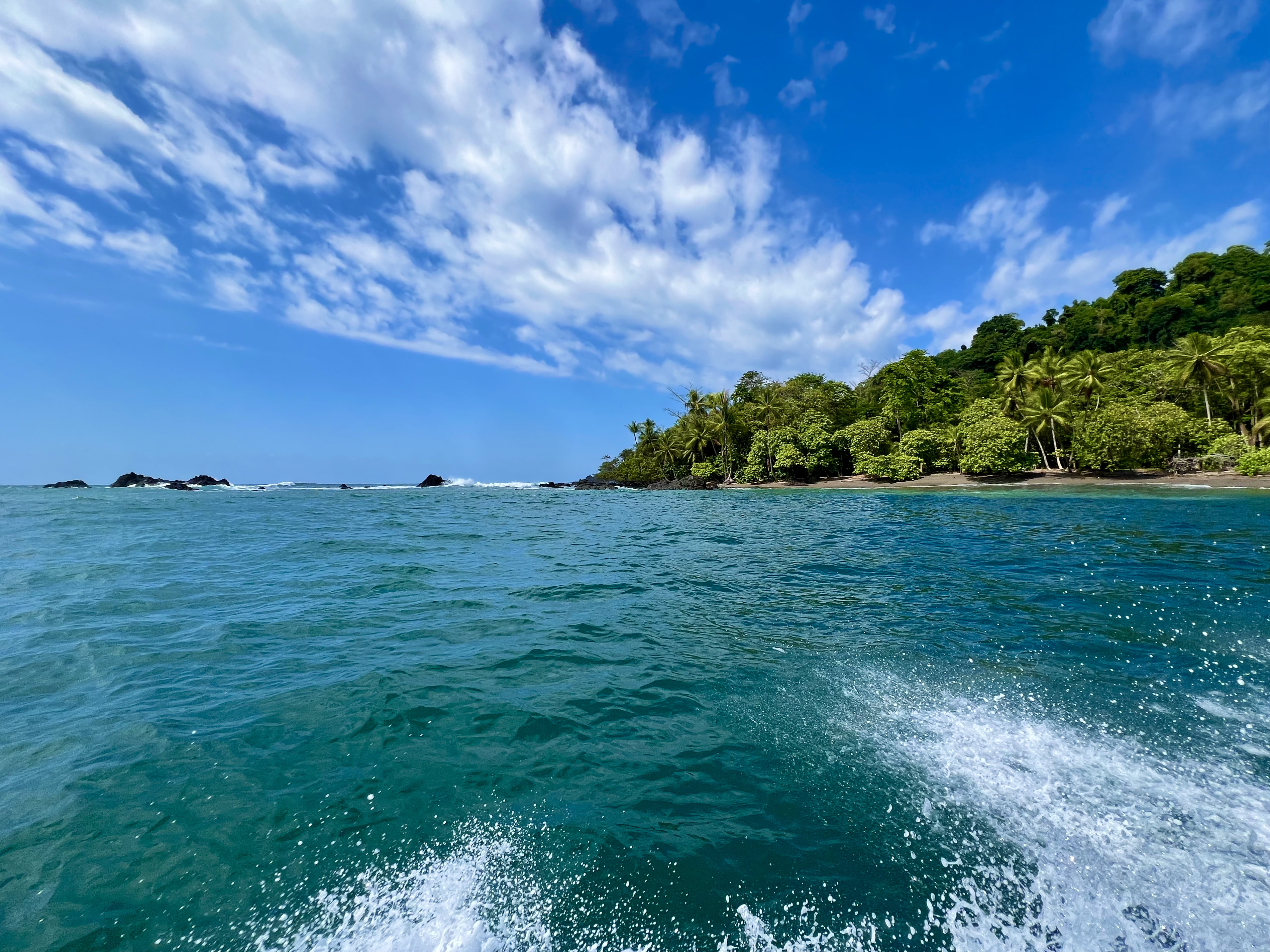
The next day started my overnight excursion to Corcovado National Park. Both the day and overnight excursions into the National Park need to be pre-booked as there are limited numbers of people allowed in the Park at any given time. I had booked the tour when I booked the room, so at a little before 6am, Nubia took me to where the boat for the excursion departed. I was surprised to see the crowds filling probably ten 24 seat speedboats given the number restriction. It seems about 75% of the people were day tourers whereas the rest of us were staying overnight in the one camp where it is allowed, the Sirena Station Area. The trip with the boat takes a little less than an hour and a half to get to the shore by the entrance to the Sirena Region. After disembarking there is a short walk to the ranger station, where boat shoes are exchanged for close-toed hiking shoes, and one signs in at the registry. Bags are checked to make sure no plastic water bottles, or food of any kind is brought into the Park. Groups of six are formed based on the guide to whom one is assigned. I was with a French family who spoke very limited English, no Spanish or German. There were two adult couples, and the mother of one of the guys and one of the girls. The young man took very good care of his mother, who was probably in her 50s, and he made sure she saw everything the others did. From the Ranger Station it is a 2 km easy flat walk to the Sirena Station area. There one can purchase very expensive refillable water bottles. I didn’t bring any of mine as I was trying to limit what I brought with me from Europe due to space and weight and was reusing the one bottle I bought in El Salvador. That was confiscated, and I needed to buy one at the Park’s shop. It is even heavier and larger than the ones I have at home….
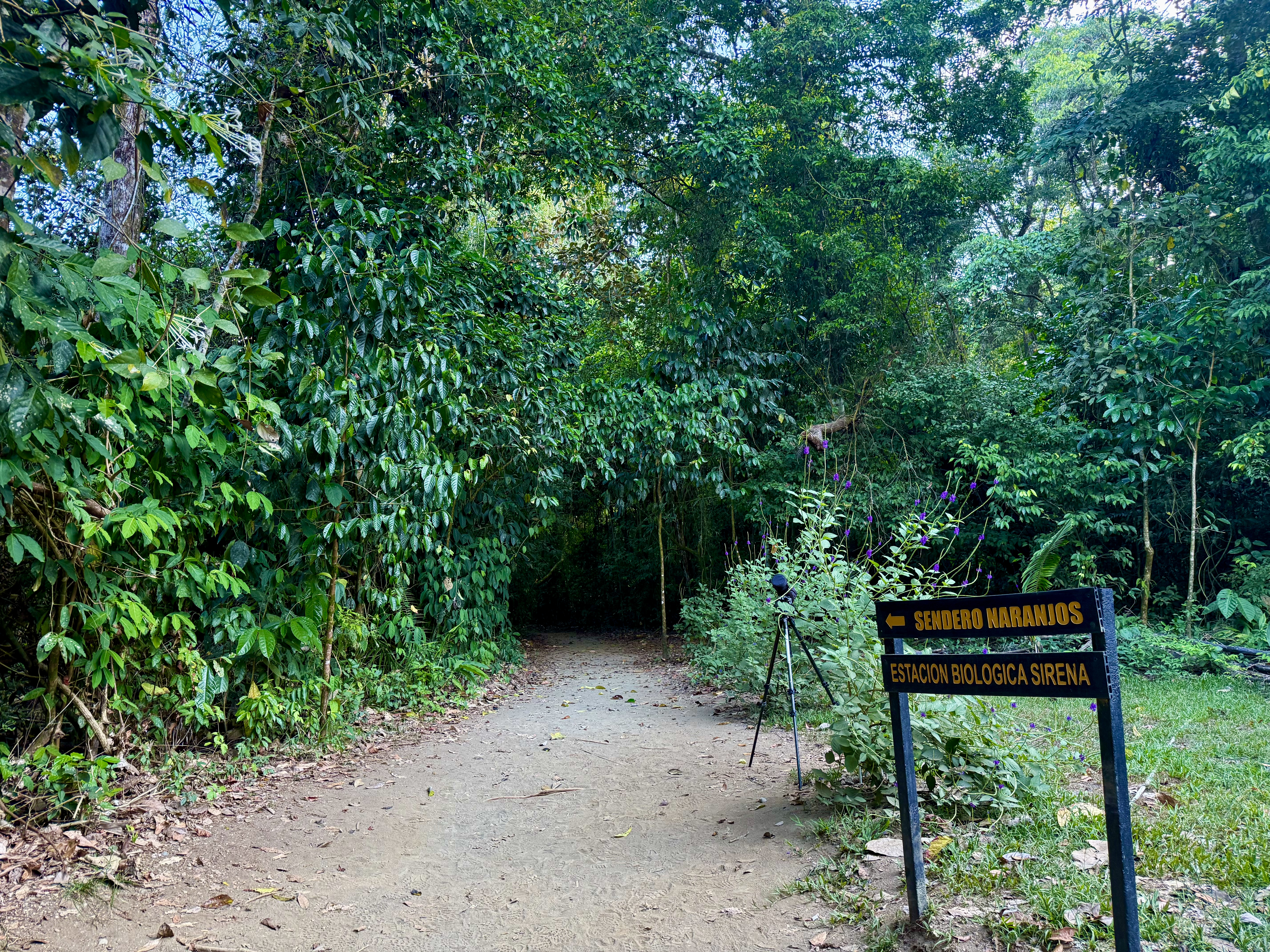
After a short break, our guide led us into the forest for a three-hour hike, where he pointed out lizards, frogs, spiders, wild boars, great curassows, and all four species of monkeys that live on the peninsula. At the end of the hike, we headed back to the Station for lunch and to find out which of the bunk beds would be our abode for the night. I was lucky to get a bottom bunk in a corner where the wind could breeze through the mosquito net and from where I could see the full moon above. The afternoon hike lasted from 2:30-6pm; we saw much of the same wildlife as in the morning, but in a different area. During the morning hike, the people staying overnight go to an area the day tours do not and then in the afternoon they head to the place where the day folks were. In both instances, the groups of six are more or less on the same trails, which leads to traffic jams when a guide is pointing out an insect or lizard or bat to his or her group and the next group wants to get by. At the end of the first day, I was rather frustrated. It was wonderful to see an anteater, although I couldn’t get its picture due to the dense brush, as well as the howlers, spider, white-faced capuchin, and very cute squirrel monkeys, but I hadn’t seen a tapir or sloth, both of which I was expecting to find as I’d seen so many in Manuel Antonio years ago. The day was redeemed, however, as just before lights out at 8pm, the ranger called those still nearby to see a tapir by the water tank of the Station. About twelve of us hurried out and saw this large mix of a hippo and mini-trunk baby elephant with dinosaur footprints as it walked from behind the tank area across the field. It was a fabulous site.
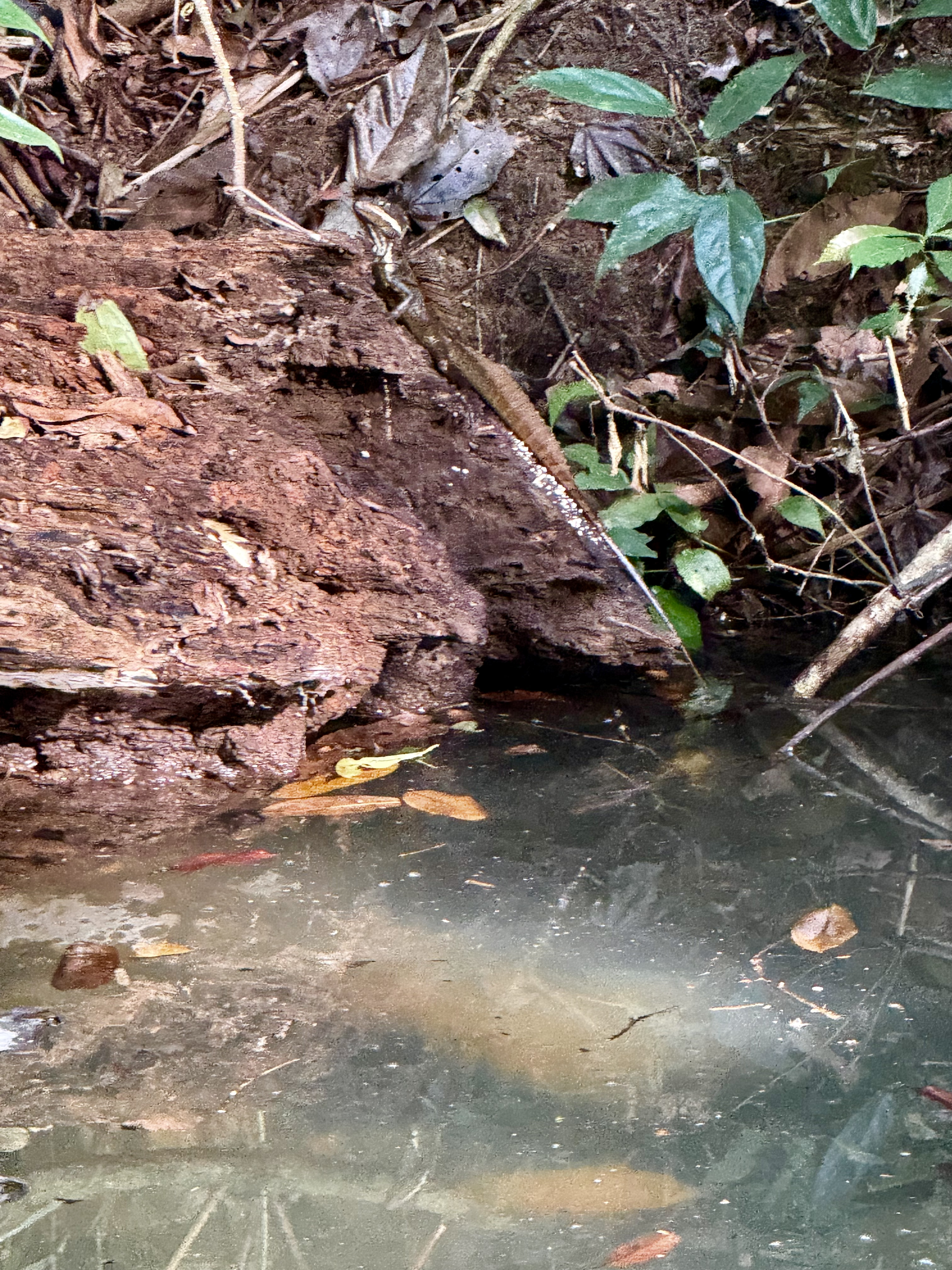
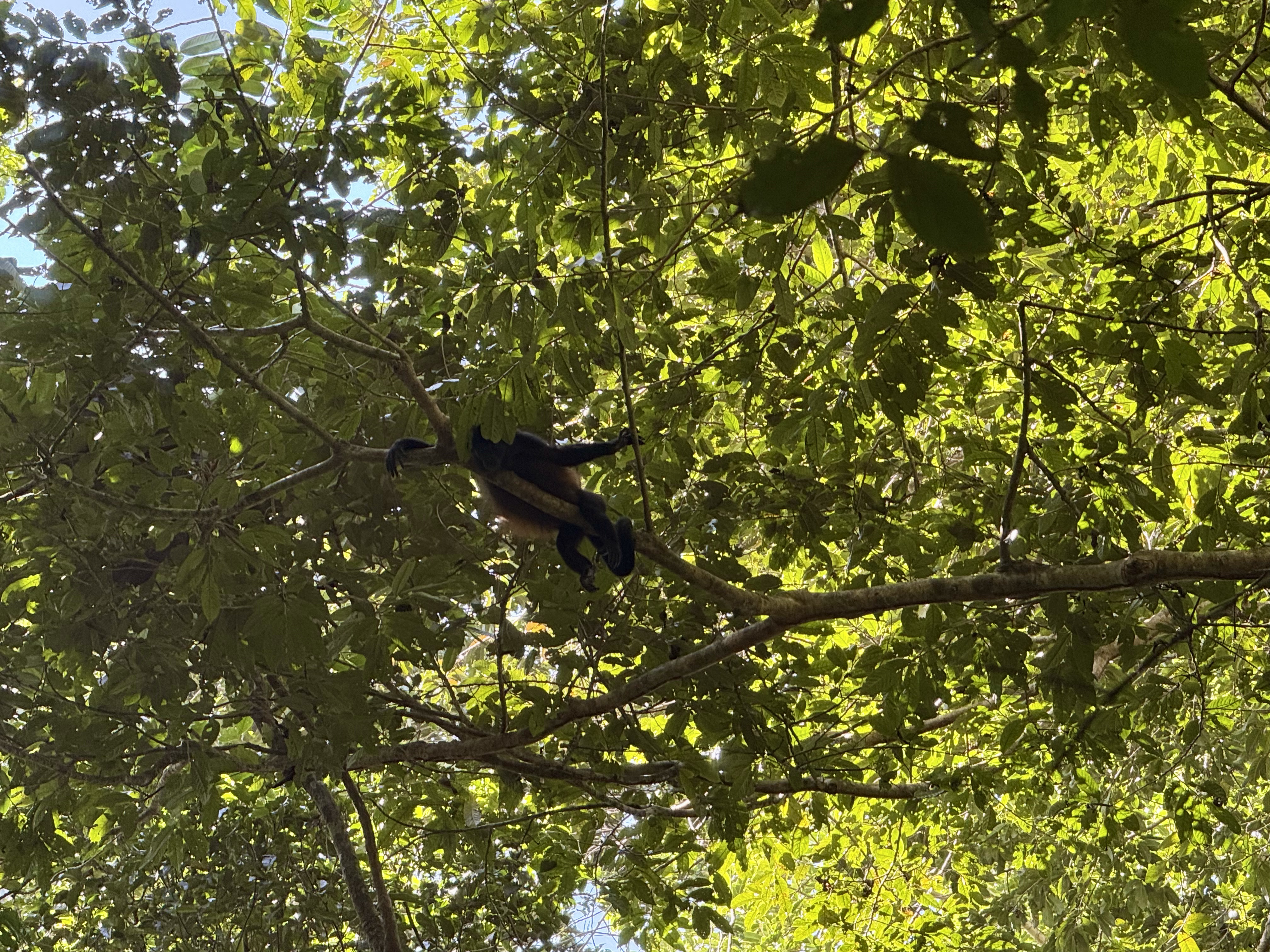
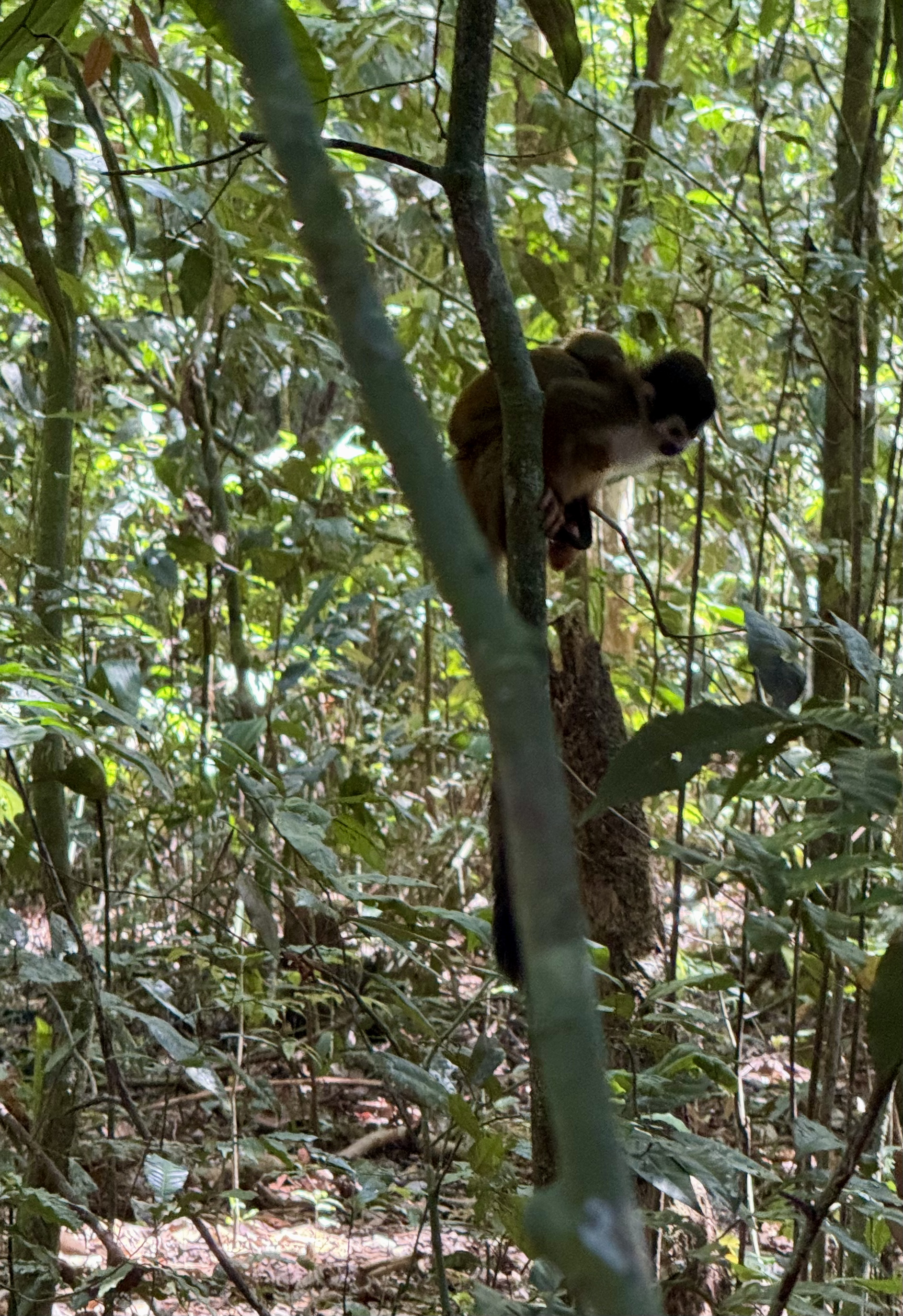
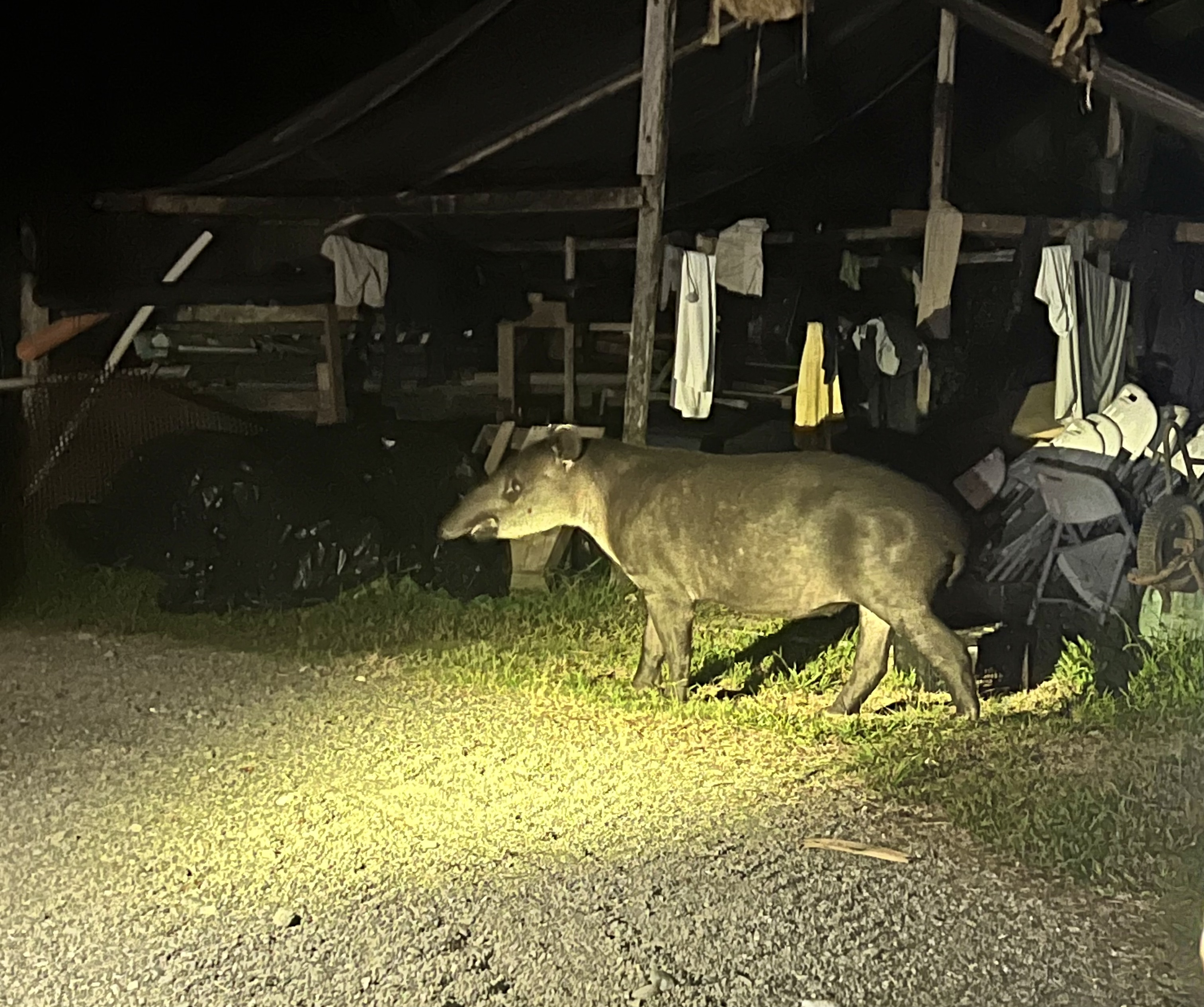
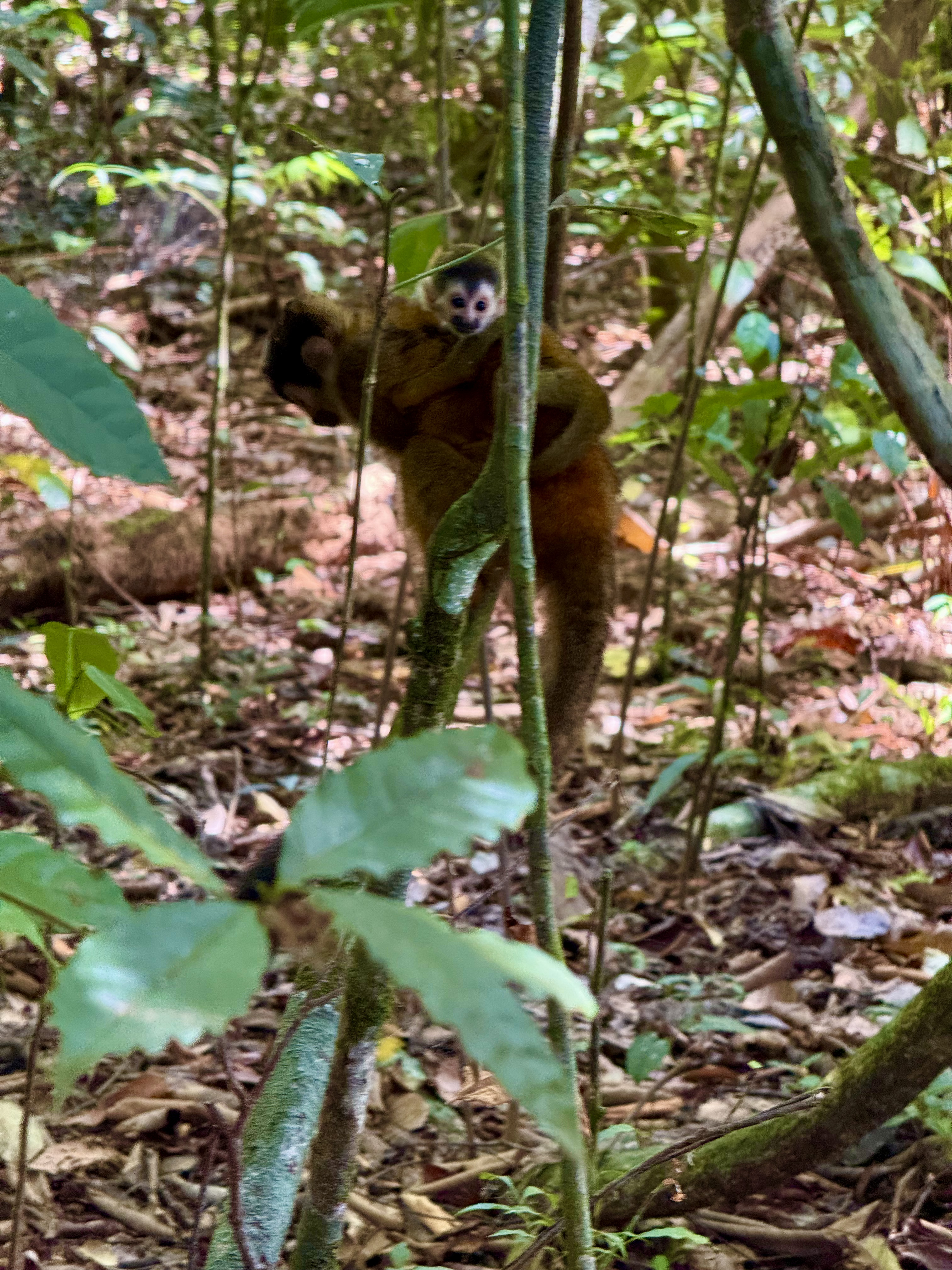
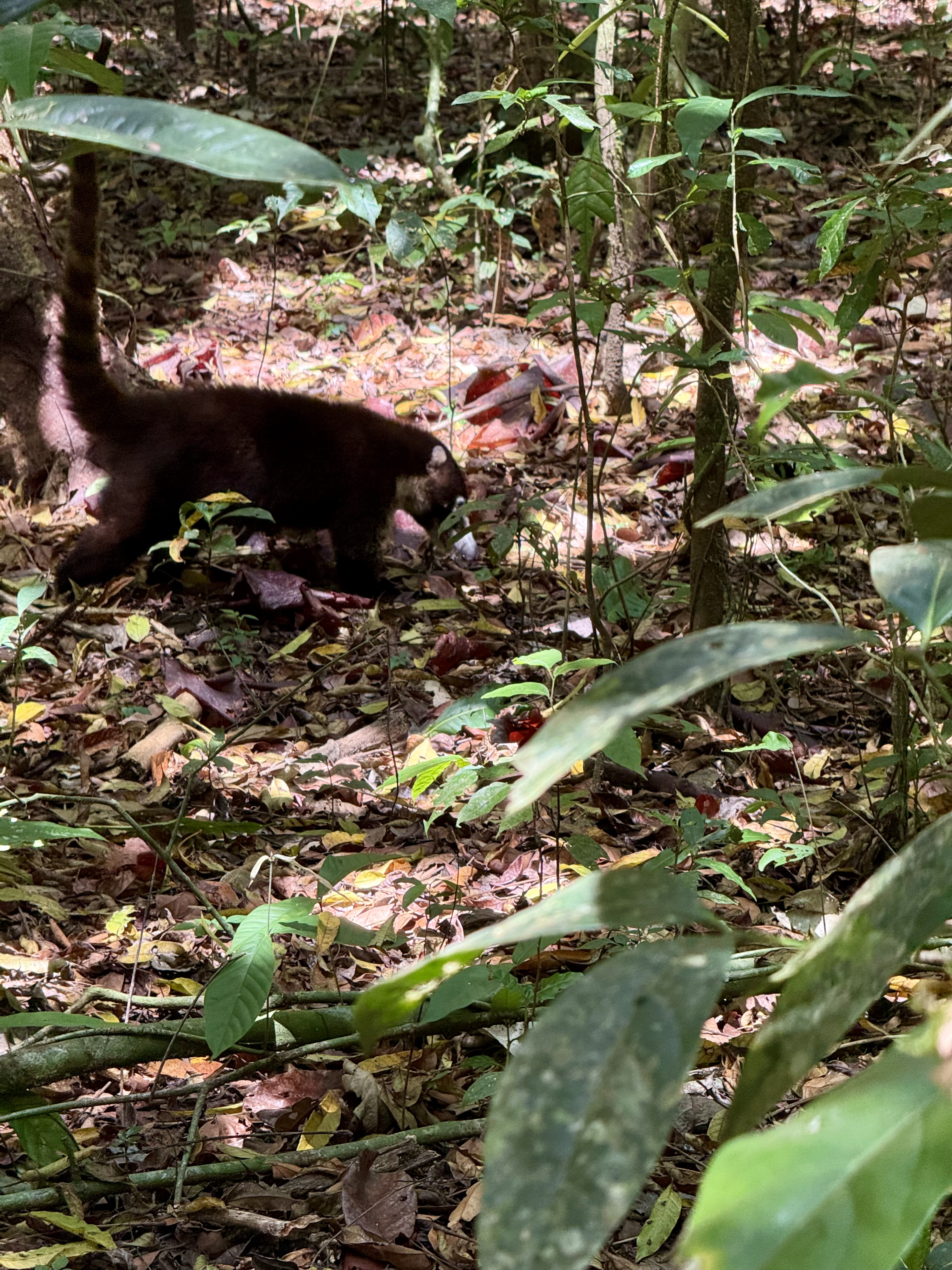
The next morning, we left the Station at 5am for the early morning hike. We saw more monkeys, lizards, bats, wild boars, macaws, and great curassows. There was a sloth up in the trees, but it was so covered by the leaves that it was impossible to make out. We returned to the lodge around 7:00 for breakfast and then left for the final hike at 8:30. This time we got really lucky; a tapir came out of the forest, came very close to us, swam away toward the mouth of the river, then hung out by the shore for quite a while placidly munching on tree leaves while we stared at and photographed its movements. It was absolutely an amazing experience. On the way back to the Station for lunch, we saw a couple of Coatis, and a large family of incredibly cute squirrel monkeys, a few with babies on their backs. After lunch, about 12pm, the day folk as well as those who spent the night headed back to the ranger station and the boats to depart for Drake Bay. My review of this excursion is that it is worth spending the night, even though sleeping in bunk beds with probably 30 other people is a bit unnerving with all the snoring, but the additional hikes and time spent in the forest is invaluable. Corcovado’s wildlife is extensive. The CostaRica.org website states that it “contains 5% of the animal population of the planet. … four monkey and over 40 frog species and all four sea turtle species. In addition, there are 100 butterfly species, several types of snakes, 10,000 insect species, over 25 lizard species, tapirs, crocodiles, all six feline species, peccaries and over 400 bird species.” Of this diverse splendor, I saw the four monkey species, a couple of frogs, three lizards, a few spiders with large webs, many wild boar, coati, an anteater, not clearly visible two kinds of sloths, many bird species, and both a female and male tapir. Only a fraction of the Park is available for tourists. This area is perhaps now overused. There is no chance for quiet reflection or for a sense of being one with the forest for all the human chatter on the trails. The guides did request that people don’t talk, but whenever there are groups of people, there will be human induced noise, which means that often the animals leave. I have to admit, Alexis and I saw far more wildlife in Manuel Antonio twenty-eight years ago than I did this year in Corcovado. The tapir, the spider and the squirrel monkeys, however, were a real treat. I have posted a video on the wildlife in Corcovado. It can be viewed at: https://youtu.be/DCC_eBYighE
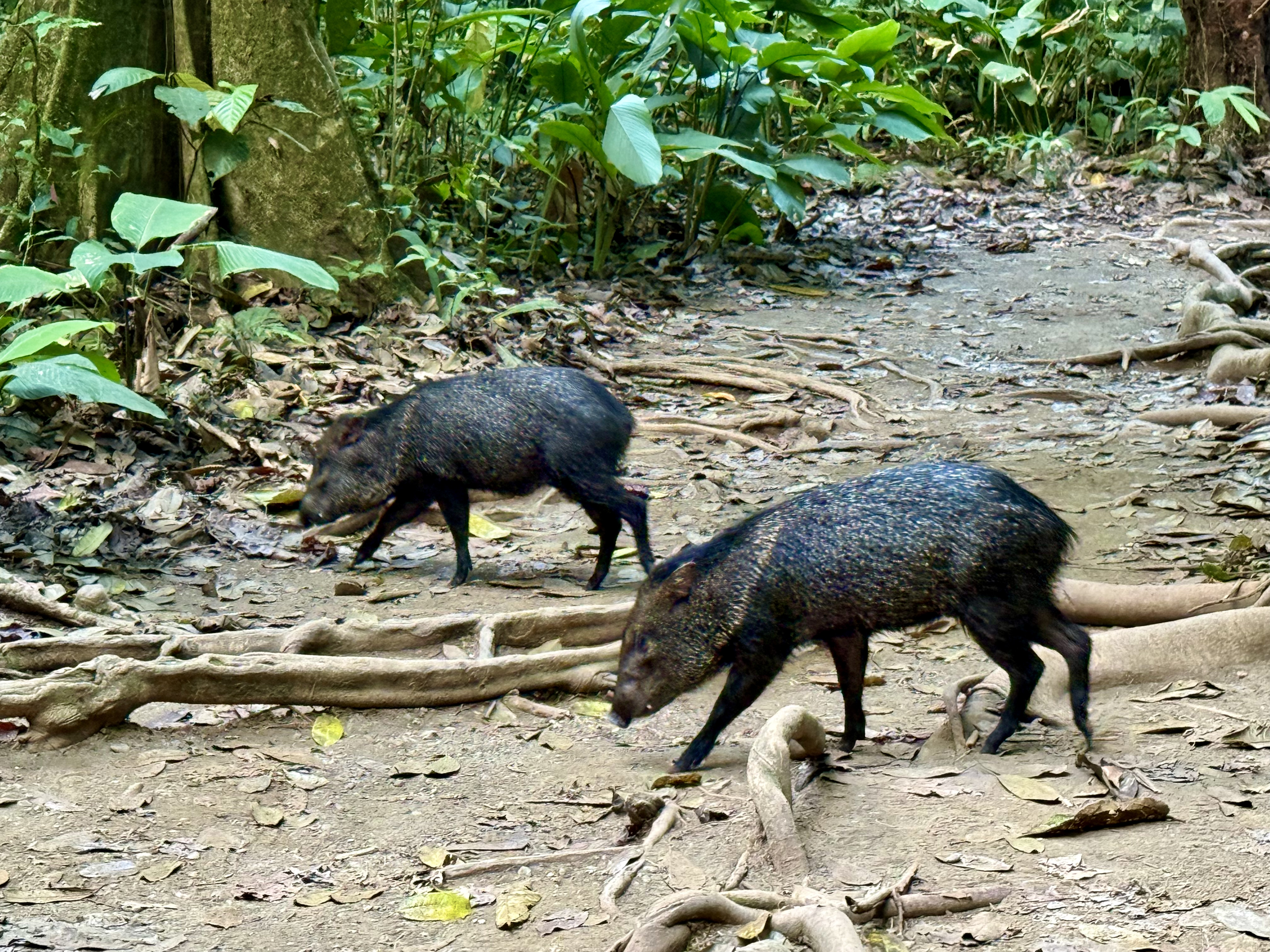
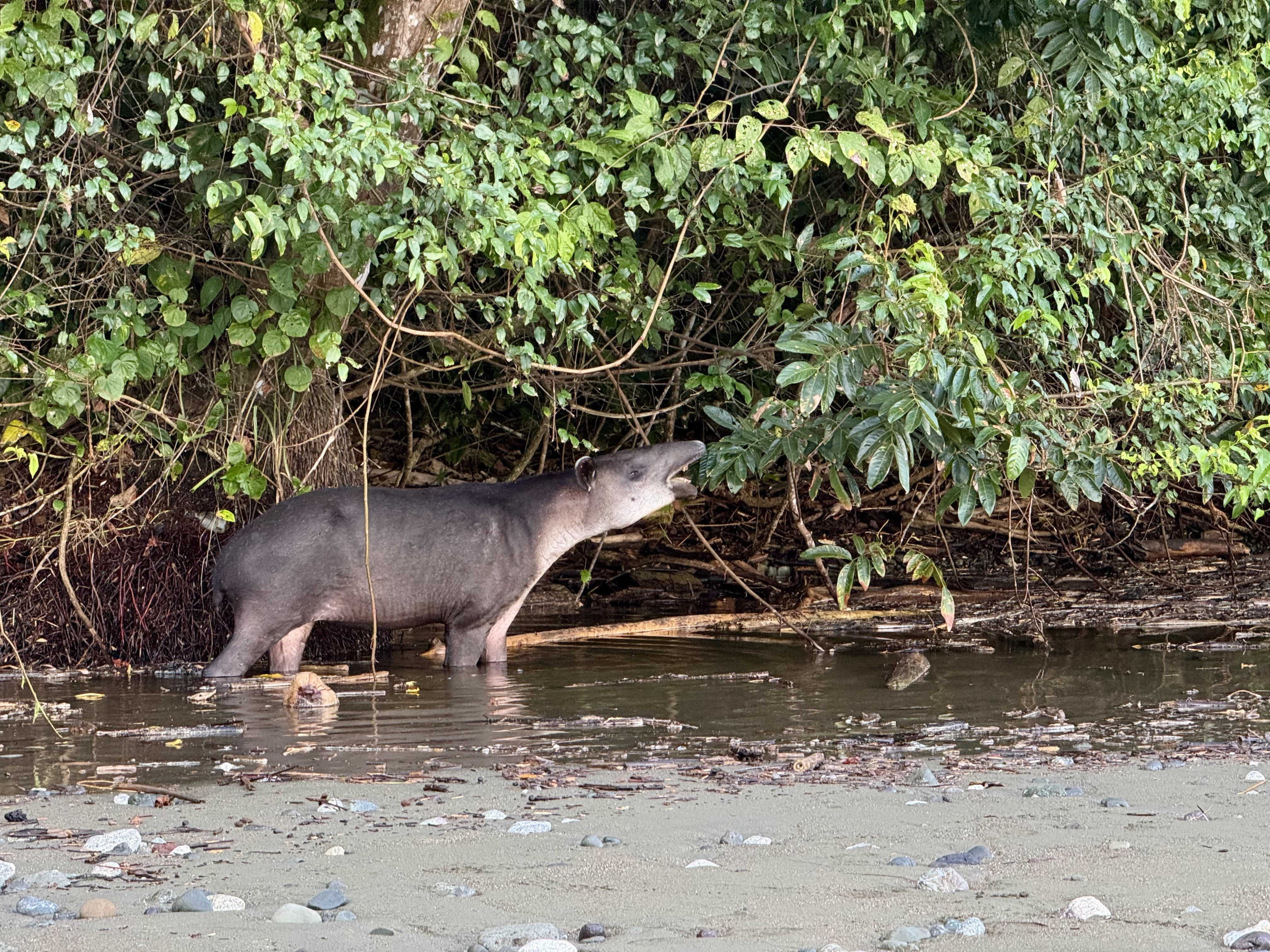
I should probably also mention that there weren’t too many mosquitoes when I was there, but the heat and humidity were almost overpowering. So much so, that I took a shower (there is only cold water) after every hike just to cool down and get the sweat off my body. The hikes were more like gentle walks, but the temperature was hot and very sticky.
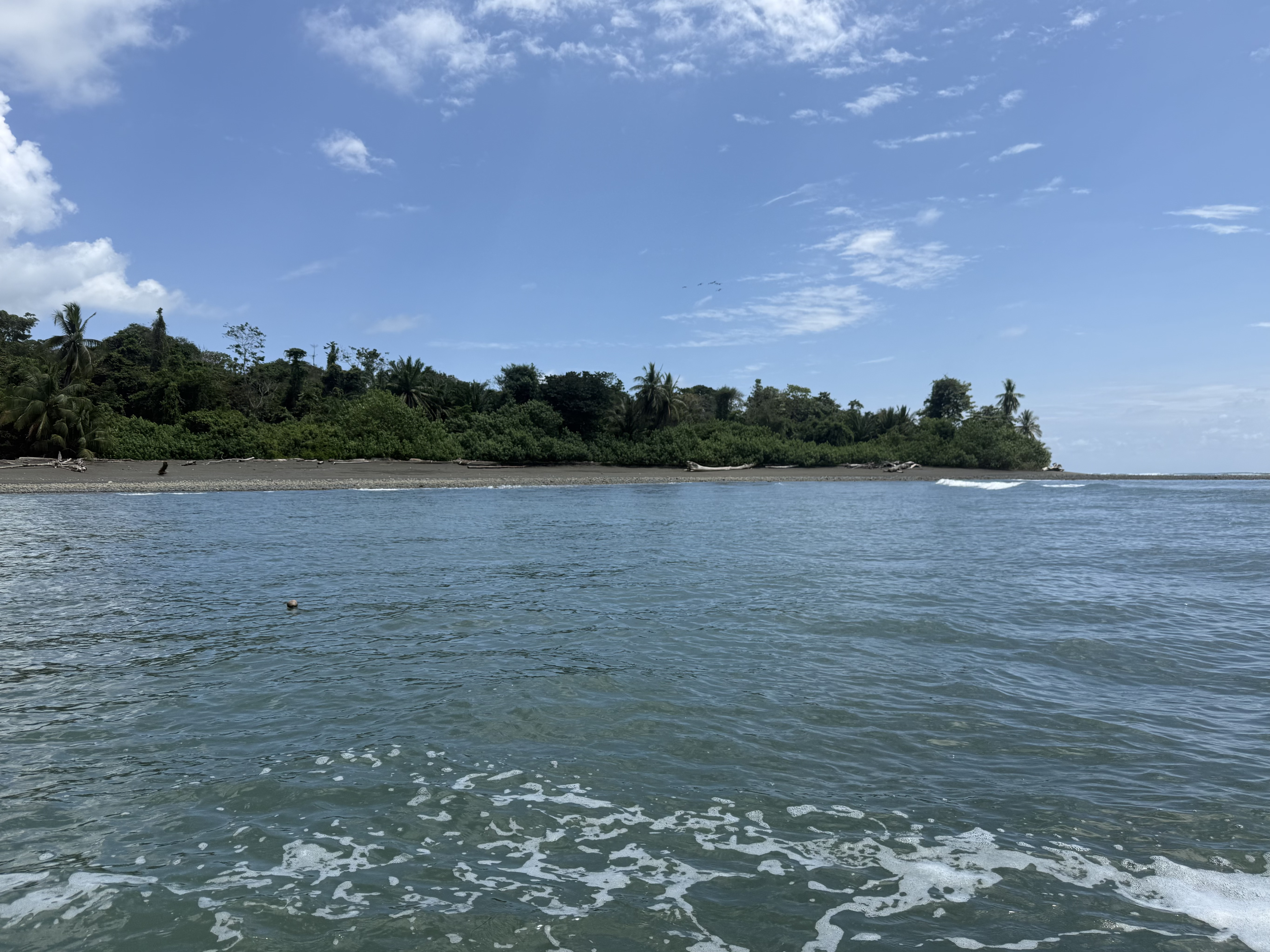
Upon returning to Drake Bay, I had to change B&B as the Pura Vida was booked up. Nubia took me next door to her neighbor at Drake Villa, where I was able to get a room for the next two nights. On my final day in Drake Bay, I tried to go on a tapir hike, but it was cancelled because they couldn’t find a guide.
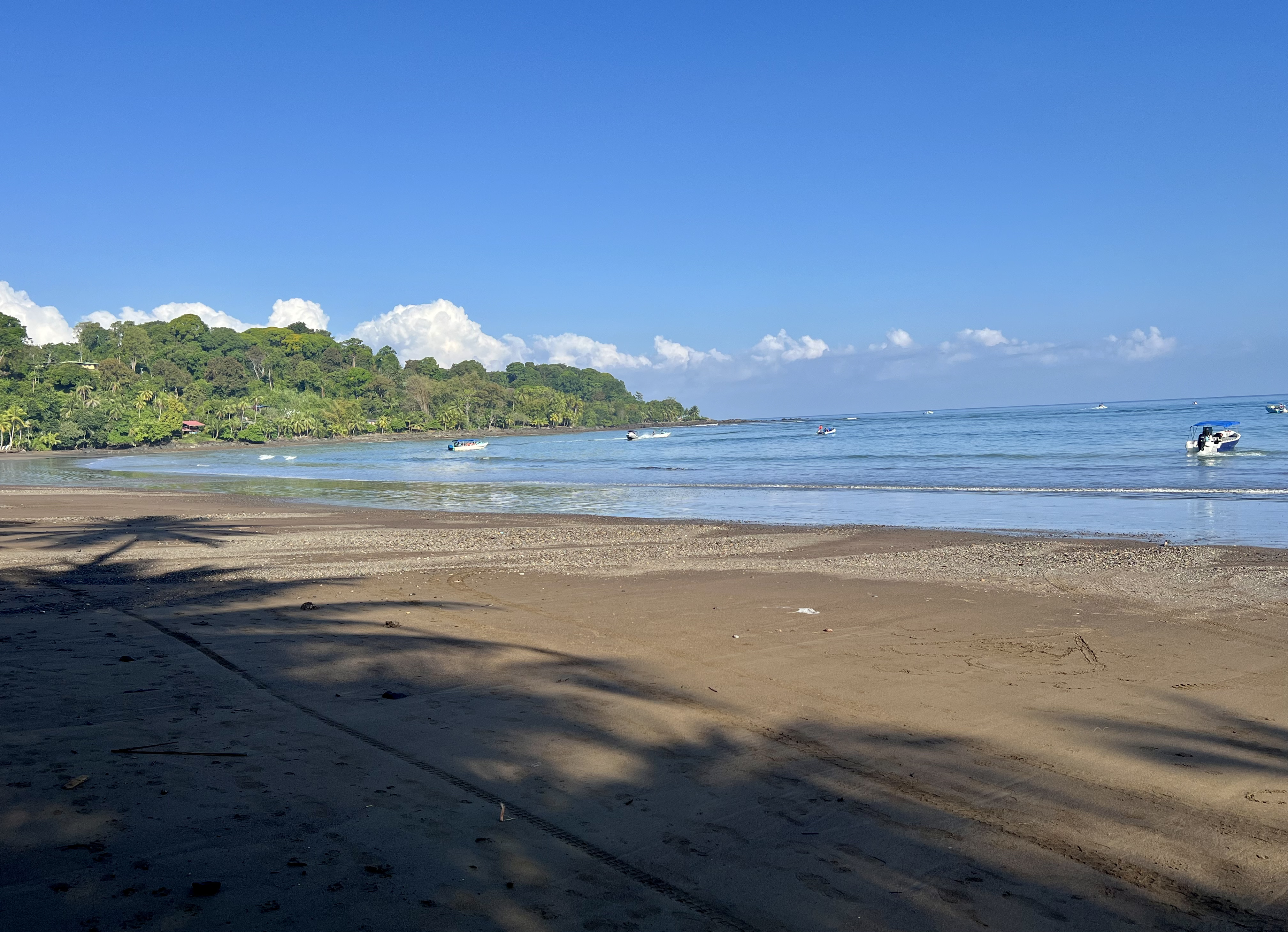
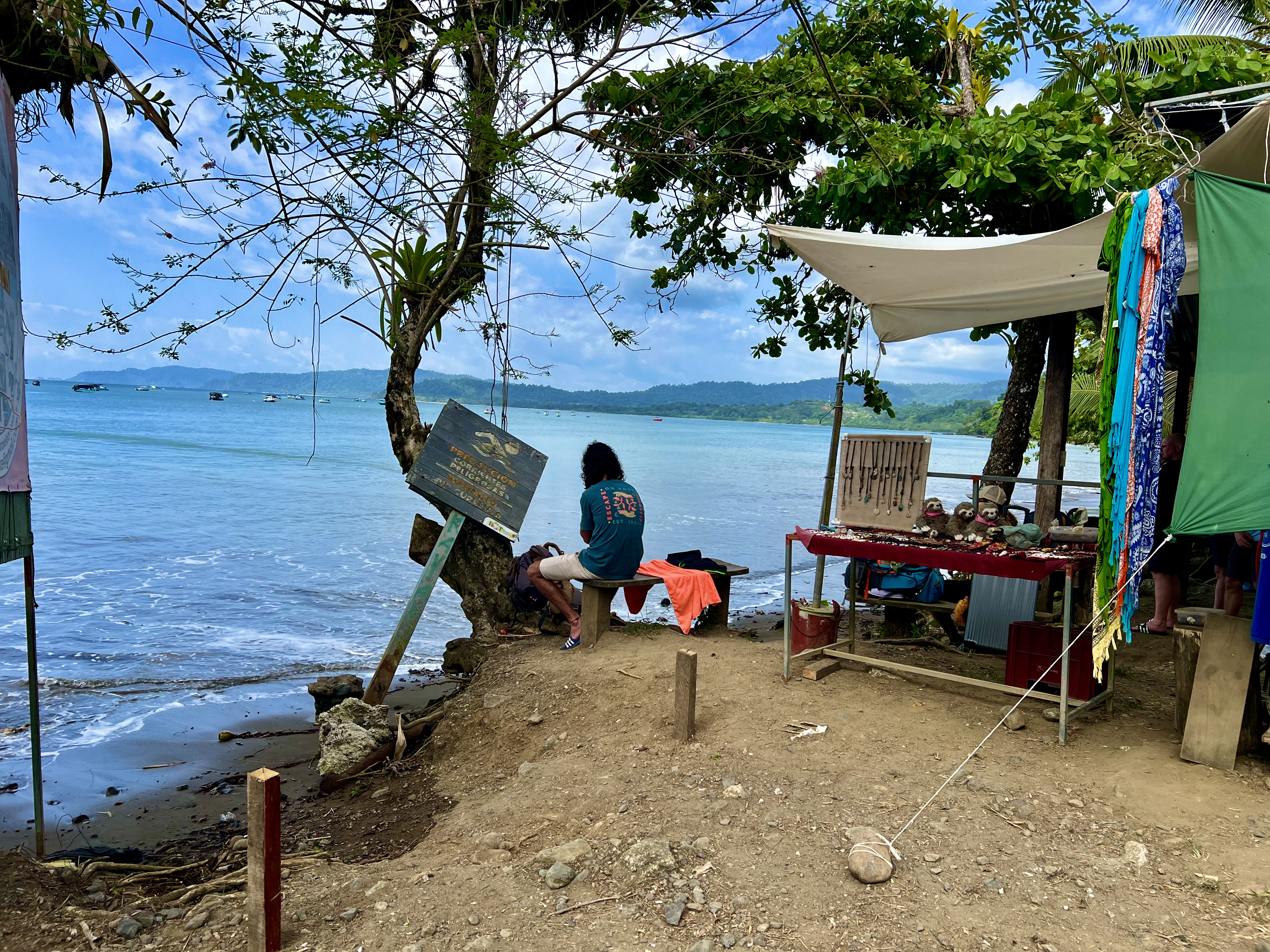
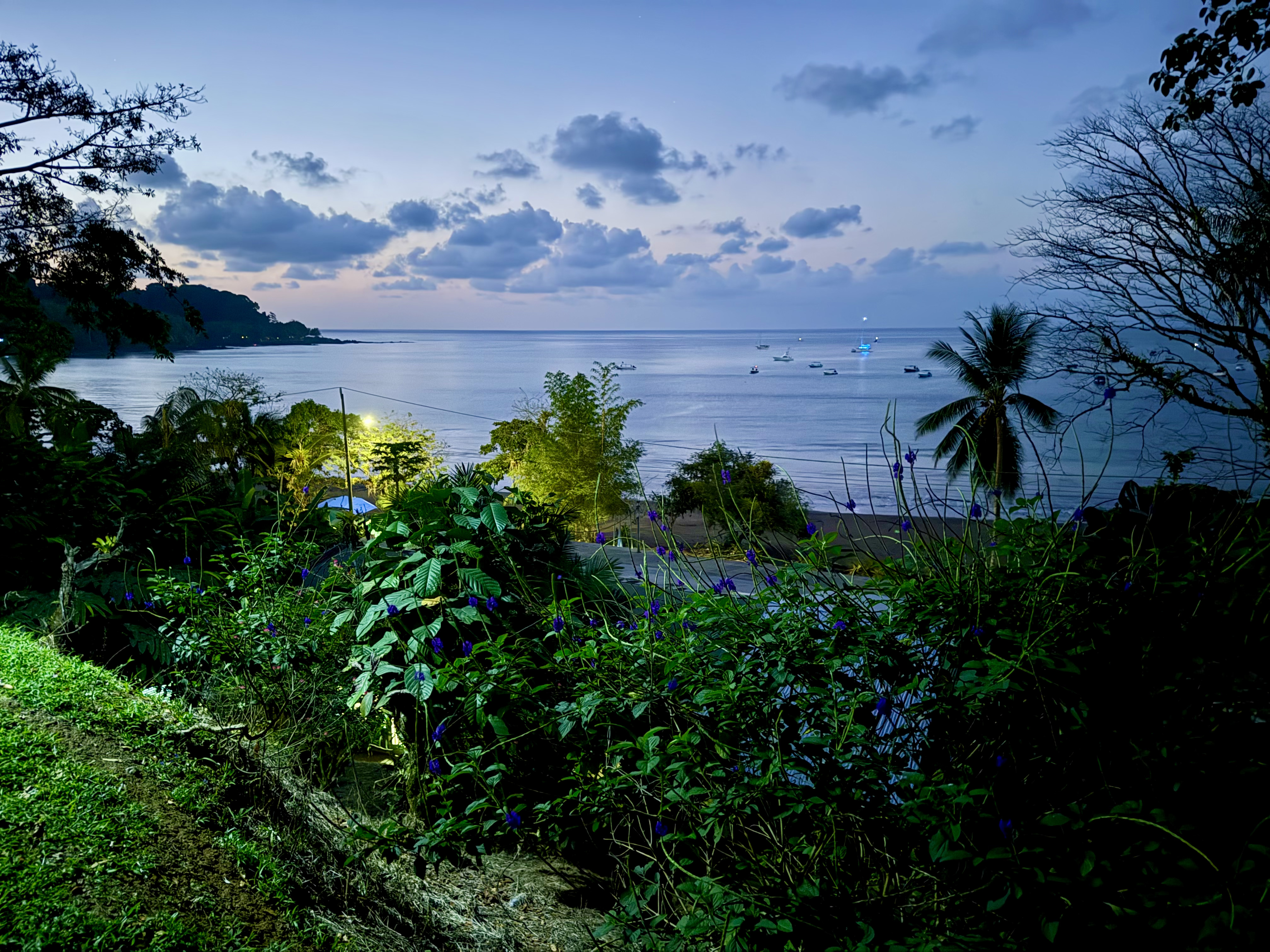
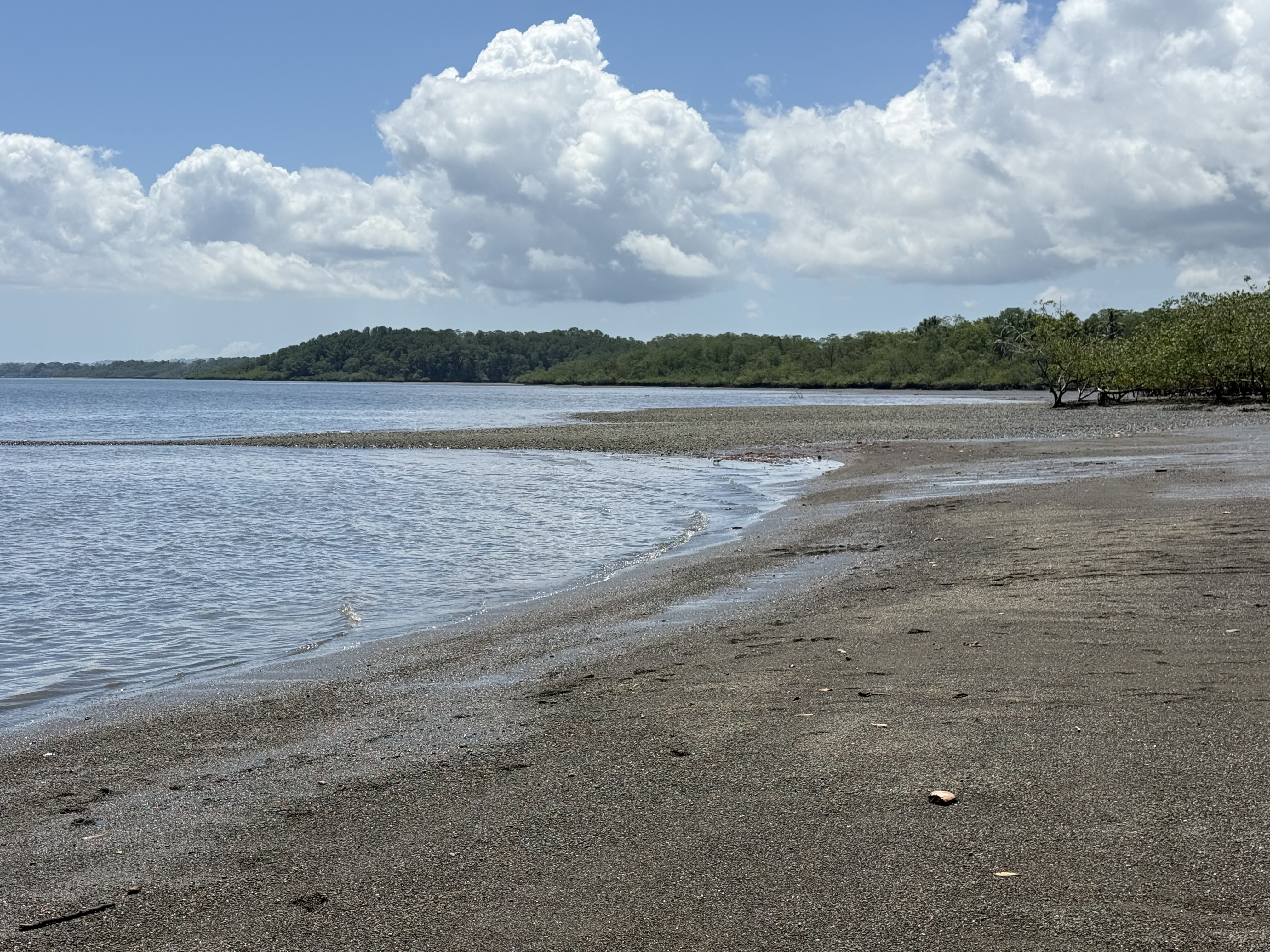
On Saturday, Nubia drove me in her truck to Puerto Jimenez, where I was spending the following two nights in the rainforest behind town. The drive went through rainforest vegetation mixed with patches of agricultural areas until arriving at a series of beaches opposite the inland side of the peninsula. We stopped for a brief stroll at Playa Blanca, a beautiful small pebble sandy beach. The tide was out, and the water was calm. The difference between the raging waves in Drake Bay and along the Pacific Coast was striking. I waded into the water and was shocked at how warm it was, like a warm bathtub rather than the sea.
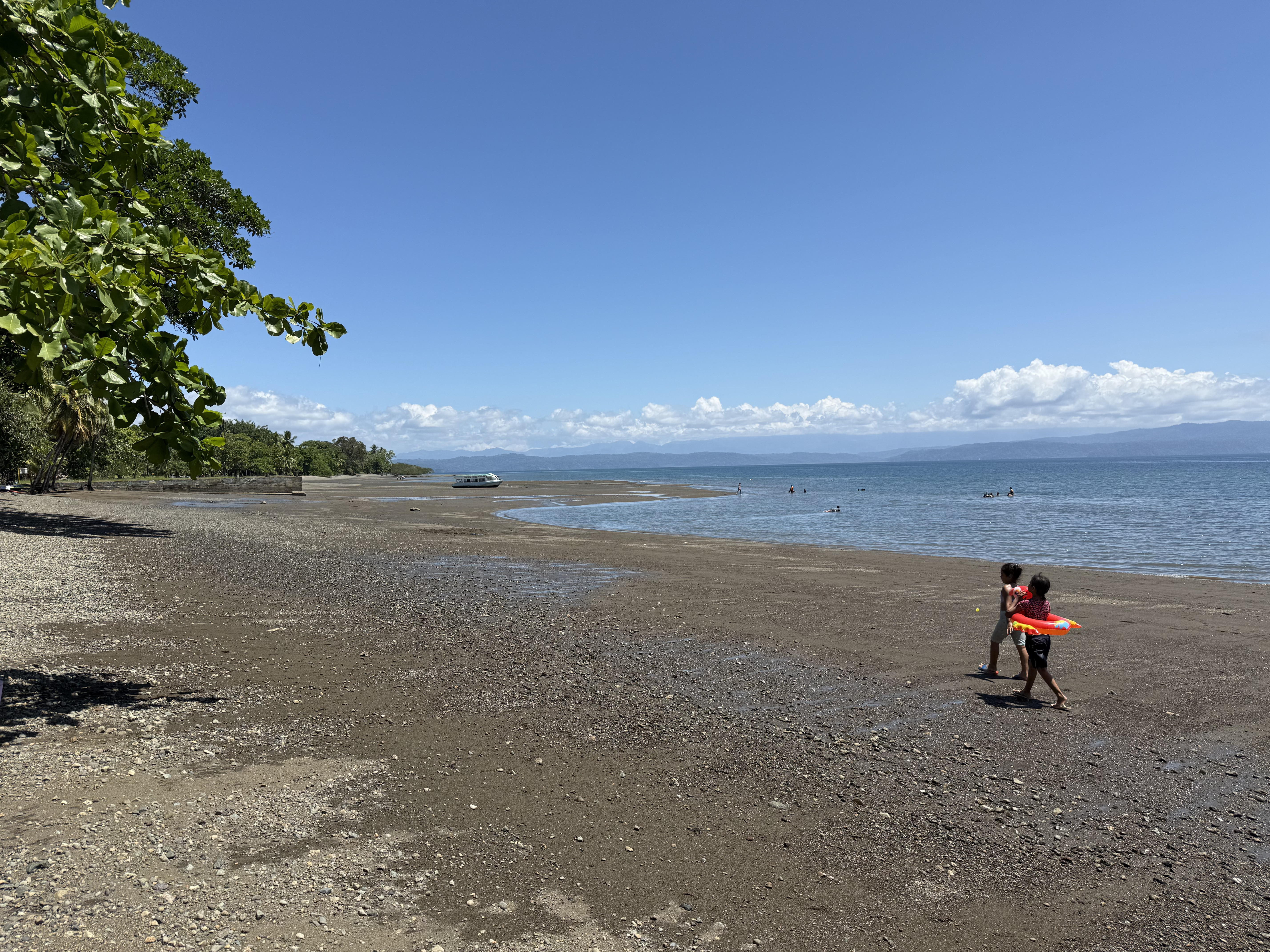
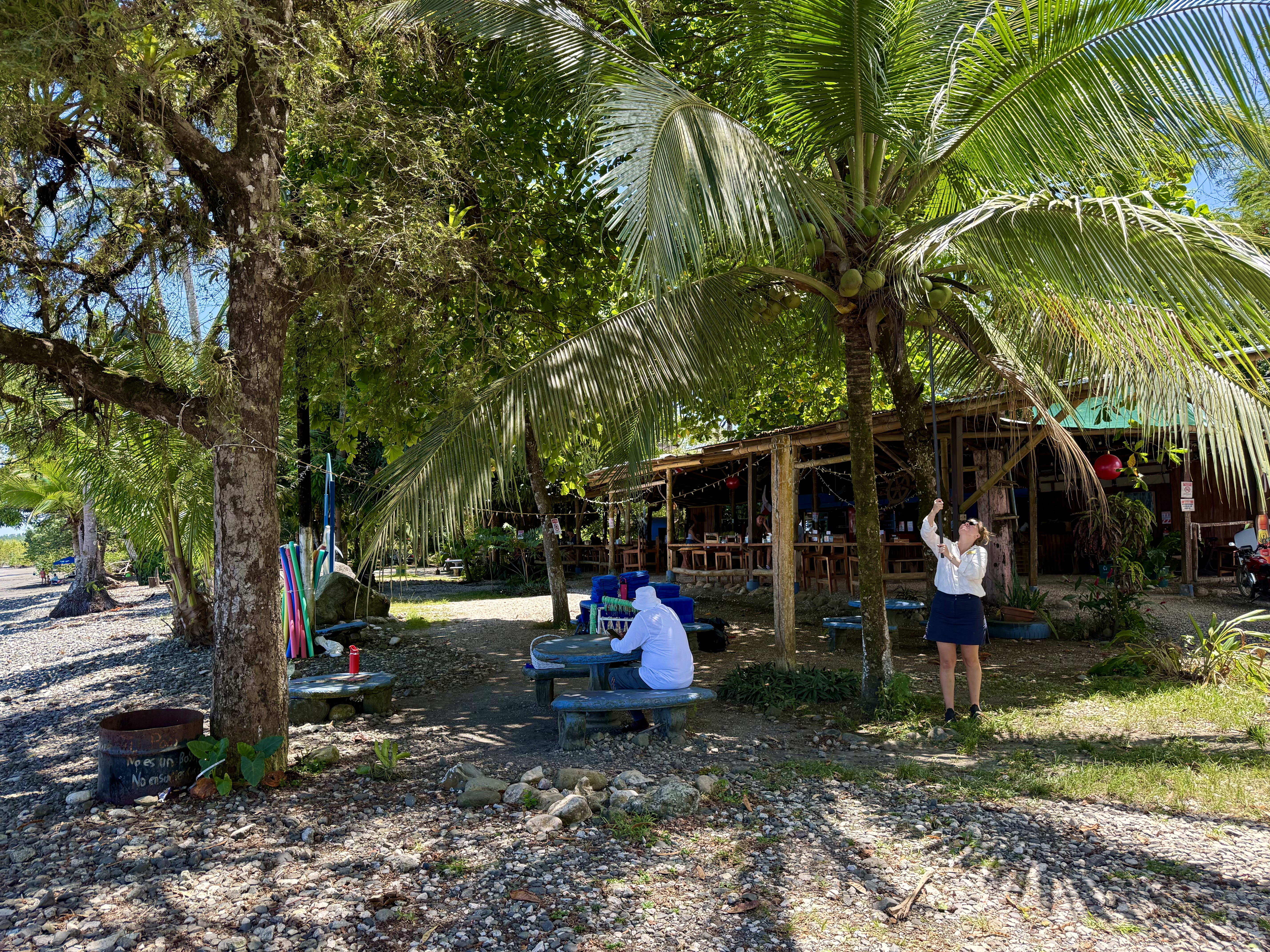
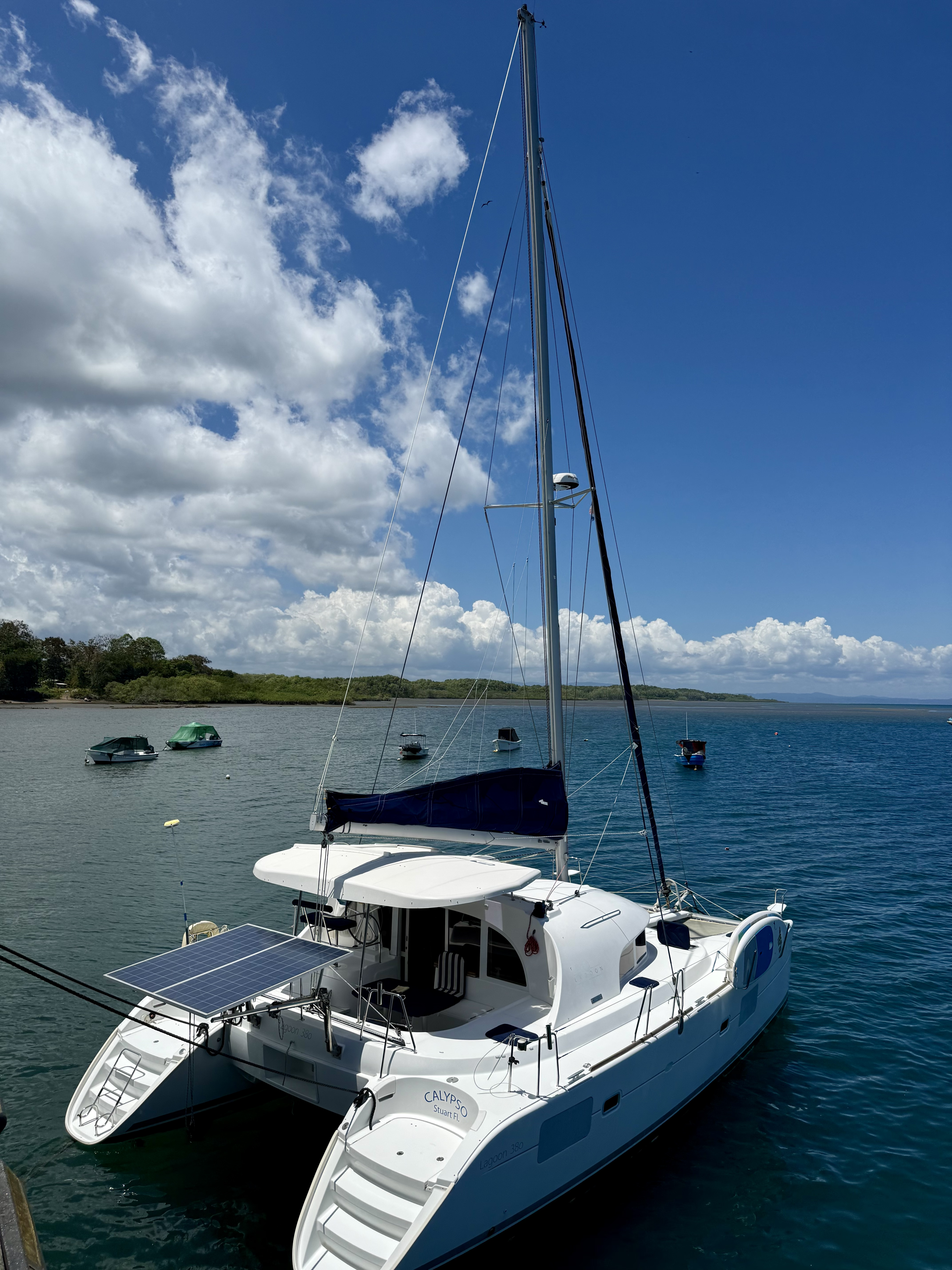
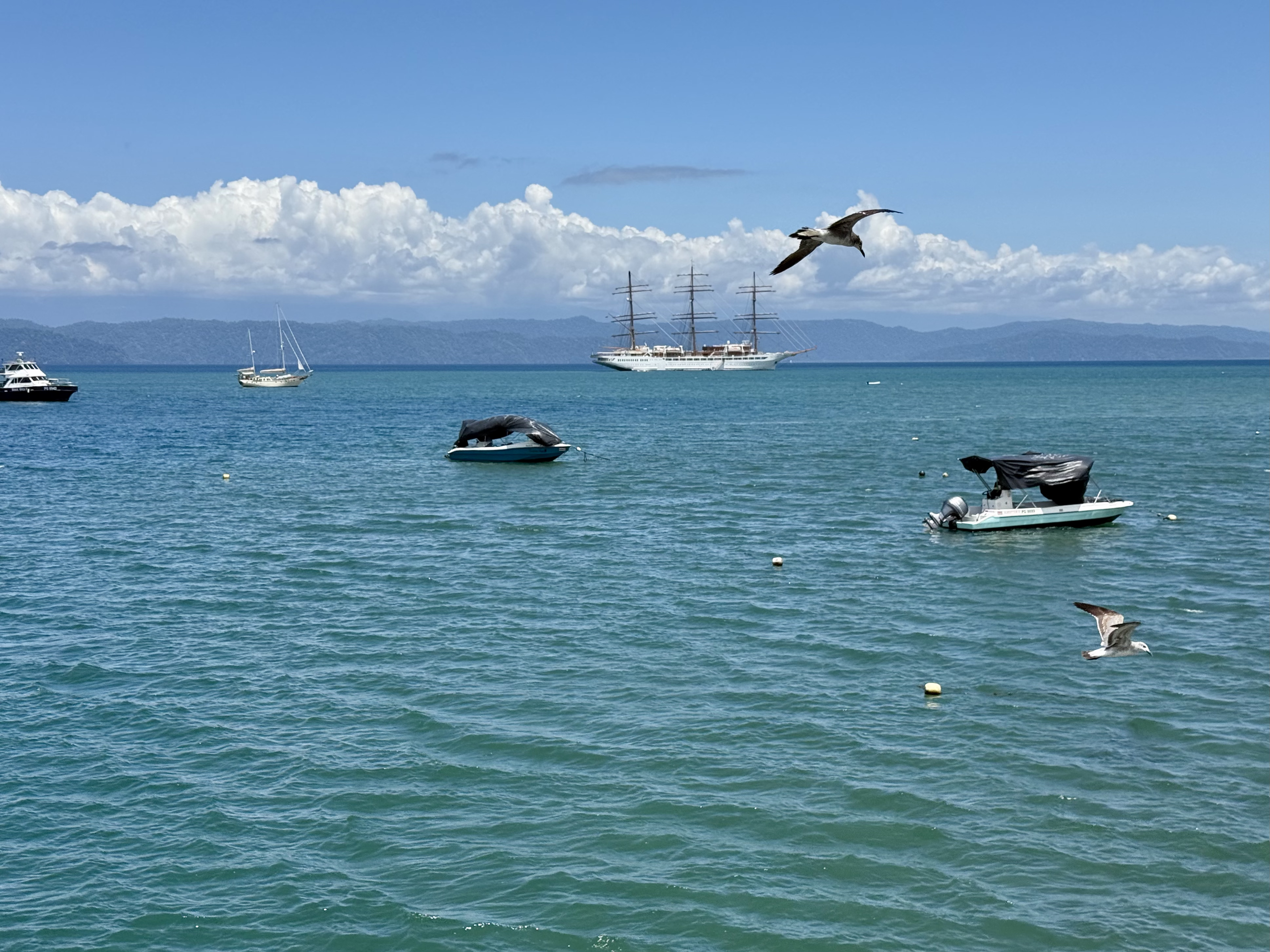
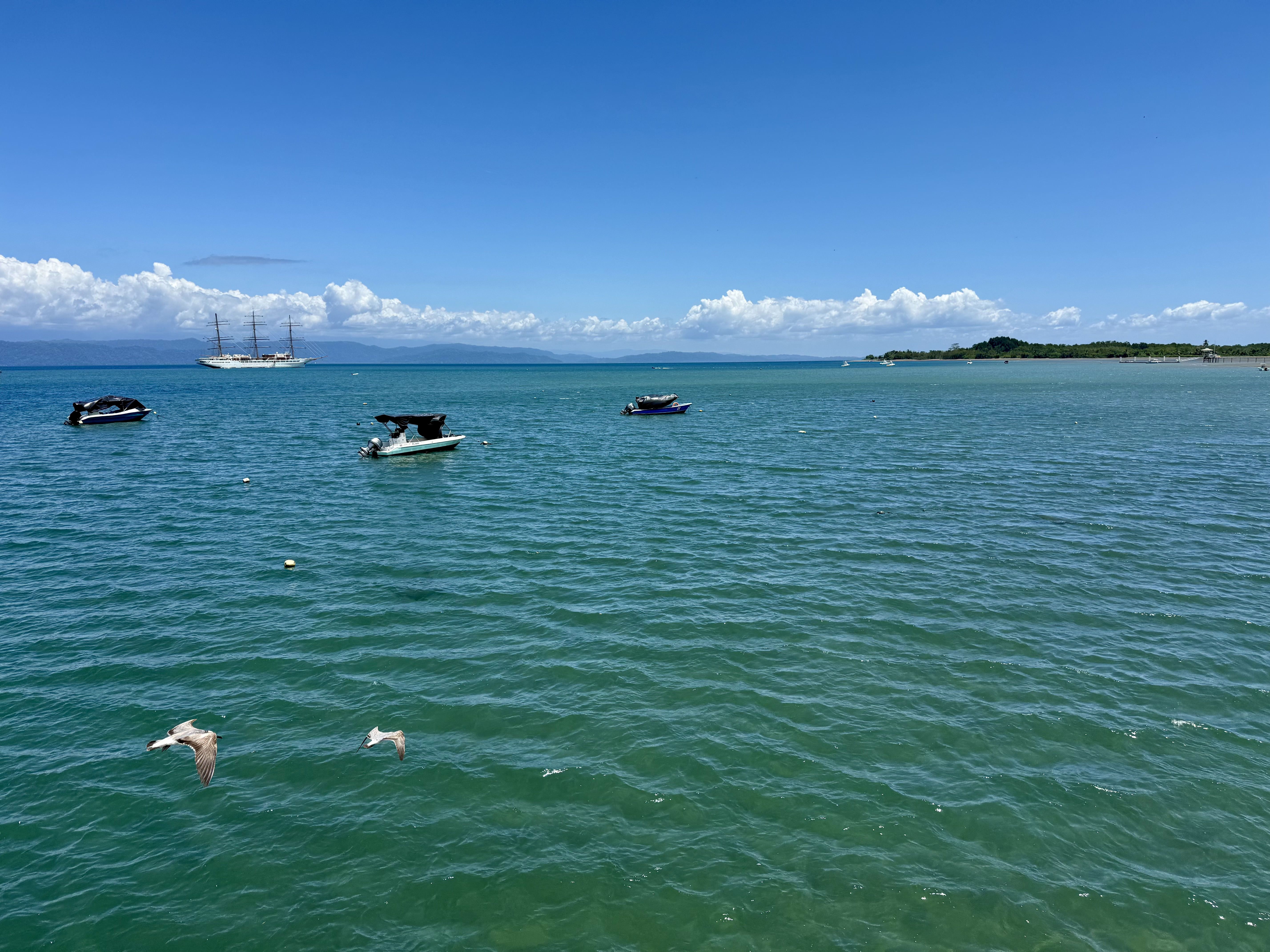
From Playa Blanca we headed down the coast to Puerto Jimenez and the main beach there. This one has a different feel to it as there is more commercial activity in the area, including jet skis, but the beach itself is lovely with palm trees all along the shoreline. There is a short pier from where a car ferry departs for Golfito on the opposite side. I took some photos from the dock of the boats moored in near the beach. Two were especially remarkable, the first was tied up at the pier and was a large catamaran from Florida. It was a beautiful boat. The second was even more striking; it was a three-mast sailing vessel. When we stopped for lunch at the beachfront restaurant, folks from the Sea Cloud, the name of the vessel, were there. As they were speaking German I asked about the ship and learned that it took mostly German and a few English-speaking passengers on cruises between Panama, Puntarenas, and sometimes up to Cancun. They did put the sails up when the wind was conducive, but at night they sailed by motor. The ship can take up to 130 passengers. Many of those passengers were the ones using the jet skis. There was hardly anyone swimming in the area and when I asked why the fellow from the Sea Cloud told me that everyone had to get out of the water as a crocodile had been sited. I guess it is better to swim off of Playa Blanca.
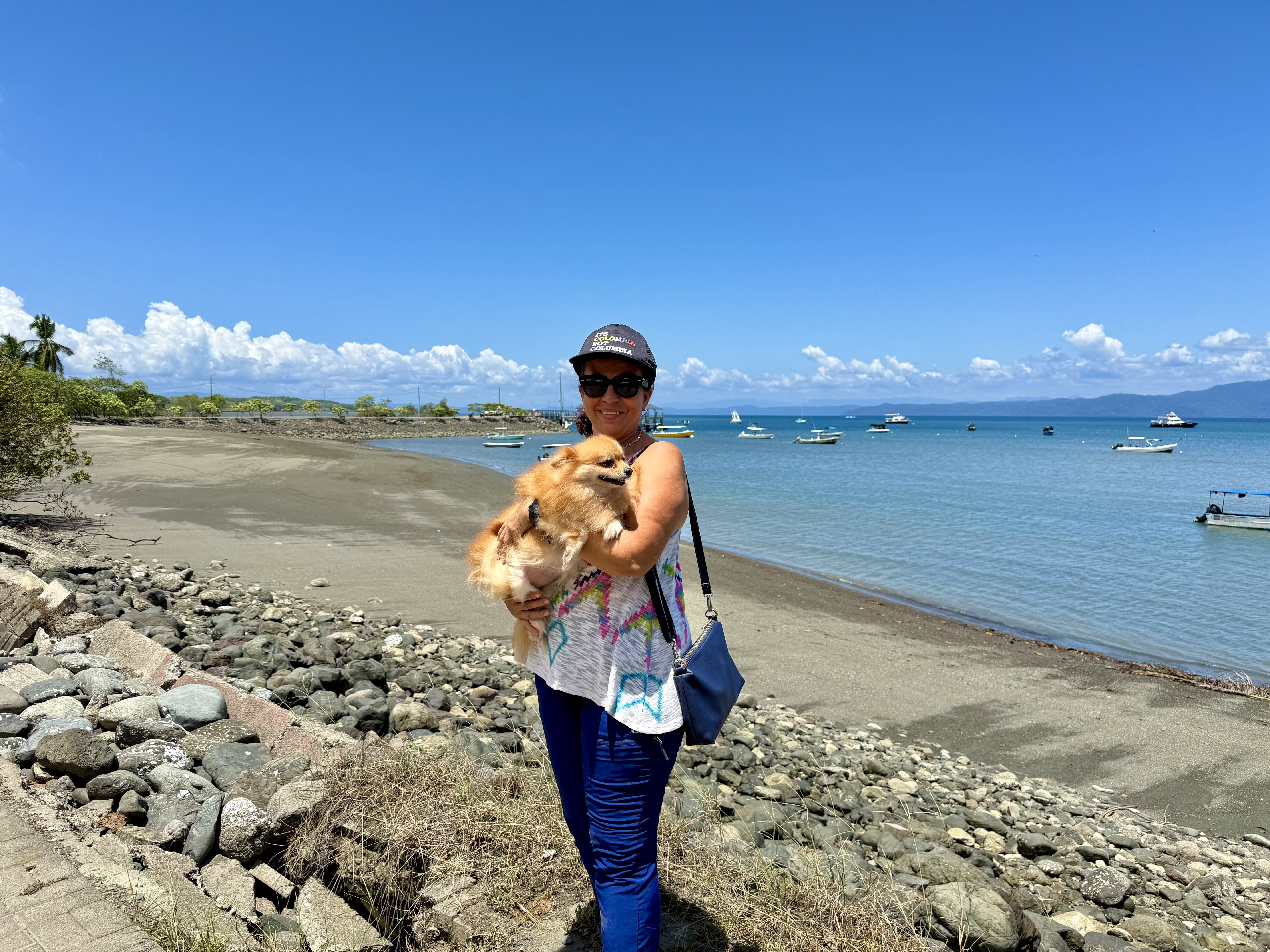
Nubia was a little concerned that the GPS was sending her in the wrong direction to the El Cerrito place I was staying, but the windy rocky relatively steep road was the correct one. It was good to meet her and learn of her story. Everyone has one and it is fascinating to learn how others have managed the ups and downs of life.
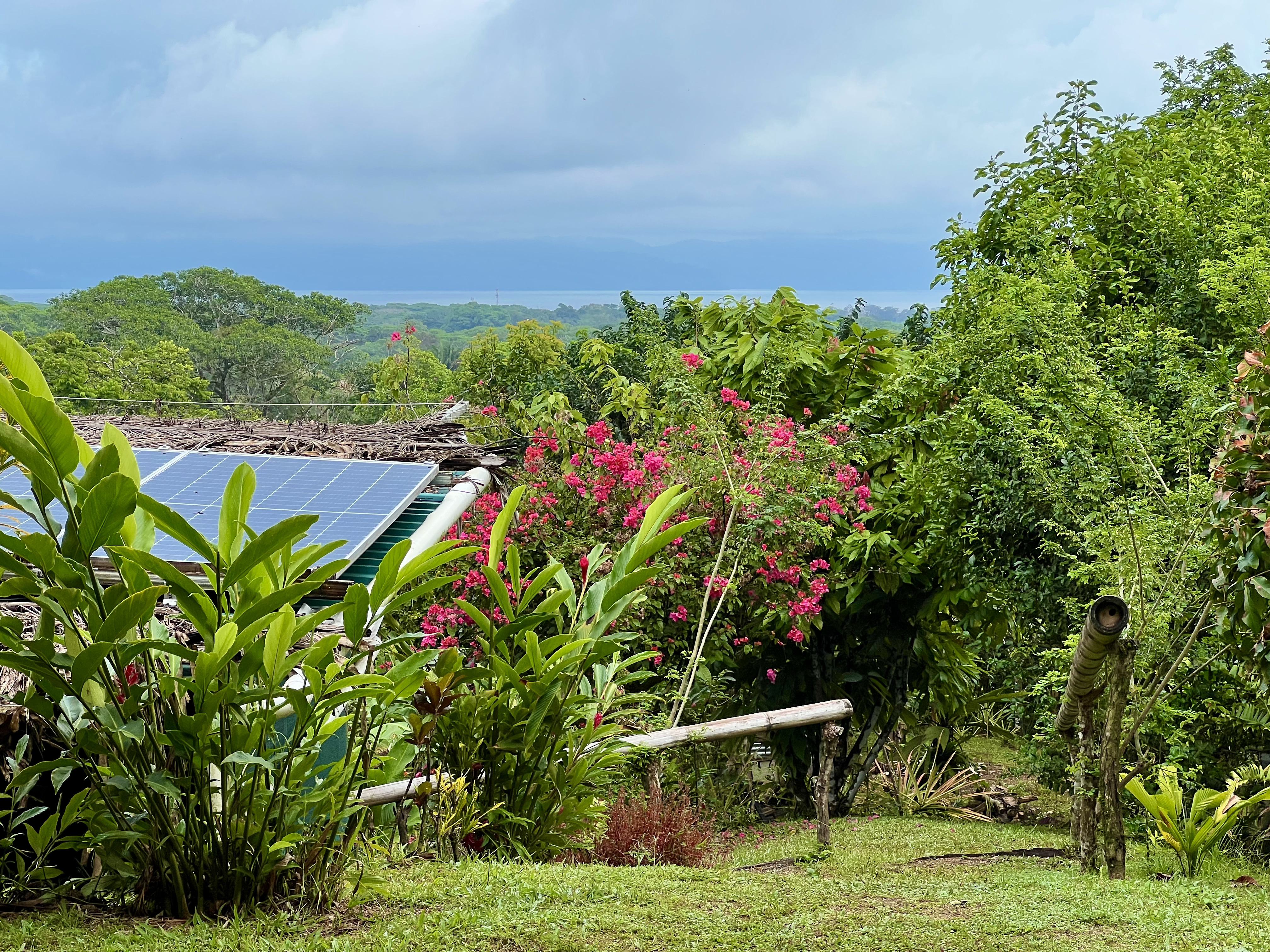
El Cerrito is owned by a Costa Rican couple and a young expat from Manhattan. The land has long belonged to Dan’s family, but it hadn’t been used for many years before he and his wife, Lis, decided to leave the city and move to the countryside. They started without any conveniences, such as power and water, but with the combined efforts of their young neighbor, Allison, who had just moved in across the dirt road, the three of them worked tirelessly to put in electricity, create water sources, build cabins and residential structures. Their story is one of tenacity, perserverence, love of the land, and the power of friendship to create a dream come true for all of them.
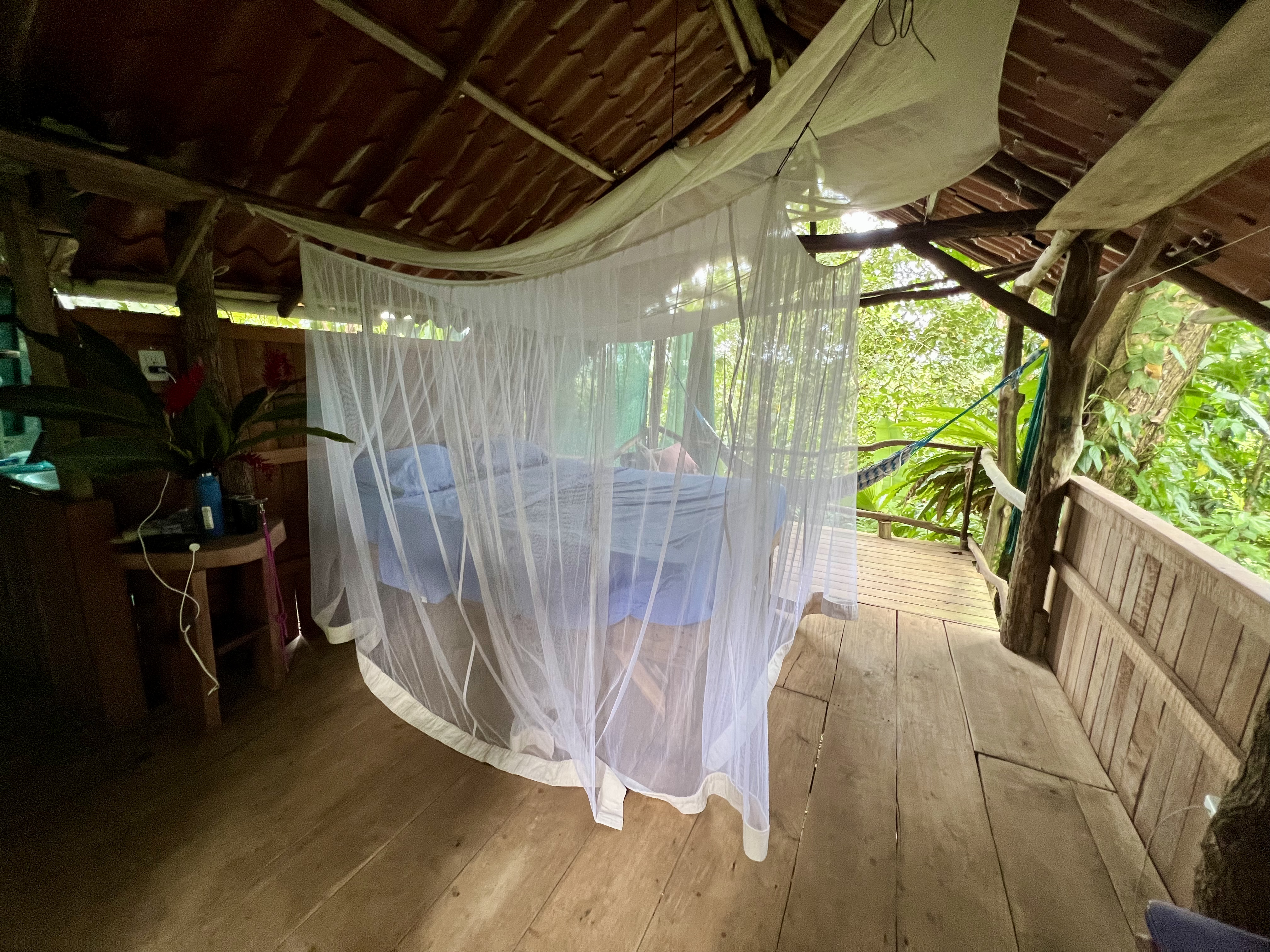
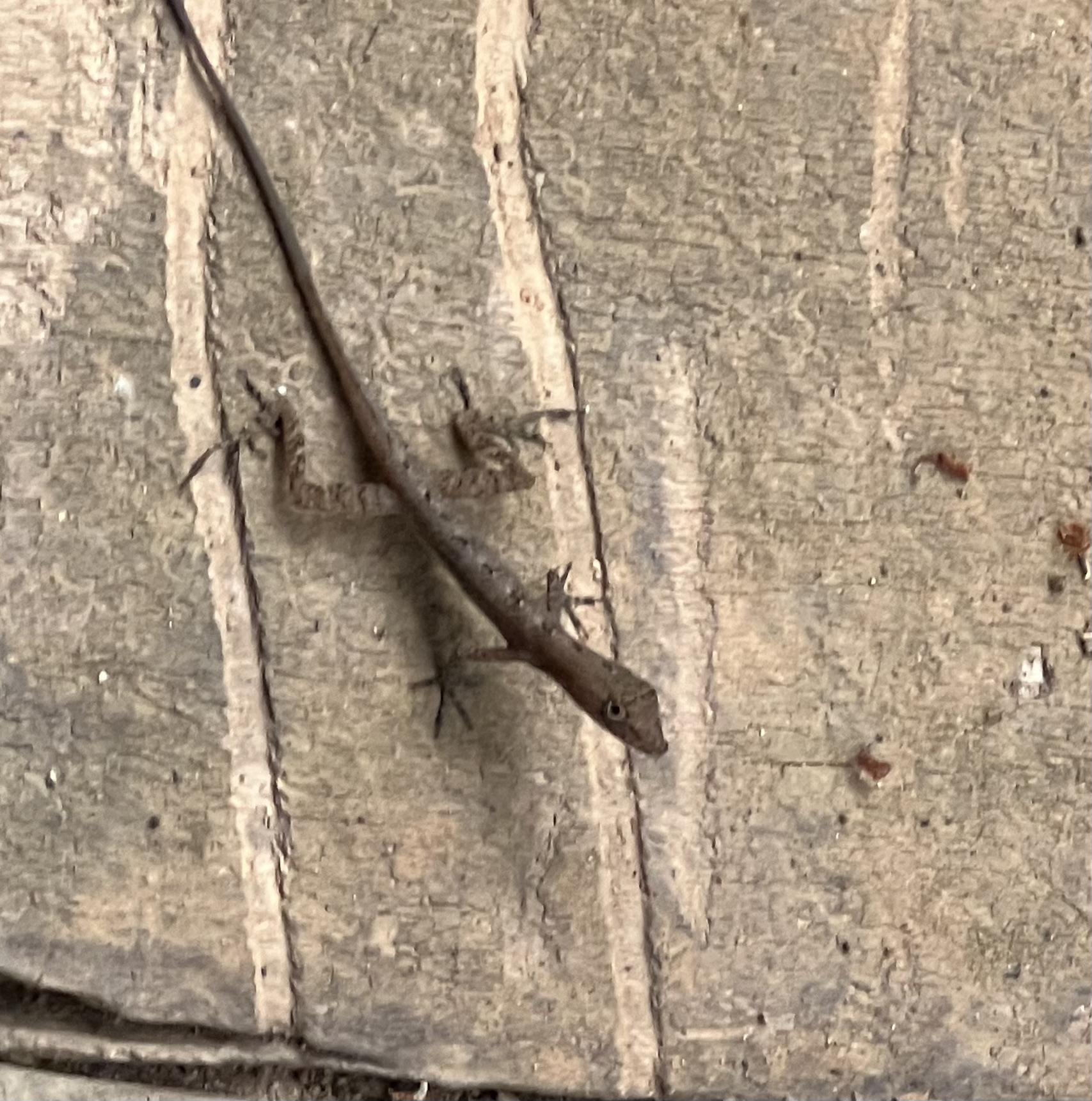
El Cerrito is very rustic; my cabin is basic yet set in the most glorious jungle. Little cute lizards run across the wooden plank floorboards and the family has four dogs of various sizes. It is a nature lover’s paradise. The wildlife is kept at bay by the dogs, but howler monkey screeches, insect and birdsongs can be heard throughout the day and night. There is supposed to be a mother and baby sloth near the entrance to the compound, but I wasn’t able to locate them.
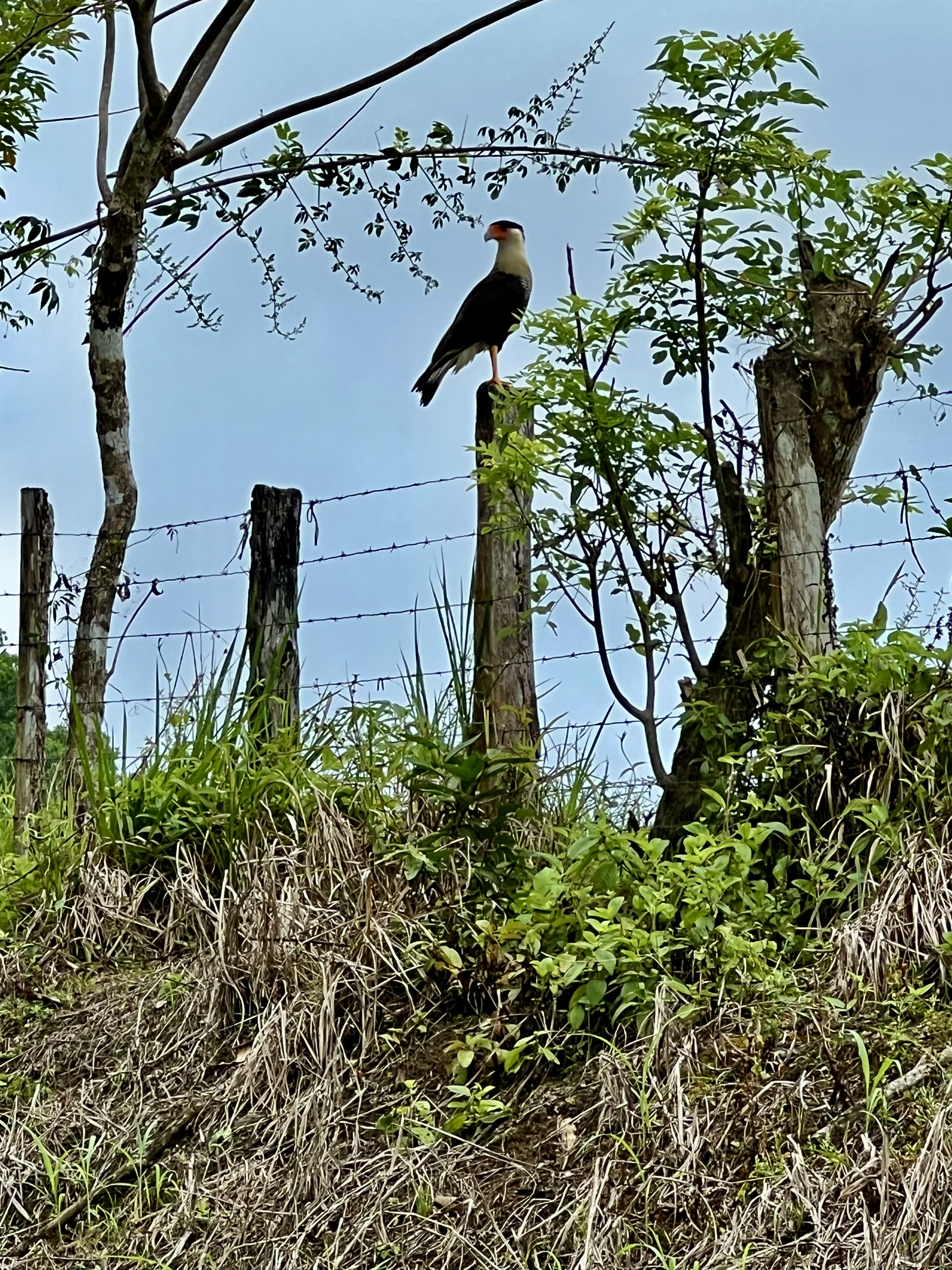
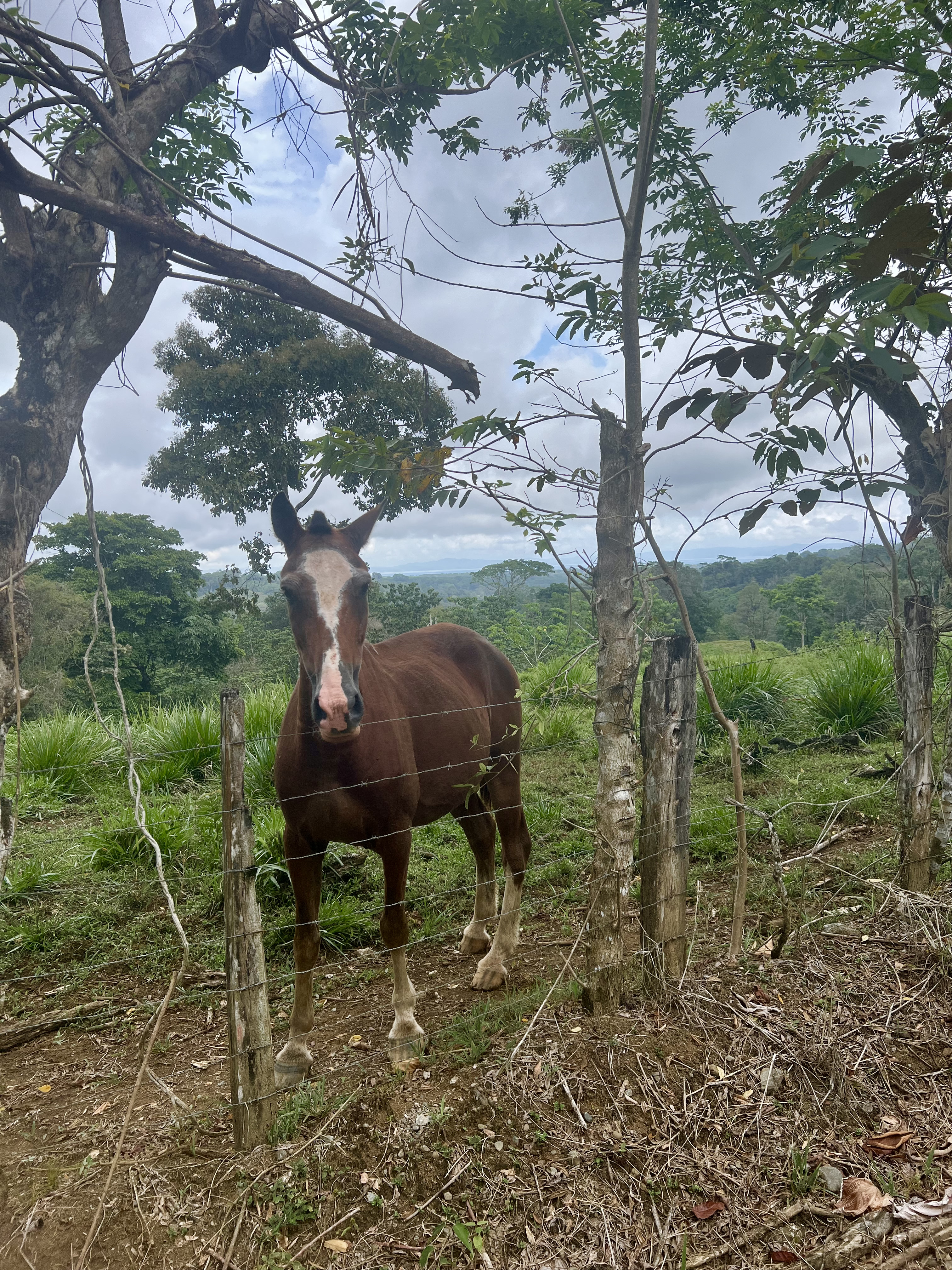
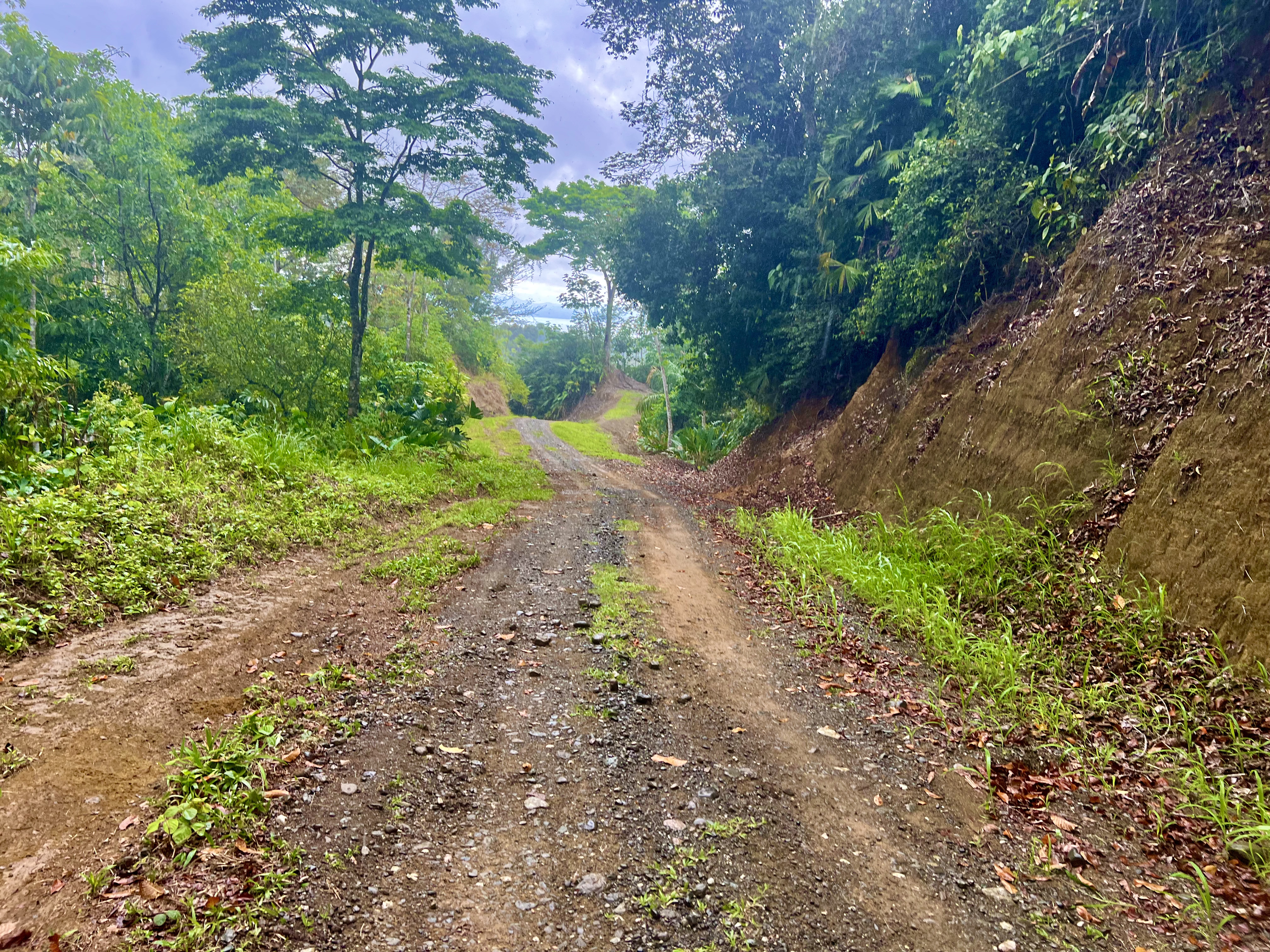
In the morning, I went on a walk up the back road to find the howlers, but, unfortunately, didn’t see them. Instead, I found a few horses in the fields and a few dogs, some of which tried to chase me. At the last minute, I had decided to take the umbrella as a precaution and was glad I did; first to ward off the barking teeth baring dogs and later to ward off the rain when the downpour suddenly started. Even in the rain it was a serene walk with no noise other than the wind, rain, birds, and howlers.
After lunch, my hostess, Lis, gave me a tour and lecture on medicinal plants that grow in her garden and in the region. Every bush and tree in the yard seemed to have a medicinal effect. She had studied with shaman from a number of cultures in Central America and Columbia and brings this knowledge to her garden. It was amazing to learn that even regular bougainvillea leaves can be helpful with eye ailments. As she went through the hillside jungle garden, she pointed out quite a few plants that were supposed to heal gastritis and kidney problems and others that killed cancer cells. At the end of the tour, she pointed to a ground cover plant that she said helped with epilepsy. It was a fascinating tour.
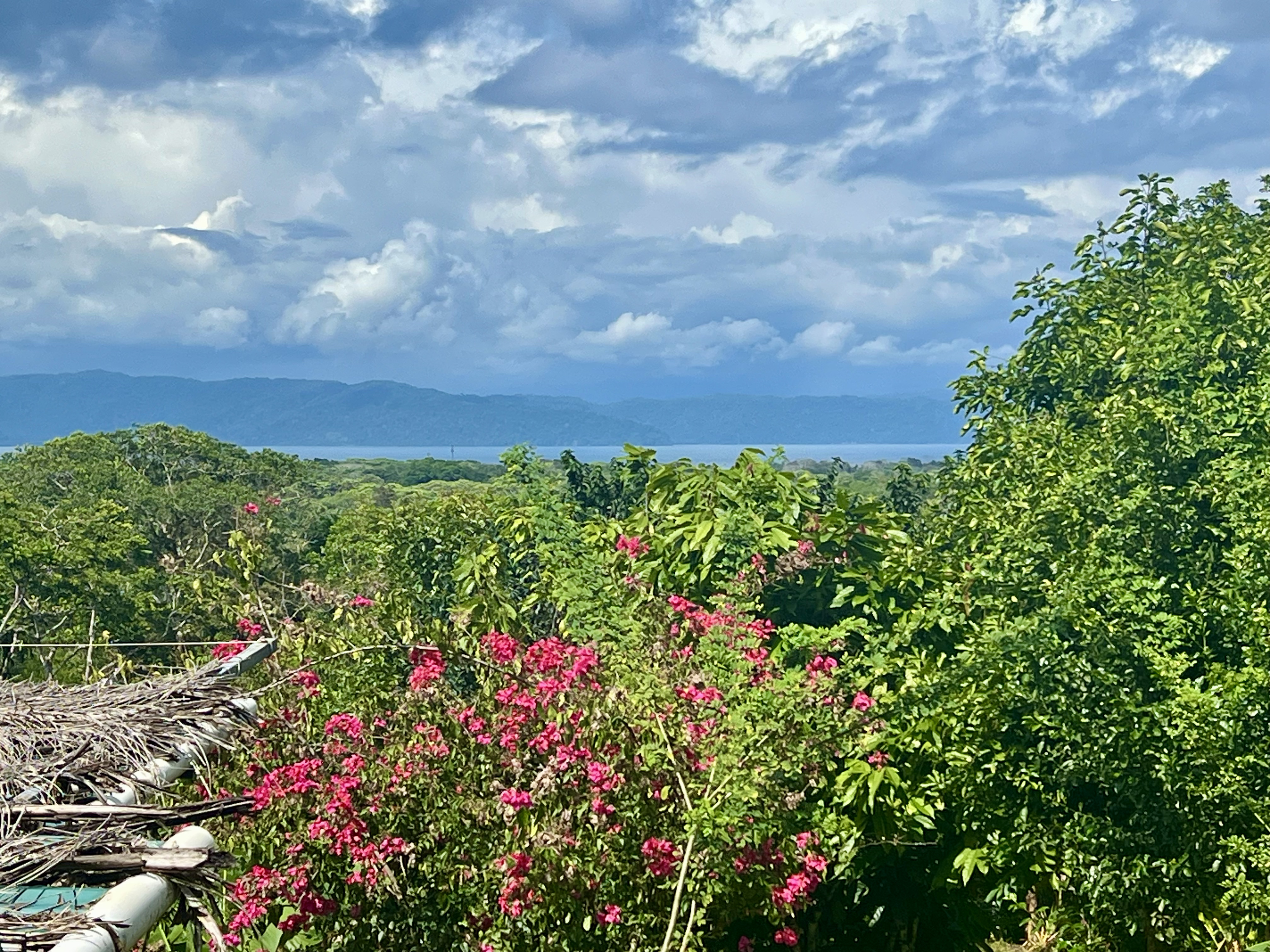
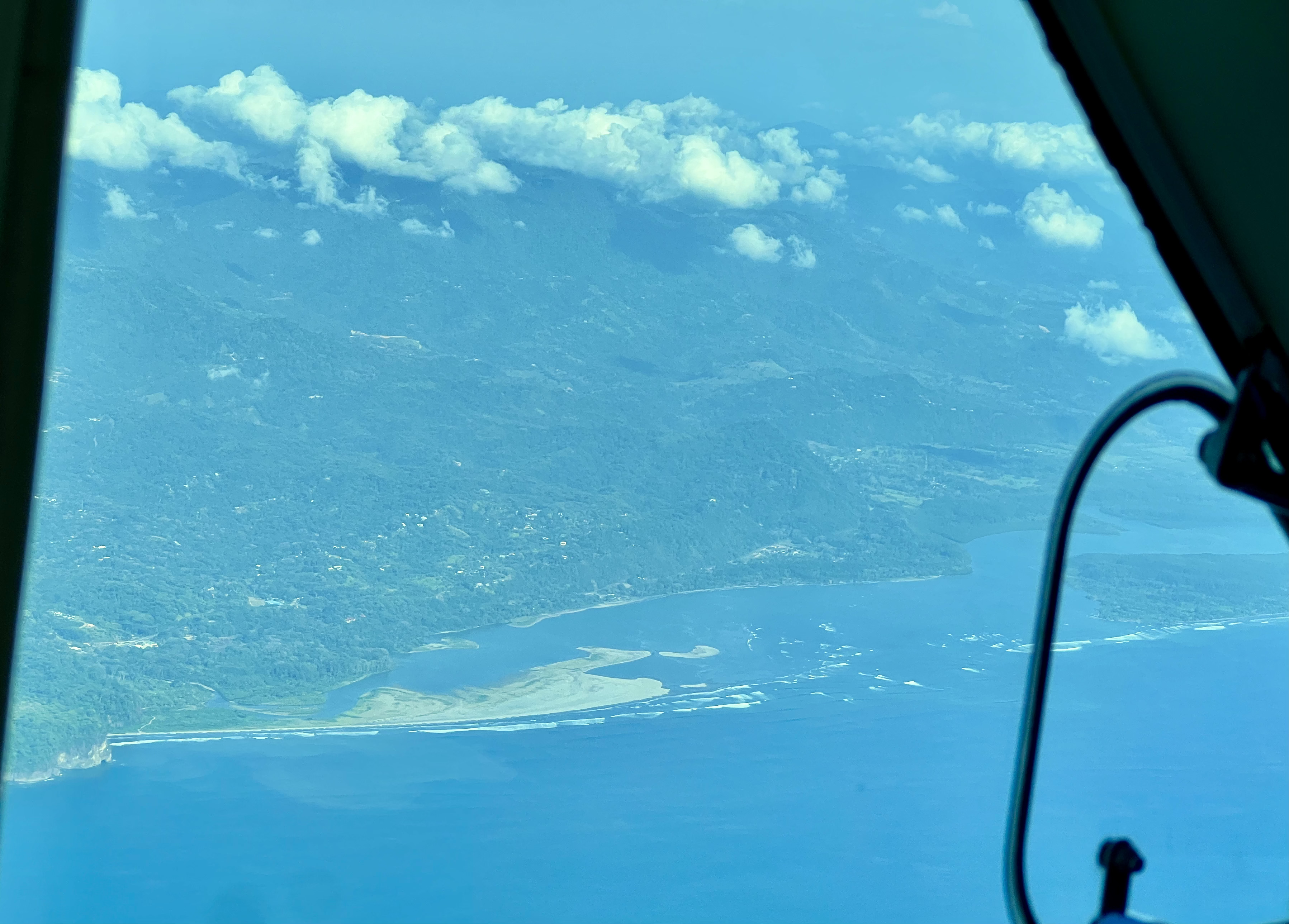
After her very informative discussion, Allison drove me down to the beach where I went on a three-hour evening kayak trip in Gulfo Dulce. I didn’t bring my iphone with me because I didn’t want to get it wet, so, unfortunately, I don’t have any photos to show. The trip with Gabriel as a guide was wonderful. Almost right away we paddled among a school of bottlenecked dolphins, then followed a mother and son around the bay. When they retreated, we headed up a small mangrove lined river where shorebirds, macaws, and snowy egrets were visible. Gabriel explained about the three levels of mangroves along the sides, which are basically three generations of trees. As he was talking, the rain started. It wasn’t strong, but it was a steady flow, and we were completely drenched. Nonetheless, we continued on. Towards the end of the river, or where the kayaks could no longer continue, we detoured into a taller mangrove area until that too was blocked off. Returning back to the main channel, we paddled to a sand dune where we pulled the kayaks up over the dune to the other side of open water, i.e., Gulf side, and put them in amid the waves there. The rain just about stopped when we started to paddle back up the other side of the peninsula we had come down. The waves were gentle, which I very much appreciated! At the top of the peninsula, we again pulled the kayaks out of the water onto a sandy beach area. There Gabriel created a small picnic snack with pineapple slices, watermelon slices, and a very sweet delicacy that was made from his grandmother’s recipe. It included coconut flakes and sugar cane and some other ingredient that I didn’t understand. By the time we were finished with the snack, it was dark enough for the bioluminescent show in the water just by the shoreline. The firefly sparkling creatures in the water seemed to be reflected in the fabulous star show between moving clouds in the sky. After about a half hour with the bioluminescent display, we put the kayaks back in the water and paddled a good half hour in the dark back to Gabriel’s place. It was at times pitch black and at other times, the clouds moved enough for thousands of stars to be visible. This kayak tour was absolutely a unique experience. On the flight out, I was on the wrong side of the plane for a good photo, so I handed the iphone to a person next to a window on the right side. Although the photo doesn’t show the entire spit of peninsula for the kayak tour, one can see beyond the pier to the starting point, then how we went around the pier and bay into the river and where we crossed the sand dune to continue up the other side and then back.
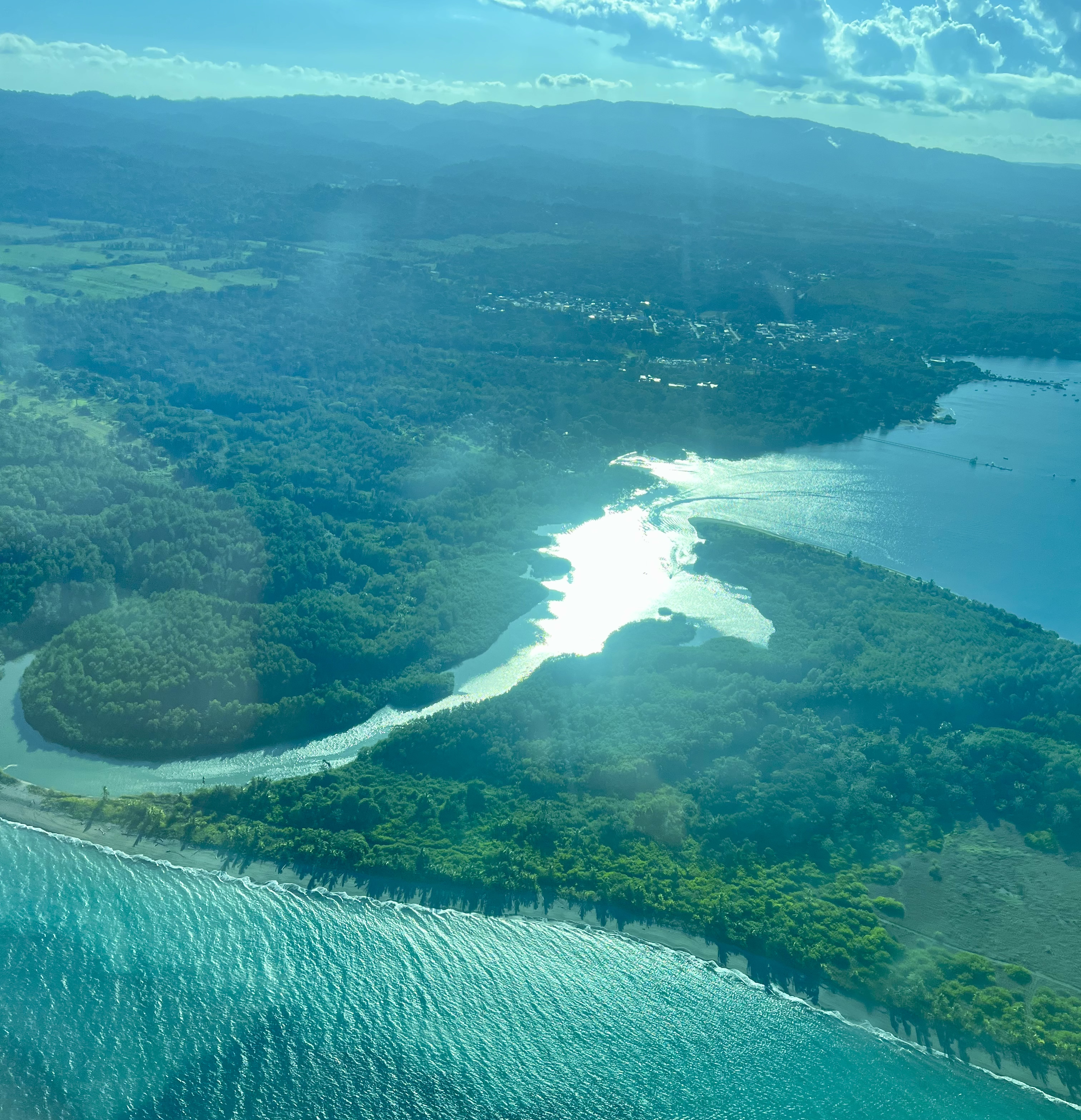
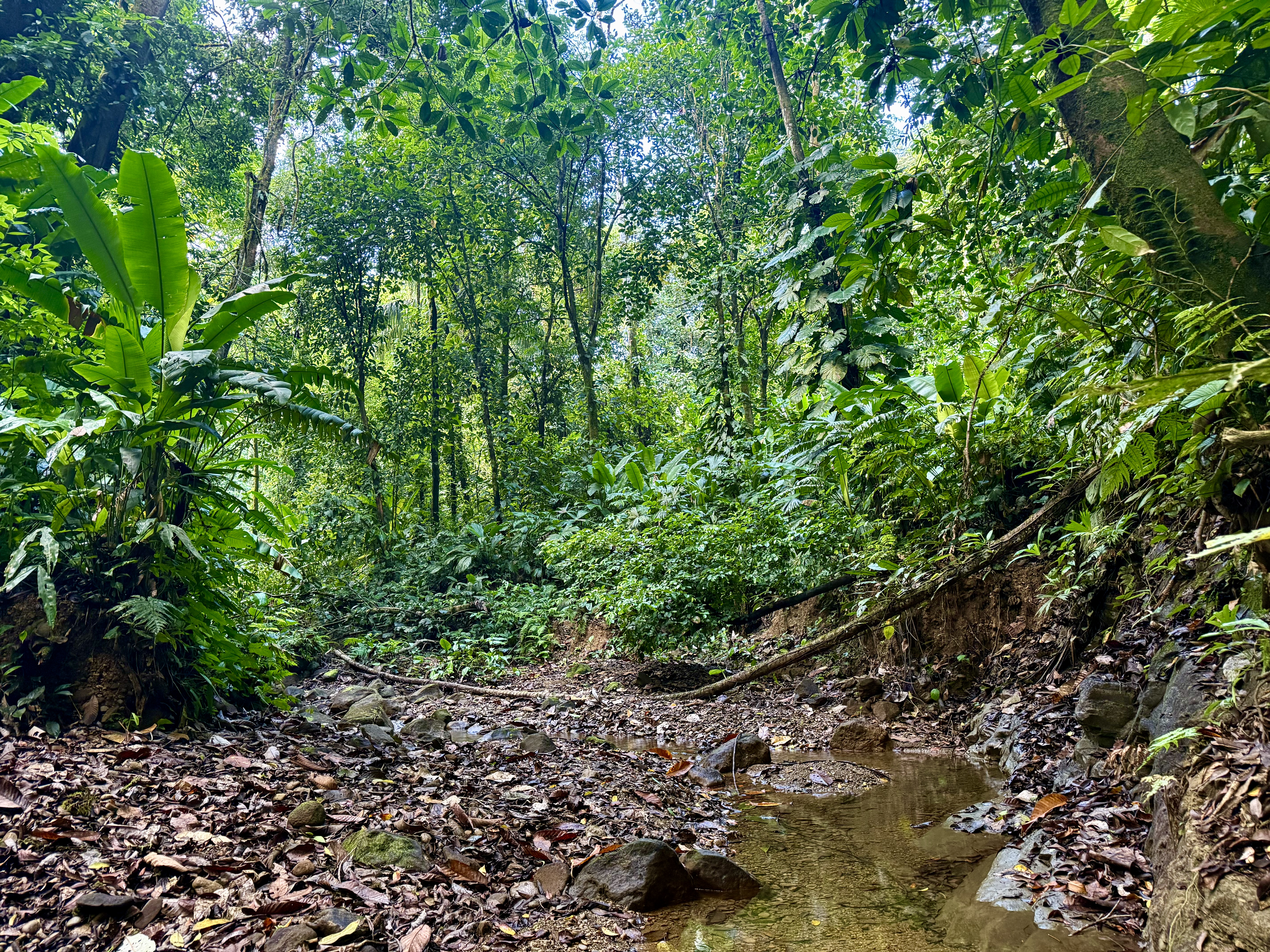
The next morning, a couple of other people staying at El Cerrito and I were supposed to go on a three-hour hike with Dan, but he had a problem with his foot, so we cancelled. The others were going to stay on for a few days, so their hike was only delayed. Allison was concerned that I otherwise would not get to see the primary forest by the stream, even though I was fine just redoing the road walk I’d done the previous day, but she insisted that I really did need to see it. The two of us and her two dogs then headed for the hike to the stream. The path was very steep leaf covered muddy clay. I was glad I brought a walking stick with me. The dogs had a glorious time running everywhere and when we got to the stream, they took off playing and running in the water, just like my dog, Nori, would have done. As it was just the two of us, we decided to find separate spots and just sit and communicate with the rainforest in peaceful silence. This experience was sooo much better than the hike would have been. Simply sitting on a rock listening to the wind, water and birds amid the towering lush green vegetation was a true blessing.
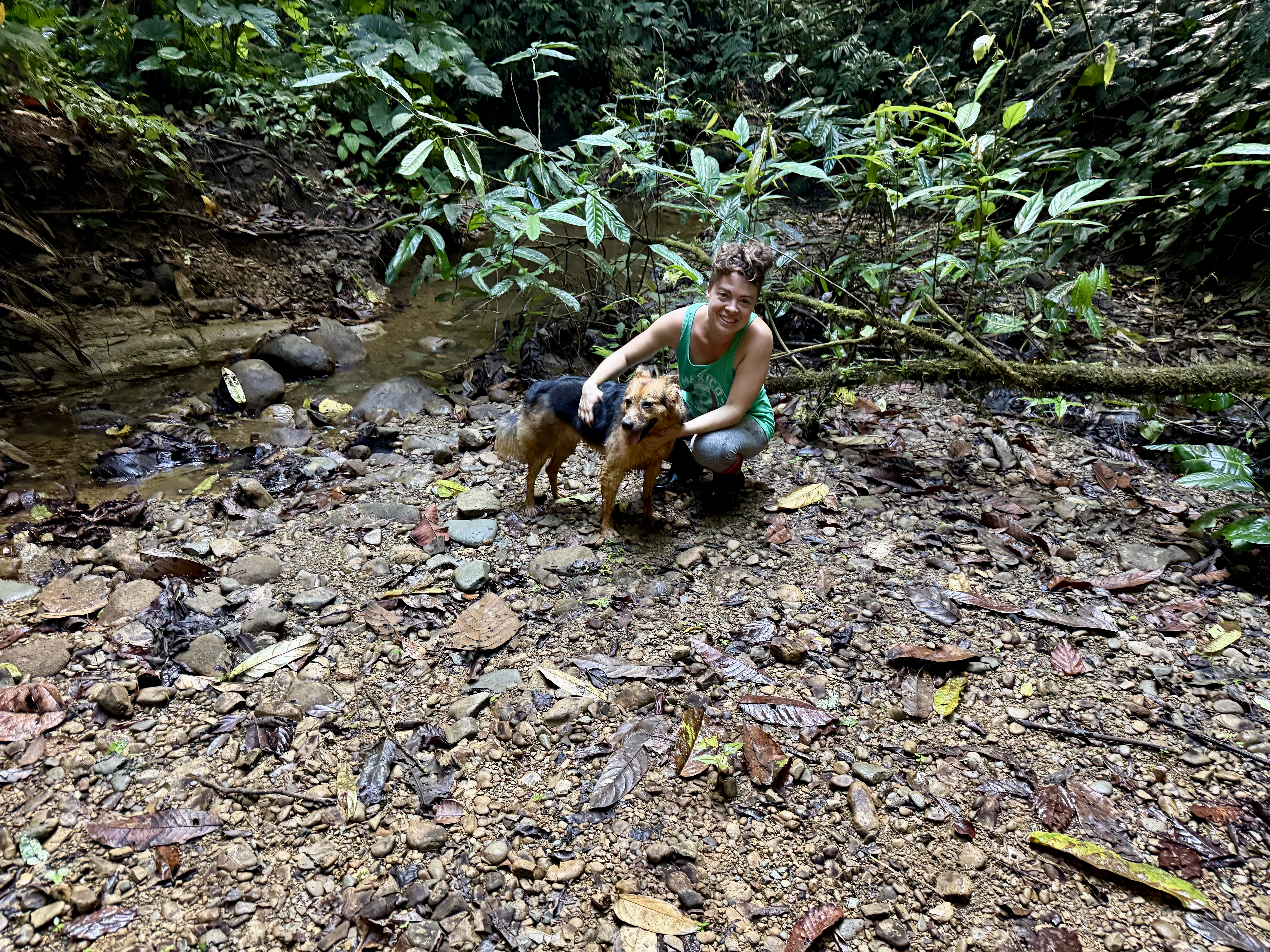
After the hike, I still had time for a much-needed shower – the heat and humidity were stifling, and the sweat just poured off the body – and time to work on this entry before heading to the airport for the small plane Sansa flight back to San Jose.
Just fyi, for those flying on Sansa. My luggage did not change weight for my three flights with the airlines, although the price for the excess baggage did. My bag weighed 38 lbs, much less than the 50 lbs regularly allowed, but on the flight from Managua I was charged $10 for excess baggage, then from SJO to Drake Bay $38, and for the flight from Puerto Jimenez back to SJO a whopping $56. Be prepared to pay extra regardless of how much or little your luggage weighs.
I want to thank Nubia, Lis, Danger and Allison and Gabriel for sharing their love and knowledge of their areas with me. They made the Osa Peninsula portion of my journey both fun and educational.
My time in Central America has come to a close. The next adventure begins back in South America, this time in Guyana.
 omegoodyssey