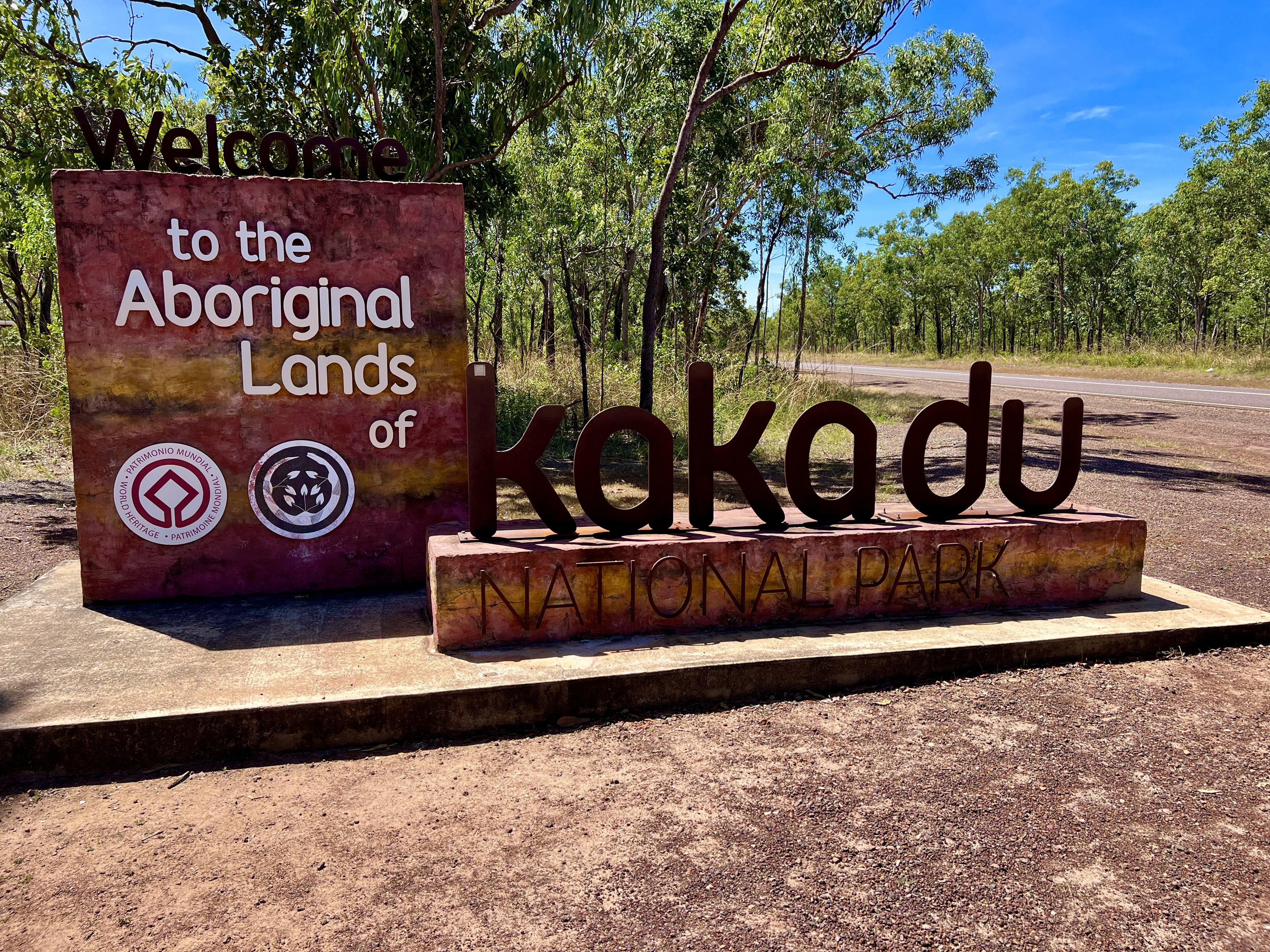
The flight from Cairns to Darwin takes about 2 and a half hours and flies over rainforest, semi-arid terrain, and the ocean. The view was clear and the greater Darwin region looked beautiful from the plane as it was surrounded by greenery leading down to the what seemed like sandy coastlines.
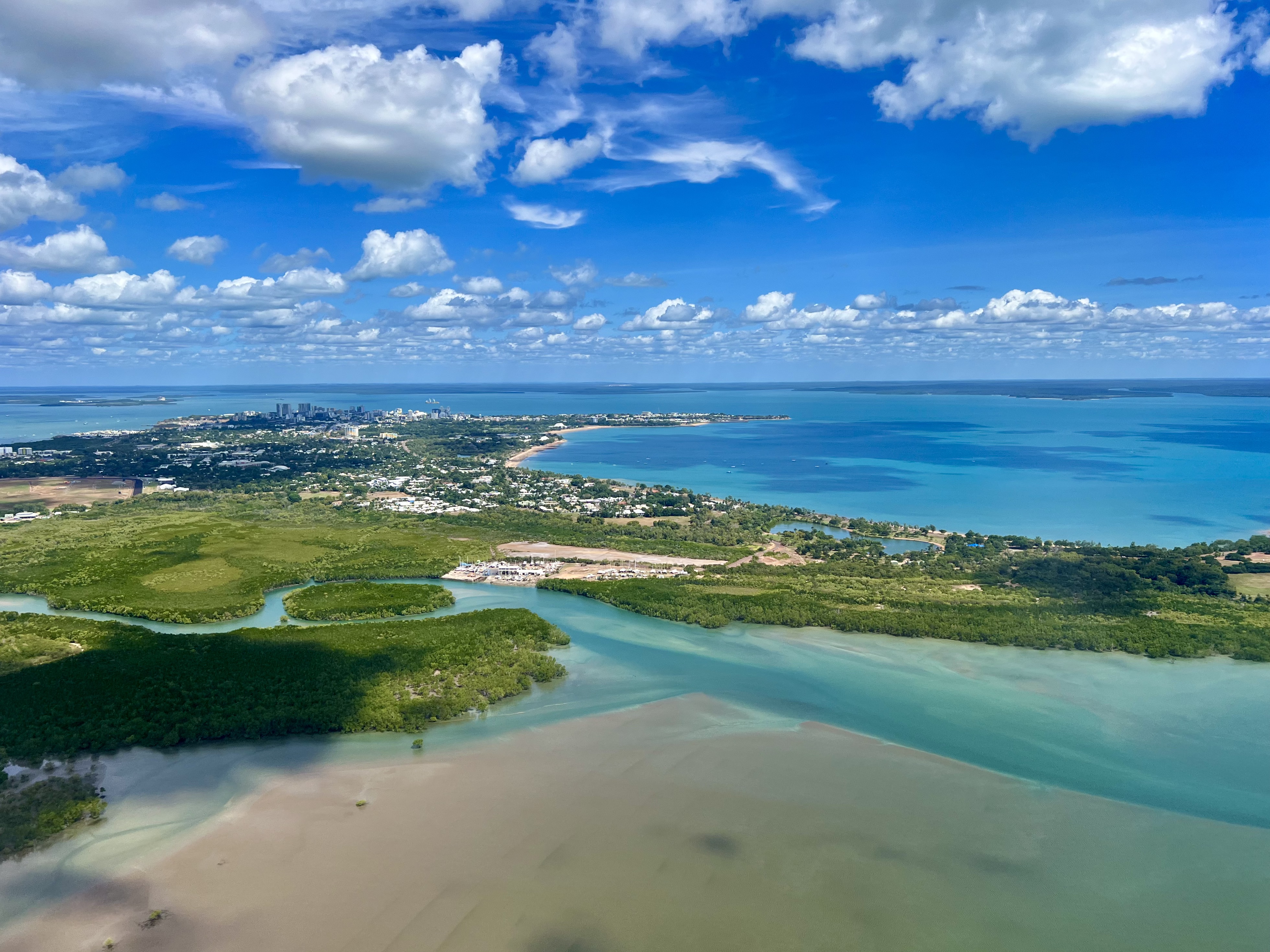
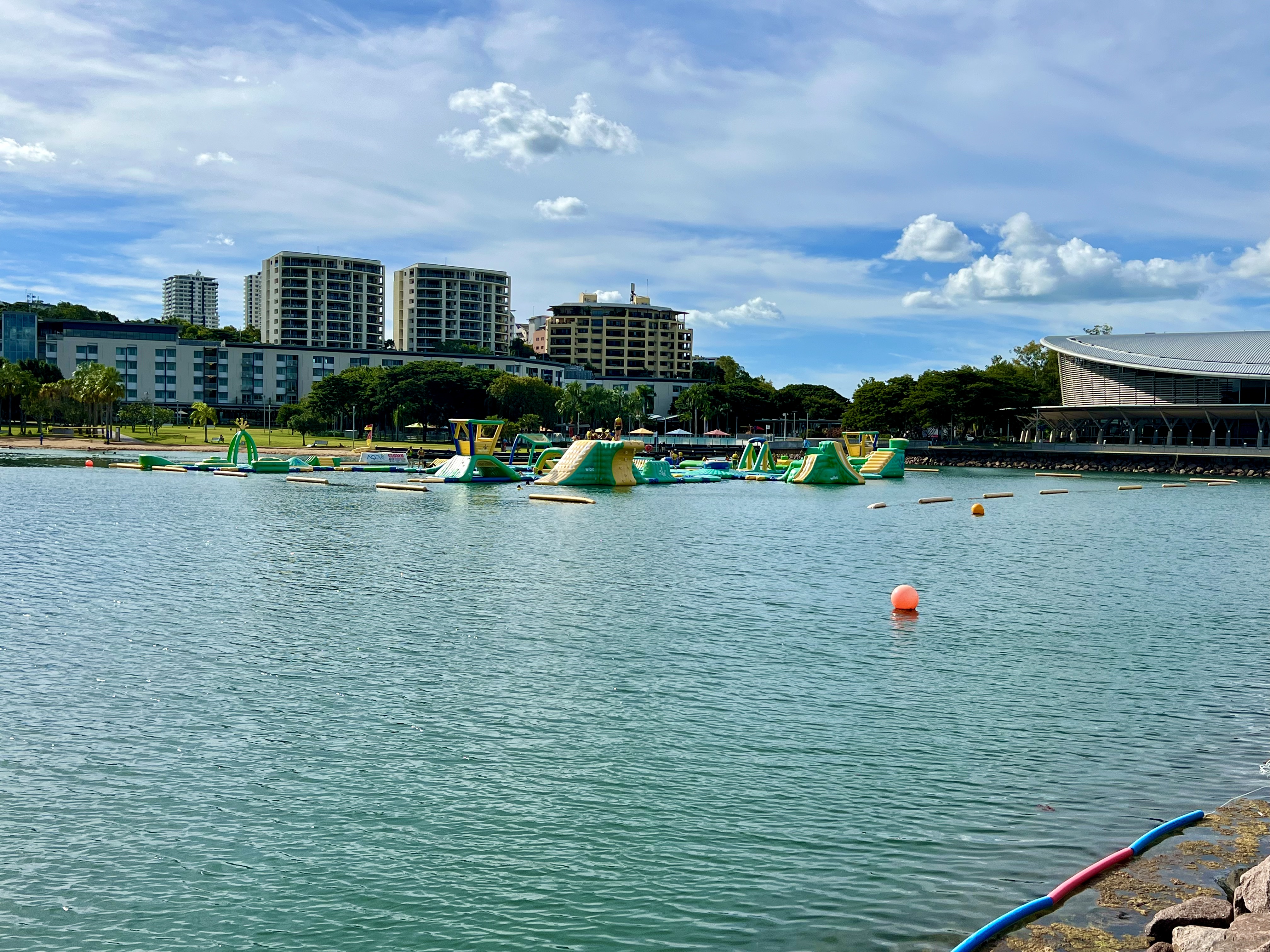
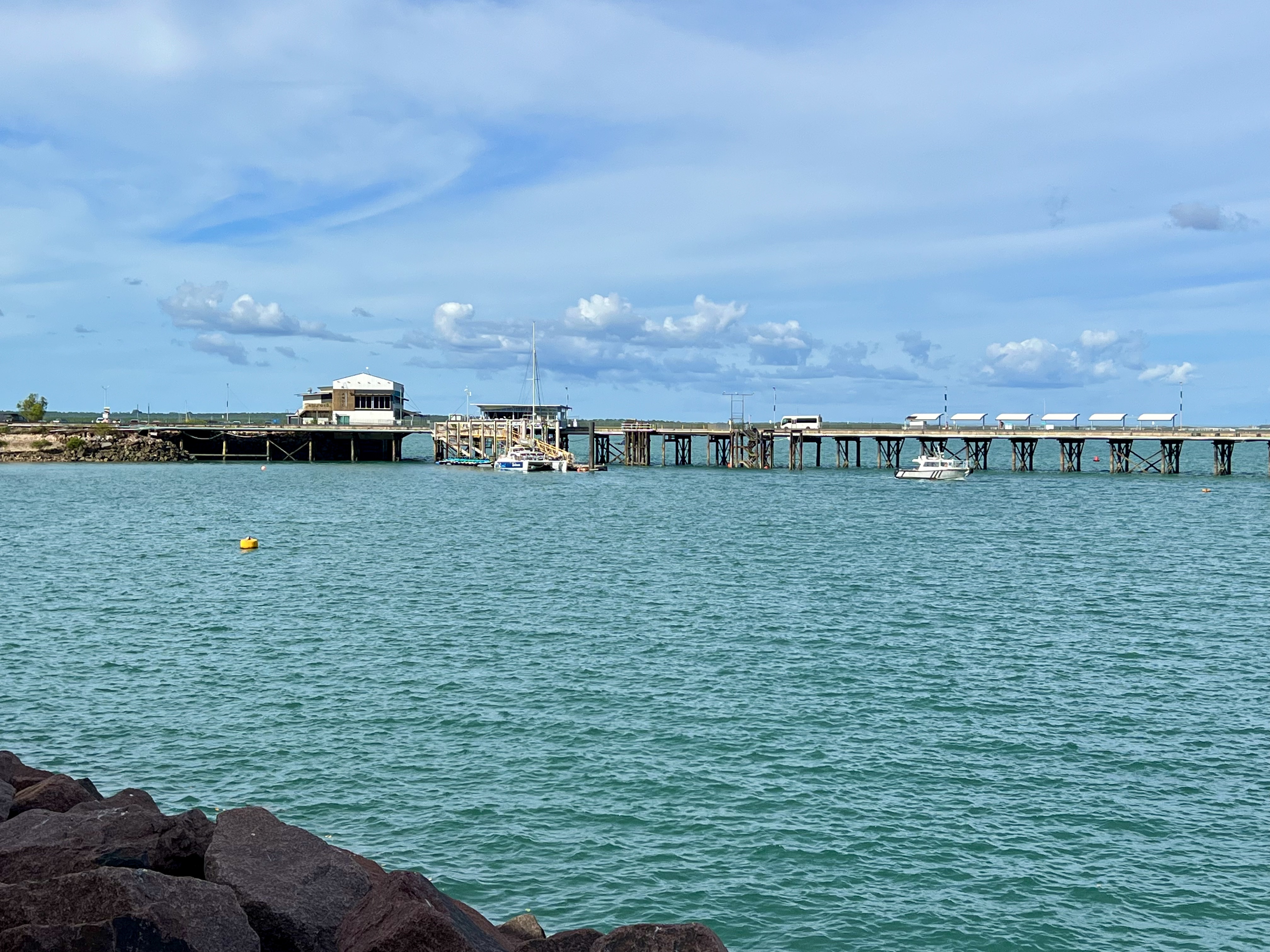
Upon disembarking we were hit with a heat wave; it was much hotter here than it had been in Queensland, and it took a couple of minutes to adjust to the new temperature. There was a sign for taxis outside the terminal and there was a long line of people waiting for one. Eventually, the line dwindled as one by one taxis did arrive to take passengers all over the territory. I was luckily only going into the Central Business District, so the cab ride was about 25 minutes. My hotel was on one of the main streets in walkable distance to the waterfront and wharf. On my way to the water, I stopped at the main Top End Information Center to book a tour to Kakadu National Park for the next day. Kakadu’s Ubirr Rock was the reason I was coming to Darwin, and I was very disappointed when the tour I had booked months ago cancelled. At the Information Center I learned that the road to Fogg Dam, which is part of the tour, was closed due to flooding until late last week. The tours had just reopened. Ticket in hand, or rather on the cell phone, I headed further down the street bypassing the Esplanade to the water’s edge. Here I had a surprise. Instead of a sandy or rocky beach that I was accustomed to, I found an enclosed lagoon with a couple of different sections, one for swimming and one with lots of inflatable platforms, slides, and other kid friendly apparati. In a separate lagoon, across the lawn, there was a large infinity pool. Behind the enclosure was a wall that was wide enough for trucks to drive on and behind that another wall that opened to the sea. Darwin harbor has a unique structure. It is both boat and swimmer friendly, allowing for the two groups to not interfere with each other. The park surrounding the swimming area was well kept and songbirds chirped away in the trees.
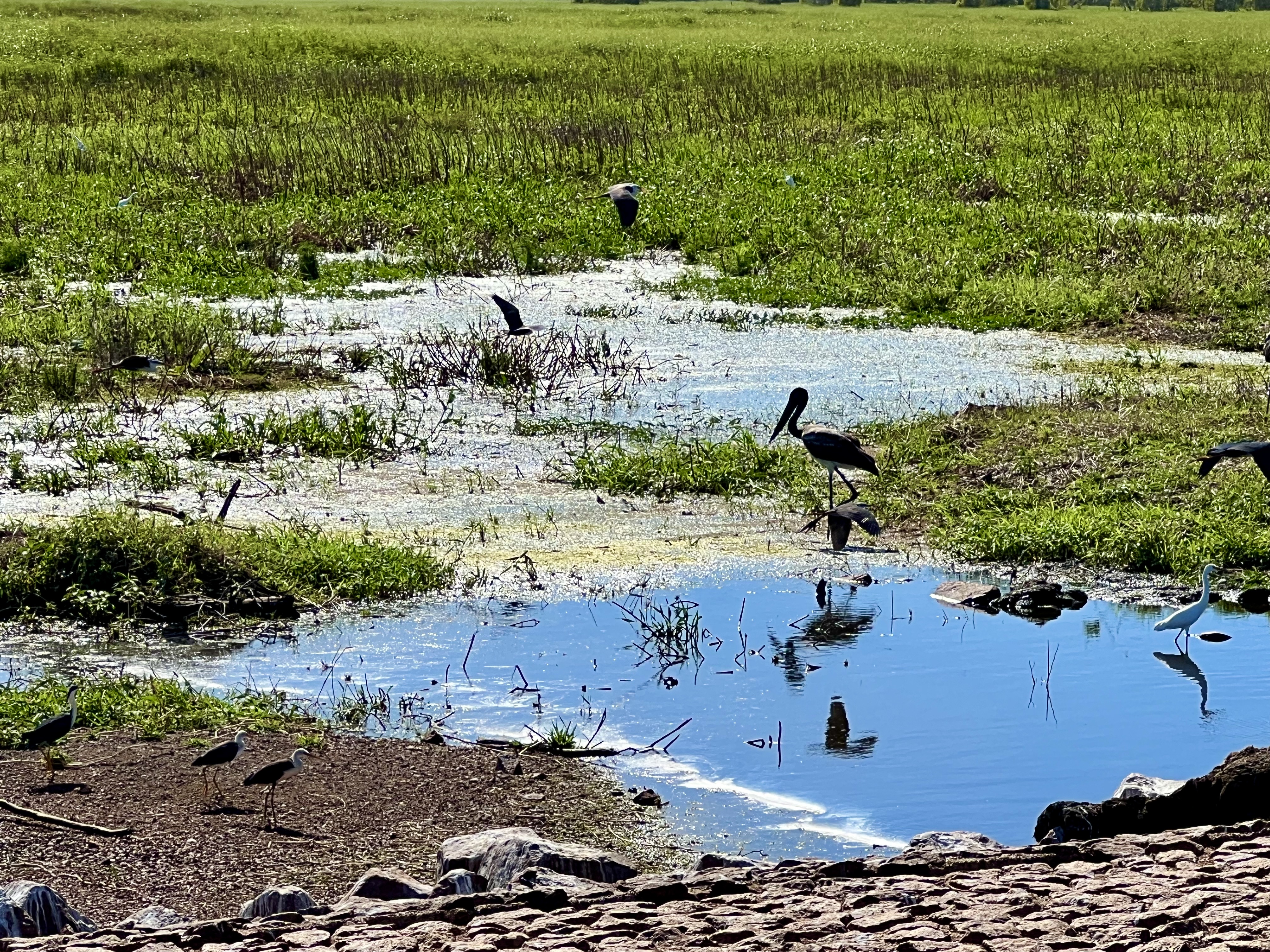
The tour to Kakadu started with a pick-up at 7:30am. We only had six people on the tour, which could have taken up to 25, as it was early in the season and mass tourism hadn’t yet started. The first stop was at Fogg Dam. From the name, I thought this might not be particularly interesting, but I was wrong. The Dam was built in the 1920s, but then never used. It created a large wetlands area, though, which is now home to saltwater crocodiles, pythons, and hundreds – if not thousands – of birds, including quite a few black Jabirus. We saw the birds, but luckily not the pythons, which apparently come out in droves at night, or a crocodile. The road there was still too flooded for a little car, but the 4WD bus made it through without any problems.
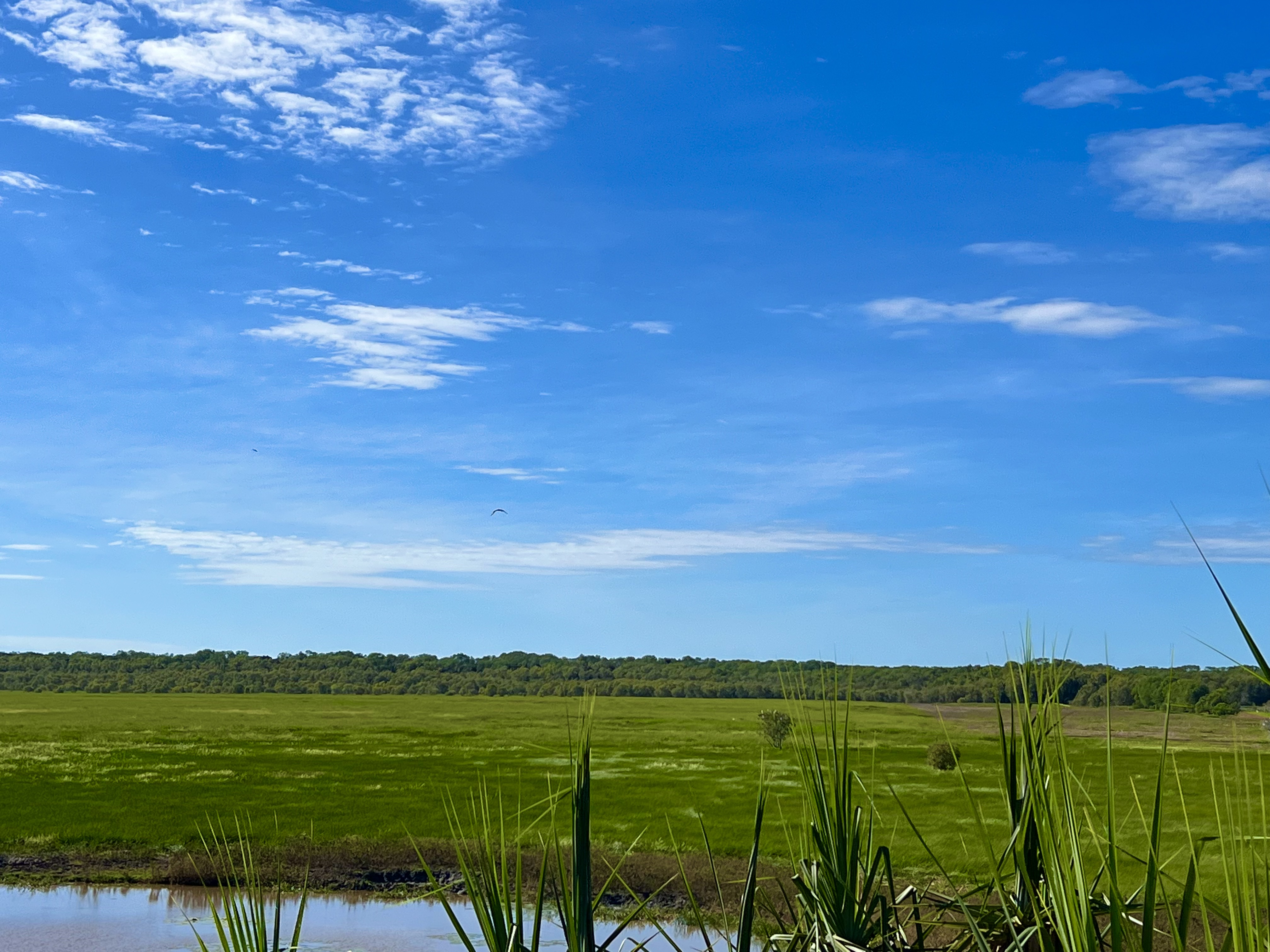
Fogg Dam, do you see the black Jabiru?
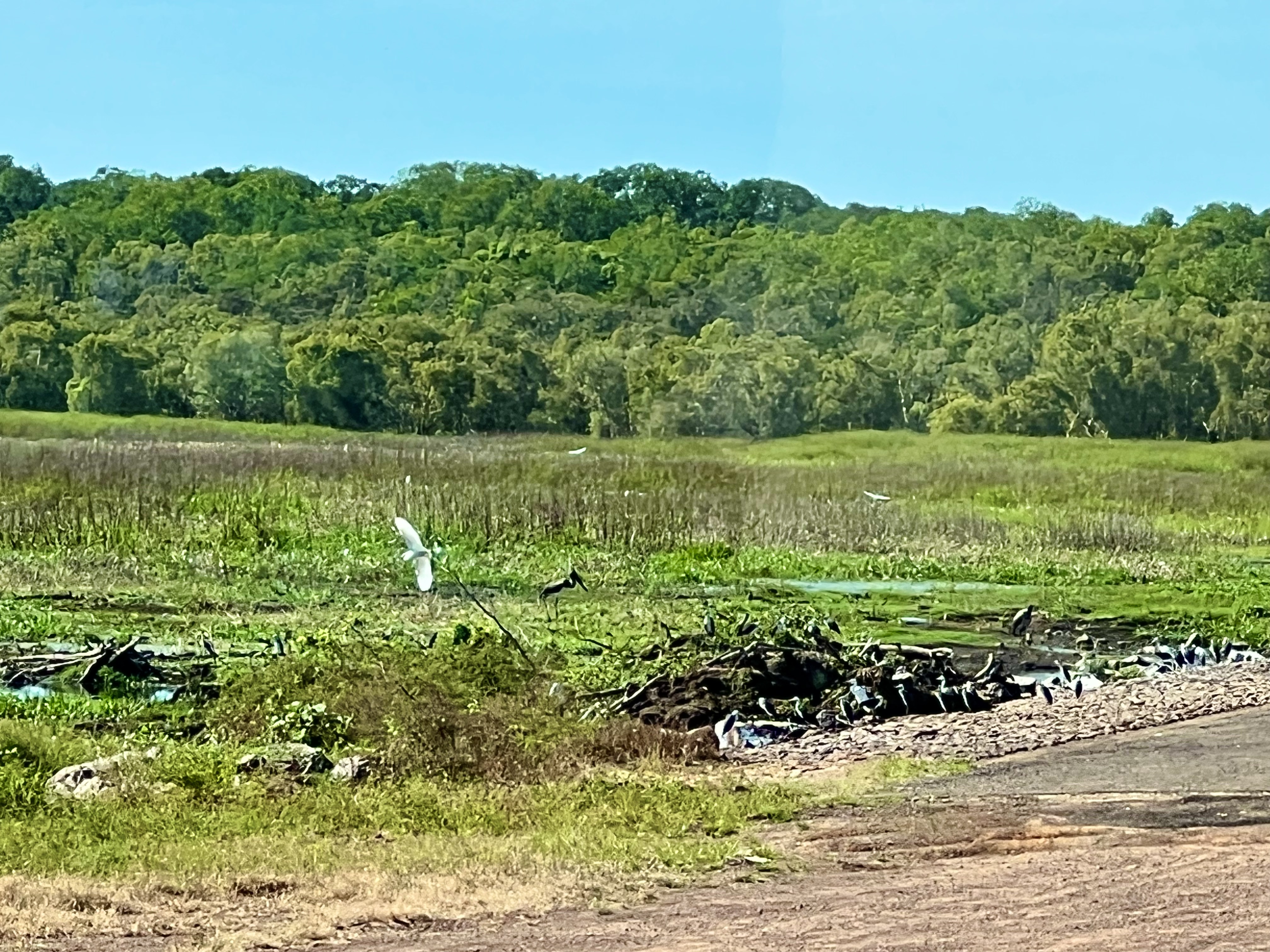
And now?
While some of us were at Fogg Dam, others on the tour went to the Crocodile Feeding show, where the crocs jump high out of the water to get the food the handler hangs from above. For those who are interested in such an activity, there is an extra fee. I wasn’t as I was there for the Ubirr Rock Art. It is about 185km from Fogg Dam to Kakadu National Park and then another 17+ to get from the entrance of the park to the Rock site. It’s a long drive. We arrived after 2:30pm. The drive was worth it. The ancient petroglyphs were fascinating.
Just fyi: For the photos, I have deepened the color and definition so that the glyphs are more clearly visible.
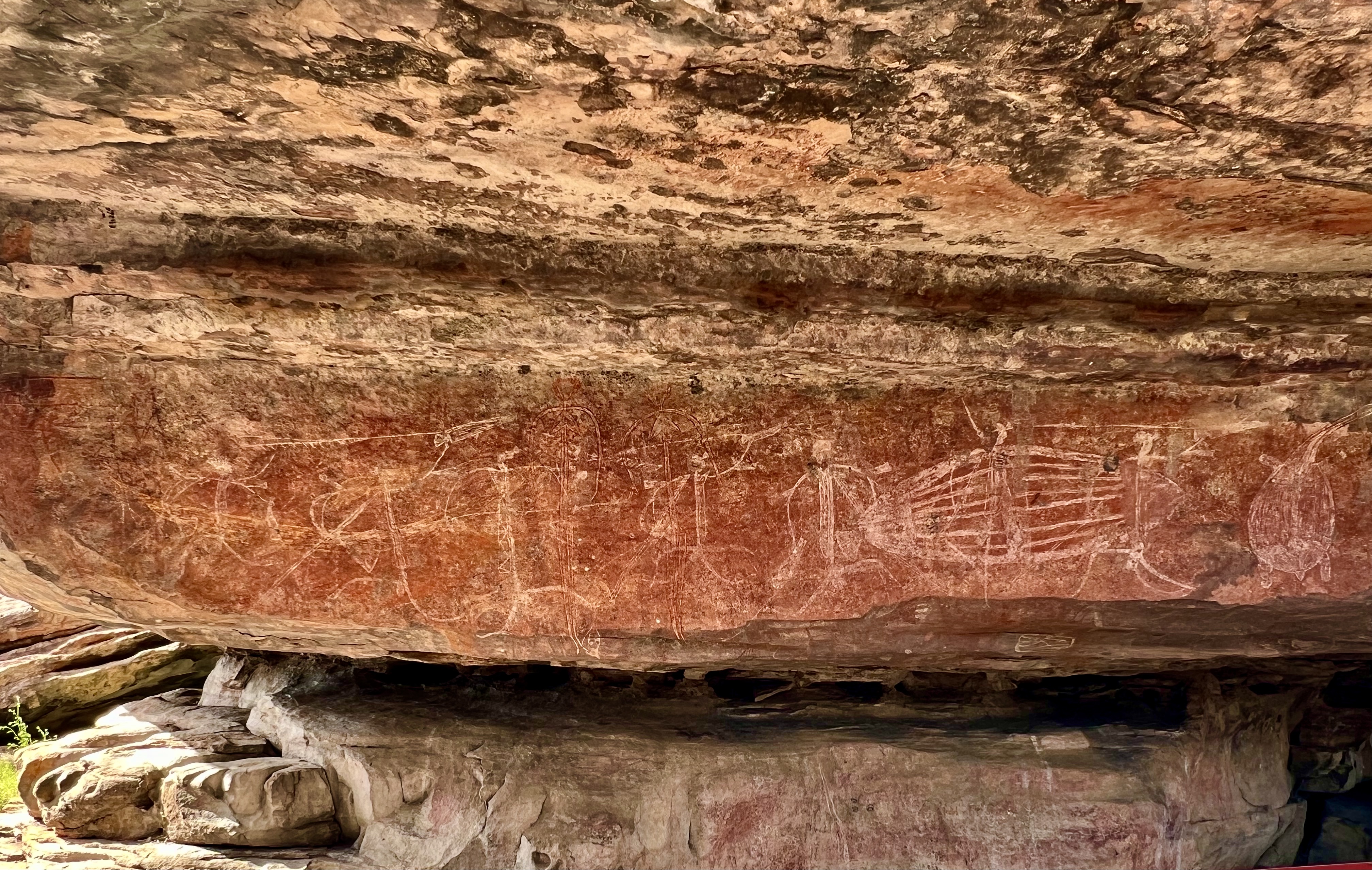
Kakadu’s rock art is reputed to be 20,000 years old. This puts it somewhat younger than the cave paintings in France and Northern Spain, but not by much. There are informative plaques throughout the site. They explained that the original ancestors of the Bininj/Mungguy people (the clans living in the area) traveled across the land creating its natural features. Others say it was Rainbow Serpent who did this. Still others associate Rainbow Serpent with the original ancestor. All seem to agree, though, that while they were creating the topography, they also established the rules for social behavior and language. This is one of the reasons why Aboriginal people are inseparable from the land where they are born. Land is country and country is not just a place, but also the people, family, social groups, etc. Country is to be protected at all costs as it is the basis for the society. Infringements against the norms, which are pretty strict, are severely punished, with physical punishment as well as banishment. Freethinkers are not encouraged as that upsets the balance of life. One of their stories tells of a young girl who broke with traditional values by eating a Barramundi (a kind of fish) at the wrong time. She was so severely punished that a war among clans broke out and many people died. Her transgression harmed the entire community/country. The legends and the messages in the rock art provide illustrative examples of the lessons children learn. The drawings have been painted and repainted many times over the past millennia. Rainbow Serpent in the first gallery is not quite distinguishable from the masses of red color that has been laid on in layers. In the main gallery, however, the illustrations of what food sources, primarily fish and turtles, can be safely eaten are clear for all to see.
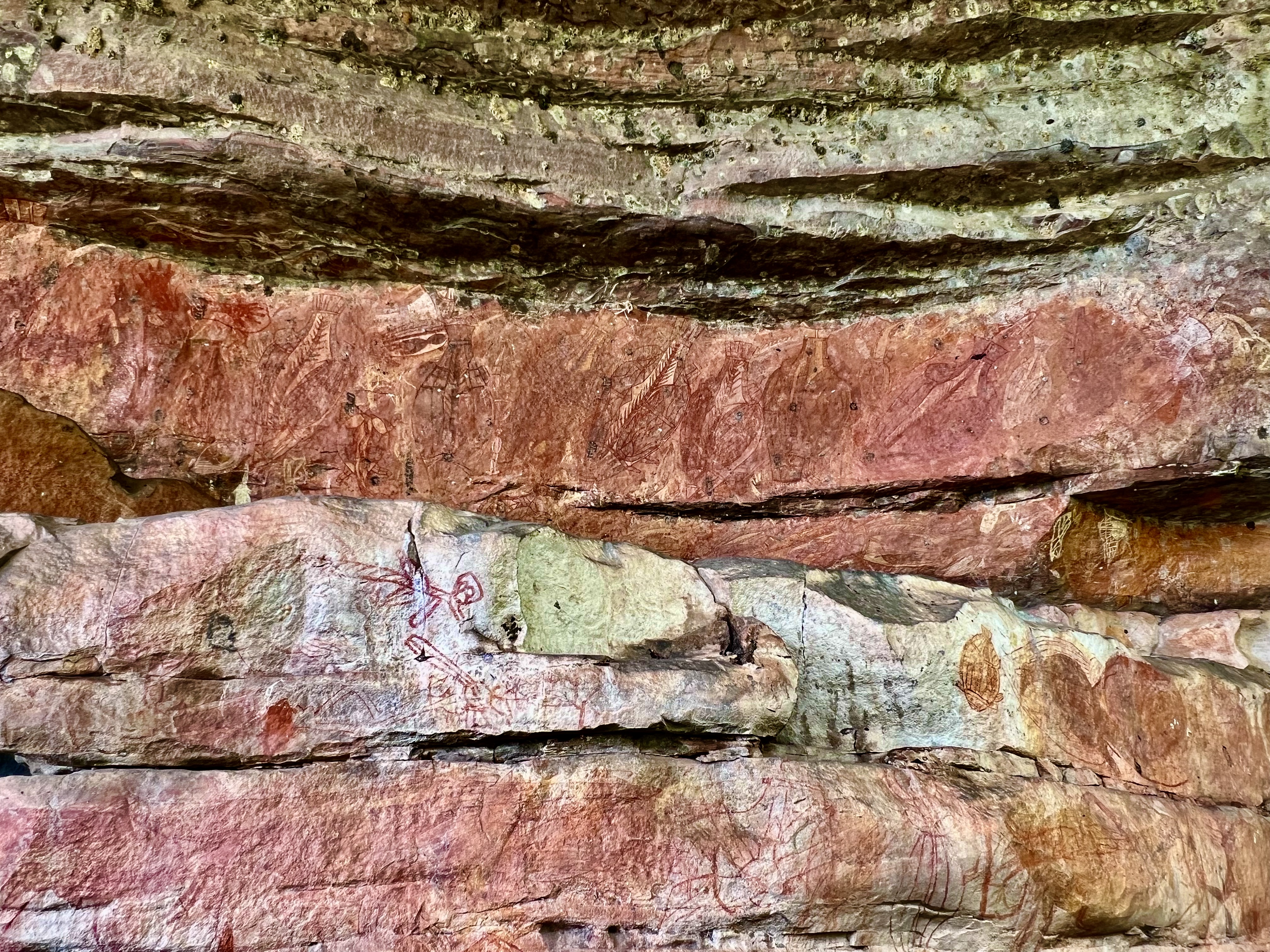
The stick figured humans in the gallery as supposed to be about 5,000 years old. No one knows how old the other paintings are. There is also a handprint, which was also one of the symbols in French cave painting. The plaque by a couple of the stick figures explains the scene as: This painting of Mabuyu reminds Aboriginal people to tell a story which warns against stealing. Mabuyu was dragging his catch on a string after a fishing expedition when a greedy person cut the string and stole his fish. That night, Mabuyu waited until the thieves had eaten his fish and were caped inside their cave near the East Alligator River. Then he blocked the cave with a huge rock. Next morning, they never came out because they punched it they got punished. Kids, ladies and men all dead – finished.
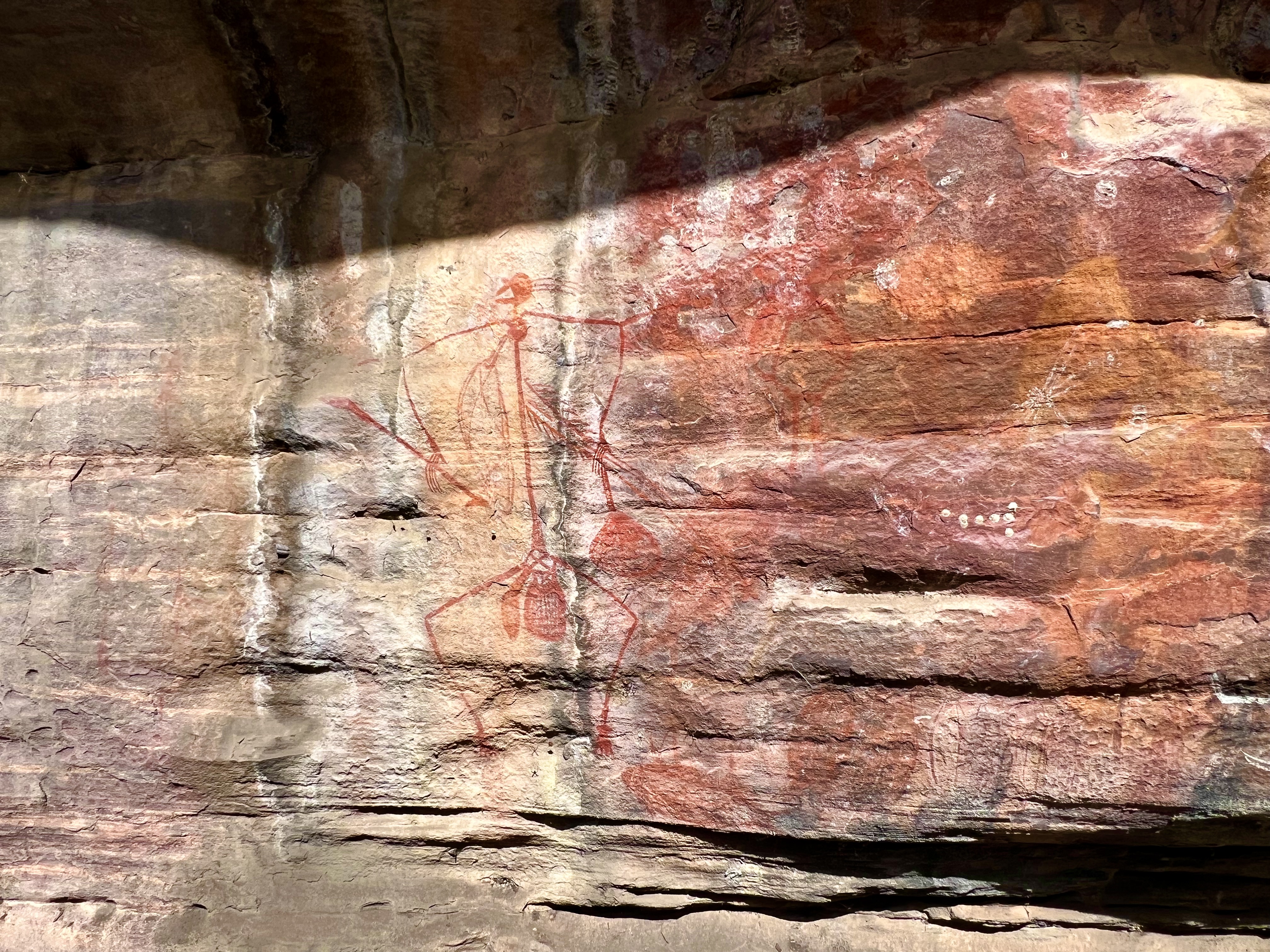
Crocodiles are ancient animals; their ancestors survived the dinosaur era. They are a constant threat to people living in the region, and yet they are also worshipped for their strength and cunning. In Dreamtime, people could change shape at will and on one rock, which was a teaching rock until it collapsed in an earthquake, the stick figures tell the following story (according to the plaque at the site): The Namarrkkanj sisters used to play games near the mouth of the East Alligator River, where they would hide from each other by changing into crocodiles. They travelled to freshwater spring near Point Farewell, where they changed their bodies into saltwater crocodiles. The palms which grow around the spring grew from the teeth which the sisters pulled from their mouths and planted in the earth. As crocodiles, the Narmarrkkanj sisters always knew where their victims are because the large scales on the backs of their necks have extra sensory powers above or under the water.
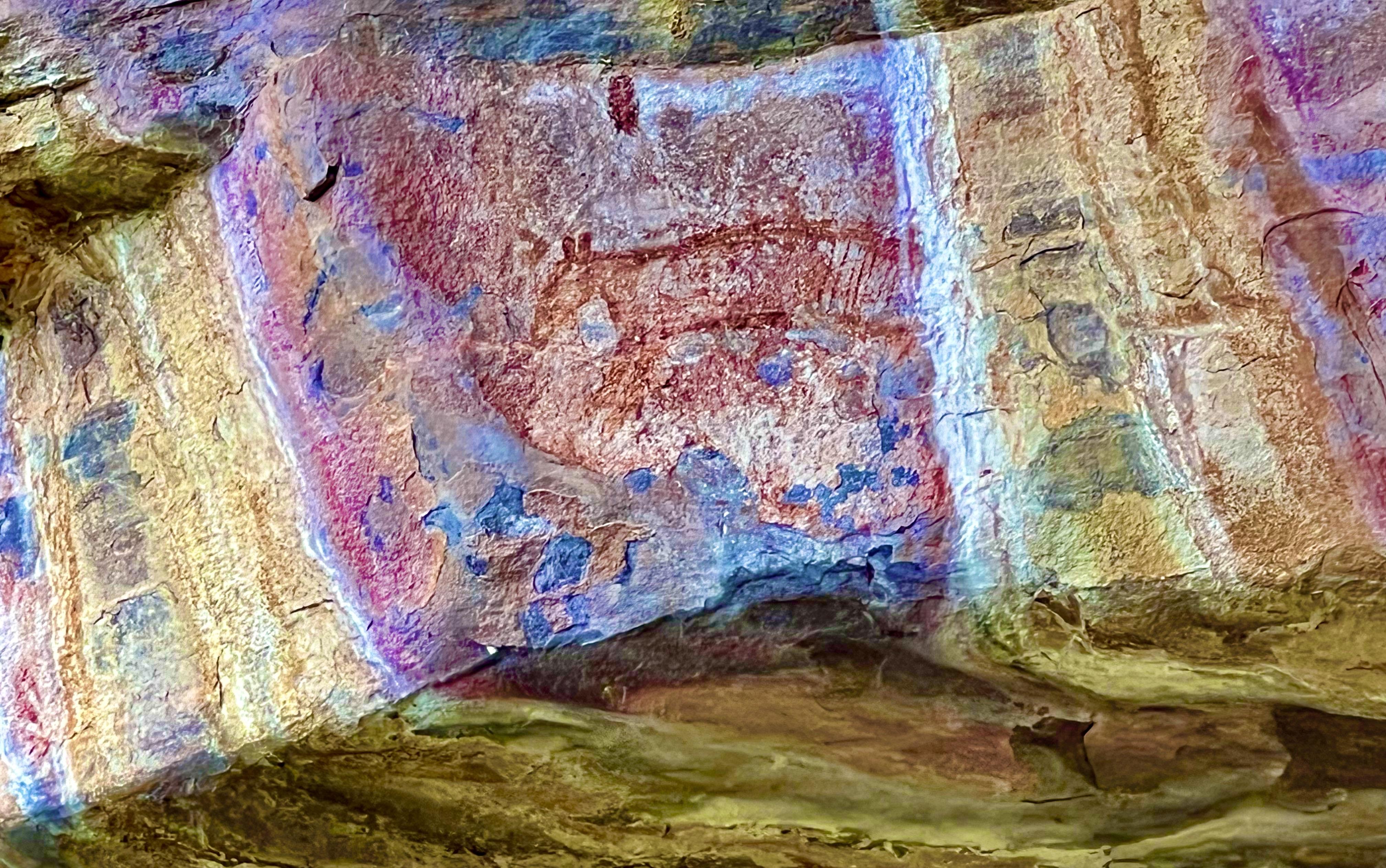
Crocodiles survived, but the Tasmanian Tiger’s numbers started to decrease with the advent of the Dingoes, about 4,000 years ago. The creature got its name from the fact that it lived on in Tasmania until the early 20th century. (Although, there are some unverifiable reports of a much more recent sighting.) A Tasmanian tiger is depicted fairly high up on the rock by the main gallery.
Not all of the rock art is ancient. There are newer illustrations, called contact drawings, showing interactions between the original inhabitants of the land and European newcomers.
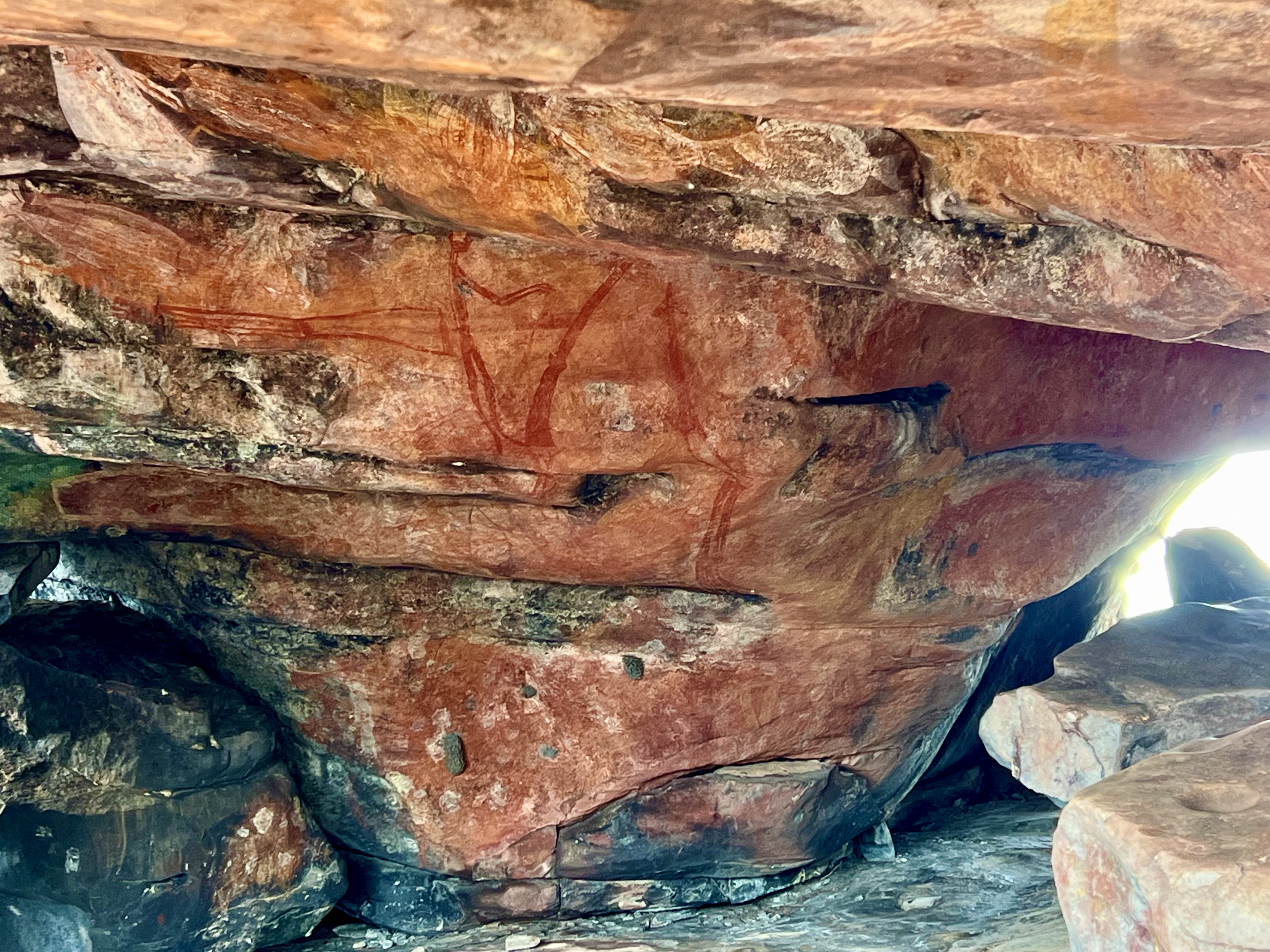
This is supposed to show a man hunting a kangaroo with a European looking on
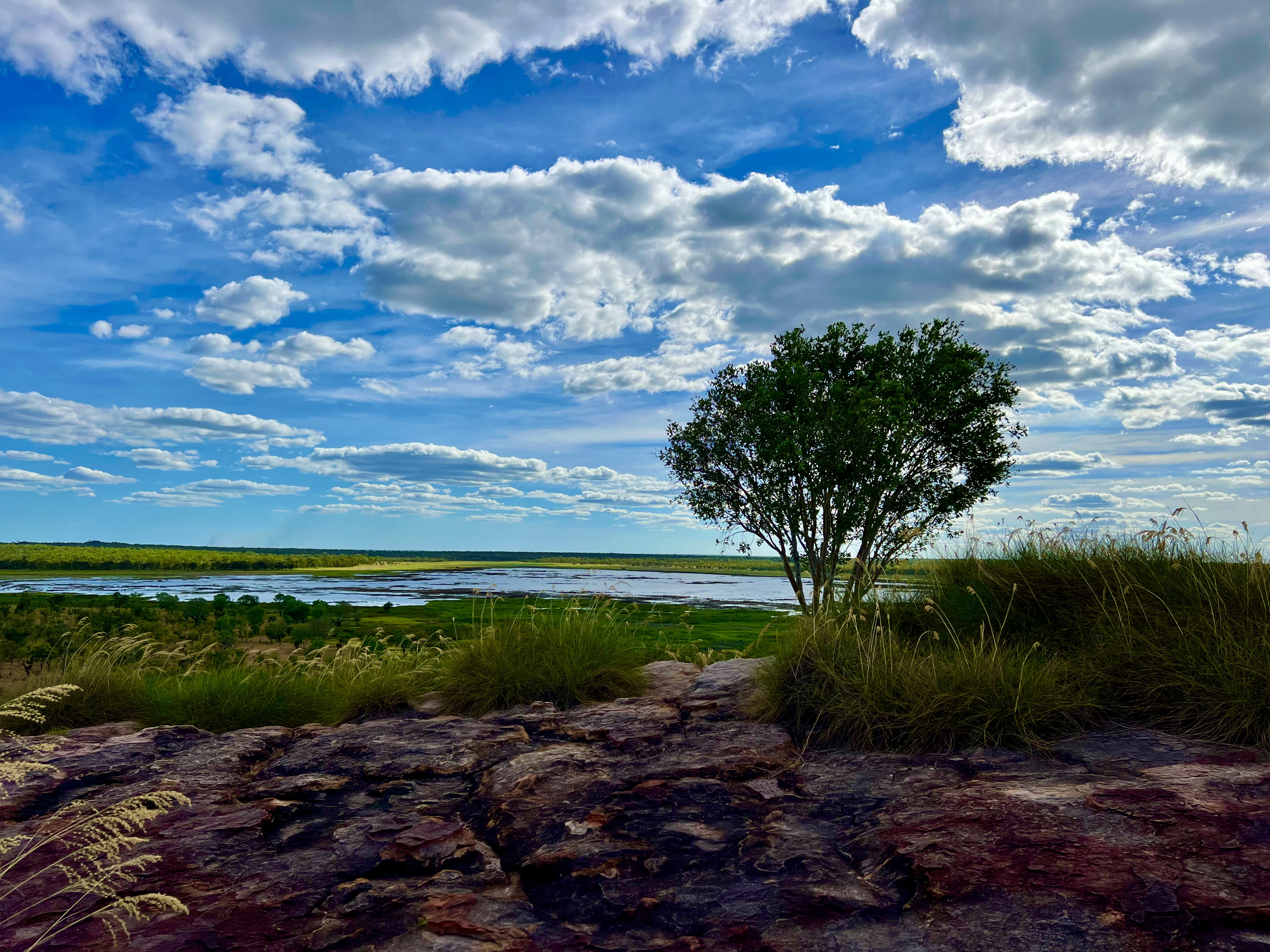
There are many more Rock Art sites in Kakadu, but Ubirr is considered to be the oldest and most accessible. At the end of the official path are markers pointing up the rockface to the overlook. The 360 degree view gives one a sense of what this land looked like when Aboriginal peoples lived here without outside interference.
There was a beautiful orange pink sunset on the way back – only marred by the hordes of insects that landed on the windshield. At one point, I remarked to Darrell, our driver/guide, that it was like driving through snow flurries. He said that today wasn’t as bad as yesterday and that the day before he also had to watch out for all the pythons and other snakes on the road. On my trip, we only had to watch out for the wallabies hopping across the highway. Luckily, we avoided the marsupials, but the insects – well, someone was going to have to scrub really hard to get them off.
Just a few more rock art photos –
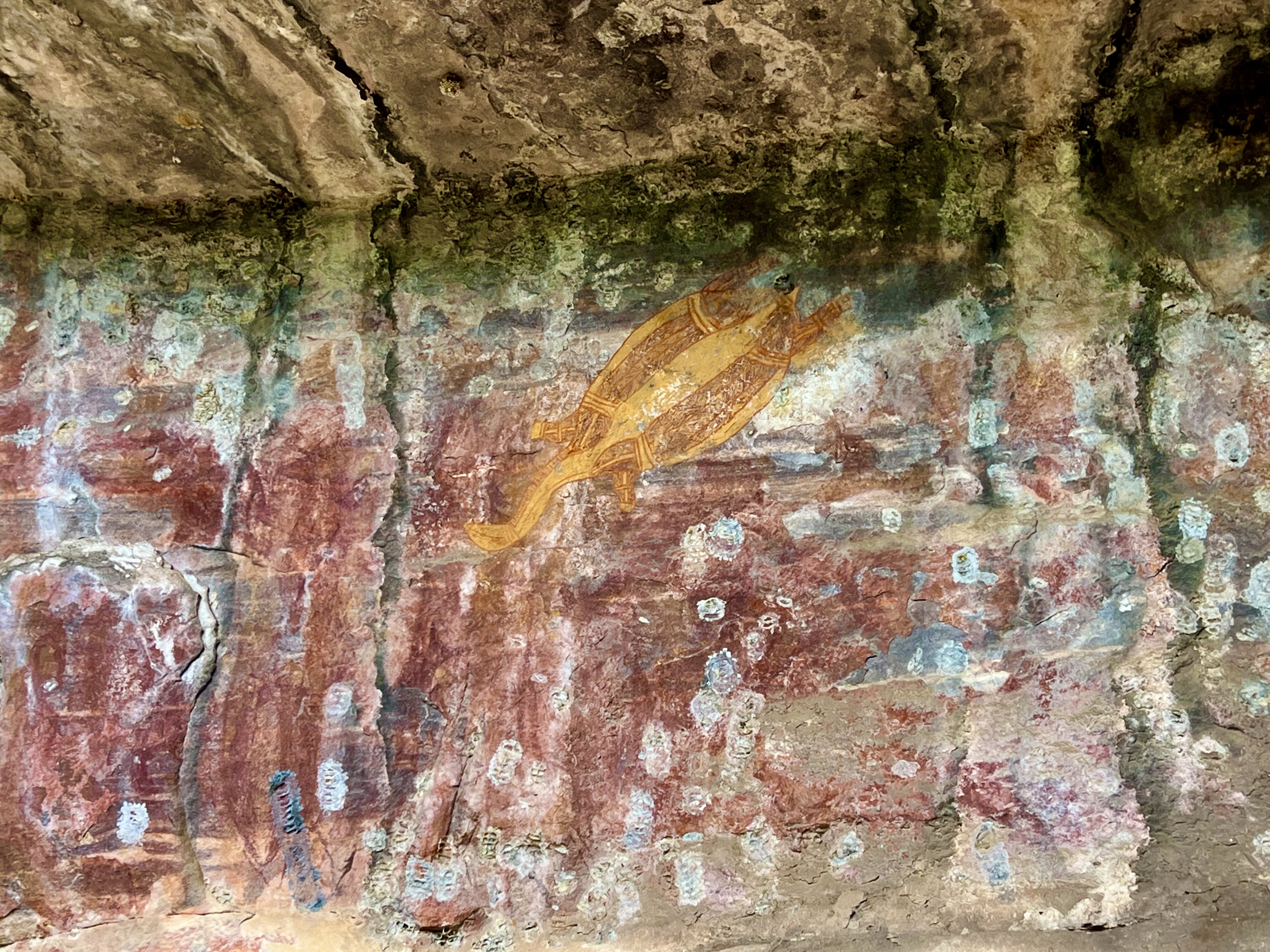
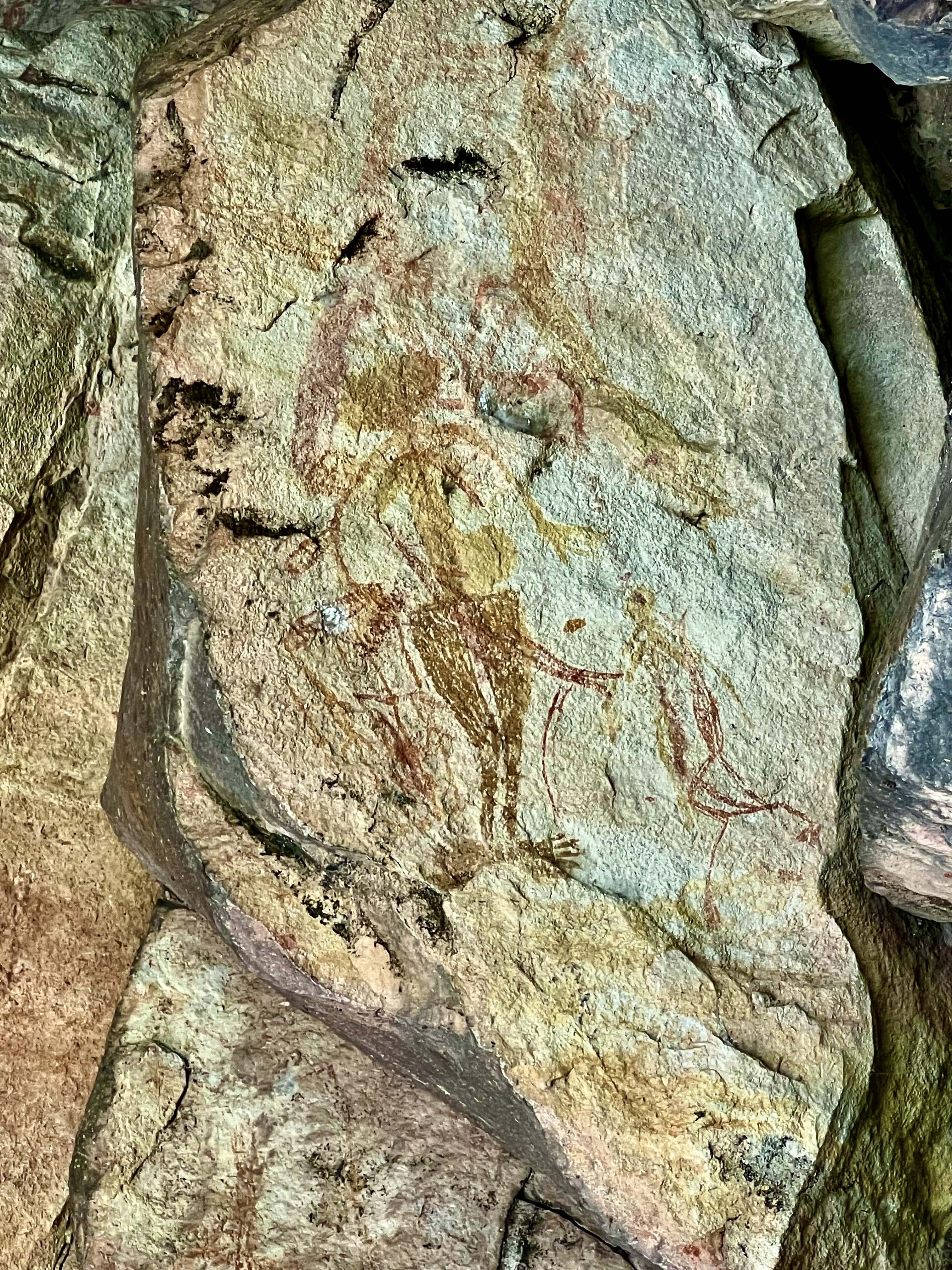
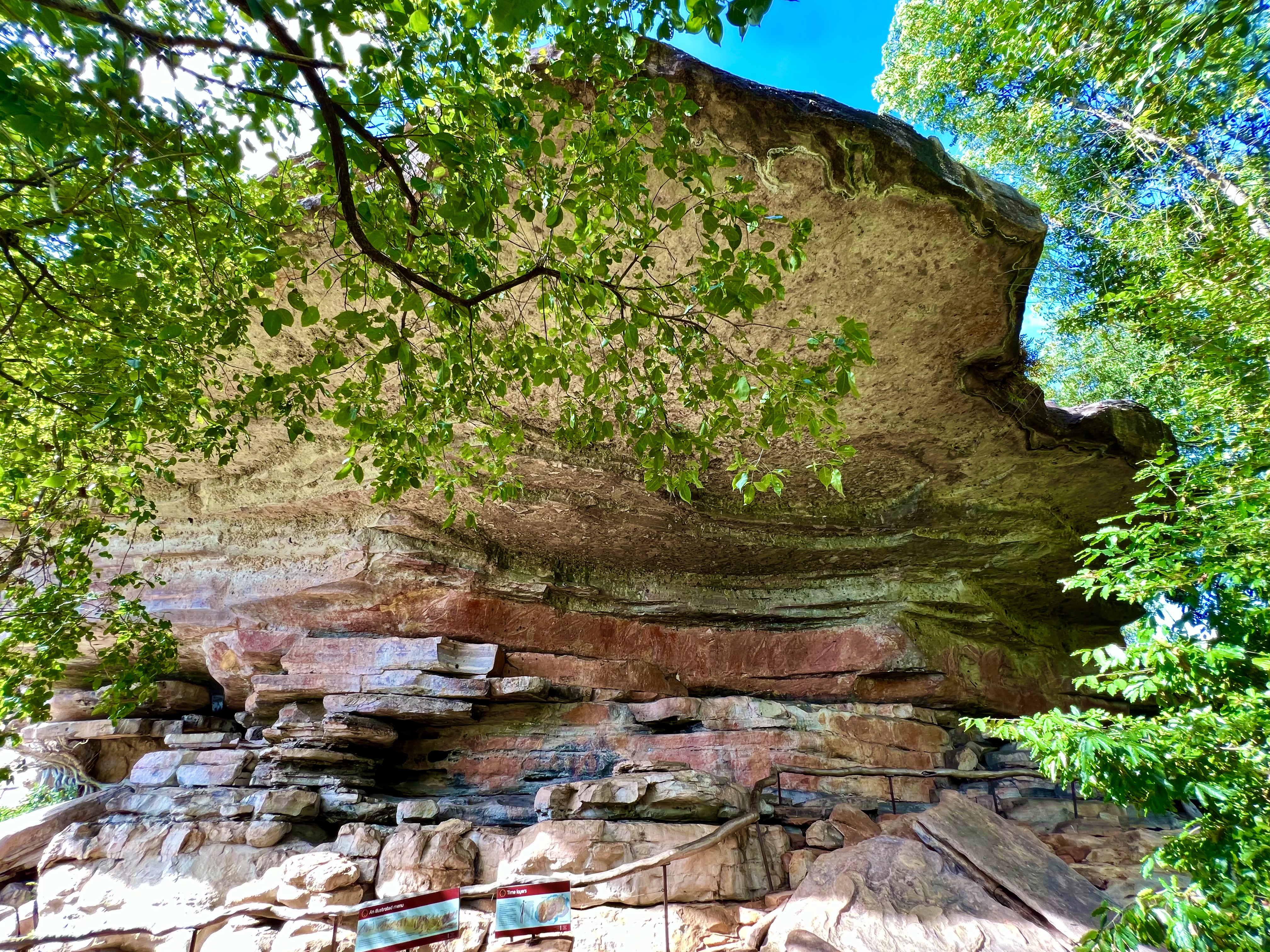
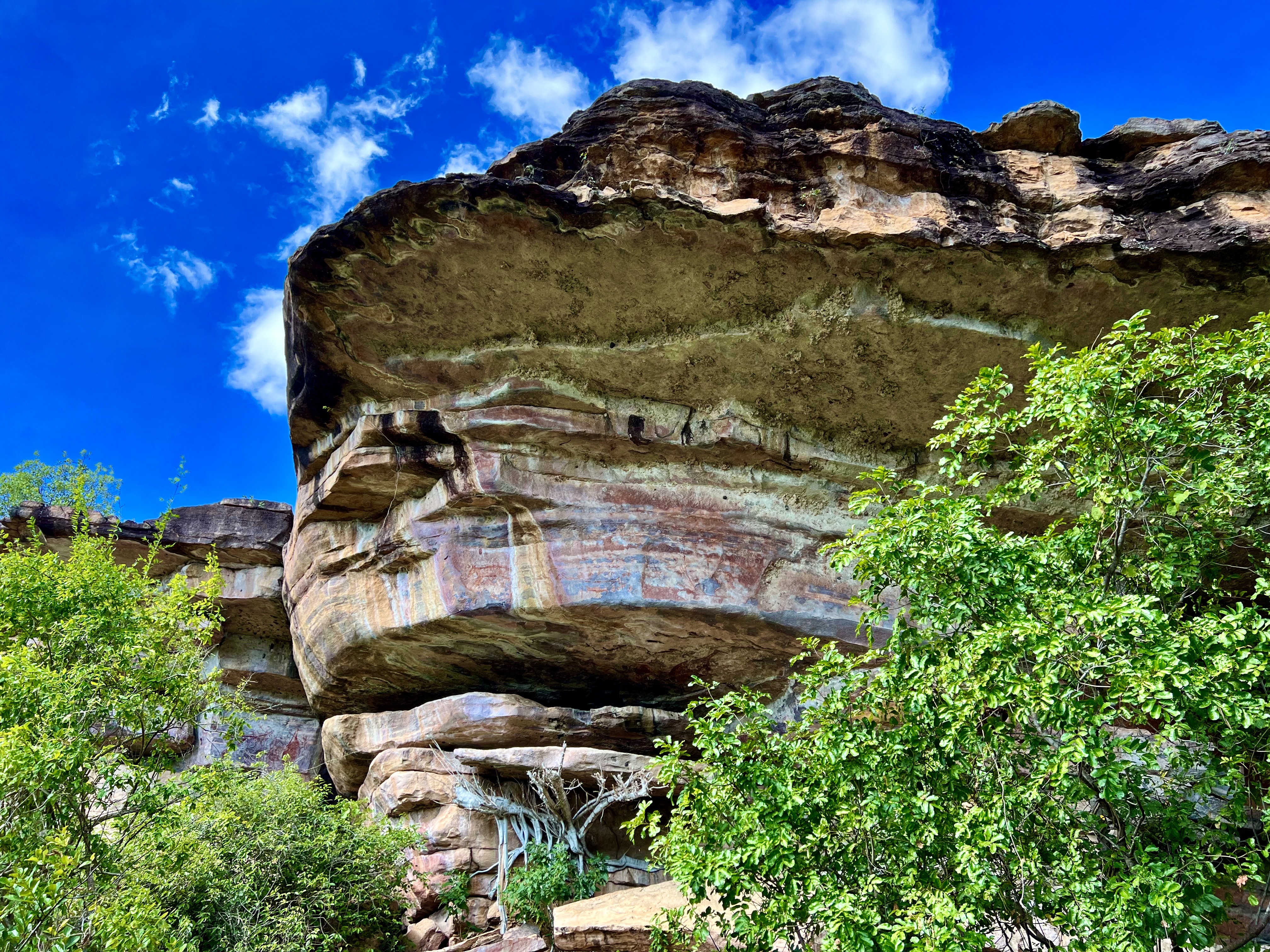
Ubirr Rock, Kakadu National Park, Northern Territories, Australia.
 omegoodyssey