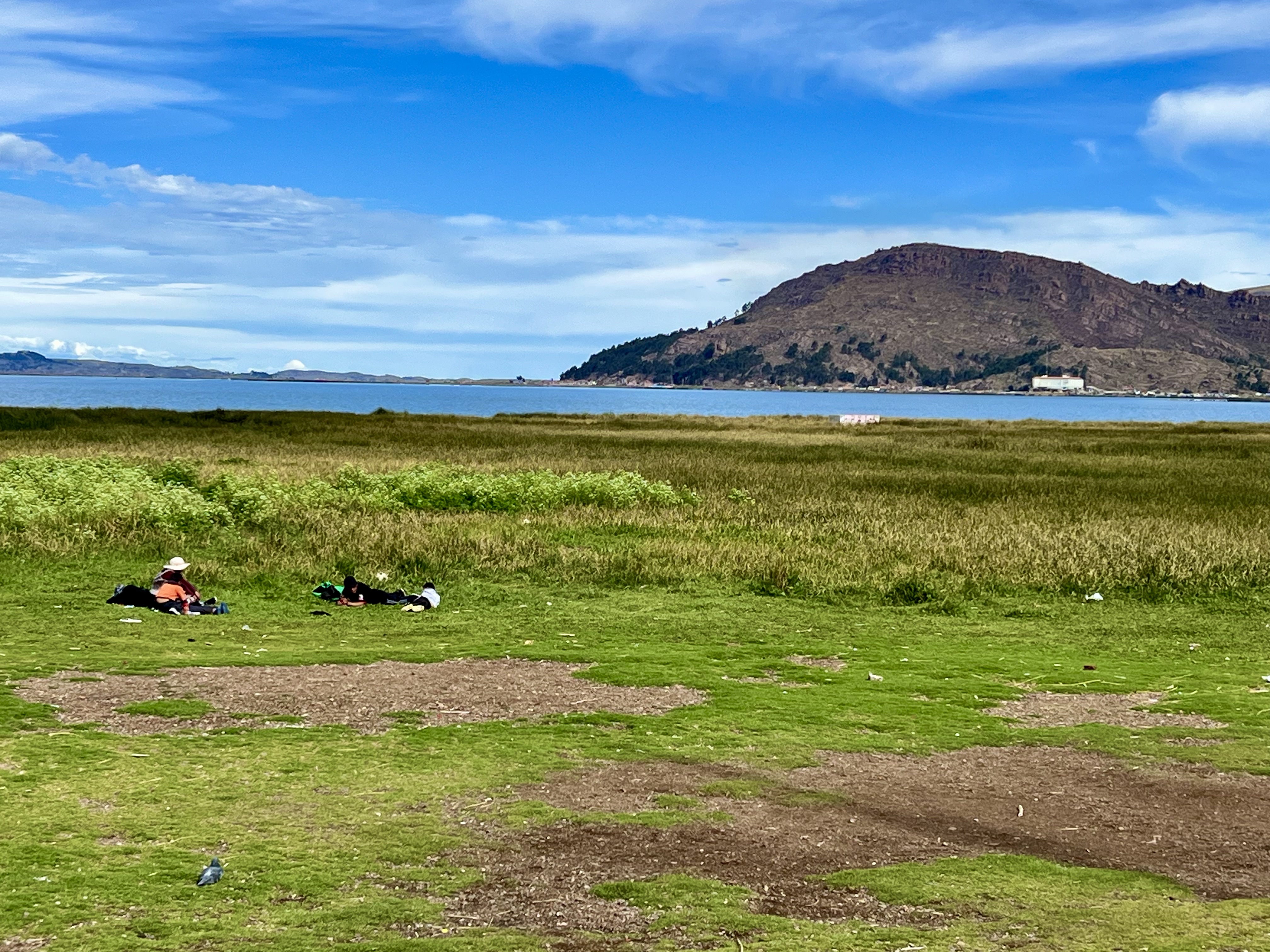
From Chiclayo I flew to Juliaca with a change of planes in Lima. The Latam flights and connection worked flawlessly and both flights took off and landed on time. From Juliaca, I took a packed shuttlebus to Puno where I was let off not far from the Plaza de Armas. I wasn’t sure where the hotel was, but luckily, I managed to connect with Google Maps and found that the hotel was just behind the other side of the main square. It’s always a bit worrisome when dragging luggage across towns, which is why I prefer to take a taxi or Uber when it makes sense to. It didn’t make sense this time, so I rat-a-tated the bags across the broken-up cobblestones. Part of the road by the square is being redone, hence the broken stones.
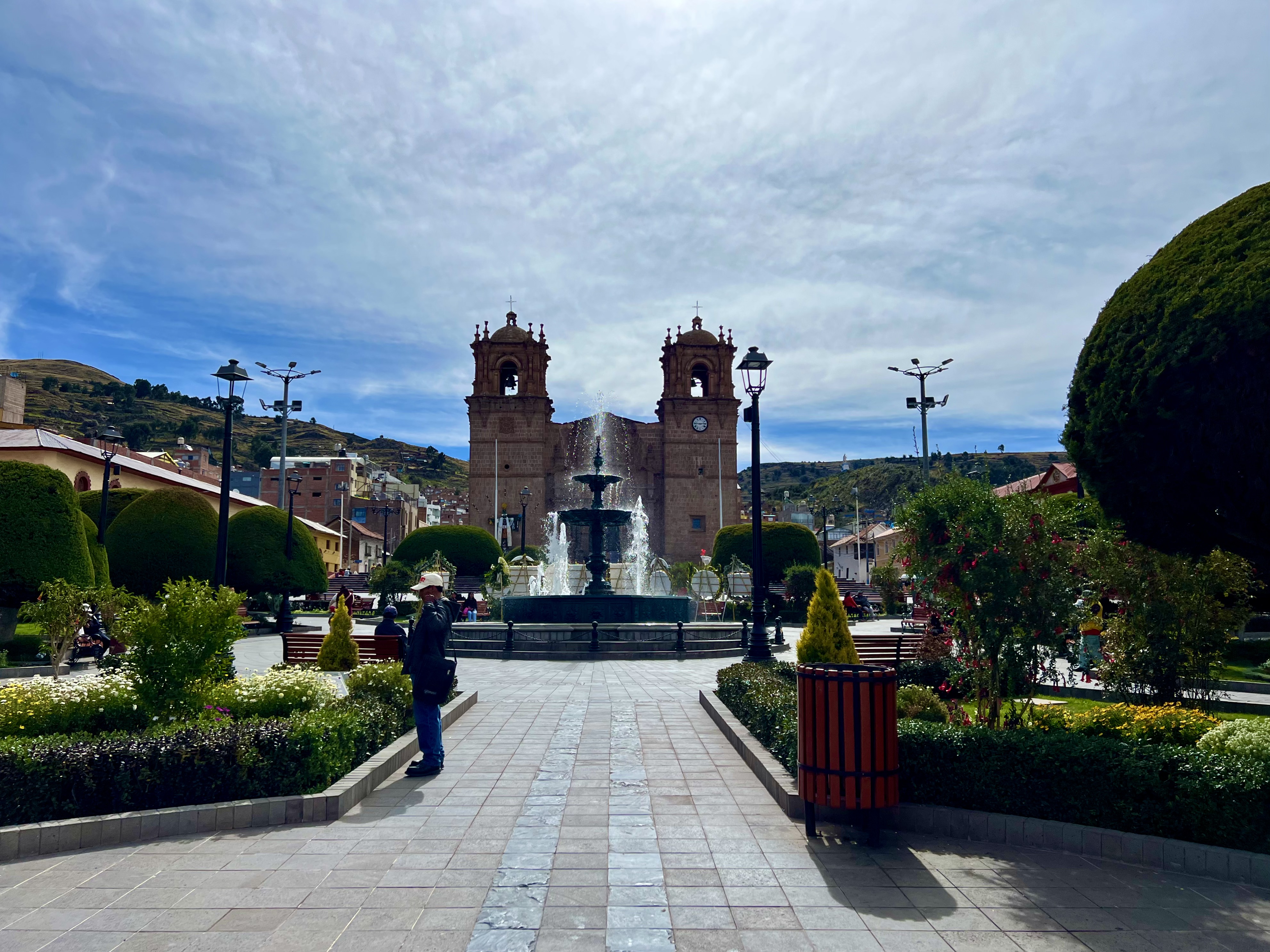
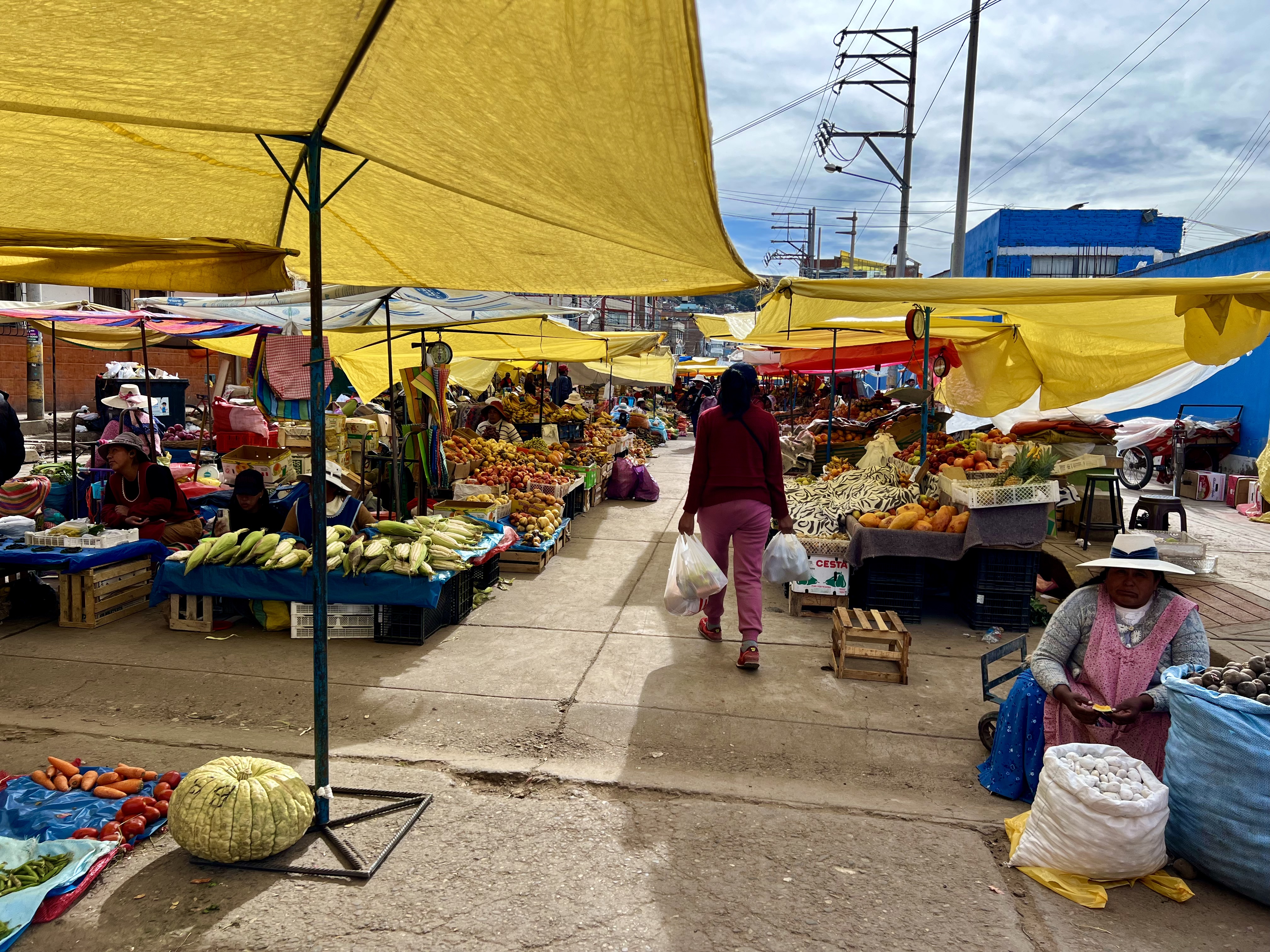
I’d been to Puno with my daughter over twenty years ago, but the town wasn’t the way I remembered it. The area around the main square is now partially a pedestrian zone and has been touristified. There is even a recently constructed white stairway (of over 600 steps) leading to a viewpoint with a large condor statue. Some things hadn’t changed, however, such as the Cathedral and the outdoor fruit and vegetable market. I wasn’t planning on spending much time in Puno itself, but rather using it as a jumping off base for a two day, one night excursion to Copacabana, Bolivia, and then from Puno via a 2 day, one night trip to Arequipa. As there are too many photos to share for one blog, I’m going to divide the blog into sections, the first dealing with Puno and Copacabana on Lake Titicaca and the second for the trip from Puno to Arequipa via Colca Canyon.
The bus to Copacabana takes about three and a half hours. The Transzela bus had large reclining seats and was quite comfortable. In addition to the driver, there was another individual who helped with explaining and navigating the border crossing. Bolivia asks for a customs form that can only be filled out online, which can be a bit of a problem when one doesn’t have an internet connection. At the border office, however, there is a connection and a QR code to access and submit the form. There are about 100 m between the Peruvian and Bolivian immigration offices and the bus is not allowed to have passengers inside during the crossing; one walks across. At the Peruvian side, the officials check and stamp passports. At the Lima airport they no longer stamp passports, and this can cause problems when one has to prove when one entered the country. On the Bolivian side, after getting the entry stamp, one goes to the next-door customs office to be checked for the submission of the form. Only then is one allowed to re-enter the bus. The ride from Kasani, the border, to Copacabana is quite short, maybe ten minutes or so. Here again, I was let out somewhere where I had no idea where I was. I could see the lake, however, so I headed in that direction. Luckily, I had left the luggage in Puno and had only a small backpack, so wandering around lost wasn’t a problem.
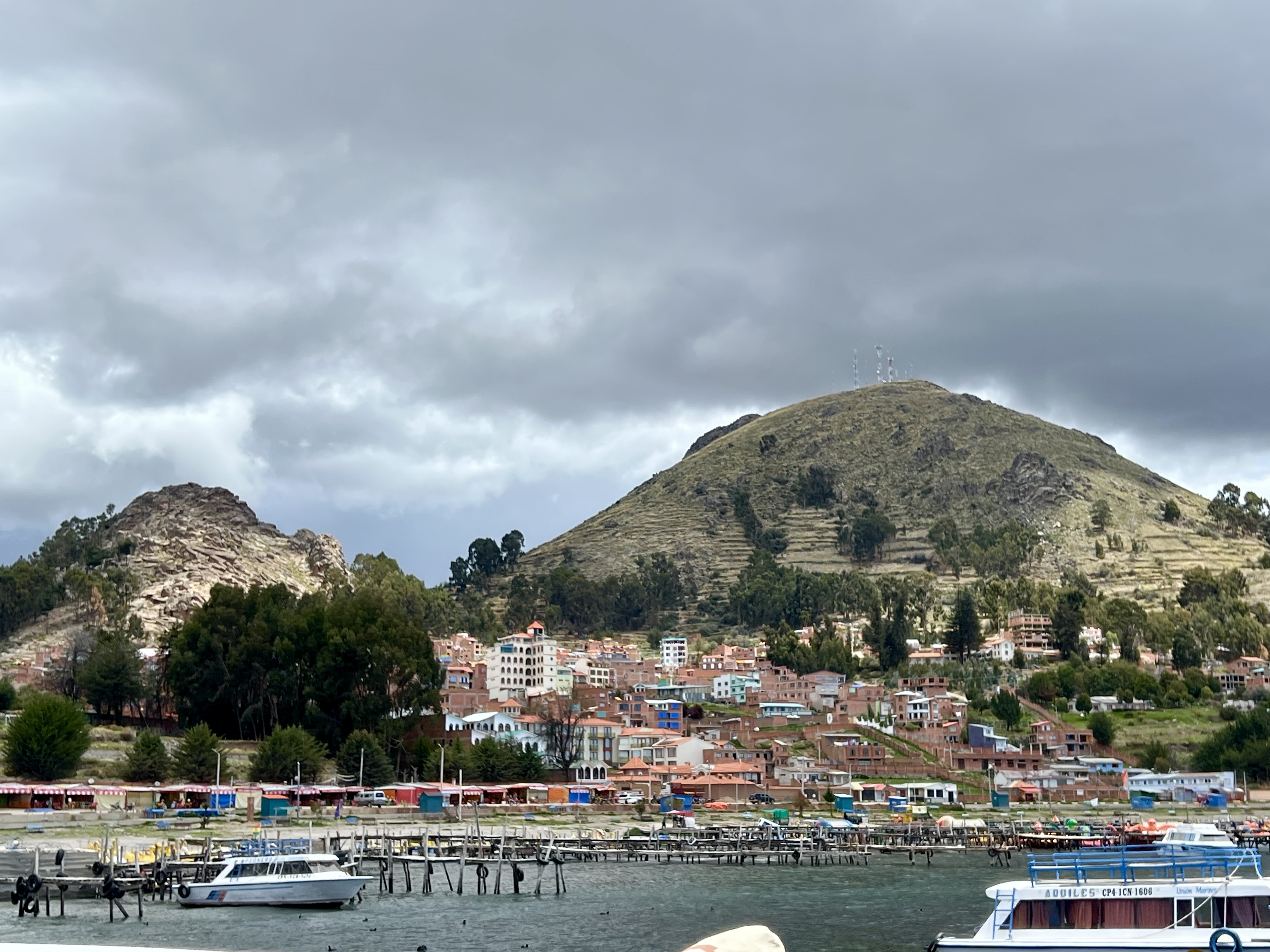
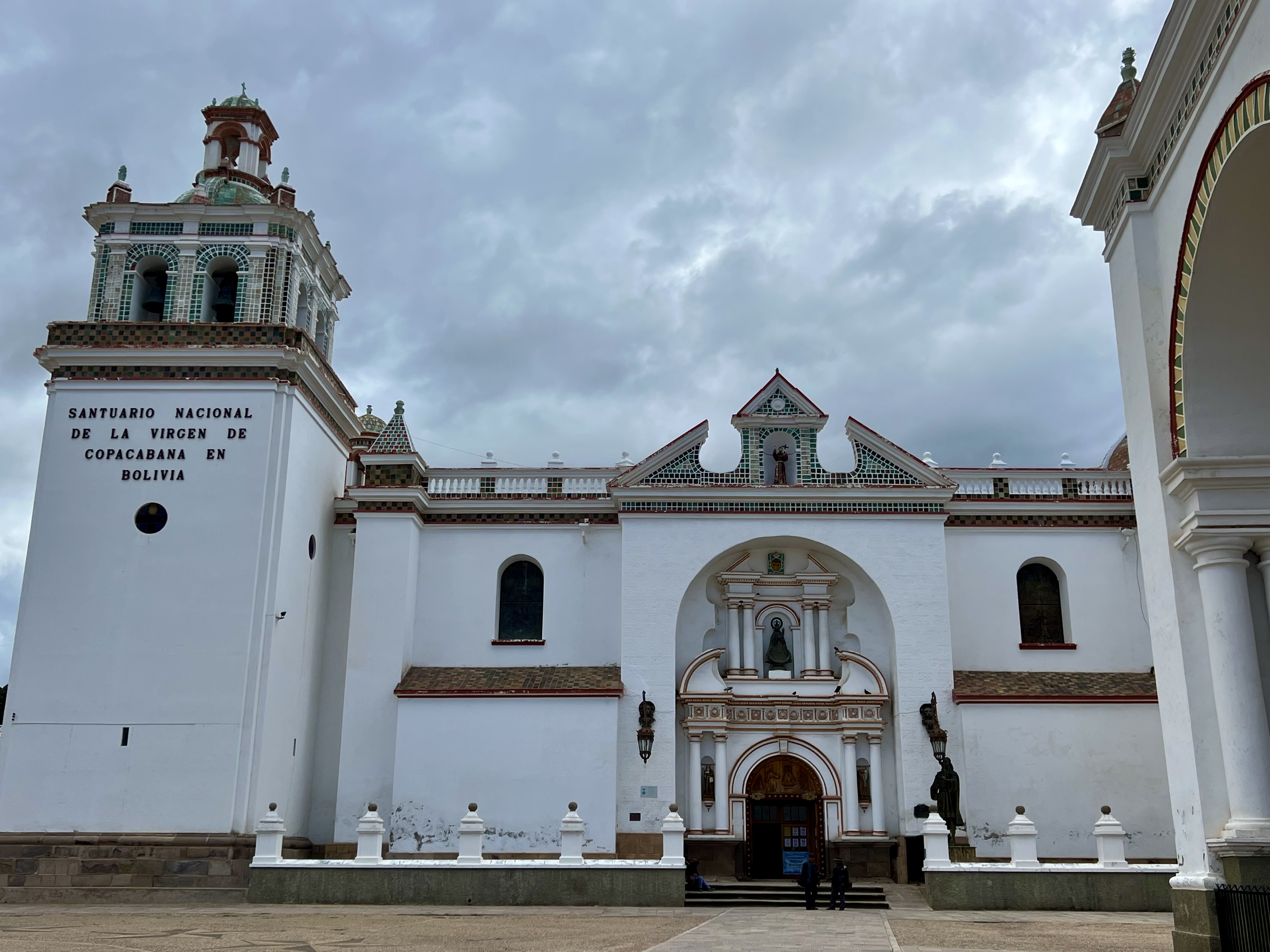
The harbor is lined with stalls selling tickets to excursions, including the one I wanted to go on, to Isla del Sol. I planned on going to Isla de la Luna the following day. The ferry to Isla del Sol left at 13:30, so I had time to find and check-into a hotel near the main square. I decided to pay extra for a guide on the island as there are a few archeological sites that are best viewed with someone knowledgeable. The guide I had said he was an anthropologist by training, I don’t know that this was true, but he did know the island as he lived on it. An Incan legend relates that Isla del Sol is the birthplace of the Incas. After a great flood, the great god Wiracocha arose from the depths of the lake to form the islands of the sun and moon as well as their celestial counterparts. After that he created the first human deities, i.e., the first Incans, Manco Capuc and sister-wife Mama Oclla, who travelled from Isla del Sol to Cusco. The more realistic explanation is that when the Tiwanaku culture was dying, probably due to an extended drought coupled with floods, the nobility moved to the lake, when climatic conditions there changed, they migrated further north to Cusco, which is why the first Incan nobility in Cusco didn’t speak Quechua as their main language, but rather the earlier language from Tiwanaku. It also explains how many of the Tiwanaku cultural and religious ideas were adapted by the Cusquenians.

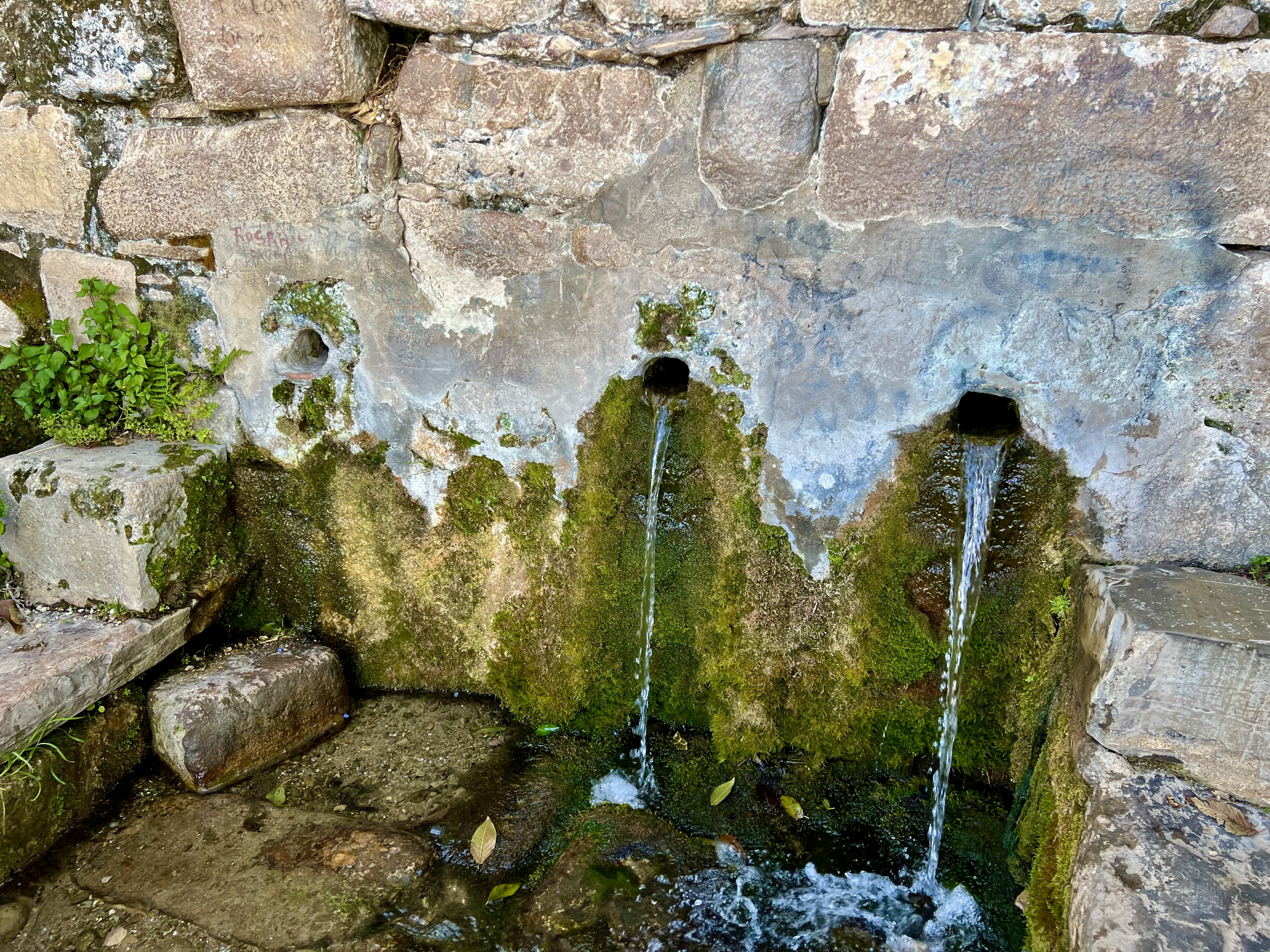
At the Yumani harbor there are 12 Incan false doorways facing the Isla de la Luna and further to the snow-capped mountains on the opposite side of the lake. There are 12 peaks on that side and the 12 doors relate to these sacred sites. From the harbor the Escalara del Inca leads uphill to a spring that according to the guidebook is supposed to be a fountain of youth. The fountain has three spouts, which the guide said, represent various kinds of love (I’d thought they represented the three worlds: upper, this one and lower), love for family, love for community and divine love. Somehow this sounds like a bit of a syncretic mixture of religions to me. The fountain of youth idea may be more plausible, although I still like my three worlds interpretation as water is the gift of life. I guess everyone can have their own interpretation.
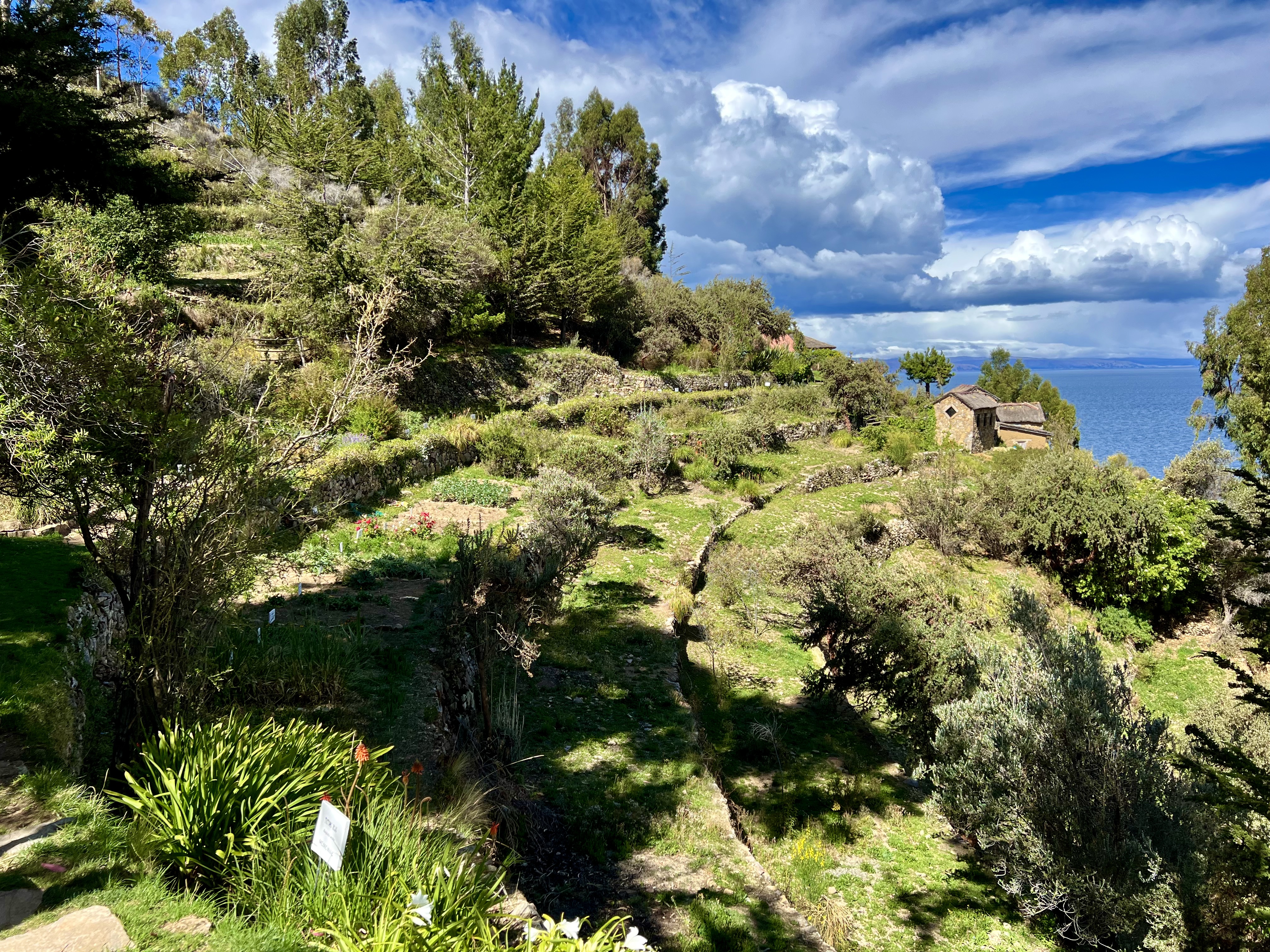
Near to the spring and fed by it are a series of terraces with various Andean flowers. I was amazed to see the same flora that grow in my garden in the summer.
Continuing uphill the path winds around the southern section of the island offering incredible views.
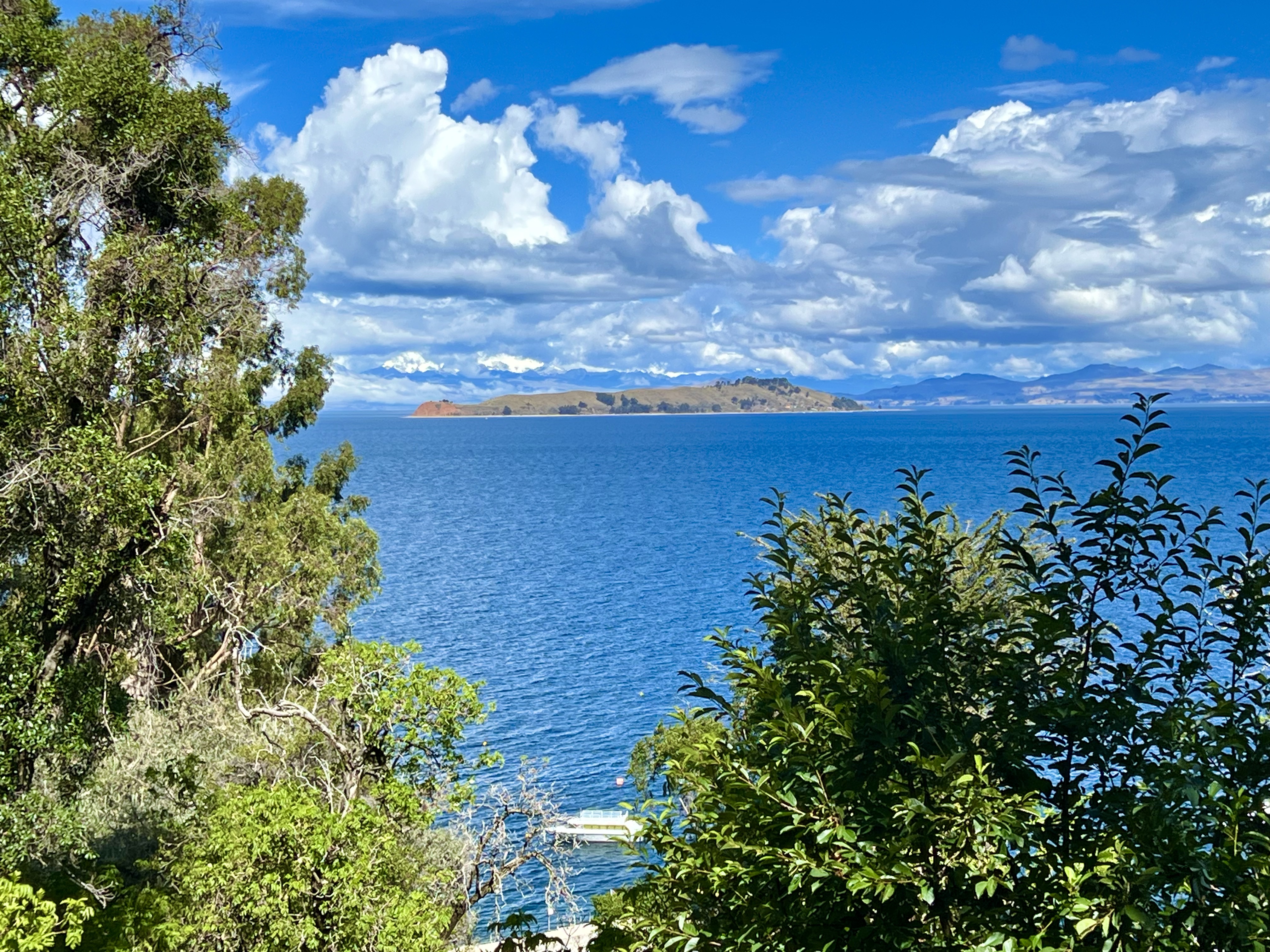
There is only enough time during the afternoon trip to stay on the south side of the island. There are three main villages on the island, one in the south, one in the middle and one in the north. To see the entire island would take at least a couple of days. The trip is worth it, even for a few hours as there are a number of interesting ancient sites along with the stunning views.
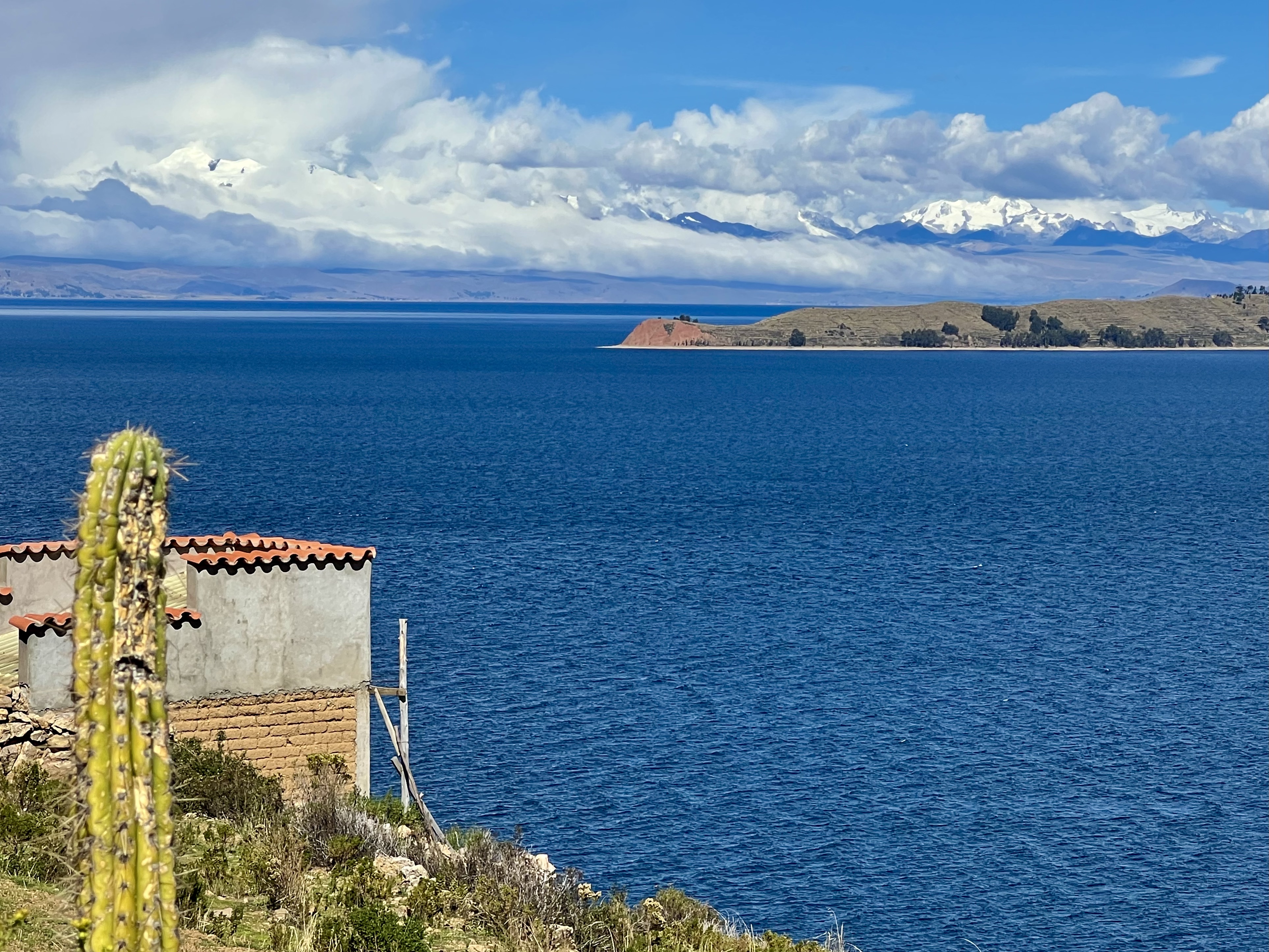
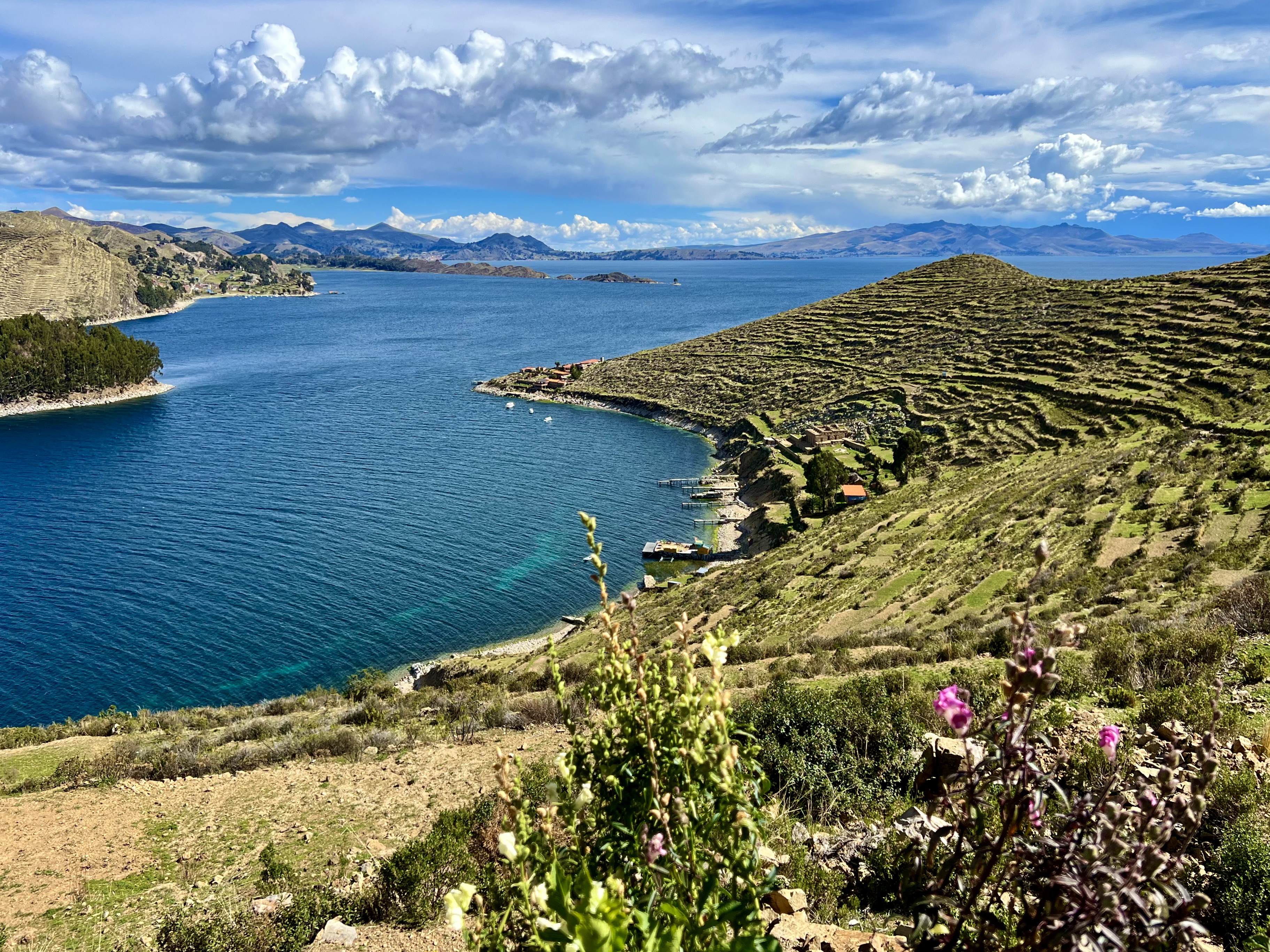
Along the way, there are a few rocks that appear to be meteorites. One stone has lead in it and although it is a stone, when hit it sounds like a metal drum. Another meteorite in a heart shape is inside a former chapel-like room in Pilka Kaina. The Pilka Kaina site is pre-Incan; there is evidence of human habitation on the island from about 3,000 BCE. It has beehive shaped ceilings, which were common elsewhere around 2,000 BCE, and was used as a tomb probably for nobility or priests. The skeletons found at the site were quite tall, almost 2m., which is quite a contrast to the height of the majority of Peruvians in the region today.
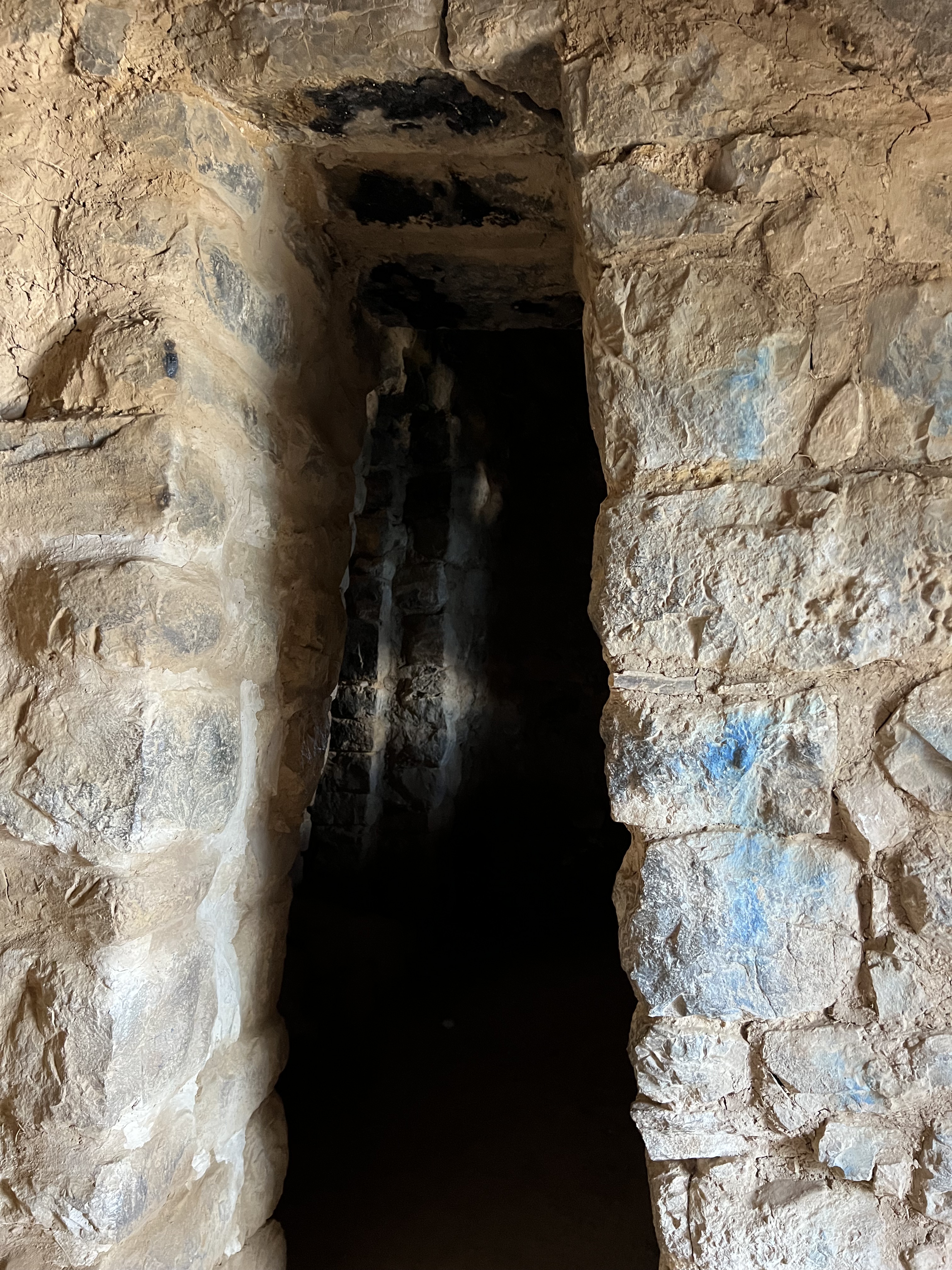
I had hoped to learn more about this site and the ones on the north side of the island that I didn’t get to see including the Sacred Rock of the Andes, but the time was too short. The ferry ride to and from Copacabana to the Isla del Sol takes about an hour and a half and the last ferry left at 17:30. There are opportunities to stay on the island, but I had read that there was no hot water, no heat, and no internet and as I was still schlepping my continuously returning cold/cough, I decided it would be wiser to stay in town. (This has now changed; I saw a few new hotels near the Yumani harbor.) Not spending the night, however, meant missing out on much of what Isla del Sol has to offer. It also meant that I never got to Isla de la Luna as the only way to get there is first to go to Isla del Sol then take another 45 minute ferry to the island. My bus back to Puno was leaving at 13:30, so there wasn’t going to be enough time for that. The Isla del Sol is dedicated to the Incan Sun God, whereas the Isla de la Luna is dedicated to the Moon Goddess and was the sanctuary for the “Invisible Women,” nuns dedicated to serving the Moon Goddess. In the end, although I was sorry to have missed Isla de la Luna’s sites, I found another very interesting place just above Copacabana town.
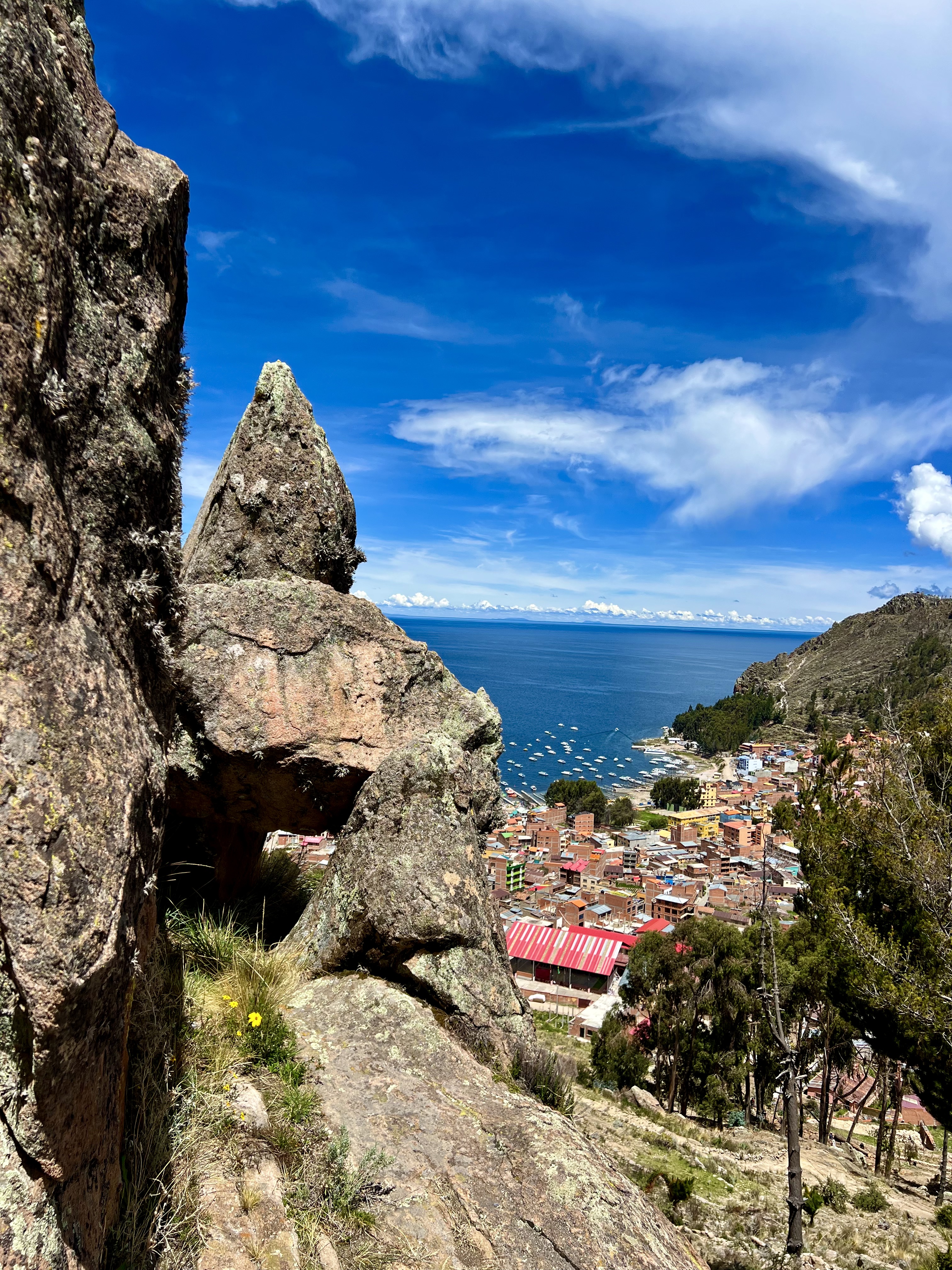
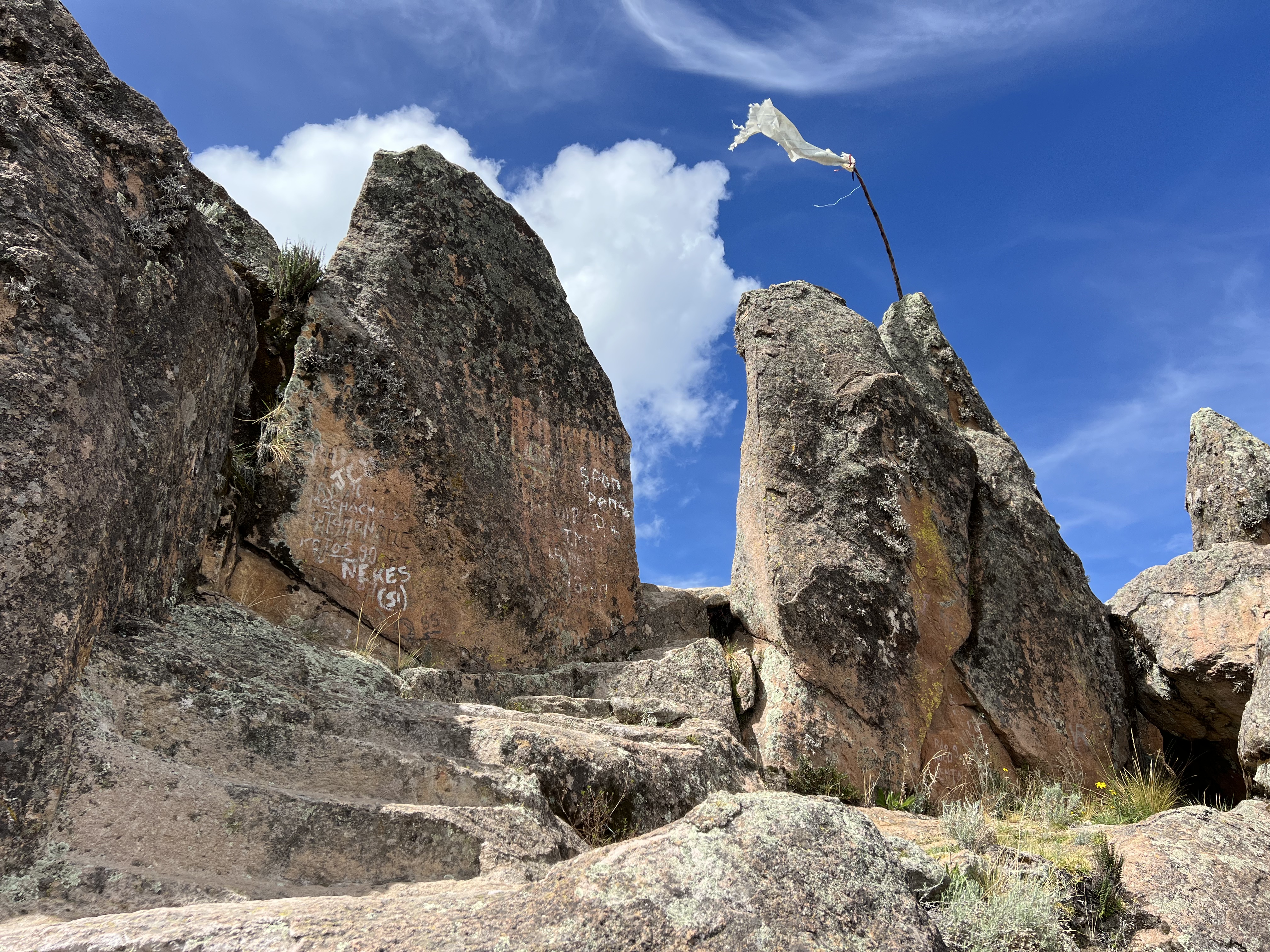
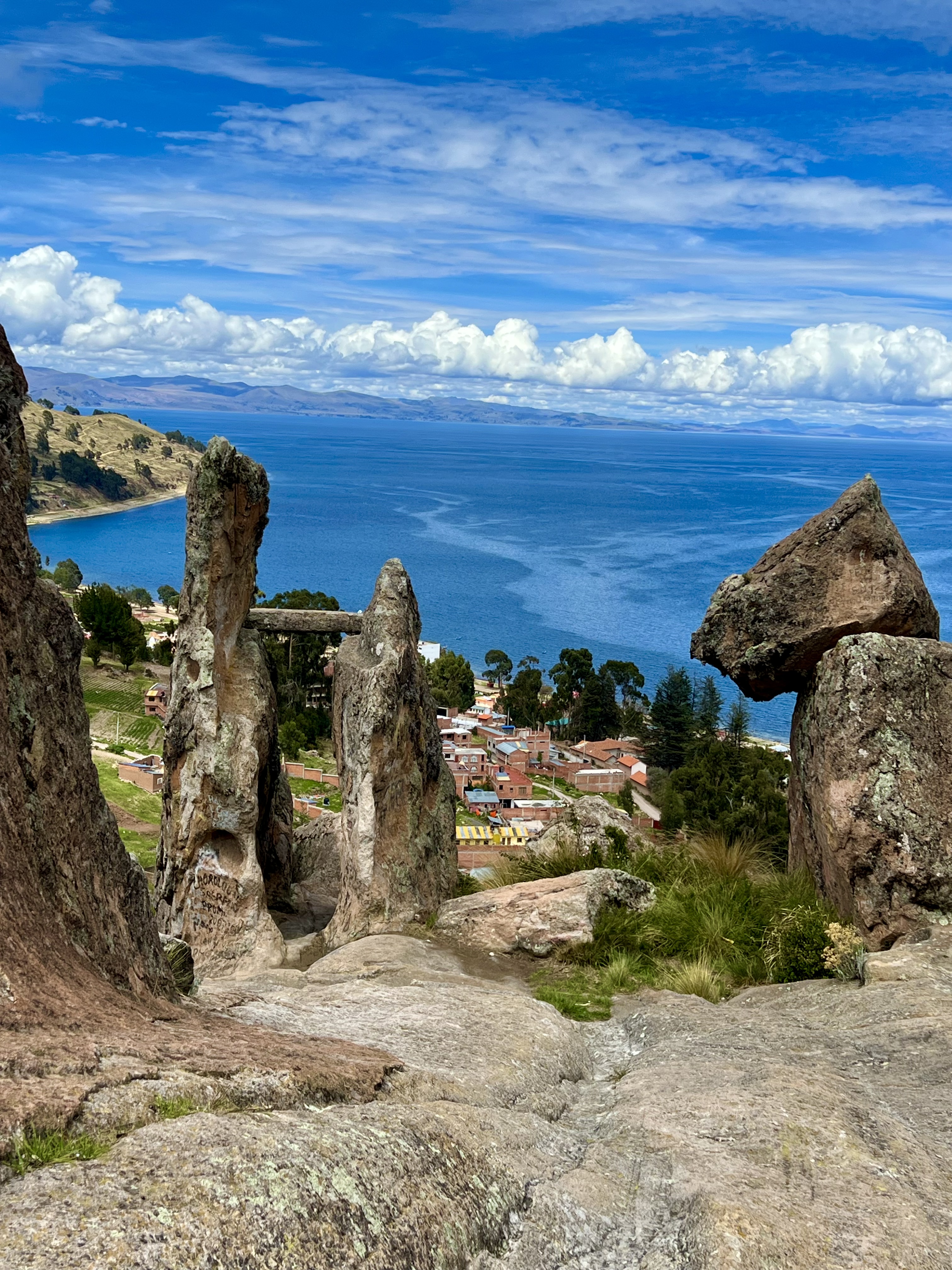
The map of the downtown that I had from the hotel showed an ancient observatory at the edge. I asked at the hotel how far the site was and how much a taxi there would cost and was laughingly told that I could walk there in 15 minutes. This site isn’t on any other map or tourist guidebook that I had access to, so I was excited to see what it was like. The walk uphill through the almost deserted back streets didn’t take long, but I did notice that my breathing was a bit more rapid than usual given the altitude, 3841m (12,601ft – which is higher than Puno, which is higher than Cusco). At first, I didn’t find the entrance to the site as it isn’t marked anywhere, but a schoolgirl passing by kindly gave me the directions. There are some stairs leading up to a hut where the guard sells entrance tickets for 10 Soles (ca. E2.50). Leaning against the side of the hut was a stack of wooden poles and the guard asked me if I wanted to borrow one. One look at the uneven rock stairwell was enough to convince me that I should take him up on the offer. It isn’t a long walk up, but it is steep and uneven; I was glad to have the third leg both on the way up and especially on the way down. Once at the top of the Horca del Inca (otherwise known as Pachataka), I saw the observatory. It is two large rocks with a connecting stone at the top that measures the solstice and equinoxes. The site is supposed to be from about 1760 BCE during a period prior to the Chiripa culture, which was present in this area from about 1500-100 BCE. It was the Incas, though, who used it not only as an observatory but also to carry signals from the hill to a viewpoint on Isla del Sol. This place was wonderful. It would have been very peaceful except for the loudspeaker from the school at the bottom of the hill that reverberated across the valley. It was graduation day, and the festivities were suitably loud. Other than that, the site itself was peaceful and beautiful. I found it to be more pristine and positive than even the sites on the Isla del Sol.


After returning to town, I had about an hour before the bus, so I finally did some of the Christmas shopping, which I had been putting off so that I didn’t have to carry presents all across South America. The Bolivian vendors were fun to talk to and that made the experience all the more pleasant. The bus back was with Titicaca bus company and the seats were not nearly as nice or as large as the ones on Transzela. If given a choice, choose Transzela buses over those from Titicaca; the price is the same ca. US $8. The border crossing worked the same way as coming in, but one Frenchman wasn’t allowed back into Peru as he had flown from Lima to La Paz and therefore didn’t have a stamp in his passport. He was sent back to La Paz, where he was going to have to pay for another flight back to Peru. Bureaucracy exists everywhere.
 omegoodyssey