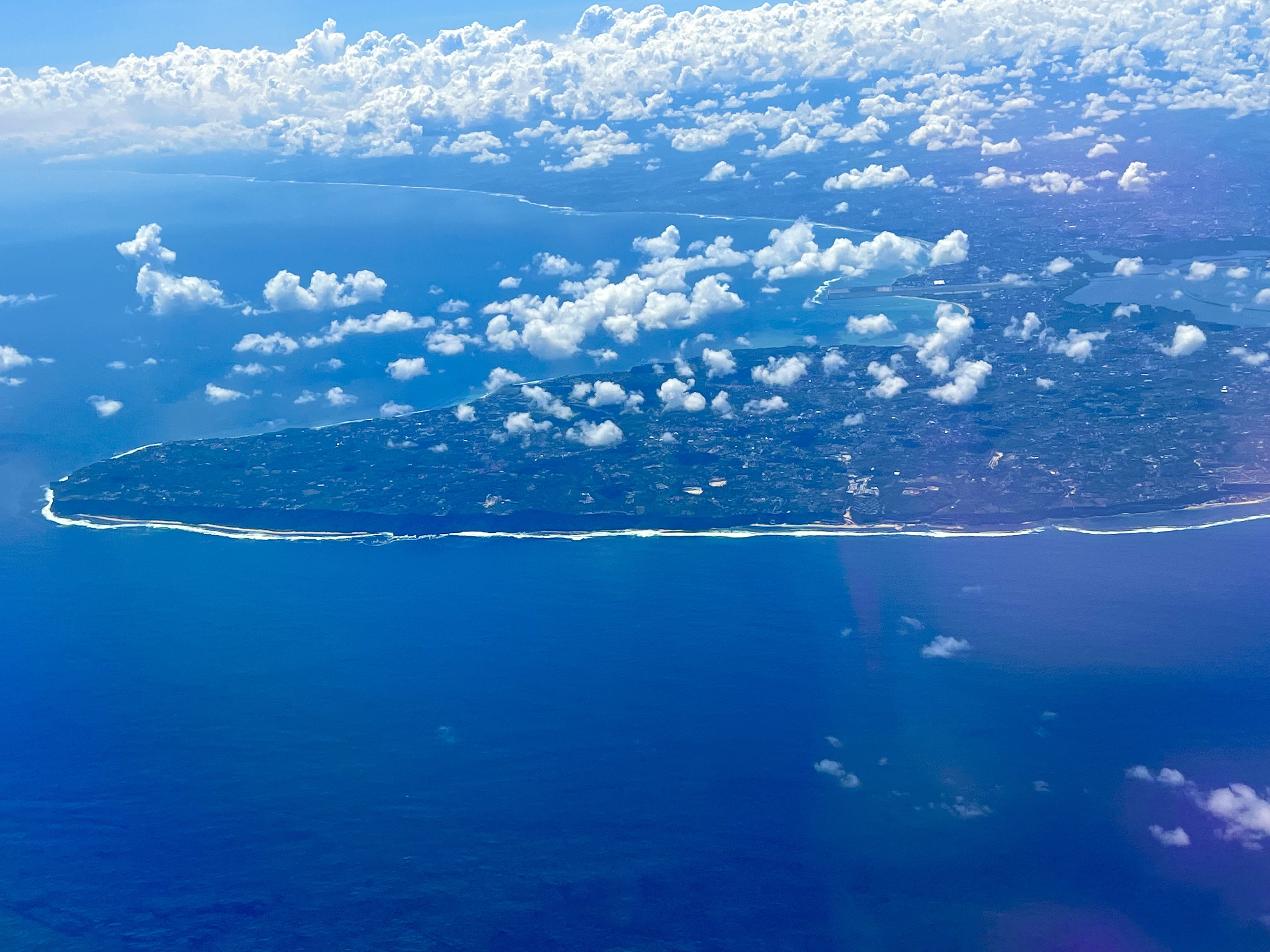
Bali Southeastern coastline from the plane
I was in Bali ten years ago and made day trips from my base in Ubud then. I was now eager to see how the place had changed and to return to familiar sites and temples. I drove when I was here the last time, so despite a few misgivings and given the intent to visit a few places in the south and north on this trip, I rented a car. This turned out to be my first mistake or rather challenge. Bali is considered the Island of the Gods, and they test us. I also believe in angels, and my guardian ones worked overtime as I tried to negotiate the traffic and horrendous mountain roads. More on that later.
My first challenge was to get through the concrete jungle from the airport to Uluwatu Temple at the very southern part of the island. This is one of Bali’s six most famous temples as it lies on a red-faced cliff backed by lush green rainforest jutting out into the very blue sea. The temple is dedicated to Sang Hyang Widi Wasa, in his aspect as Rudra, an earlier form of Shiva, one of the nine positional guardians of the island. The cliff is said to be a section of the water goddess, Dewa Danu’s, petrified boat. A temple has existed here since the 11th century, but the one visited now is considerably newer. I had not been to this temple before and wanted to see it. When I picked up the car at the airport, I asked the rental car agent for directions, and he said to just use Google maps on the phone. Well, this was fine and good, except that the sound wasn’t working properly, and I had to hold the phone in one hand while negotiating tight back roads filled with scooters and motorcycles, not to mention trucks parked on the side of the road with oncoming traffic. By the time I finally realized that I was heading north and not south, as Google maps kept dying on me, & I didn’t have a hand free to reset the system, I was already frazzled. I managed to find a place to pull over enough so that traffic could still pass me and get the iPhone to work and reset the directions. After about 20 minutes, I was finally heading in the right direction on the right road, but now traffic was at a standstill. In the end, it took an hour and forty-five minutes to drive the 21 kilometers from the airport. I was luckily there before the sunset crowd arrived and was able to get a parking spot. It seemed my luck may have turned by the time I arrived.
The Temple grounds are set up for tourists and perhaps a few pilgrims. A large amphitheater has been built on a hill next to the Temple where they have nightly Kecak performances. This dance, derived from an ancient Balinese trance ritual regarding the Ramayana, was created by a Balinese dancer/choreographer and a German director in the 1930s. I saw a Kecak dance at the Shiva temple in Ubud when I was there in 2014 and was quite impressed with it then. In the intervening decade, it seems that it has become a major tourist attraction with performances in differing adaptations offered across the island. The performance in Uluwatu is unique to their site, as is the one in Garunda Wisnu Kencana Cultural Park, or the four different shows now in Ubud, including one by women; the dance is traditionally for men other than the main female character, Sita. There is yet another in Tanah Lot.
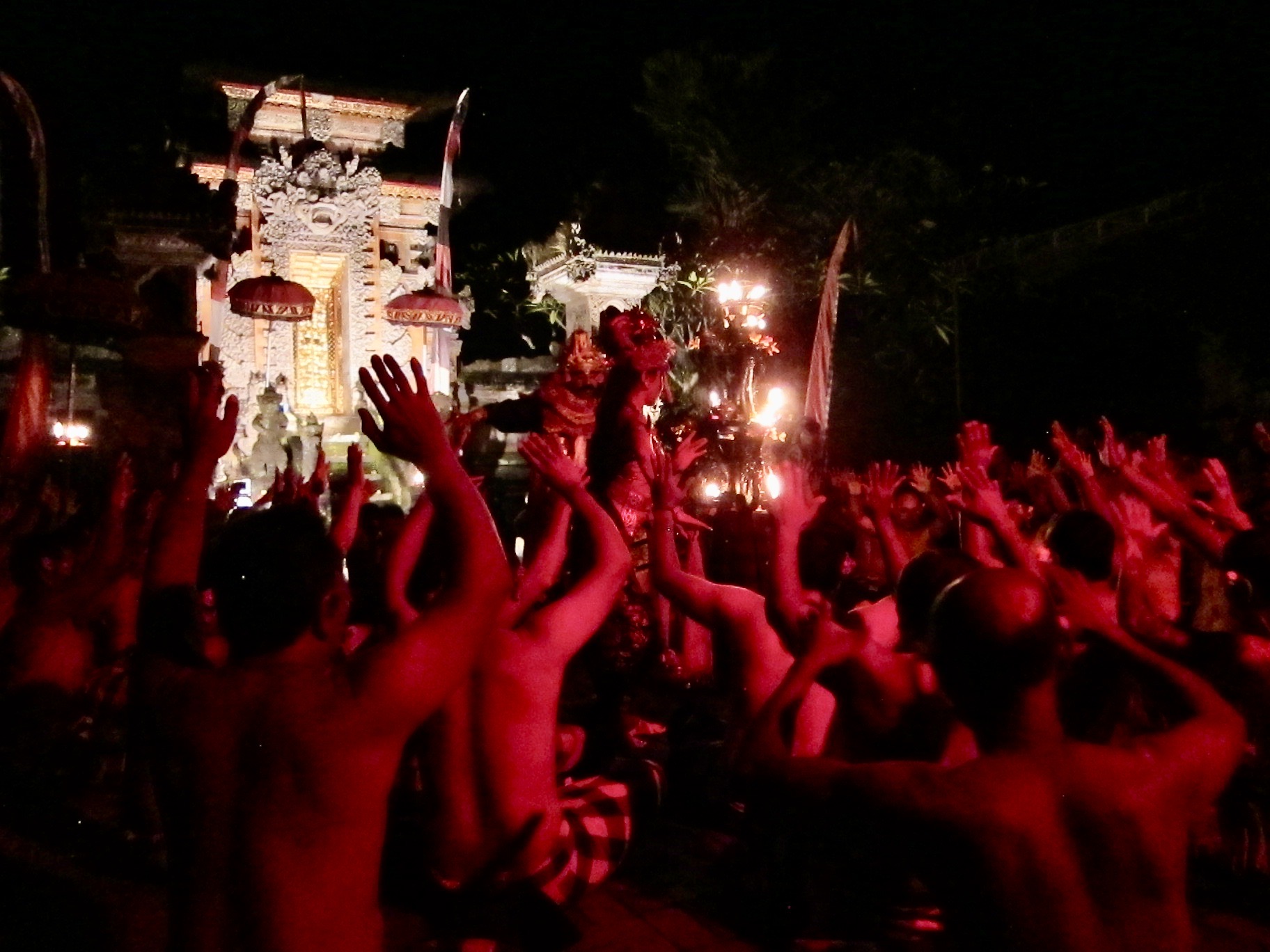
Kecak performance Ubud 2014 in the Shiva Temple
Walking around the Uluwatu site – one is not allowed in the inner Temple – I was impressed with how well the staff managed the masses of people, yet the sanctity of the place escaped me. The setting is truly stunning, yet it was marred by rows of tourists taking selfies.
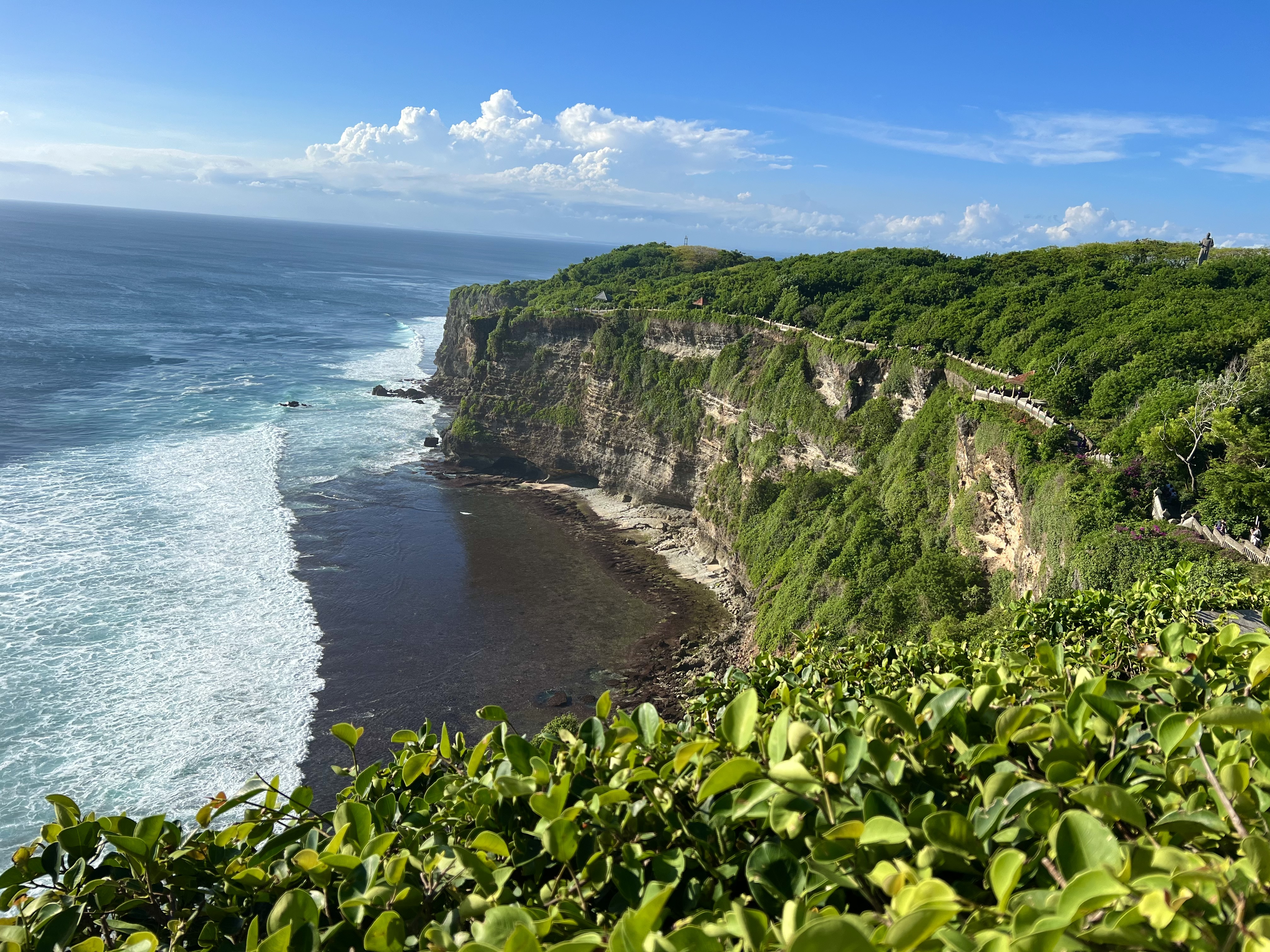
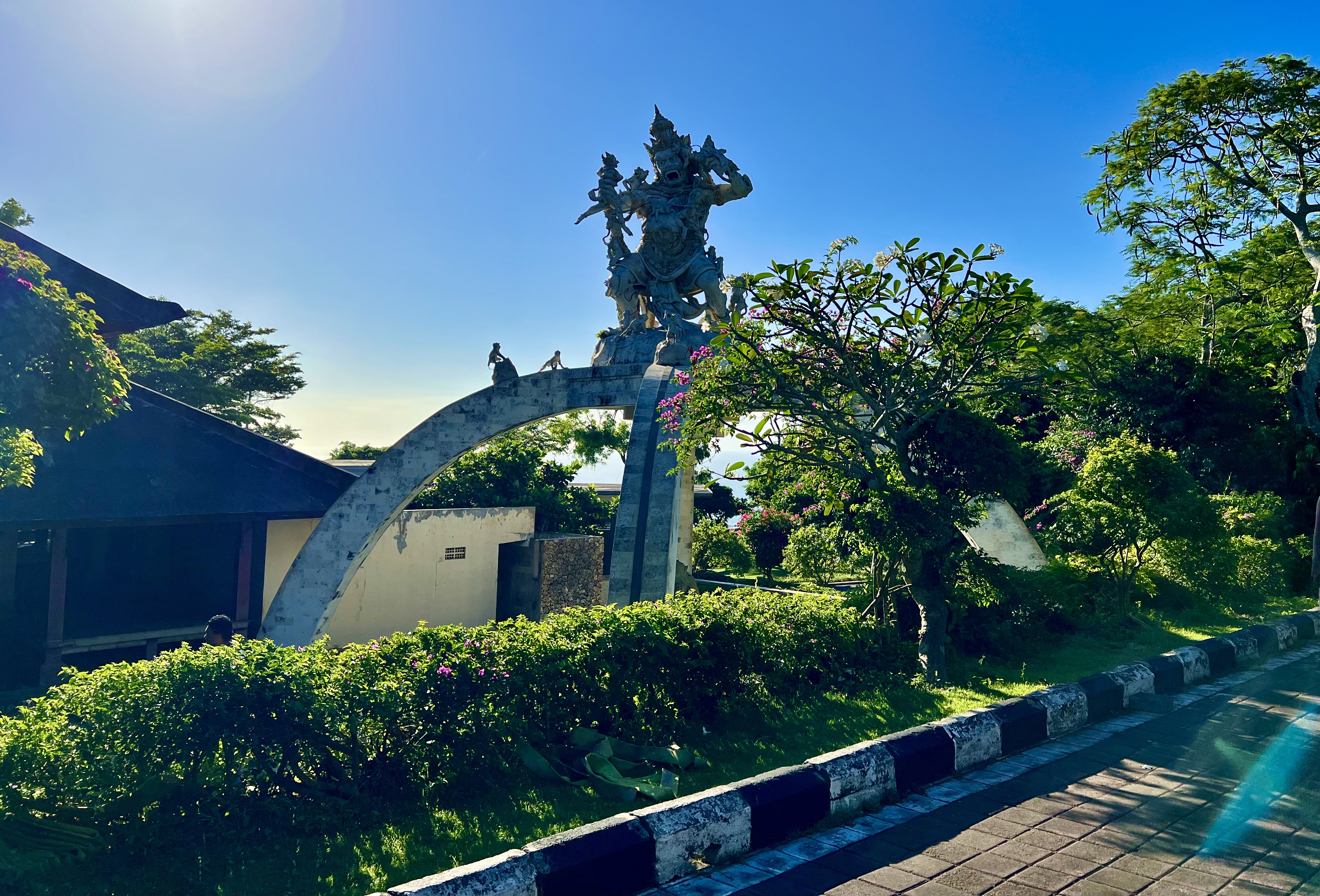
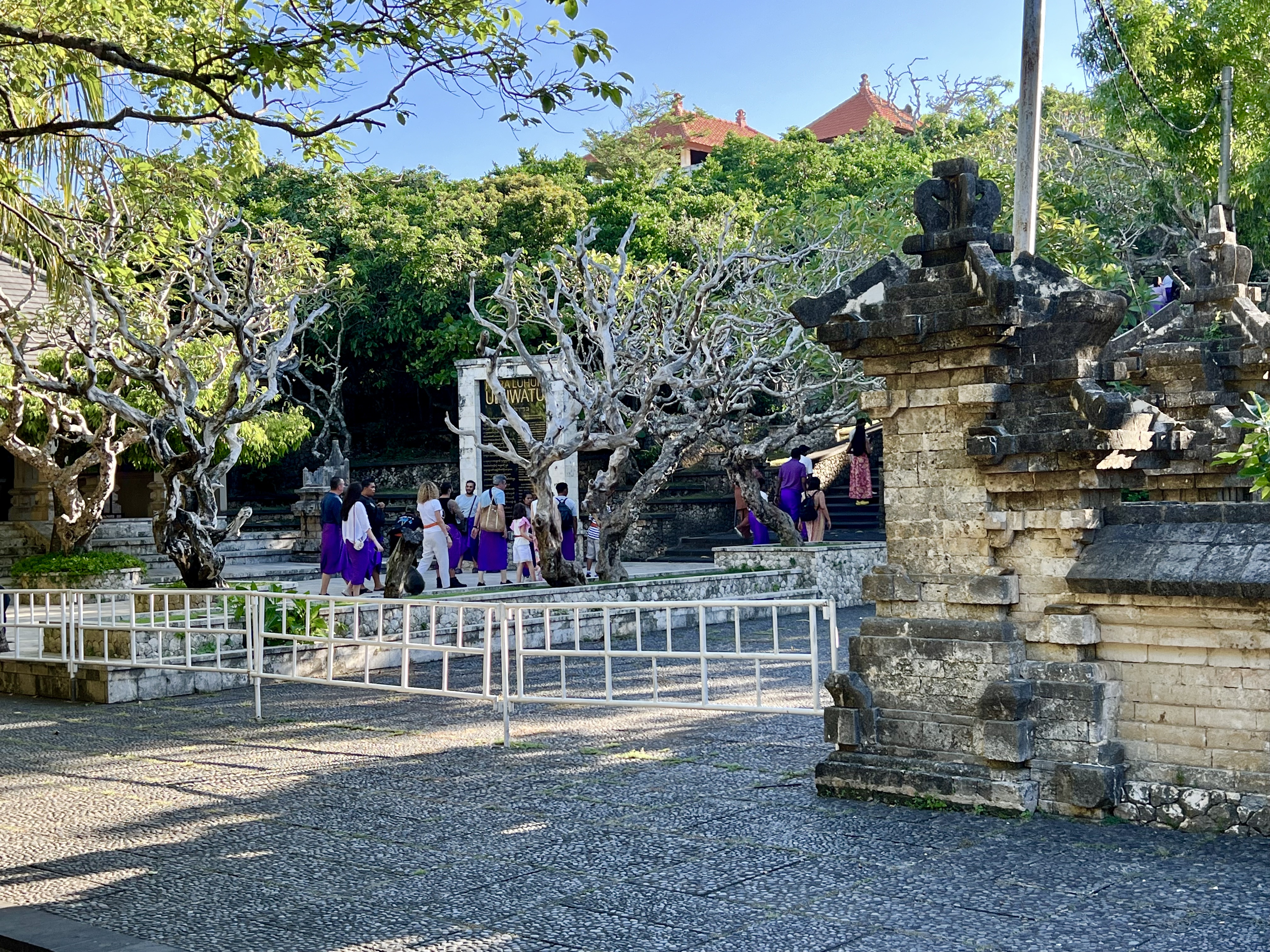
Uluwatu Temple
I decided not to wait for the performance but instead head back through the traffic to get to the Cultural Center and see a performance there. That didn’t happen. Again, the traffic was so bad that it took over an hour and a half to go the 12 kilometers between the two places. By now it was getting dark, so I headed straight for the hotel, which was near the Cultural Park. When I got there, I asked where I could walk to for dinner and was told there wasn’t any place within walking distance. As I had only had a light breakfast and nothing since then, I was hungry. The owner kindly said that he had to go to the convenience store on his scooter anyway and he would pick me up some yoghurt and fruit. It was incredibly kind of him as there was no way I was getting back in the car that night. The Balinese are very kind and hospitable, which is one of the reasons people love to come here in addition to Bali’s stunning landscapes. It is only when they get on modes of transport that their flip side shows through. In Bali everything is about a harmonious balance between opposites. In 2014, I felt the beauty and serenity of the forest gardens, waterfalls, rice terraces, and temples. Now I was confronted with the other side of this yin and yang, with hordes of people, horrendous traffic, and concrete enclaves.
All of this, however, is grounded in the Balinese sense of spirituality. To showcase and promote aspects of the religion in the 1990s a group of entrepreneurs embarked upon a journey to build the Garunda Wisnu Kencana Cultural Park for both locals and tourists. Things didn’t go as planned for the park and statue and construction stopped for sixteen years; it was finally completed sometime after 2013. The Culture Park is a large complex with a huge 122m high statue of Vishnu riding Garunda. This statue towers above the forest and is the tallest on the island. The statue is a reminder of the story of how Garunda agreed to be ridden by Vishnu in his search for Amrita, the elixir of life. Garunda’s mother had been enslaved by his brother and he could only free her by stealing the holy water of the gods, Amrita. Vishnu agreed to help Garunda on the condition that the mythical bird would become his vehicle. Figures of Garunda and Vishnu are also popular in Nepal, but there are artistic and cultural differences between the Nepalese and Balinese interpretations. In addition to the main statue, there are very large statues of Vishnu and of Garunda’s face along with some smaller ones of Vishnu riding Garunda, as well as one for the serpent Ananda and for the goddess Laksmi. It takes about 25 minutes to stroll from the entrance to the tall statue. For an extra fee one can go up to the top. Also, for an extra fee one can avoid the walk and take a shuttle buggy. The walk is actually quite pleasant albeit hot. The Cultural Park offers dance and music performances every hour on the hour from 11am to 6pm. I had wanted to see the Kecak dance there at 6pm the night before but settled for three short pieces at the 11am show as I still had the drive to Ubud ahead of me. The dances were interesting and varied. The first had five women dancing a flower welcoming ceremony, then there was a single male masked figure, who functioned like a clown with audience participation, and finally a dance that is traditionally done by one male dancer, but for the adaptation at the Cultural Park used three men. All of the dancers were accompanied by Gamelan musicians. The entrance fee includes the on-site museum, which showcases typical Balinese furniture, household items, tools, and some paintings and textiles. The gift shop sells all kinds of Balinese and made in China souvenirs, but no books. There are numerous coffee and ice cream shops near the entrance, including a Starbucks. While the topic of the Park may be a sacred legend, the Park itself is a holiday theme park with all the trappings. It is also a green haven where one can still find some green space away from the concrete congestion and traffic noise surrounding the site.


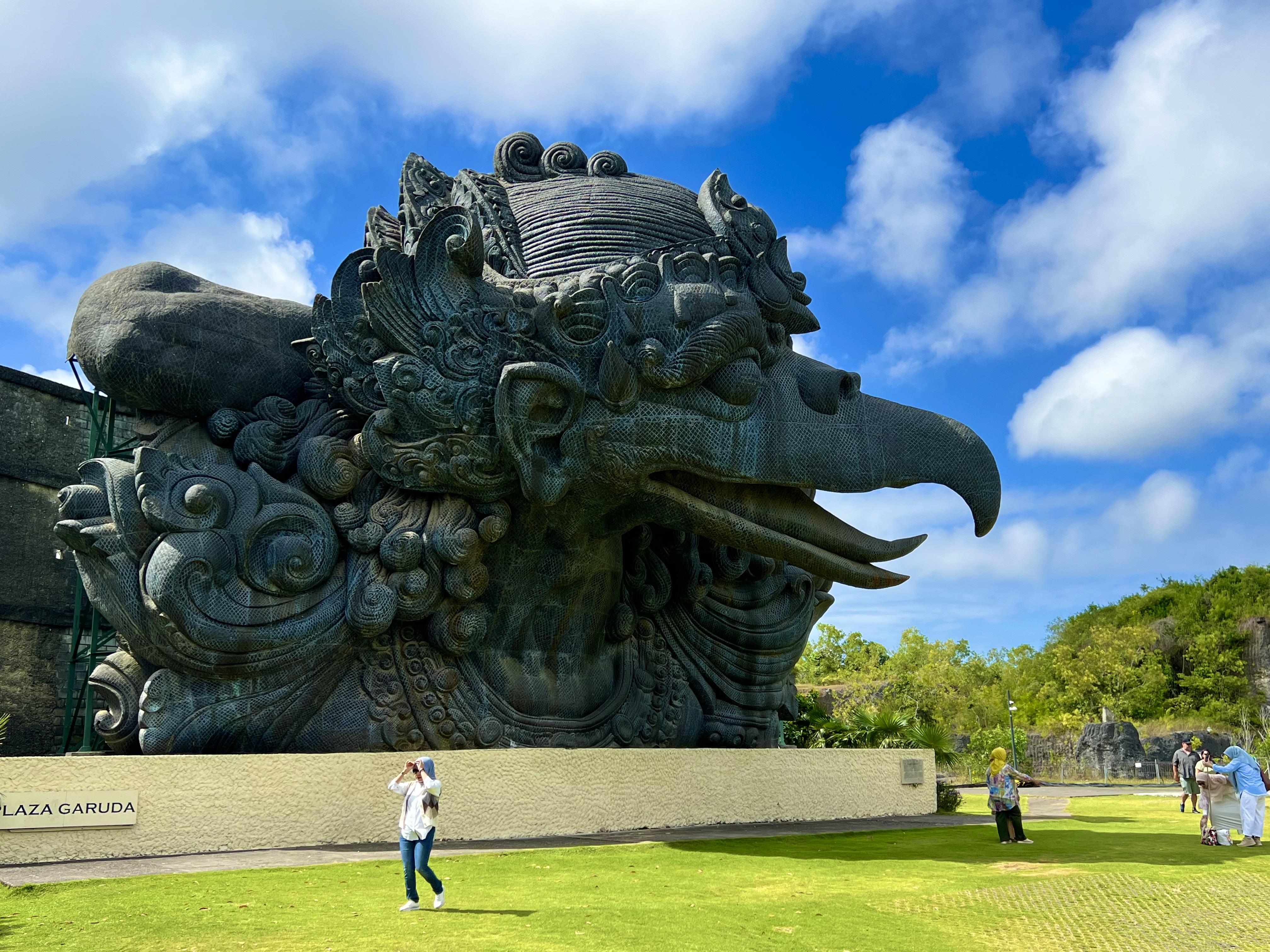
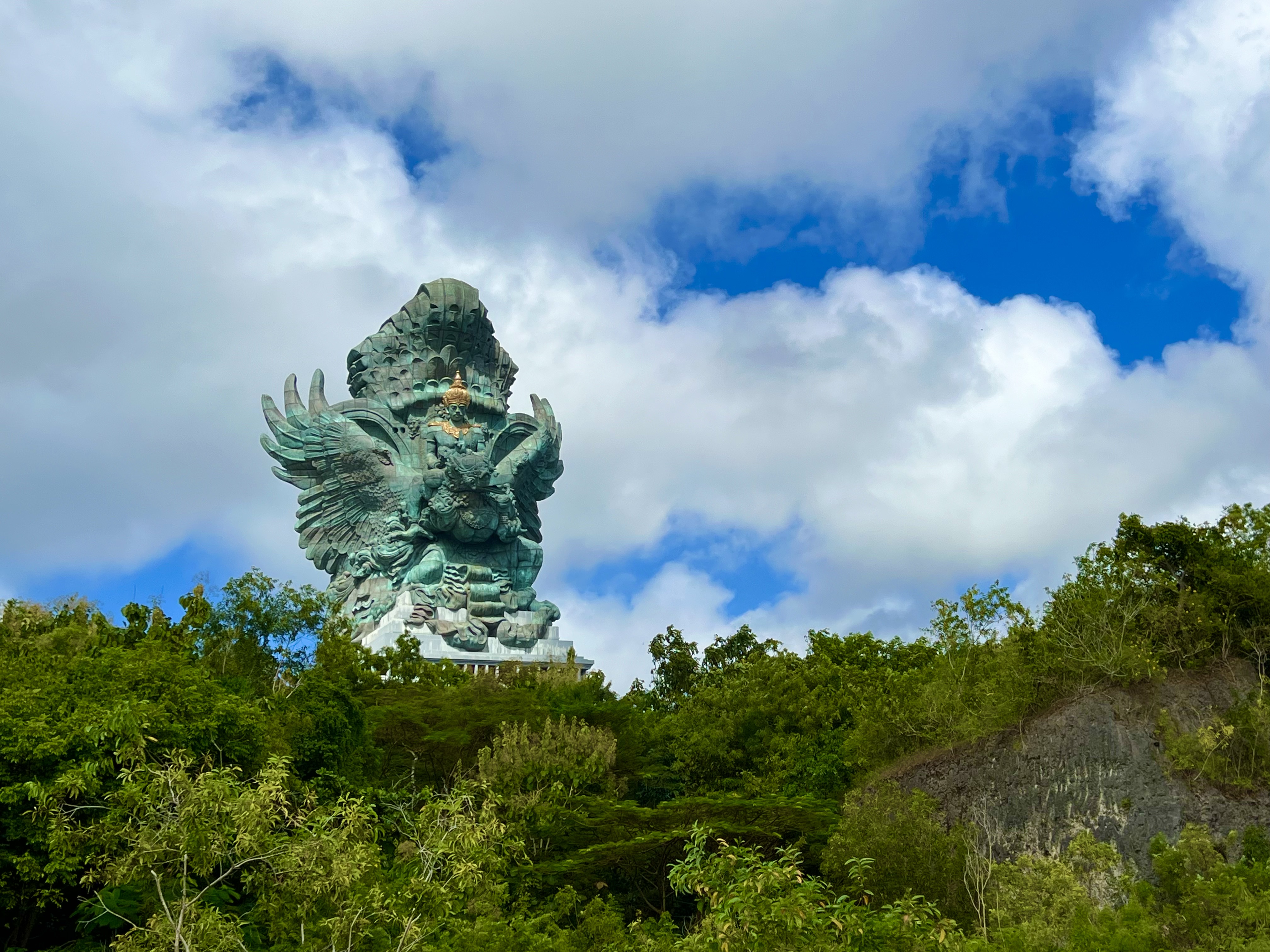
GWK Cultural Park
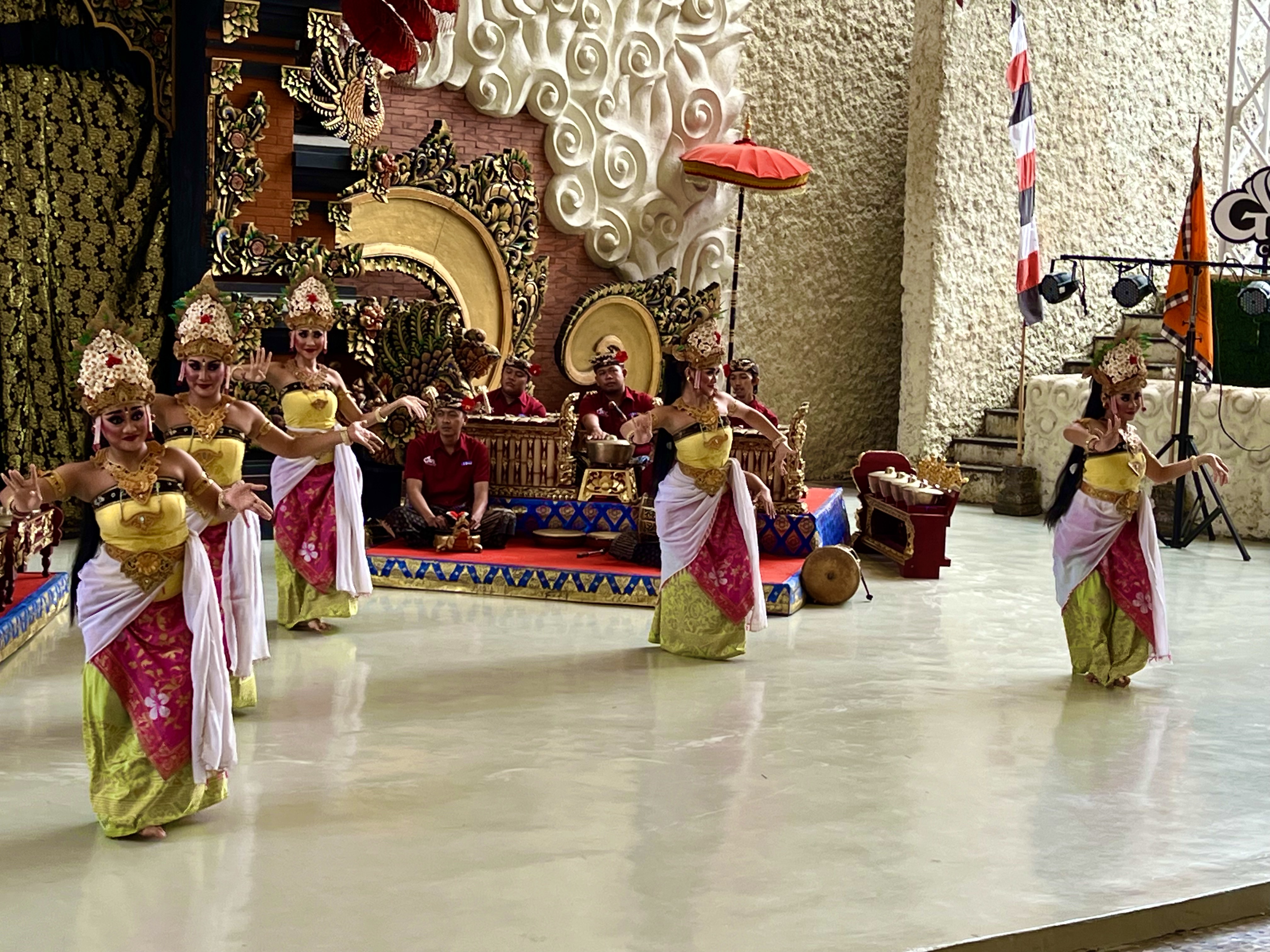
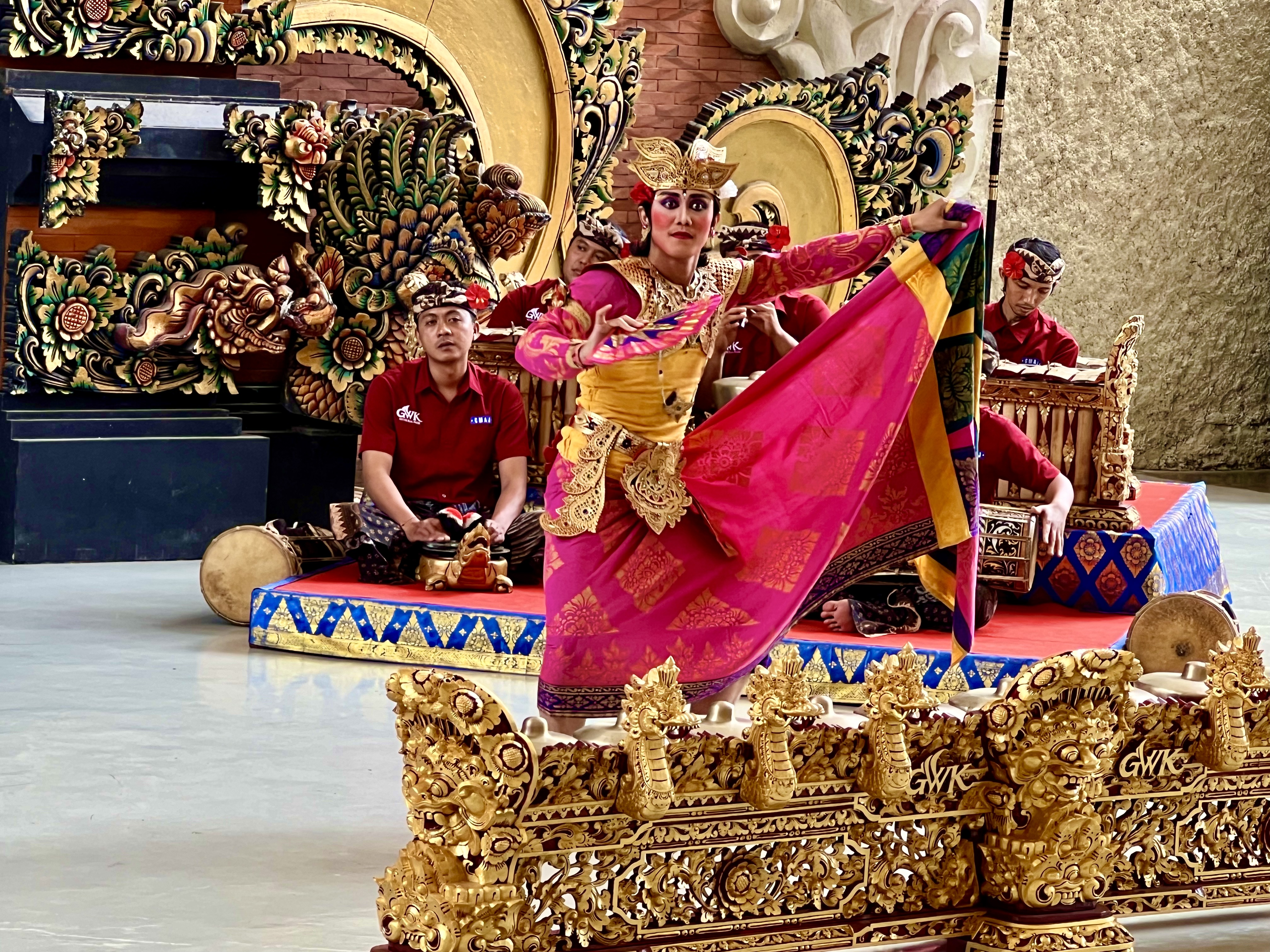
GWK Performances
It was time to get back in the car for the drive to Ubud. On the way, I first wanted to stop at the famous Tegenungan Waterfall. It turned out I had left one theme park for another. This one centered around the waterfall, which was impressive. Having come from the waterfalls in Lombok that were in the national park, the atmosphere here was dramatically different. In Lombok the forest and the natural world took precedence, here it was about having fun. There is a steep staircase to the bottom of the Falls and a swimming area under the Falls. Most people, however, were on the rocks looking up at the Falls getting wet through the spray coming off it. Families were there with their kids and lots of groups of young people having fun together. There were also a fair number of tourists, but there was a good mix of locals and visitors. Only later did I learn that the water in the Falls, comes through the irrigation canals for the rice paddies, so one is swimming in irrigation water, not the pure mountain stream water one expects.
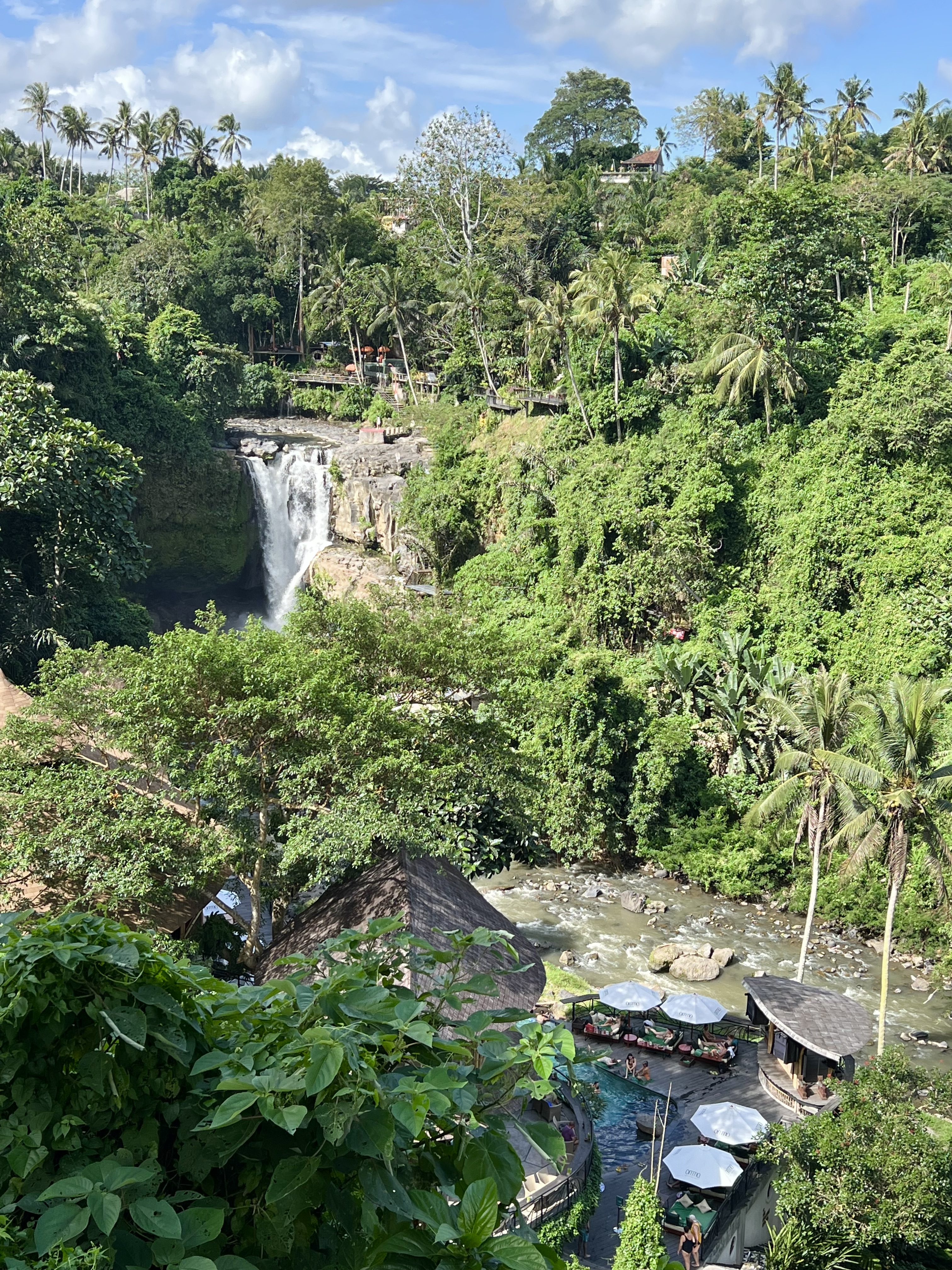
Tegenungan Waterfalls
From Tegenungan it was on to Ubud, where I was hoping to recapture some of the experience from ten years ago. That wasn’t to happen. First the drive there was absolutely obnoxious, with hundreds (no, I’m not exaggerating!) of scooters crossing over the lane into oncoming traffic trying to avoid the cars in their lane, cars and trucks parked on the side of the road, but as the road is so narrow, they take up half the lane. Google Maps was still a problem directing me to go down side streets that were blocked or to make turns where it was impossible to do so. When I finally did arrive at the Bali Asli by EPS B&B, I was on a small bricked path with nowhere to park. So, I did what the locals do. Simply parked the car in the middle of the road and went in to the complex to let the family know I’d arrived. Made, one of the owners, came to greet me and she had her husband move the car to a secure parking lot so that I didn’t need to negotiate any more Ubud traffic. I have to say this family was simply wonderful! The room bordered directly on the rainforest complete with songbirds. With all the noise and congestion that is now in Ubud, this was a true sanctuary.
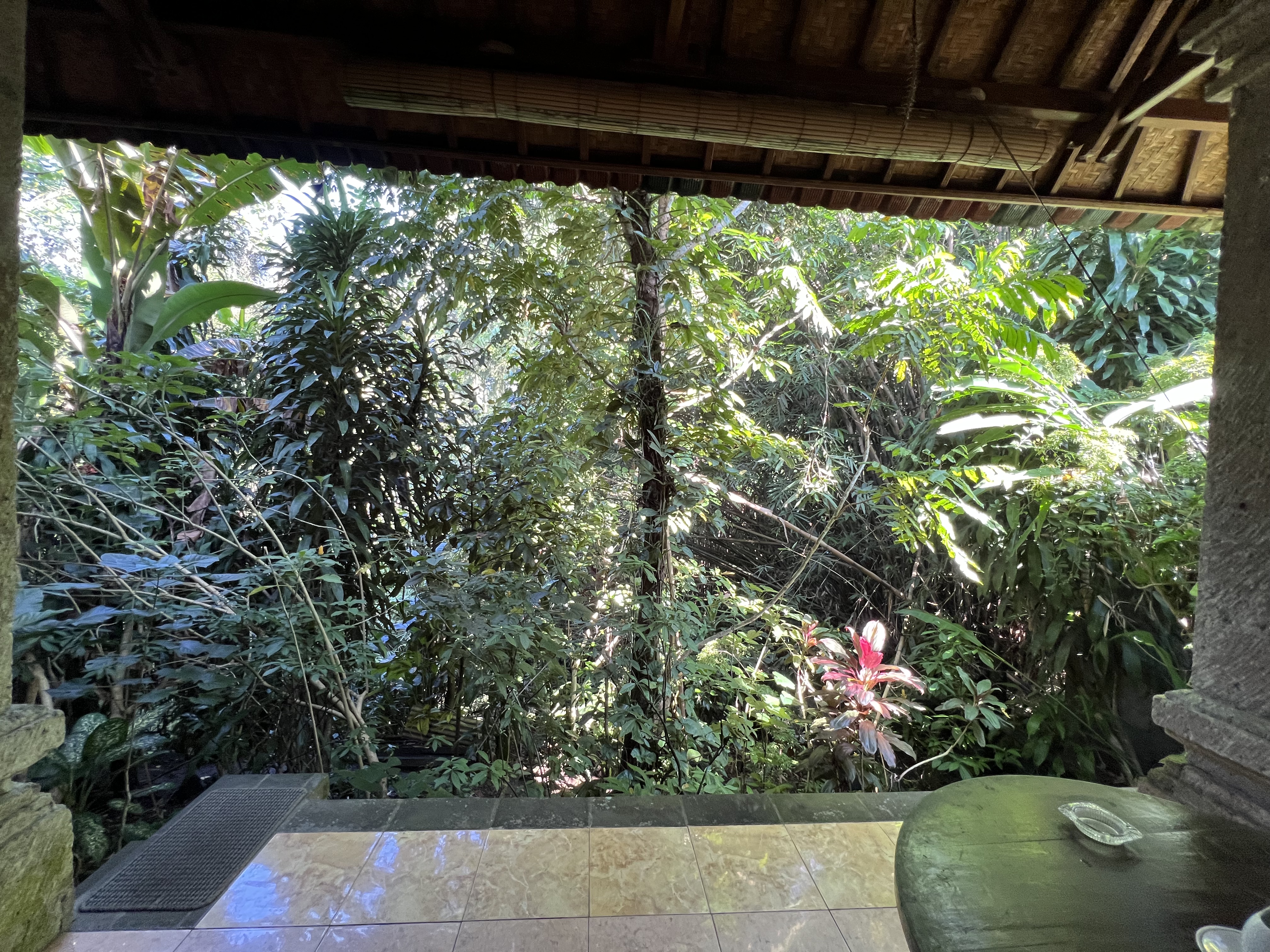
View from my room with its terrace
I was very disappointed in what I found in Ubud this time. The town has deteriorated almost beyond recognition over the past decade. There were tourists before, but this is simply too much. The motorized traffic was horrendous, but so was the foot traffic. The sidewalks, when they are there, are all torn up and the crowds don’t allow for much movement. A few quiet places can still be found, including at the museum. The grounds were as delightful as I remembered and the new exhibitions of young local artists interesting. The other place, that was filled with tourists, but was set a bit back from the traffic was the Water Palace. The Saraswati Temple is closed to the public, but the outside Water Palace is open. In the back, where the Temple is, there are thrones set up for the god and goddess. They are draped with Saput Poleng, the traditional black and white checked sarong, which is ubiquitous on shrines throughout the island. This pattern exemplifies the Balinese philosophy of the need to create harmony through the balance of opposing forces, both natural and spiritual. When red is added through a sash, then it is called a Saput Poleng Tridatu where red represents energy, the Sanskrit rajas, black is inertia , the Sanskrit tamas, and white purity and wisdom, the Sanskrit satwa. These elements must always be in balance to create a harmonious and healthy world, both internally and externally.
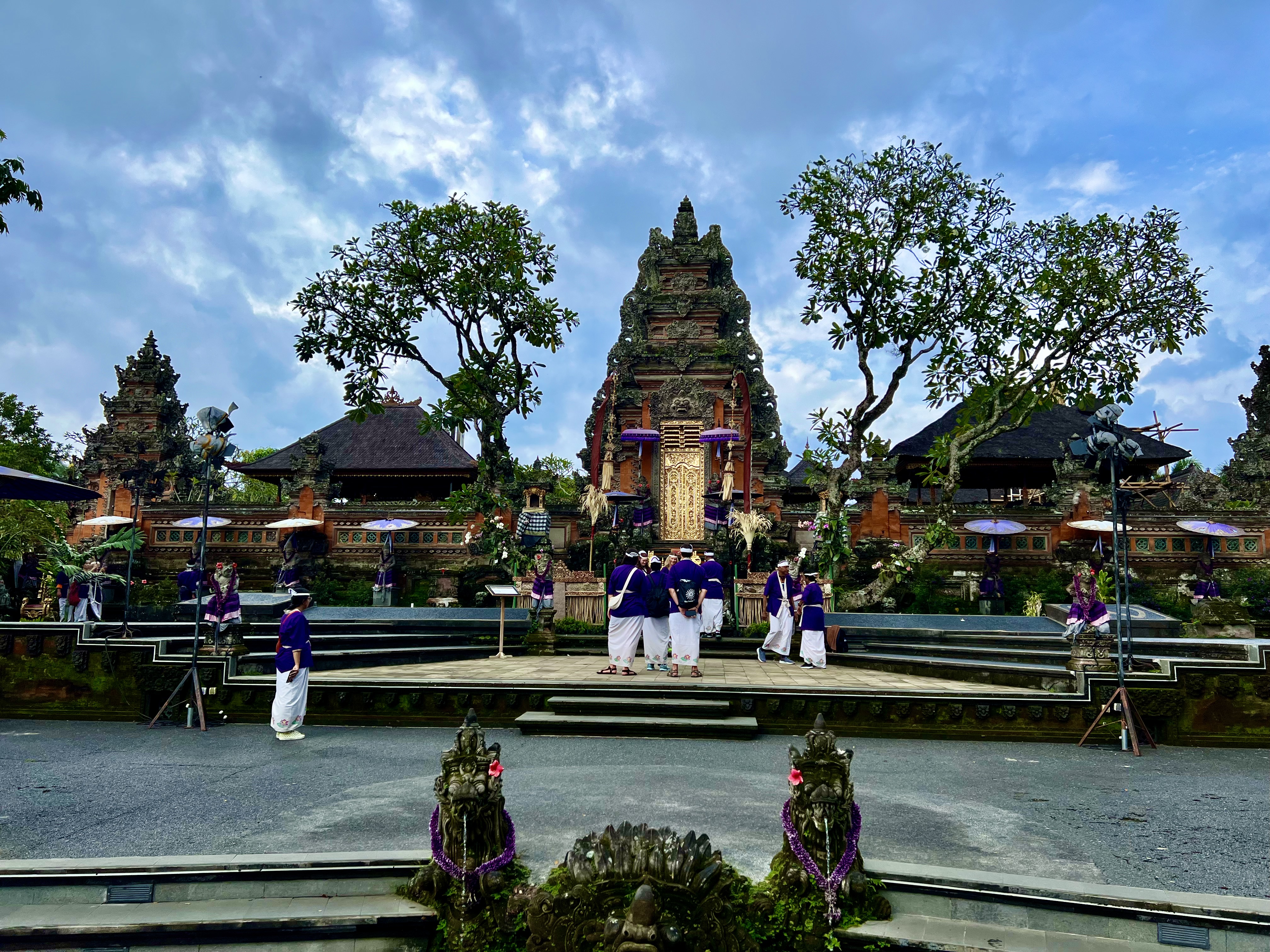
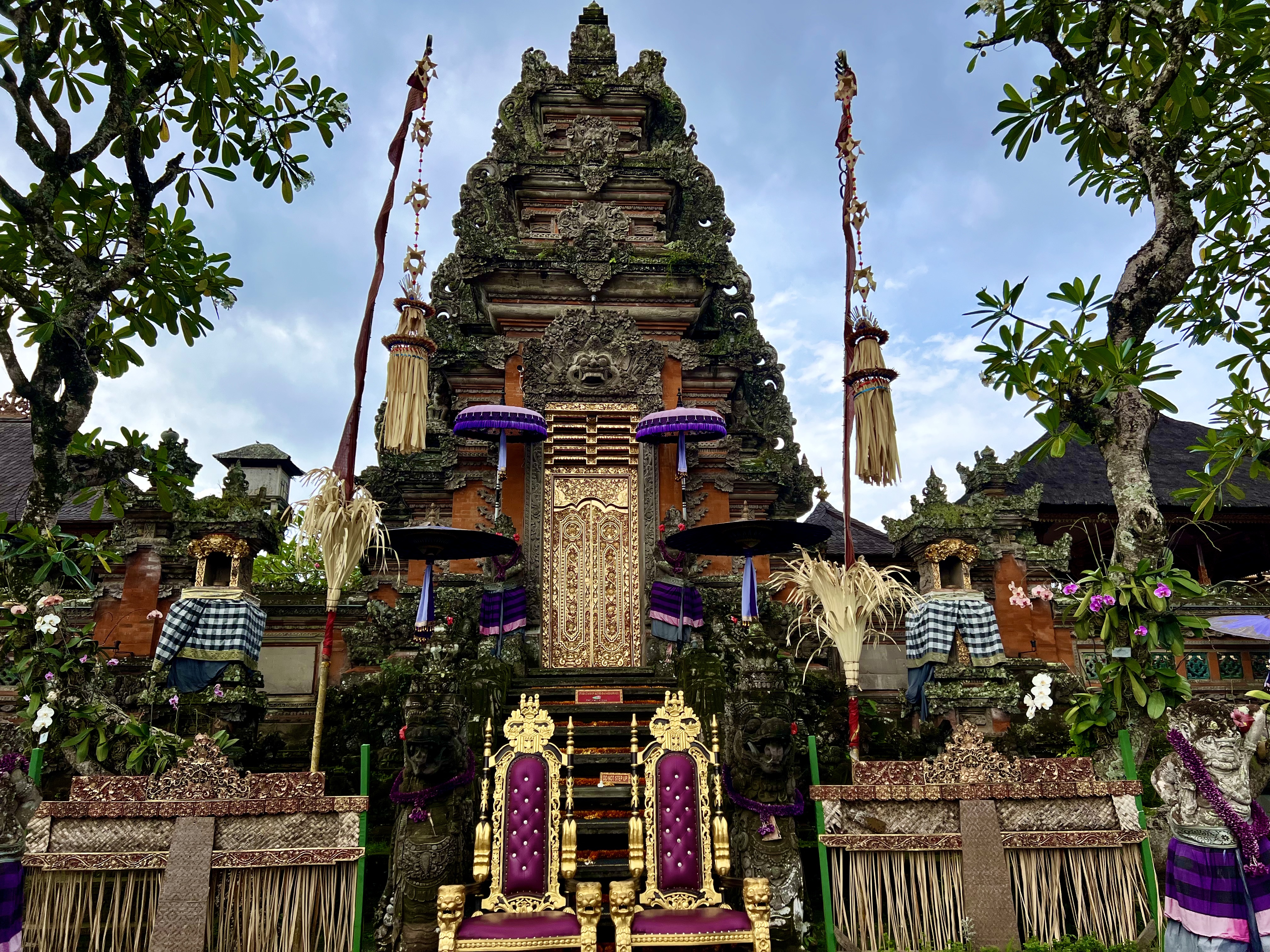
Water Palace and Saraswati Temple, Ubud
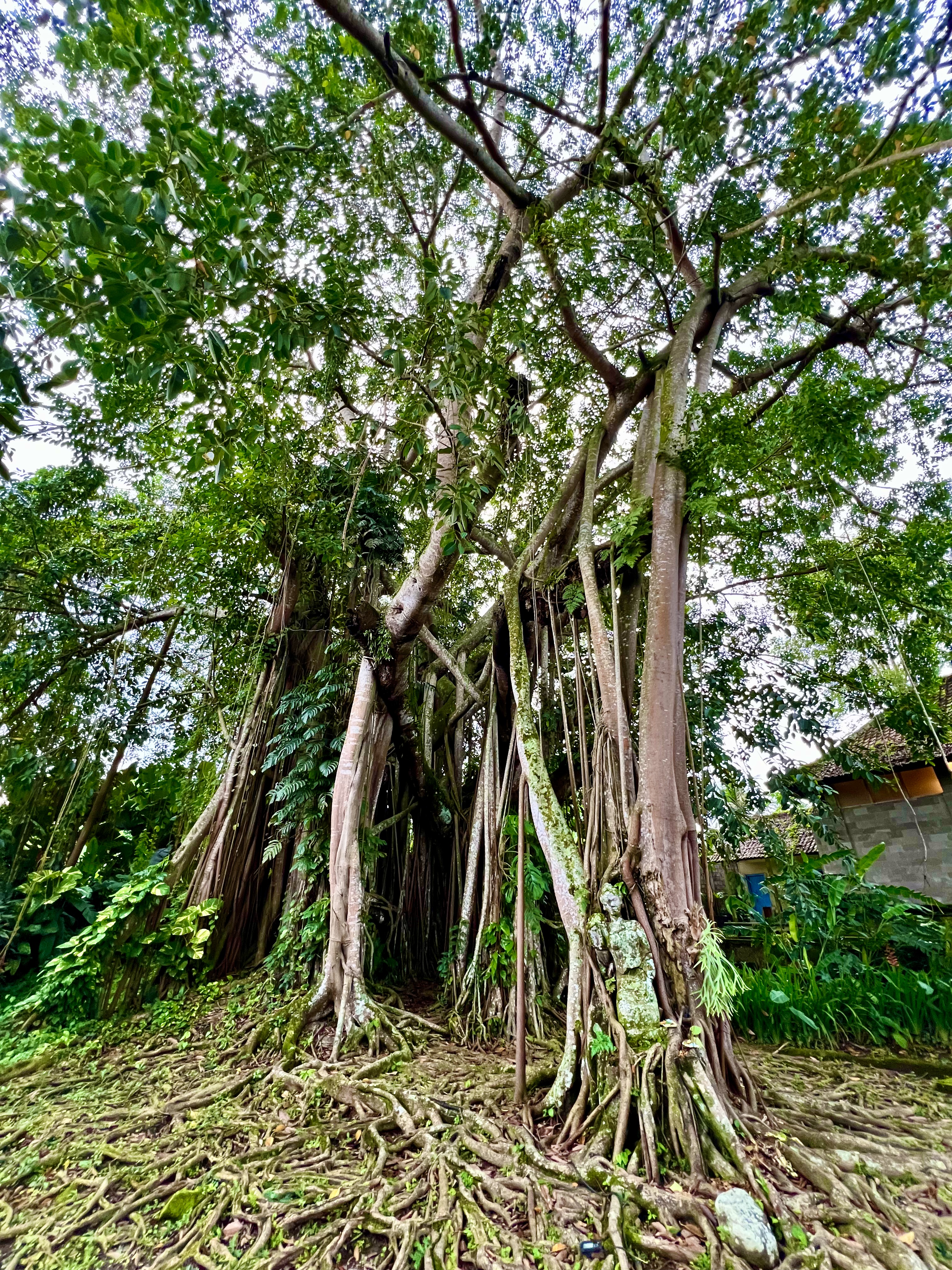
Strangler Fig Tree in the Museum gardens
The mother temple of Balinese Hinduism is Besakih, and I had not gotten to this site during my earlier visit. I didn’t want to try to negotiate the way in the car, but luckily Made’s father is a guide and driver, and he was willing to take me. The path he chose was one I would never have found, and I was very grateful for his help. We drove through areas that looked somewhat familiar but were now more built up. It turns out we did drive through what had been the rice fields beyond town that have now mostly disappeared to be replaced by housing and hotel projects, many of which are in various states of construction. Clouds covered the surrounding mountains as we drove up Mt. Agung, so I wasn’t able to see too much, but what I could see looked like a beautiful mountain filled with lush green trees of various kinds, interspersed with palms. Mt. Agung, is the holiest mountain on the island and is still an active volcano. An earthquake in 1917destroyed much of Besakih’s 8th century temples and an eruption by Mt. Agung in 1963 did more damage, so what is visible today are renovations that took years to make. My first shock when we arrived at the Temple site was the four-story new concrete parking garage that looked like it belonged at the airport not at a sacred site; it was a complete contrast to the torn up roads we’d be driving on. The next was that there was a buggy to take visitors from the entrance to just below the actual temple sites. In between the street was lined with vendors. In contrast to outside the Temple site, these streets were clean, broad, well cared for and only for Temple vehicles. Included in the price of the entrance ticket is a guide, which is very helpful as the complex is quite large with 23 temple units over six terraces. The most important is the Pura Penataran Agung, which represents the seven layers of the universe and the roofs each have seven or more odd numbered layers. The entire site is dedicated to the Trimurti, so there are temples to Shiva, Vishnu and Brahma. The Trimurti is considered an aspect of the ultimate god, Sang Hyang Widi Wasa (otherwise known as Iswara). He is often portrayed on the highest shrine as a golden dancing god, who dances all the elements of existence into being. As he cannot be directly contacted, worship is done through his aspects in the Trimurti. There are four temples associated with four aspects of the god through the cardinal points. There is also a Lakshmi Temple. I didn’t see one to Saraswati but am assuming she must also be represented somewhere. On the side of the complex on neighboring hill is the Ghost Temple. This is for those who have been sent to Hell. It is only after their sins have been purified that they can be reborn. Throughout the complex it was clear that numerology is present in the construction of the site. Seven layers of the universe, the four directions, the unification of the three gods, etc. The guide also explained that three represented the Body, Speech, and Mind, which is a Buddhist as well as Hindu concept and that how one positions the hands in prayer is dependent upon who one is addressing. At the head, one is addressing the divine; at the mouth, the community; and at the chest, person to person. Another interpretation is that the head leads toward the heavens, the chest to humans, and the lower part of the body to nature. Colors are also important. In addition to the white and black checkered cloths, many of the statues and all of the pilgrim worshipers wore white and yellow. White represents the Supreme God, who radiates pure white light, and yellow Mahadeva, or Shiva, who emits a more earthly tone, as such the colors represent the blending of the divine and material worlds. The white and yellow frangipani flowers that are everywhere are also used as part of this symbolism.
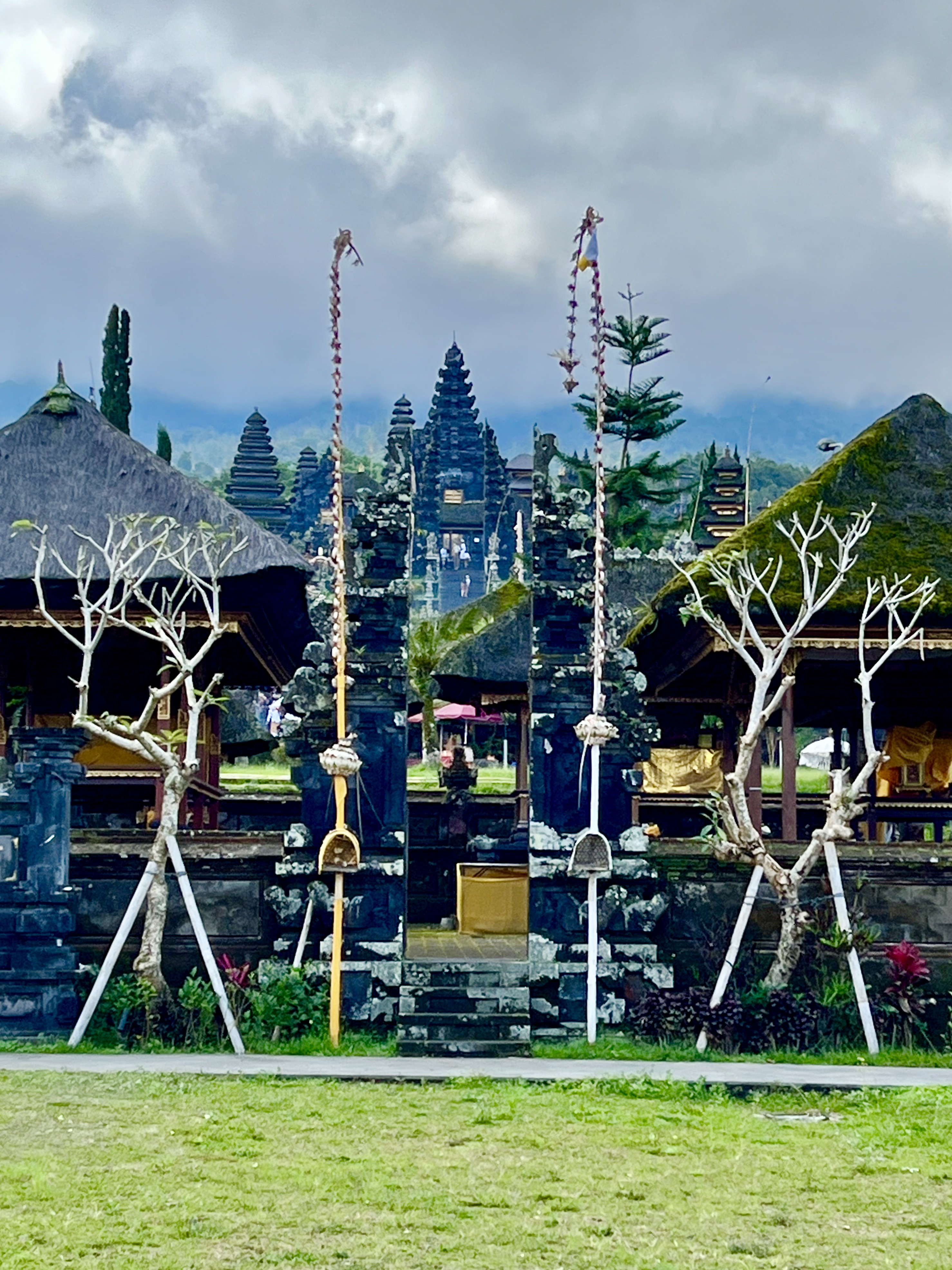
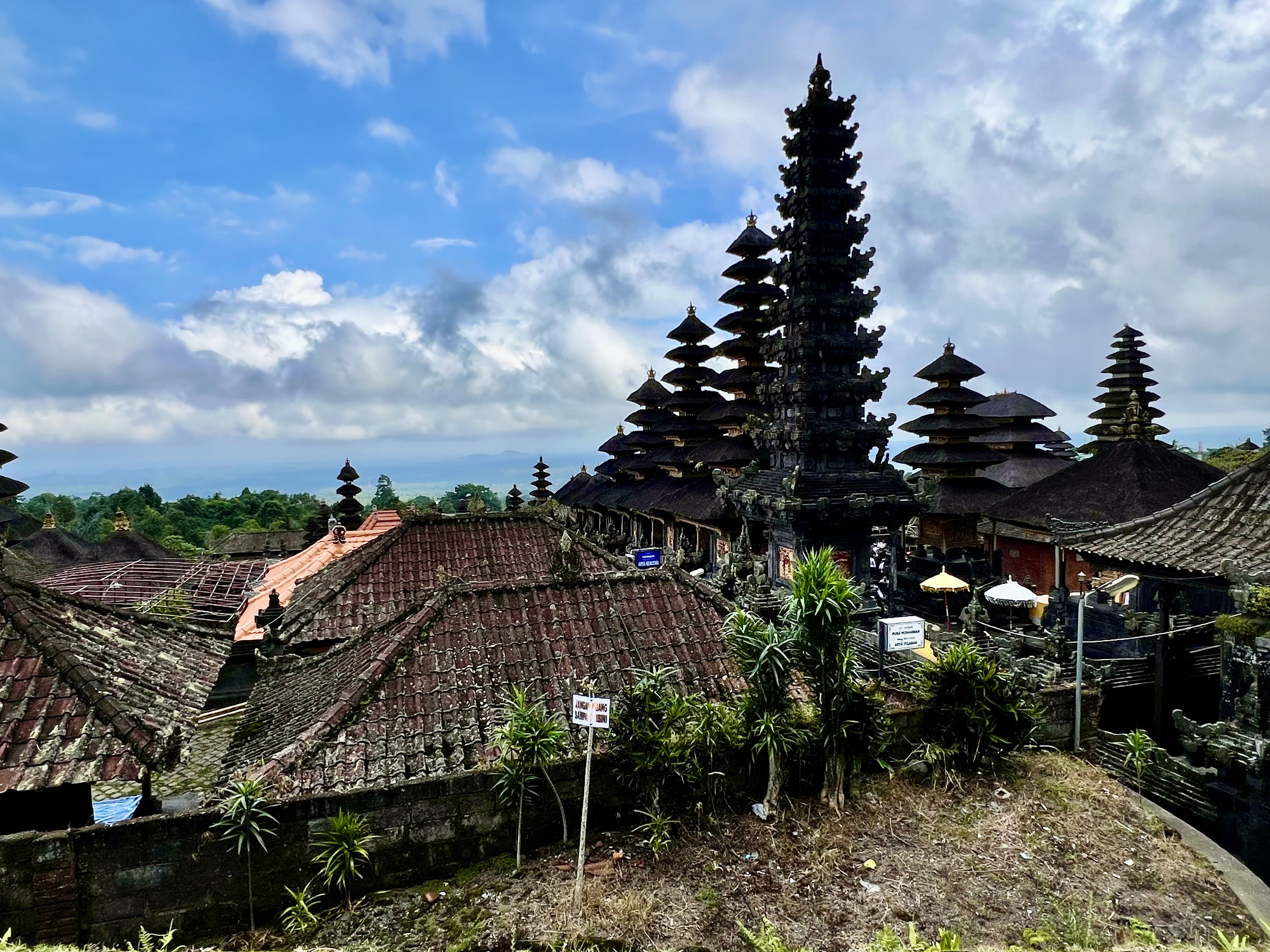
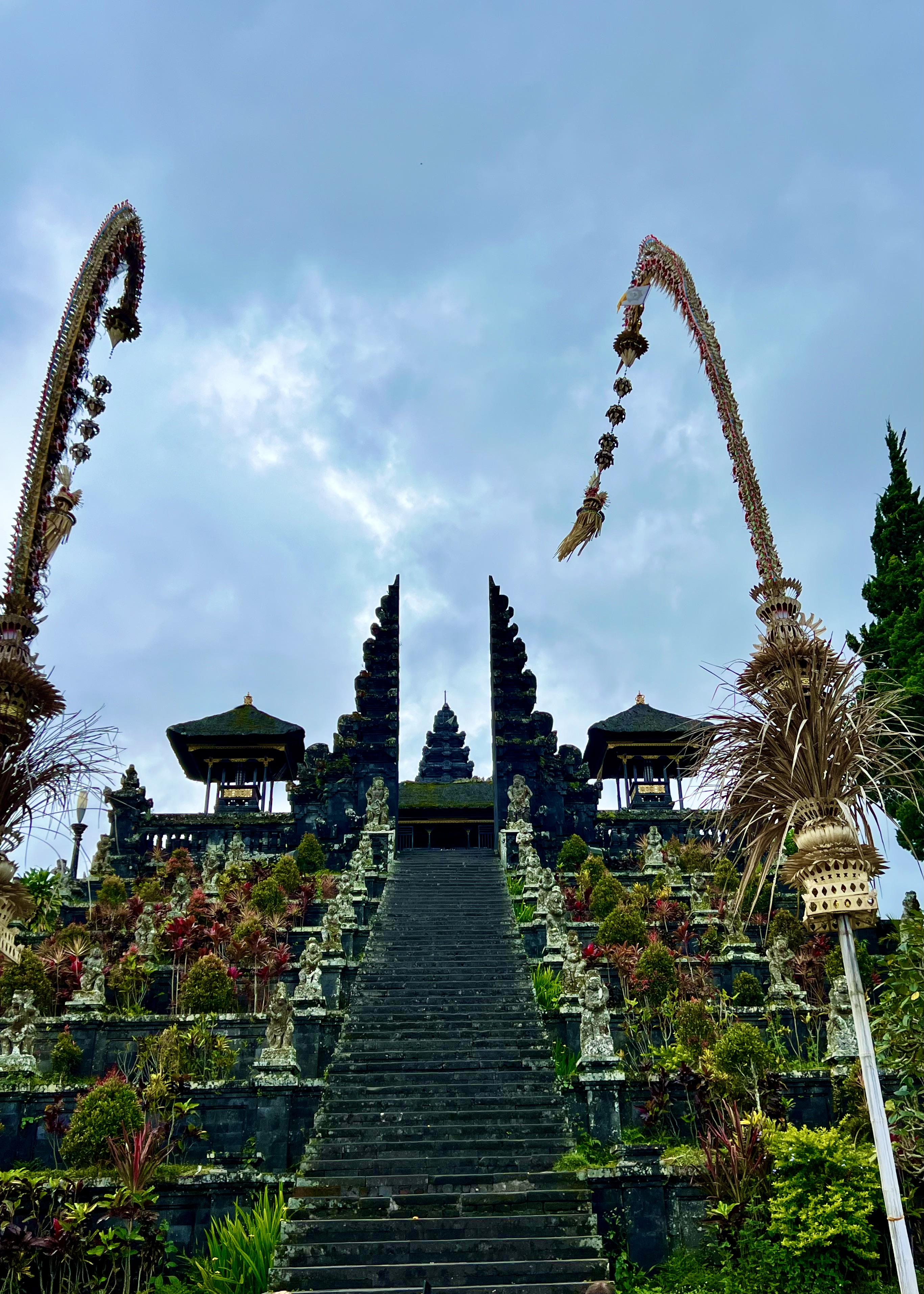
Besakih Temple
The temple entrances had the typical gateway, the dual triangular Candi Bentar, which represents Mt. Kailash split in two allowing passage into the sanctuary, and guardian spirits at the side. Mt. Kailash is the home of Shiva, and the guardians are called Bedogol. They have the task of organizing the unbalanced outside world to make a neutral entry into the sacred site. The guardians, Dewa Drawapala, i.e. the Buddhist Dravapalas, are often male and female, but also just male, in which case they may represent youth and maturity.

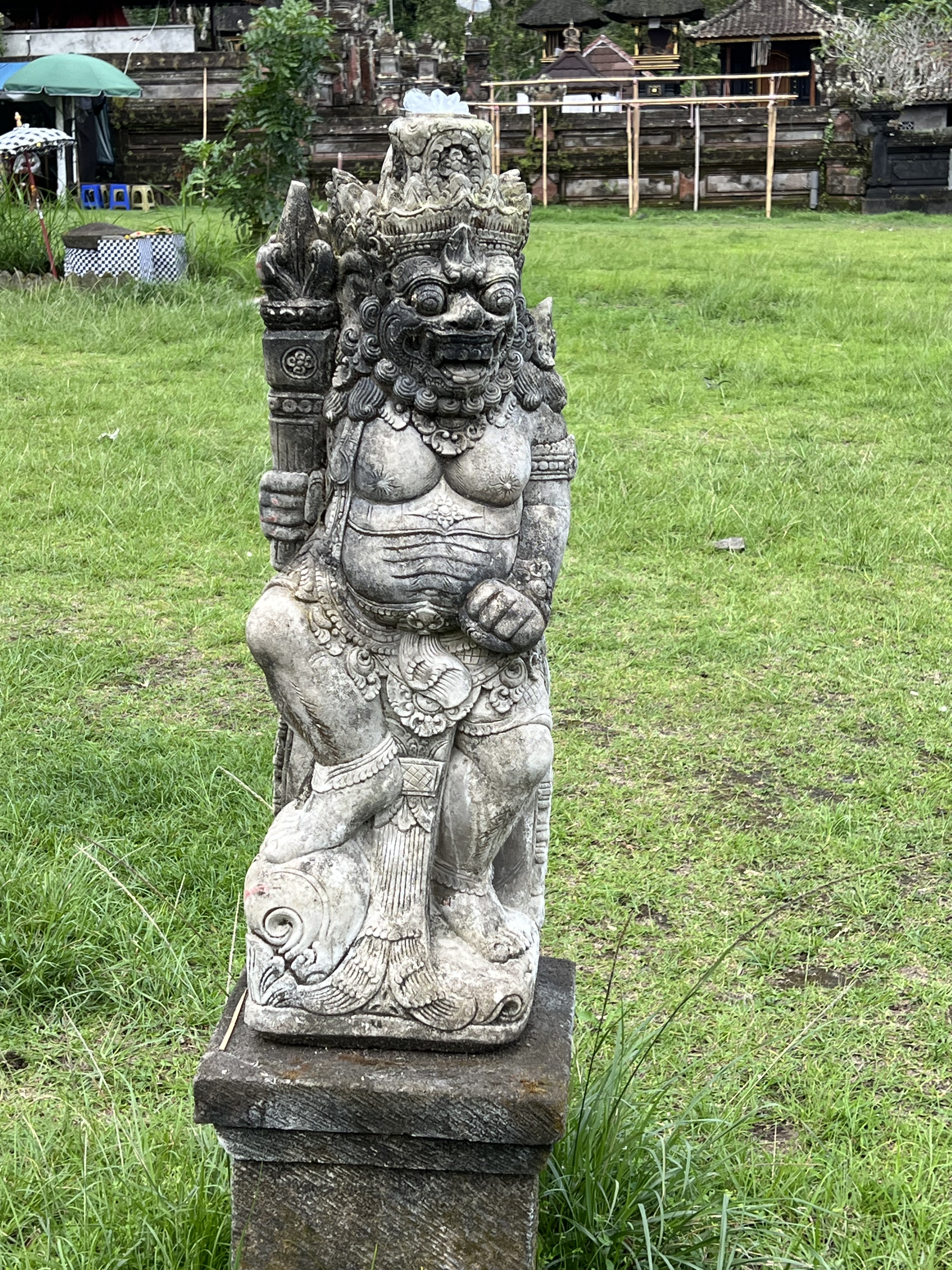
Besakih guardians
Besakih is a major pilgrimage site and one in which everyone is supposed to go with the ashes of their deceased to be blessed. The ashes are then taken back home. Each region has their own temple complex. Tourists are not allowed inside the actual temples, but only on the paths between them. I was able to get into the Laksmi Temple, though, as I wanted to pray. The guide wasn’t allowed in as he had troubles at home and that energy wasn’t permitted inside the sanctuary. That rule didn’t apply to the two canine yappers that were inside the Temple, though. They were clearly not happy that someone had come into their space.
I was glad I finally made it to Besakih, but as with Uluwatu, was disappointed that it felt more commercialized than sacred, but I guess that was just me. For the local pilgrims, the site remains the most sacred on the island.
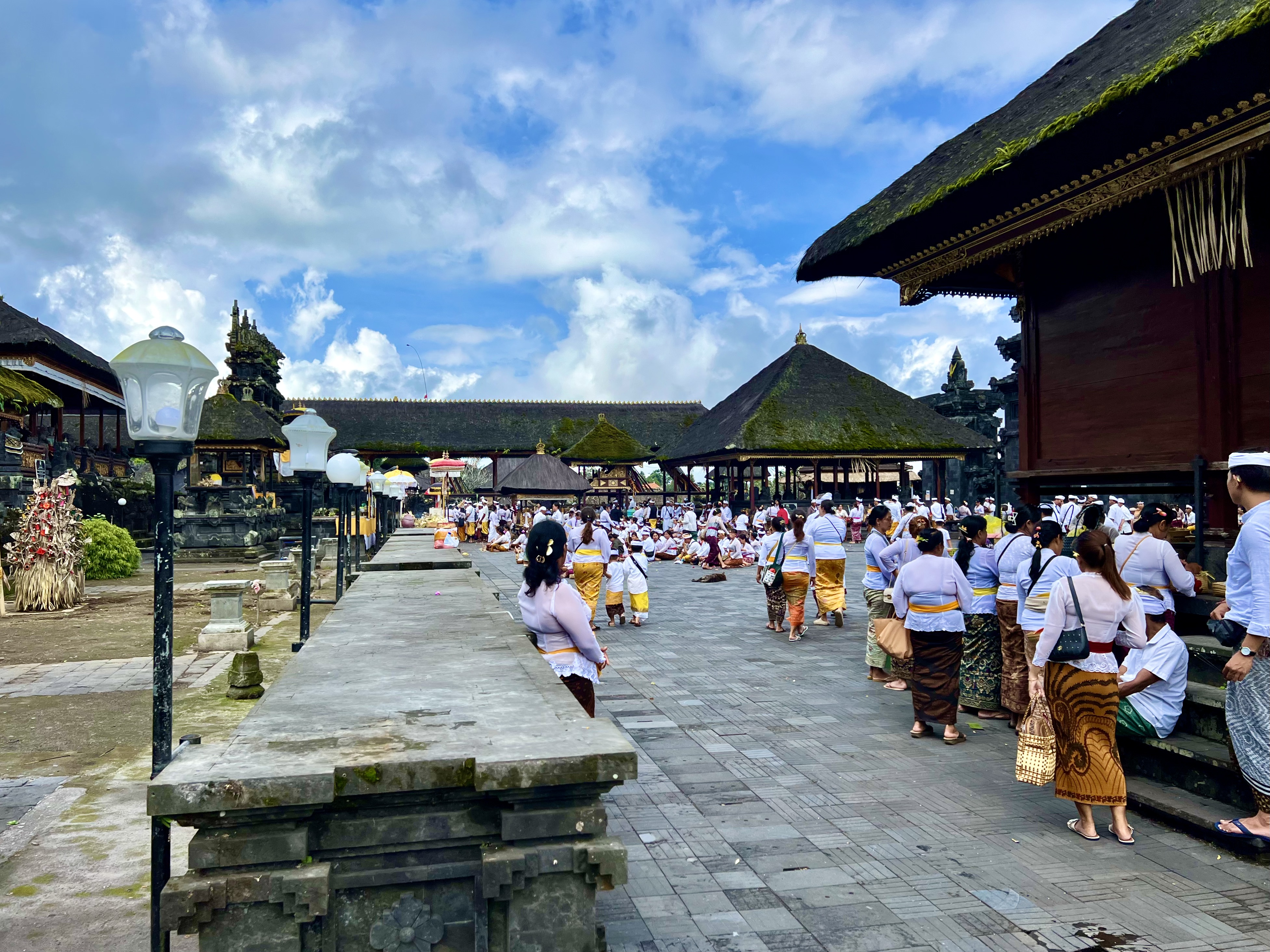
Worship at Besakih
I had had enough of the congestion in Ubud and wanted to escape to what Bali used to be like. I thought about going up to the West Bali National Park, but the drive would have taken an experienced Balinese driver four hours, and that was too long and stressful for me. I chose the next site not for any reason other than Google Maps showed that it was a straight line to the Tejakula coast which had Mt. Batur as a backdrop. I should have known by now not to trust Google Maps! The first part of the road was bad, but still drivable until the Geopark near the turn off to Besakih, but from there it became sheer hell then sheer terror. The first part of that stretch went on the periphery of Lake Batur, where I was detoured into the rice fields due to a local festival, which would have been fascinating under any other condition. Then Google sent me up Mt. Batur on a path that was barely wide enough for the car and steep enough to qualify for a double black diamond ski slope. The small car almost didn’t make it up even in second gear. There was absolutely no room for anyone to pass; I prayed no one would be coming in the opposite direction; they did, but luckily only on motorbikes and when there was a bit of space through the shrubbery they could get by. Then I had to go back down. These weren’t hairpin turns, they were much worse. I live in the mountains and drive mountain roads all this time, but these ‘roads’ were not meant for cars. I would round an uphill jack-knifed bend to look out at open air with the sea on the horizon as the road dropped so precipitously that I didn’t see it. I continued to pray that no one would come in any four wheeled vehicle either in front or behind me & luckily no one did. & then I was concerned that the brakes would give out. I have never been so glad to get down a mountain. I have burdened my guardian angels many times, but they worked overtime on this drive. Had I been able to look around and not be solely focused on the almost non-existent road, I would have been able to see the beauty of the mountain. As it was, I felt only sheer terror. Sometimes what seems like a direct path somewhere is really not the best way to go. When I got to the hotel, I promptly upgraded the room to one with ocean view. I needed the relief of hearing waves caressing the black sand and rock beach, songbirds in the palm trees and the serenity of the green garden. I swore not to drive again until I had to on Monday to go back to the airport. And this time, I checked with the locals as to which road to take.
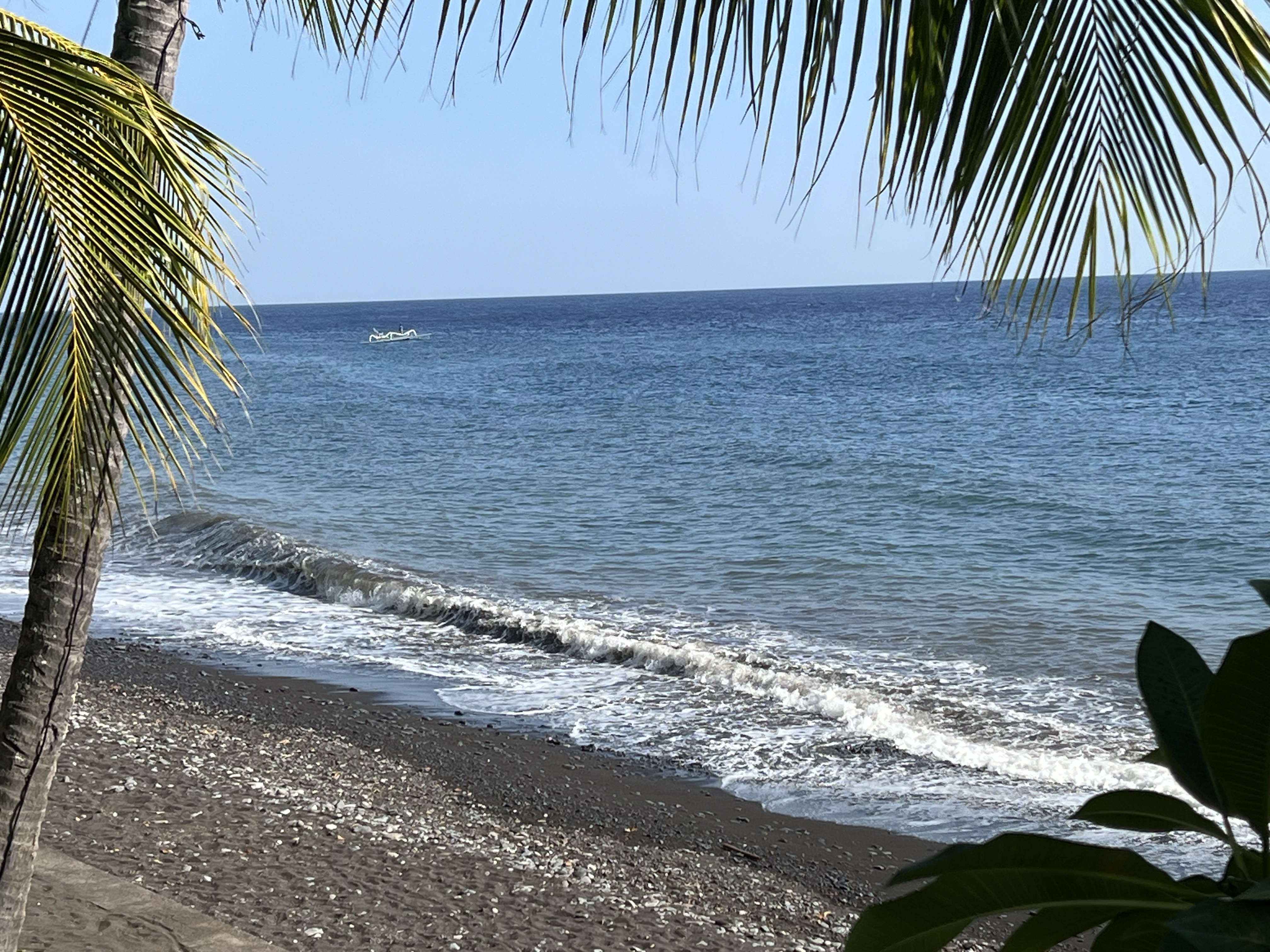
Beach at Tejakula hotel
Odyle Knight in her book Bali Hai: A Woman’s Journey remarked that Bali is like an uncut diamond. Rough and crude on the outside, but with effort its core brilliance shines through revealing stunning beauty and strength. I was blessed in 2014 to see some of the core and this time I was confronted with the crust. As always in Bali, the opposites should balance out to create harmony. My sense is, though, that the core is becoming increasingly hidden from view as the crust from overpopulation and exploitation becomes thicker. This is especially true in the tourist areas around the southeastern part of the island and in the greater Ubud region. My faith in the core, however, was restored in Tejakula. Here things are more like they were, slow paced, friendly and with roads that are passable. As I had sworn not to drive again until Monday, on Sunday, I hired a driver to take me to a home-based coconut oil production site and the Les Waterfall. The coconut oil production process in Bali Pura was interesting, but the story of how the company came about even more so. The owner/developer, Samir, a young man in his early thirties, started working for the German owner of a nearby resort when he was fourteen. The owner took him under his wing, sent him to school, then to university for a degree in economics, and taught him the resort business. After graduation, Samir managed the resort for three years, then he said he was bored so he quit to start his own company using the products that the area naturally produces. He and his wife started with thirty dollars. Their business soon grew to include other products including scrubs from the tamarisk plant. In India all sorts of products are made from this plant, but in 2016 a farmer in the region couldn’t sell his product. He came to Samir, who wasn’t interested in buying it as at that time he had no use for it, but the farmer was frustrated; he’d lugged 150kg. around for weeks and was fed up. He told Samir to simply keep it, use it if he could, or toss it if he couldn’t. This was a challenge Samir couldn’t resist. After experimenting with the first 100kg, they finally got the mix right and their Tamarisk Body Scrub was born. It has become an international hit and Samir was soon able to repay the farmer, who now regularly supplies them. The company has grown from the couple’s initial efforts to employ around thirty people, most of whom wouldn’t have other jobs as they haven’t had the opportunity to go to school. He is also supporting 18 students through high school and college. His assistant manager, a woman, was one of his scholarship students. His German mentor was justifiably angry when Samir left his job as the resort manager and didn’t speak to him for four years. Samir reached out to him when the oil production business was a success so that they could rekindle their relationship, but as equal adults now. Today, the resort sells Samir’s product. From this mentor’s support of one student, Samir, 18 students are now supported and with the community development side of Samir’s business even more local people are positively affected. This is the Balinese spirit that I had been missing. From there we backtracked to the Les Waterfall. This 30 m. Fall is off-the-beaten-track, tucked in the rainforest near Buleleng village. There is a 30,000 INR entrance fee for foreigners. From the small carpark one follows a path by the stream for about a kilometer to arrive at a shrine by the waterfall that shoots down over a cliff surrounded by lush forest. As it is not as popular or as easily accessible as many of the other waterfalls in North Bali, only a few people were there when I arrived. There were two European families, but everyone else was from the area. This waterfall’s site was dramatically different from the Tegenungan Falls; it was serene and, even with the kids wading and splashing, the sounds of the forest and the water filled the air while the mist caressed the leaves on the sides of the cliff to then bounce off and spray those by the side of the Falls.
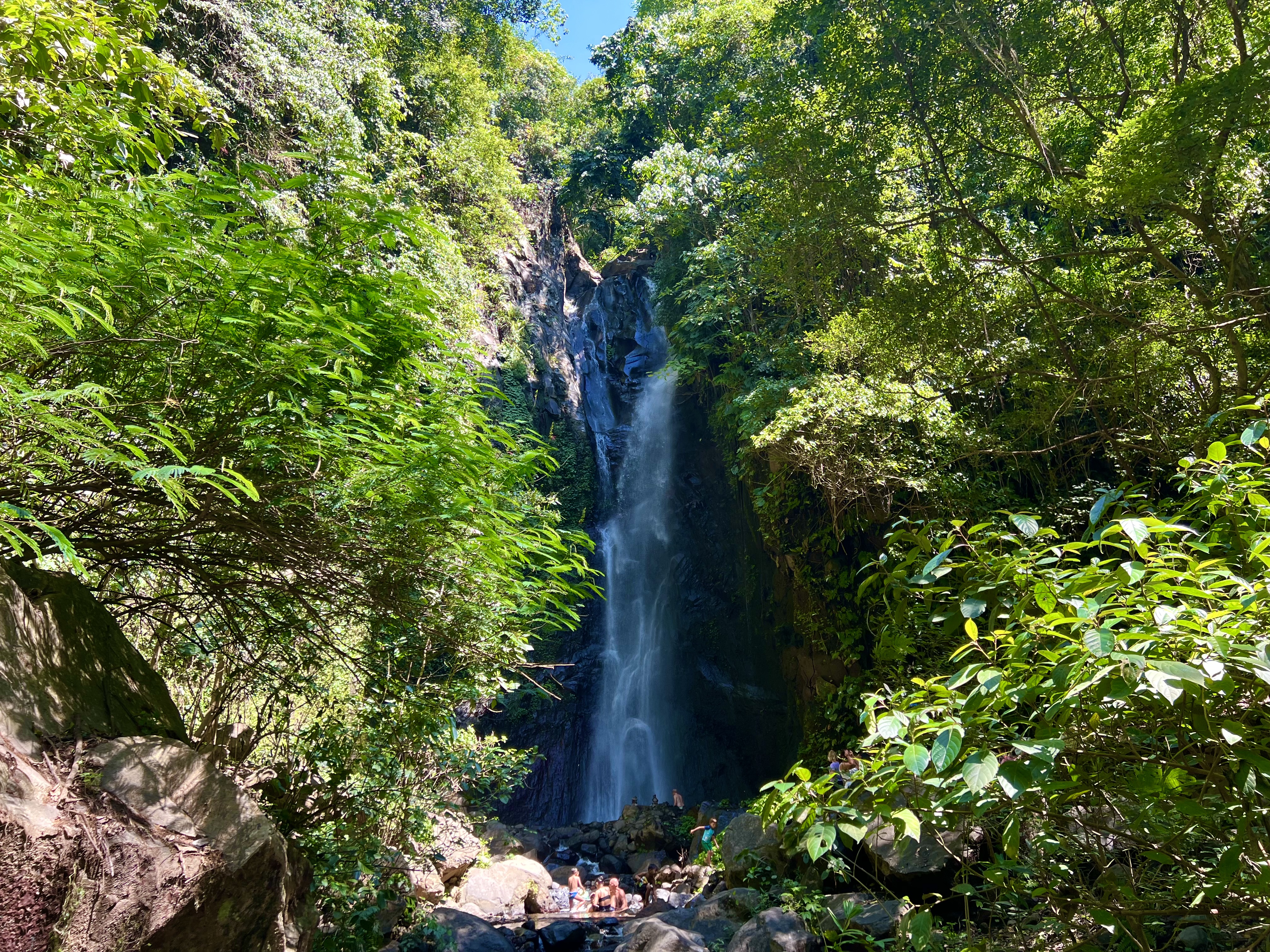
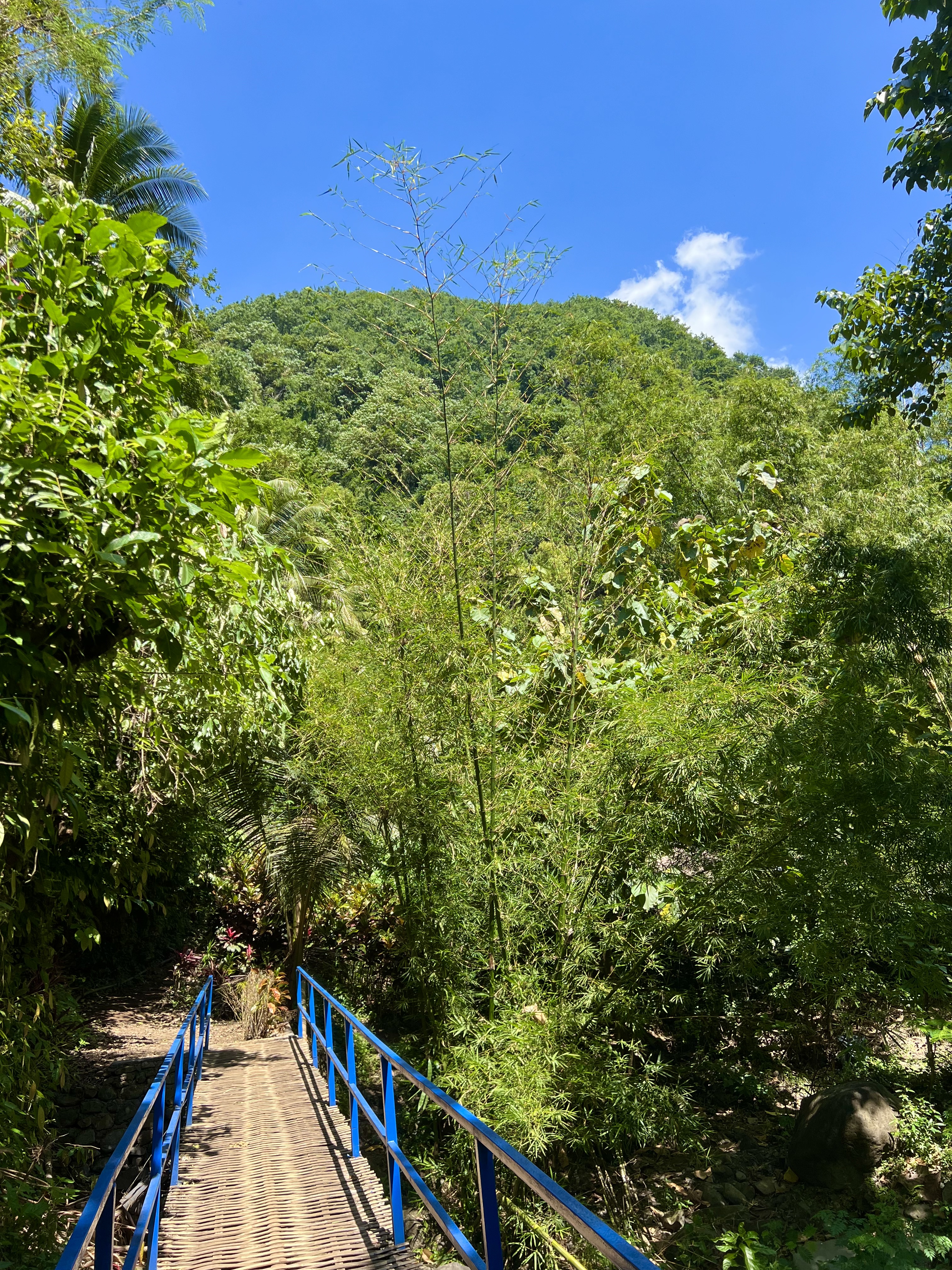
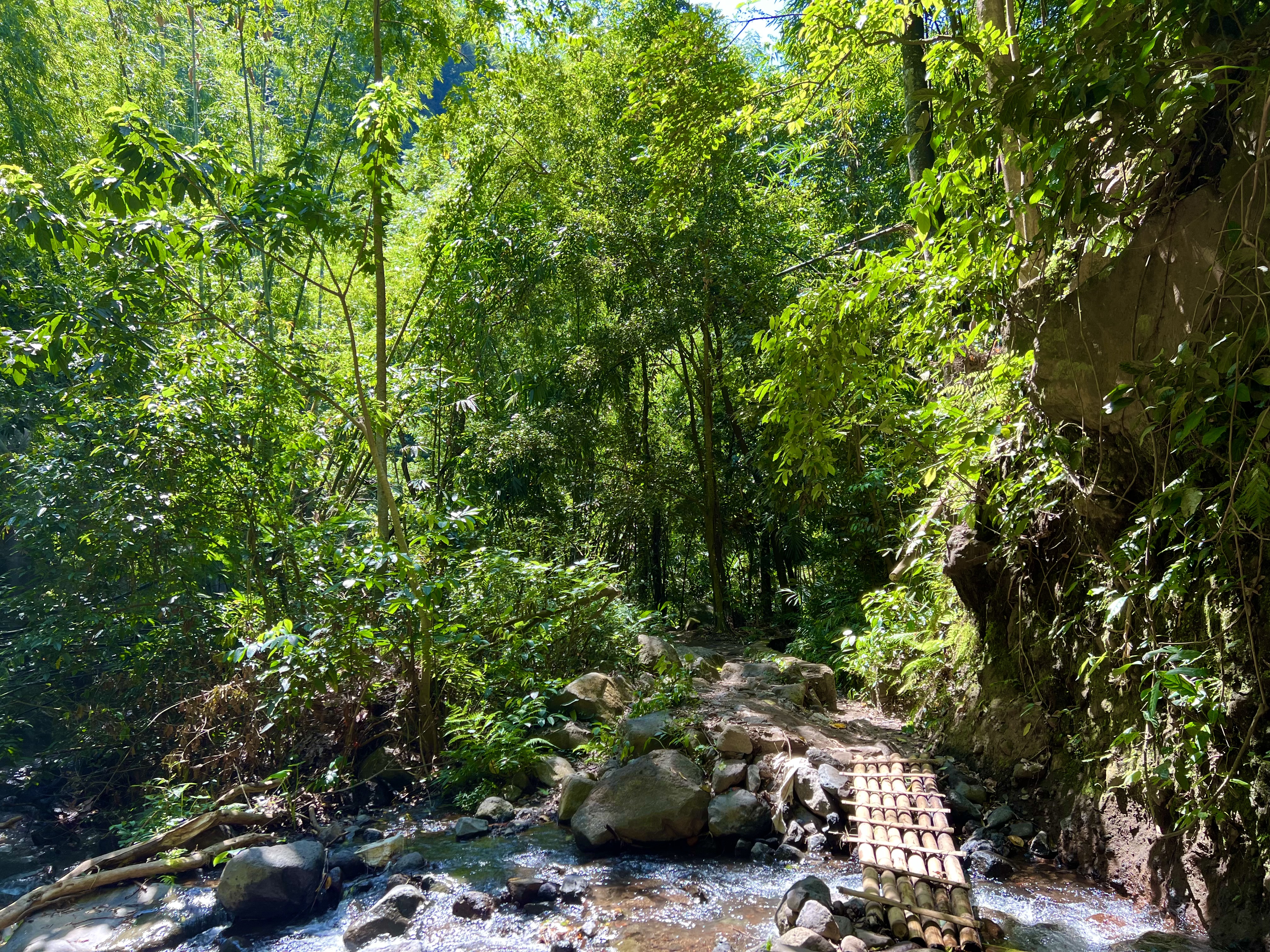
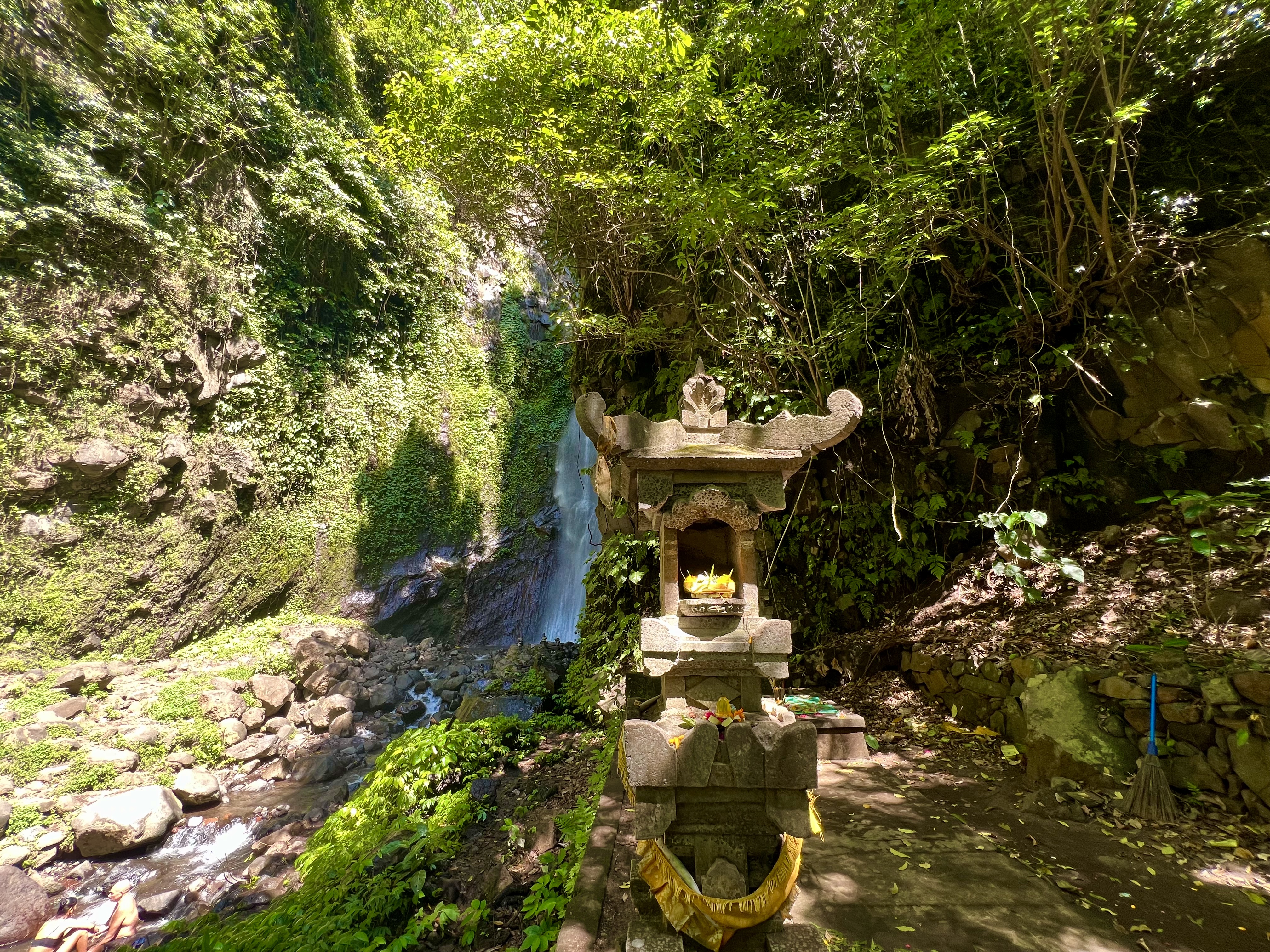
Les Waterfalls and path there and back
On the way back from the waterfall we stopped at two temples, which were hidden in the forest. The first was dedicated to Sang Hyang Widi Wasa’s aspect as Brahma and the second as Shiva. Both exuded a sense of spirituality and peace that I had found lacking at the more famous Temple sites.
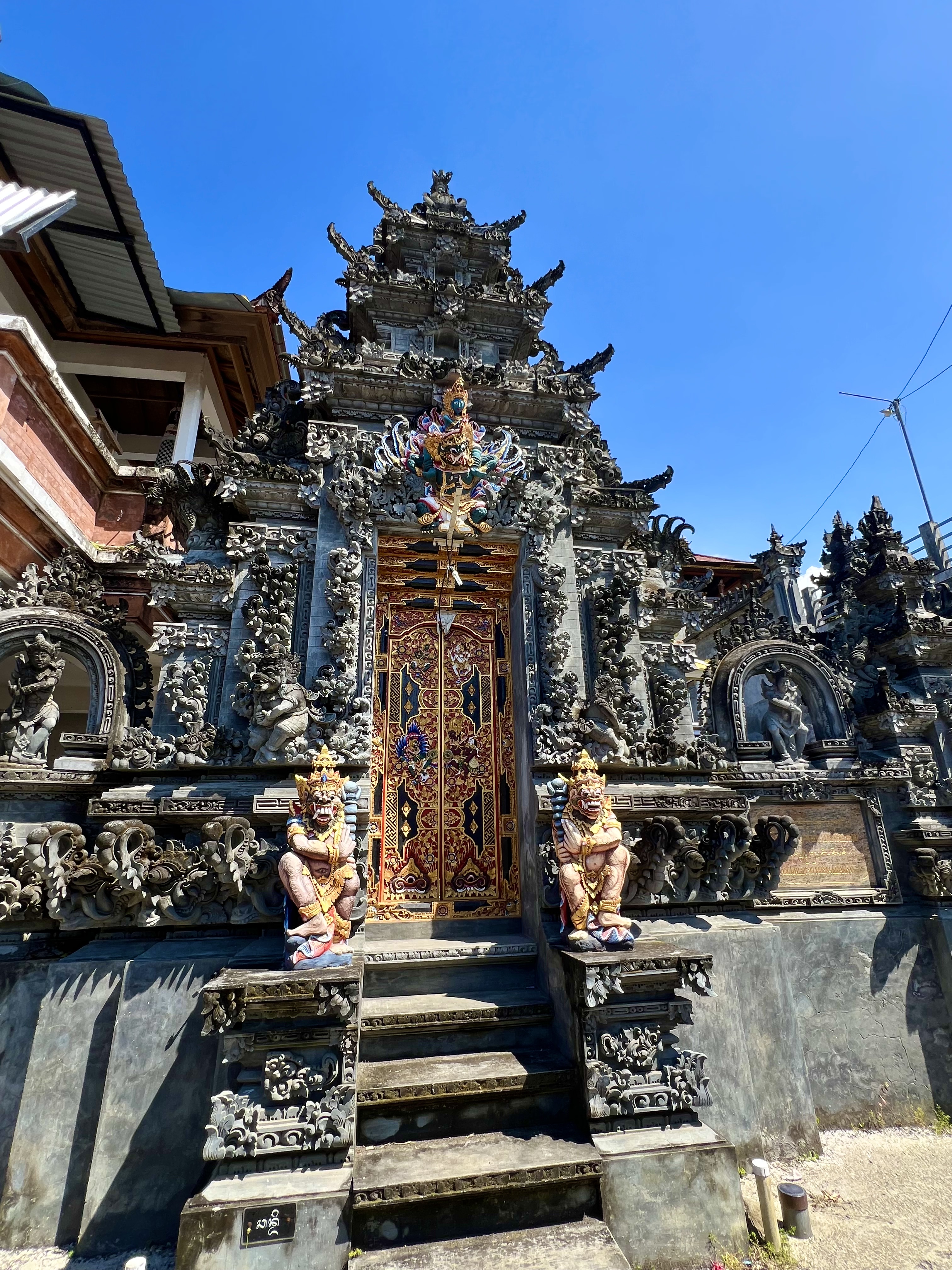
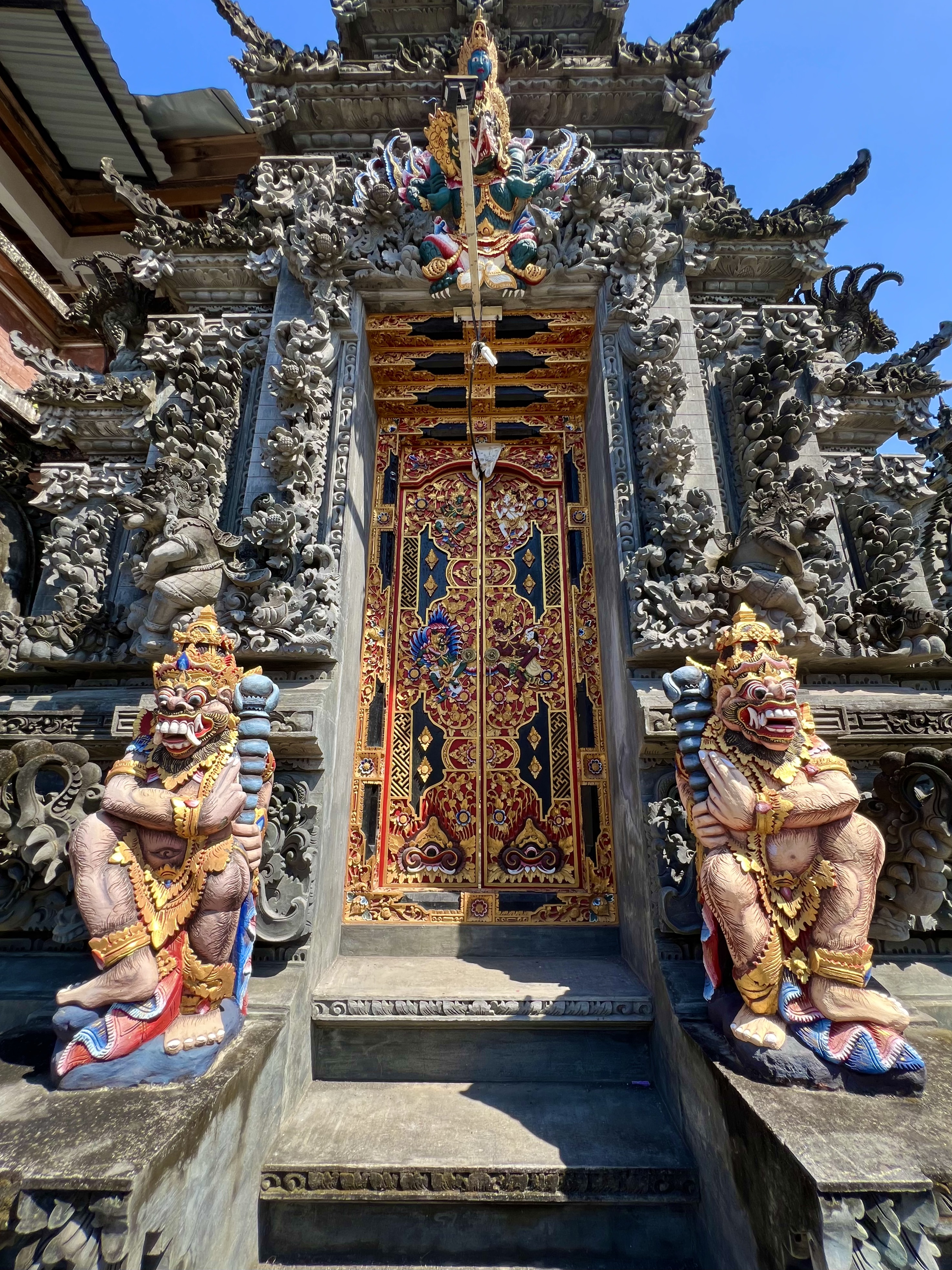
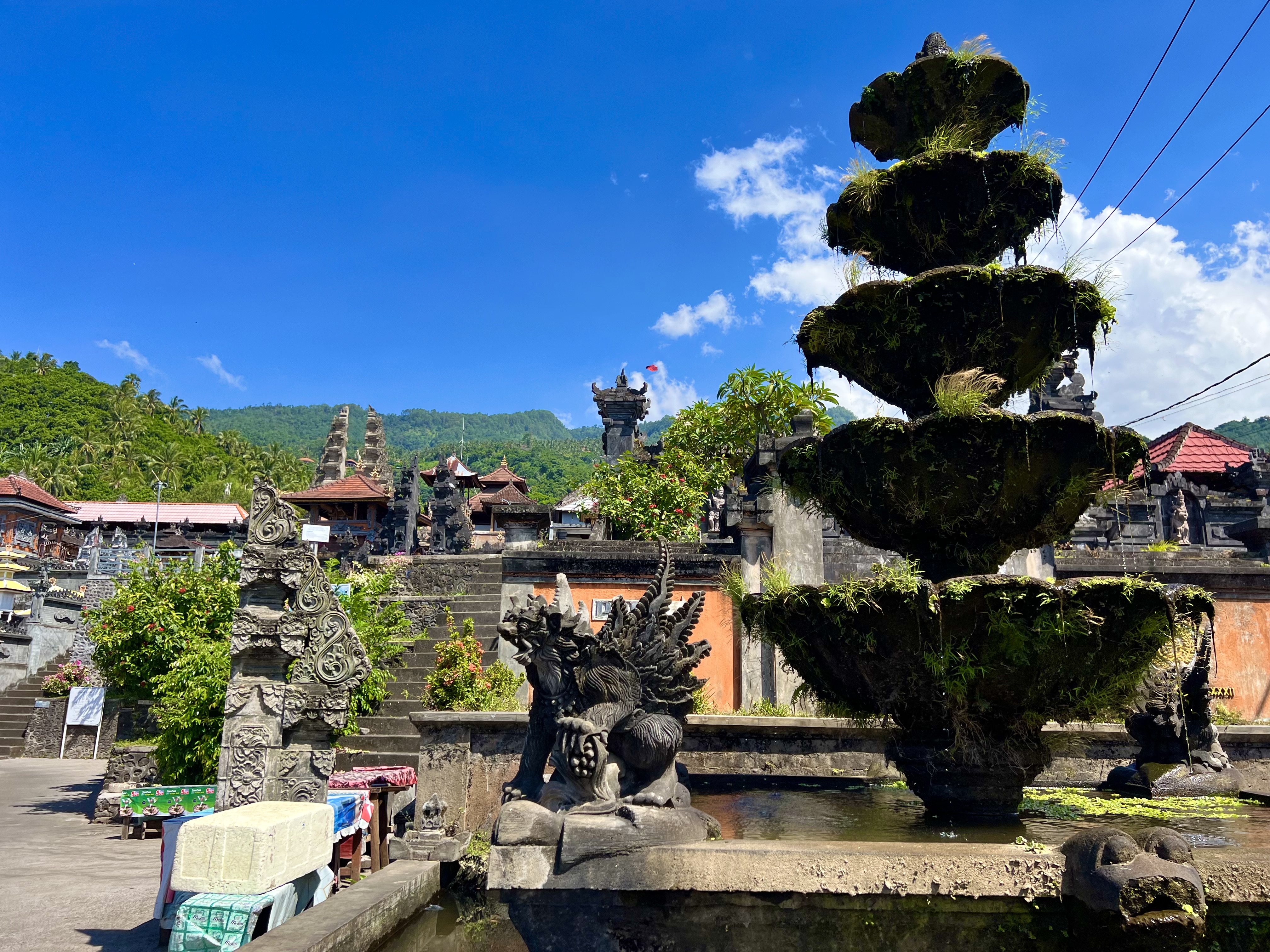
Brahma Temple
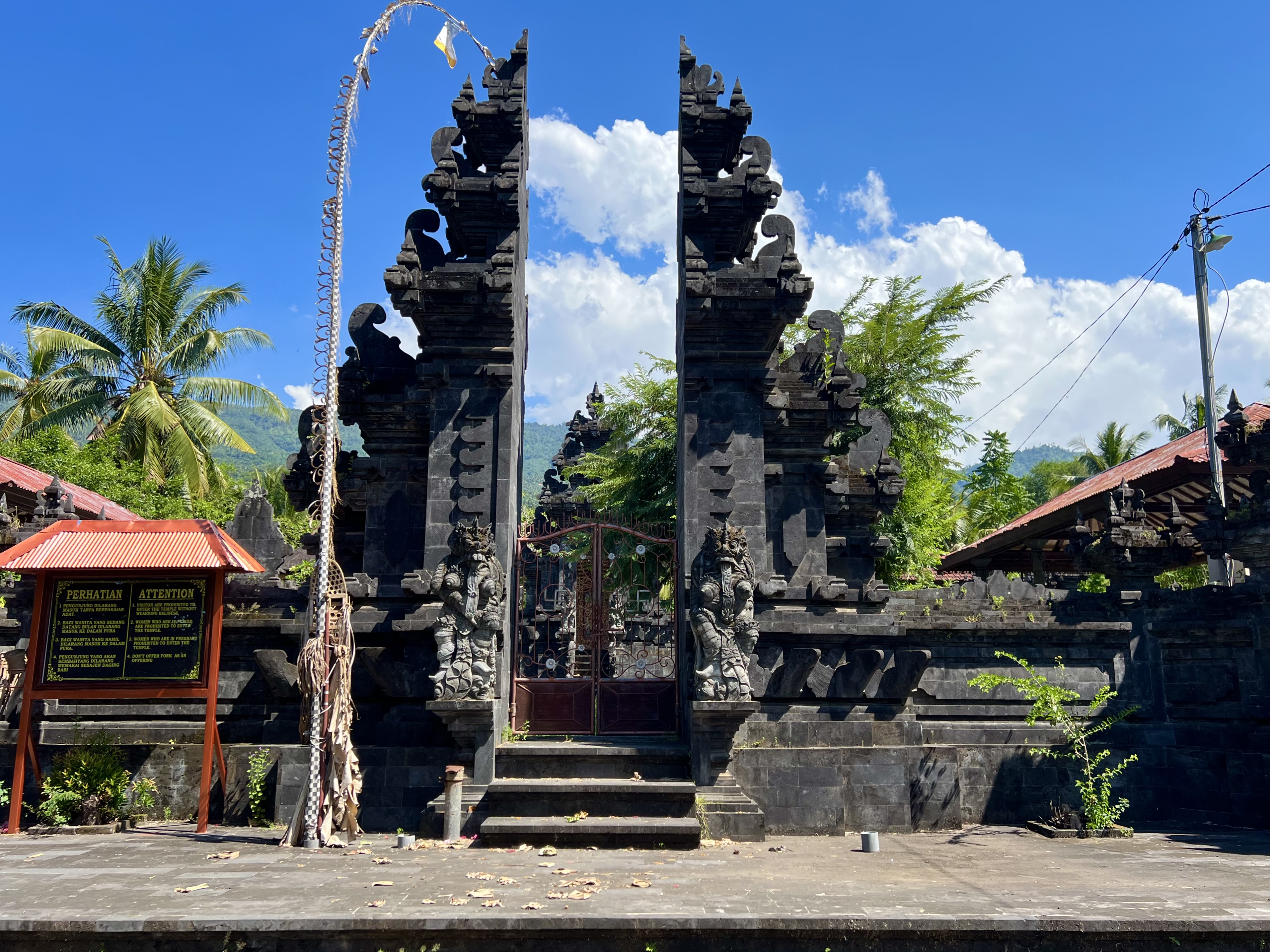
Shiva Temple
The driver mentioned that he was thinking about starting a restaurant and had in mind to do something like one that he wanted to show me. The restaurant doesn’t have a menu, people need to sign up the day before not knowing what they will be served. The chef goes to the local market each day and picks out the freshest food to make a meal out of it and that is what’s served. He uses only traditional cooking tools, i.e., wood burning stoves, and makes his own Arak, a form of Schnaps made from palm trees. I tried the Arak and it wasn’t bad, but I have to say I’m partial to our Salzburg and St. Wolfgang Schnaps. The restaurant doesn’t have set prices, one donates what one wants to. The remainder of the food goes to feed those in the local area who are unemployed. The place seemed to be very popular and the business model working, both for the owner and the community.
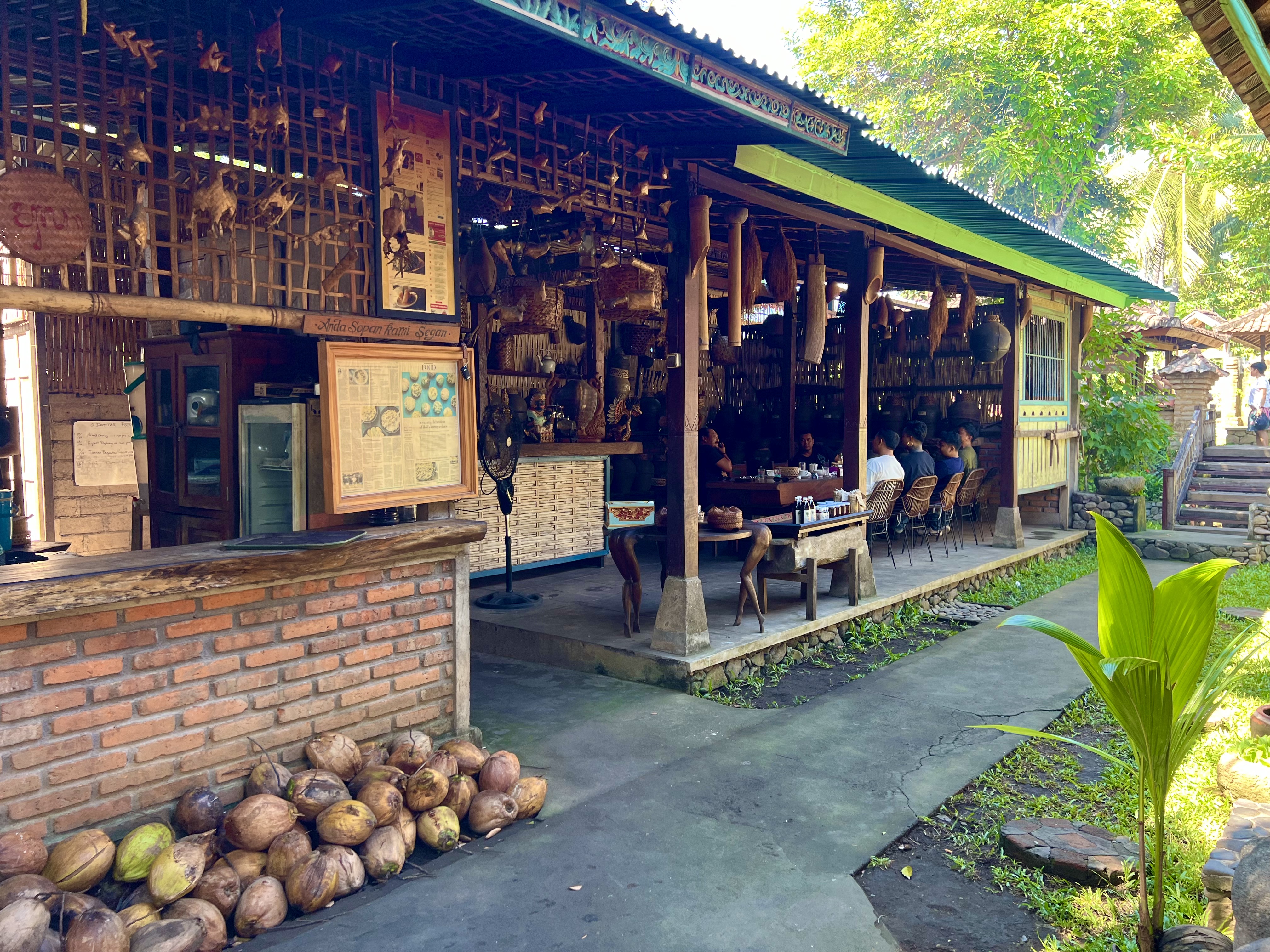
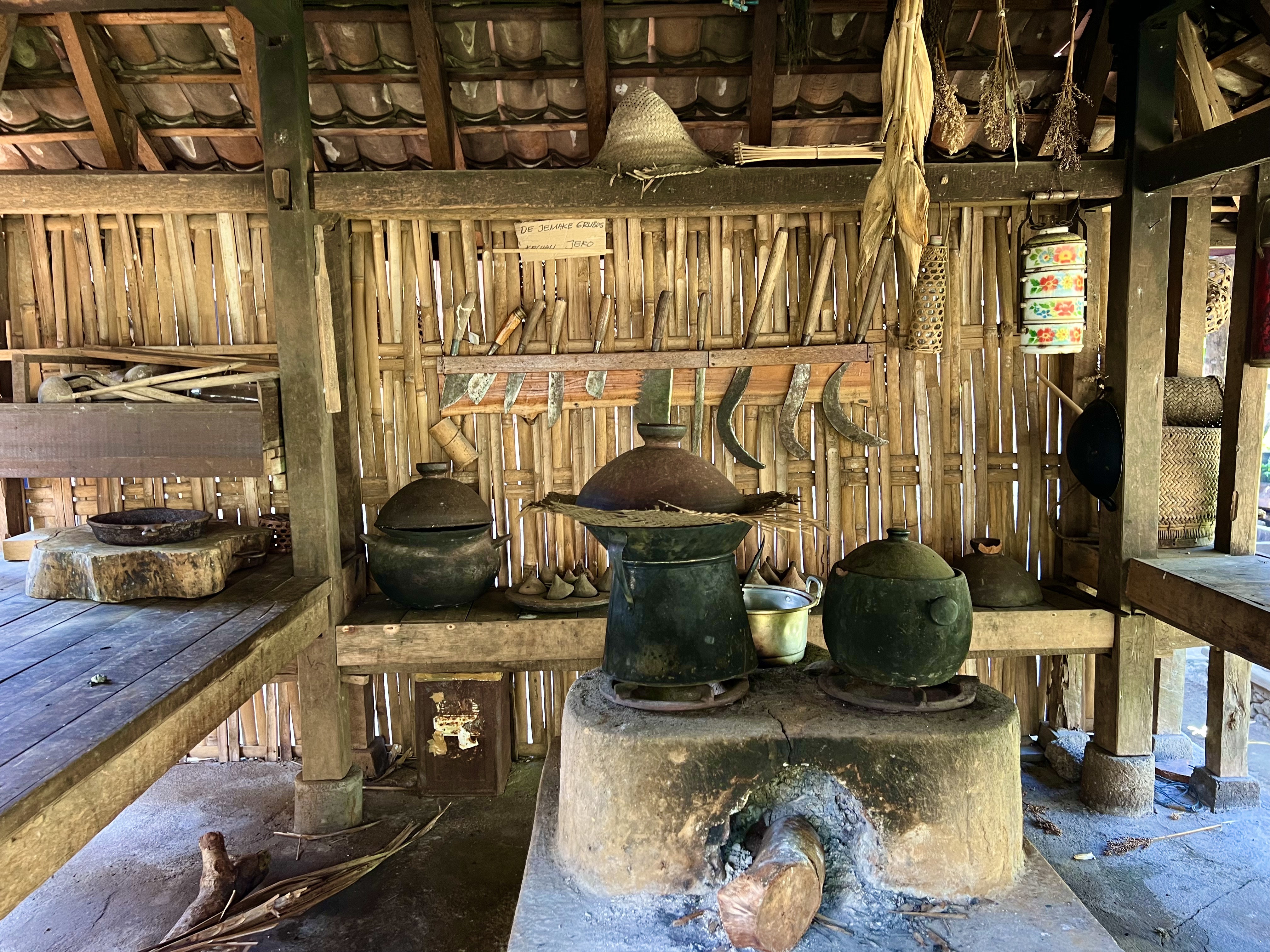
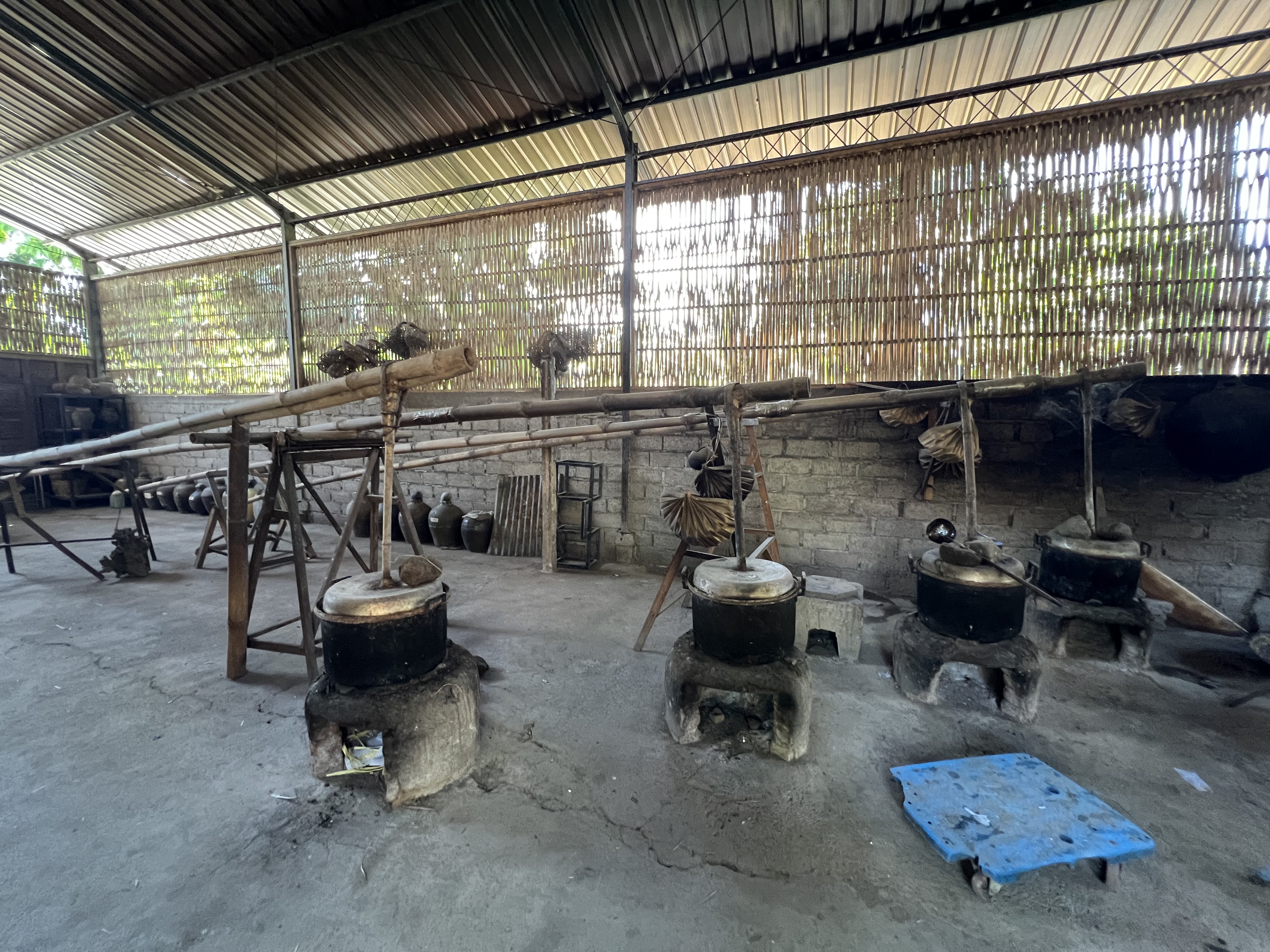
Village restaurant with wood stove and Arak production
Sunday’s excursions raised my spirits and brought me back in touch with the Bali I fell in love with ten years ago. It was good to know it still exists.
The driver, helpfully, gave me clear instructions on which road to take the following day to the airport and which to avoid. The trip back took over four hours when Google had said three, but there was a lot of traffic and it is difficult to pass trucks going only 25 km with all the oncoming vehicles. In the end, I think I travelled on the worst roads on the island, with the one over Mt.Batur at the top of that list, and the best, which is the toll road by the airport. That road is a series of bridges that are beautifully engineered and maintained. If I ever make it back here, though, I will hire a driver!
The spirits of the island have a way of testing one’s faith and comfort zone. Bali’s countryside and coastline are stunningly beautiful, yet the concrete jungles and traffic in the capital city and major tourist areas are really quite ugly. Yin and Yang, black and white, the elements need to be balanced to create harmony, yet I much prefer the mountain spirits in their lush green abodes and those of the turquoise and deep blue sea to the via negativa of torn up concrete.
 omegoodyssey