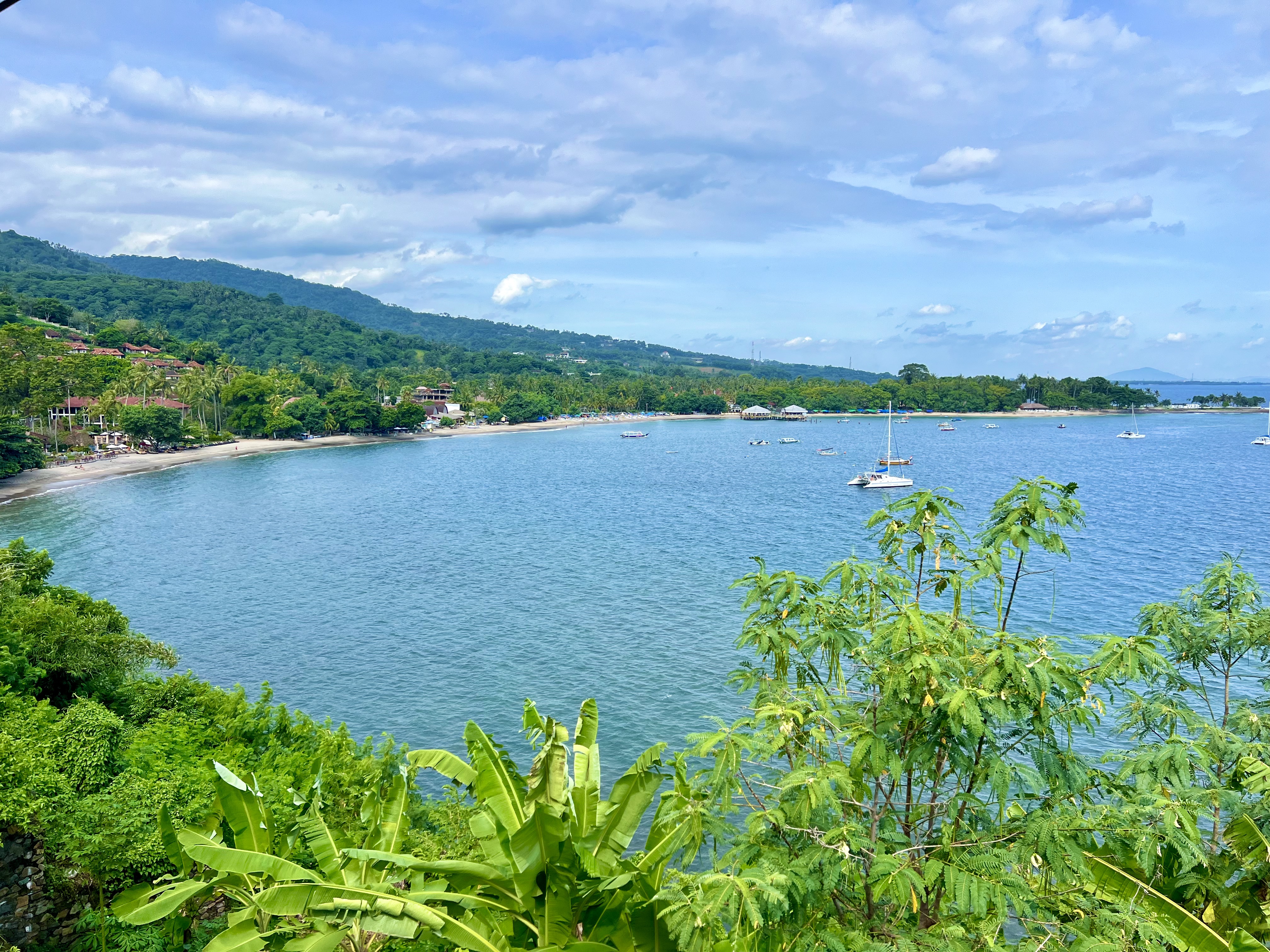
Senggigi Beach from the overlook near the hotel
Flew from Darwin on an overnight flight to Denpasar with a further flight in the morning to Lombok. It was a long wait at the airport between flights, which left more than enough time to get through all the passport and security sections. Denpasar airport has everything computerized, so the lines went quite quickly, even those for the Visa on Arrival. The domestic terminal is an easy walk away from the international terminal, but the fellows with the carts kept pestering to take me there. At least they were good humored about my refusal as they seemed to line up, each one asking the same question to which I responded with the same answer until it became a joke, and we were all smiling. I know they need work, but there is no reason to use them for such a short distance, especially as the airport provides free carts. The domestic terminal was closed when I got there as it was 3am and they didn’t open until after 6. I found the one last free bench by the entrance and was able to lay down for awhile even if sleep was impossible. My flight was at 9:50 and was naturally delayed, but we arrived only a half hour later than scheduled. The driver from the hotel met me at the airport to take me for the hour long drive to Senggigi where I would be spending the next four nights.
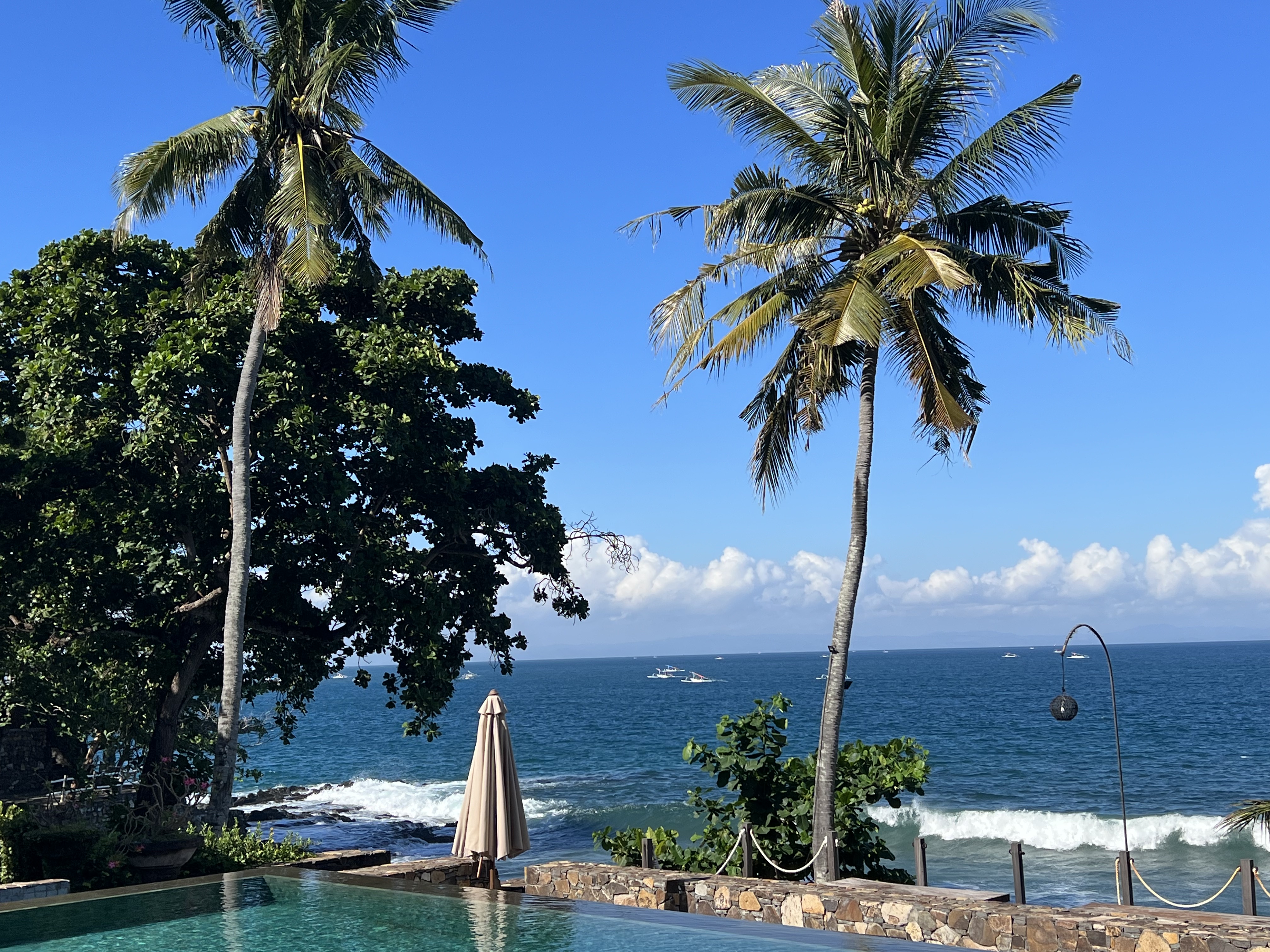
View from the breakfast table with the fishing boats coming back in
The drive northwestwards went through dry fields then to tropical rainforests with lots of palm trees, small villages, rice paddies with people crouched over planting a new crop, the capital city, Mataram, with its roundabout entrances filled at one end with a black and white replica mosque and at the other a very tall rocket-like white tiled with blue glass inlay imitation minaret, and some other urban areas with green tiled dome and minaret mosques. Throughout the drive, the driver had to weave in and out of horse-drawn carts, scooters, motorbikes, large cars, and a couple of trucks. The scooters and bikes jump out from the sides without looking, so it can make for a few near misses. I noticed that on the backroads he honked when he wanted to pass a scooter or motorbike to let the two-wheeler know that he was there and to be careful. This made for a lot of honking, but it wasn’t the blaring penetrating honking in India, but more a simple, ‘hello, I’m here’ kind of honk. In the urban areas there was simply too much traffic for this to occur.
The hotel in Senggigi, RajaVilla, is on a slight cliff incline overlooking the sea towards Bali. From my balcony, I could see over to Mt. Agung, the sacred mountain on the neighboring island. In spite of the close geographical distance between the two islands, culturally they are quite different. Lombok, like the rest of Indonesia, is primarily Muslim with only 10% Hindus. Bali is primarily Balinese Hindu, which is a unique blend of Hinduism and earlier local sacred traditions. Lombok does have a few Hindu temples, though, and one of the oldest, probably from around the 9th century is in Senggigi. Pura Batu Bolong sits on a volcanic rock spit on the sea; the entrance has the typical Balinese Hindu doors with intricate dark wood carvings. There are only a couple of sanctuary sites before one walks by the black sand beach to the main temple, which was closed for a ceremony when I was there. It is a rather simple site in comparison to the much more ornate Balinese temples, but through its simplicity and beautiful setting a perfect place for meditating and just being still with the forces of nature. The elements are all present through the fire that formed the volcanic rock, the wind that courses through the arch in the rocks, the sea, and sands of the earth.
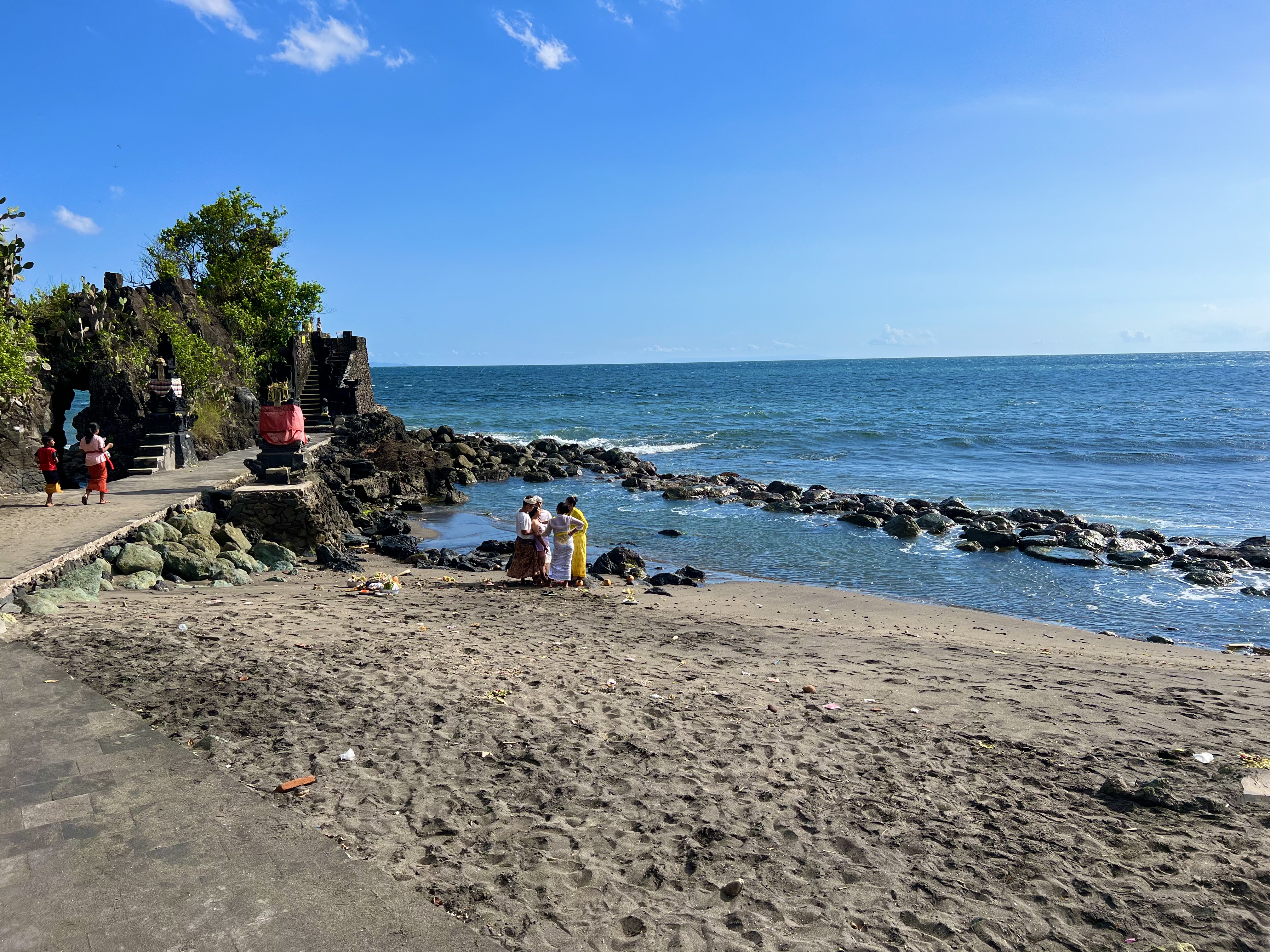
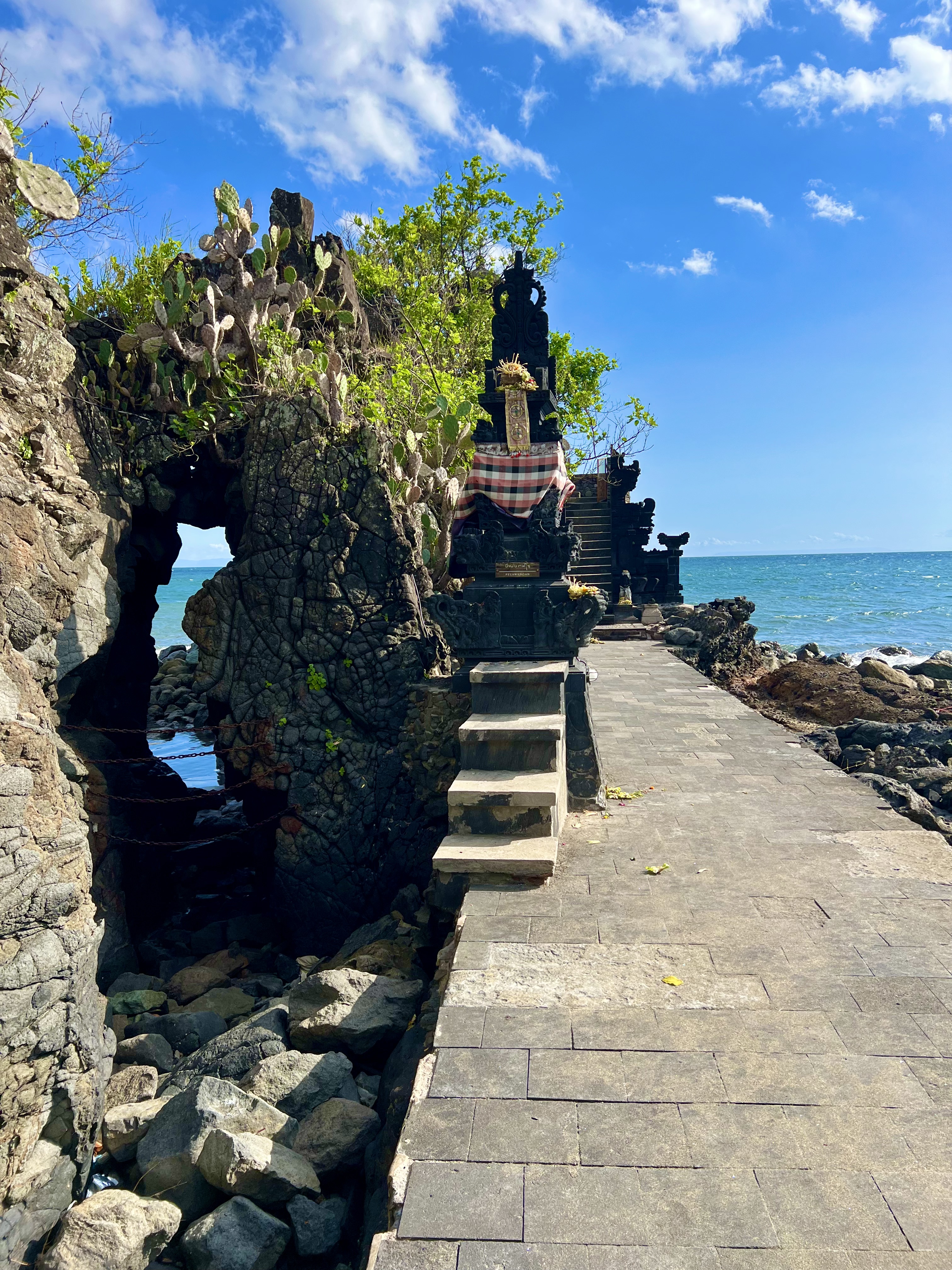
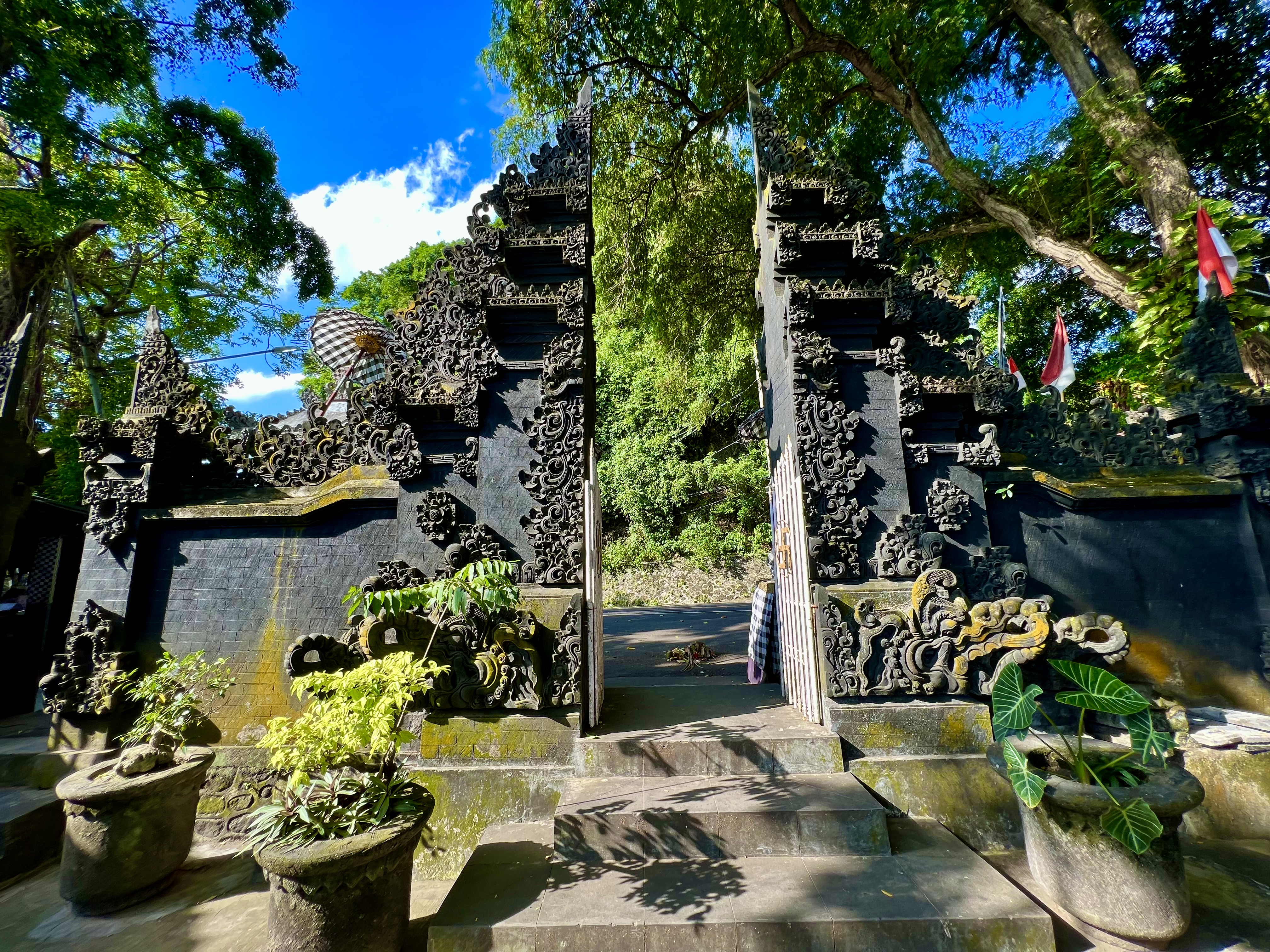
Pura Batu Bolong, Senggigi
The town of Senggigi isn’t particularly large, but it is also not a place for walking. There are only limited sidewalks, so one needs to walk most of the time on the main road adding to the confusion for drivers. The hotel’s restaurant was closed, other than for their excellent breakfasts, so I needed to navigate the broken concrete, cars, scooters, and motorbikes along with carts selling grilled corn lining the two overlooks outside of the main restaurant area. There are a number of restaurants on the beach where one can sit directly by the water for dinner. Fresh seafood is obviously their specialty. Many of them are accessed from the street through an ‘Art Market’, which is really a craft market. The square is filled with independent shops selling all kinds of trinkets, clothes, flip flops, and souvenirs. They were only lacking a bookstore or book exchange.
I was so tired after the night at the airport and all the driving I’d done in Australia, that I simply hung out by the pool and beach on my first day. The next day, I was ready to explore again. I’d asked the driver from the airport what it would cost to take me to the Wildlife Park, the Ranjani Waterfalls and the temple. For the entire day, from 8 to 5, he charged the equivalent of US$92 for a private tour, including guide at the waterfalls, which I thought was more than reasonable.
I wasn’t sure what to expect from the Wildlife Park, especially as there were no signs on the road to get there. I was very glad I wasn’t trying to navigate on my own as GPS is notoriously unreliable in this part of the world. As we got there just before it opened, I was the only person in the park. There are guides who lead the visitors through the sort of zoo like setting, except most of the animals here could easily get out of their enclosures to explore what lay beyond their moats or short walls. The Cassowaries, Orangutans, Pygmy Hippos, baby Komodo Dragons, Snakes, and Otters were kept in safe enclosures, but again with walls or fences only so high to stop them from escaping. The birds, other than the eagles flew freely about. At the entrance baskets of fruits and vegetables were available for purchase to feed the animals. I never thought I would actually feed a hippo, even a pygmy one, but I did. The otters were engaged in sexual activity when we came by, but the female was much more interested in being fed and wanted to shake him off her to get to the food. He was persistent though, and she wasn’t going anywhere until he’d had his fun. After she managed to get some of the fruit and vegetables, they both climbed a tree branch and rubbed themselves clean. It was quite an act. There weren’t any bananas, so the elephants enjoyed some other kind of fruit and only through their trunks, not through their mouths the way we fed them in Krabi. The birds were, for me at least, once again the highlight of the Park. A couple of parrots landed on my shoulder, and I had a lengthy conversation with the black cockatoo. The hornbills were more interested in their food bucket than in talking to humans, but they sure talked a lot amongst themselves. The Wildlife Park has a breeding program for many of its inhabitants, and the staff I met were informative and caring. It was a delight to have spent some time there, and I am very glad we stopped before going on to Ranjani National Park and the waterfalls.
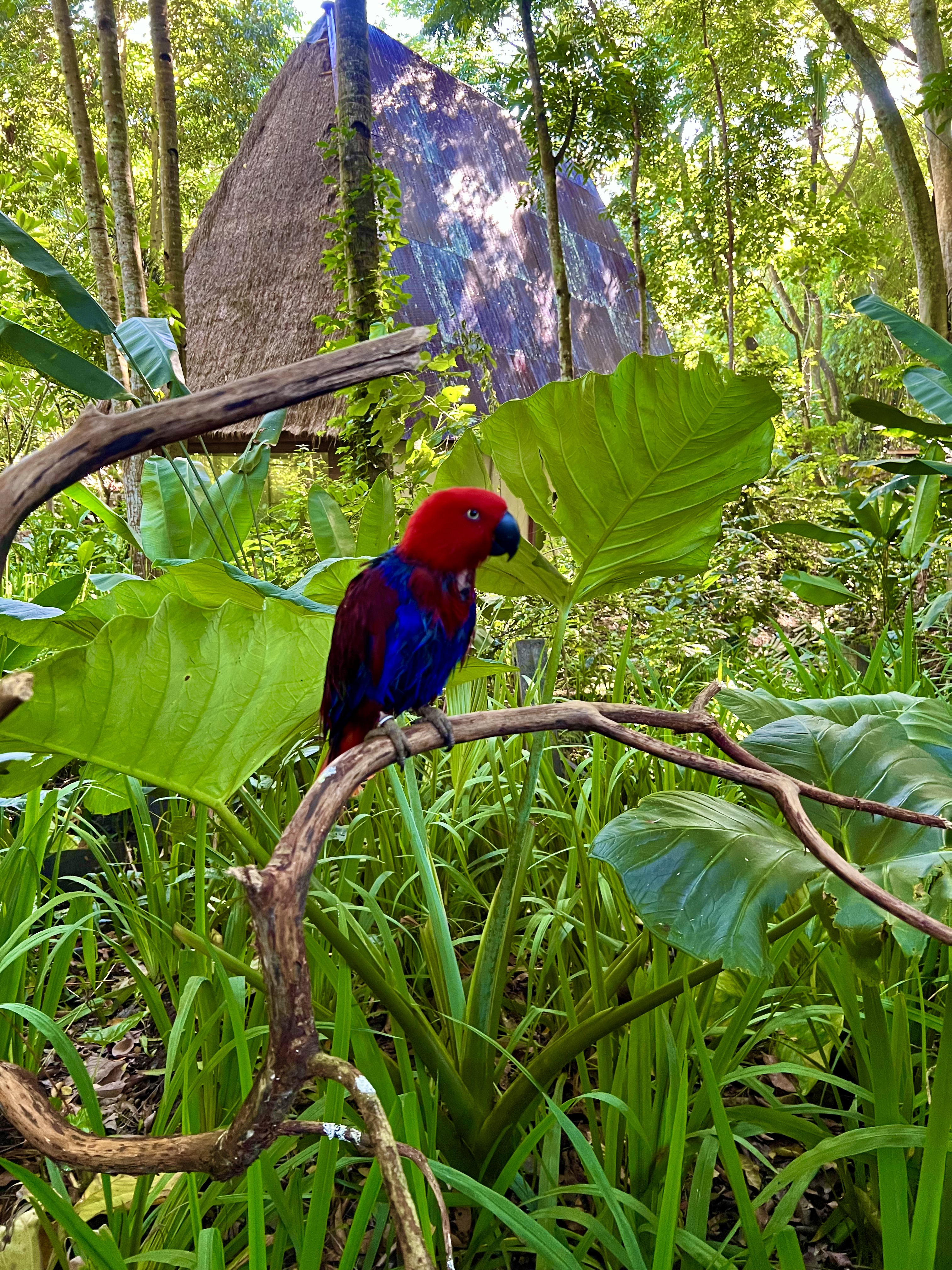
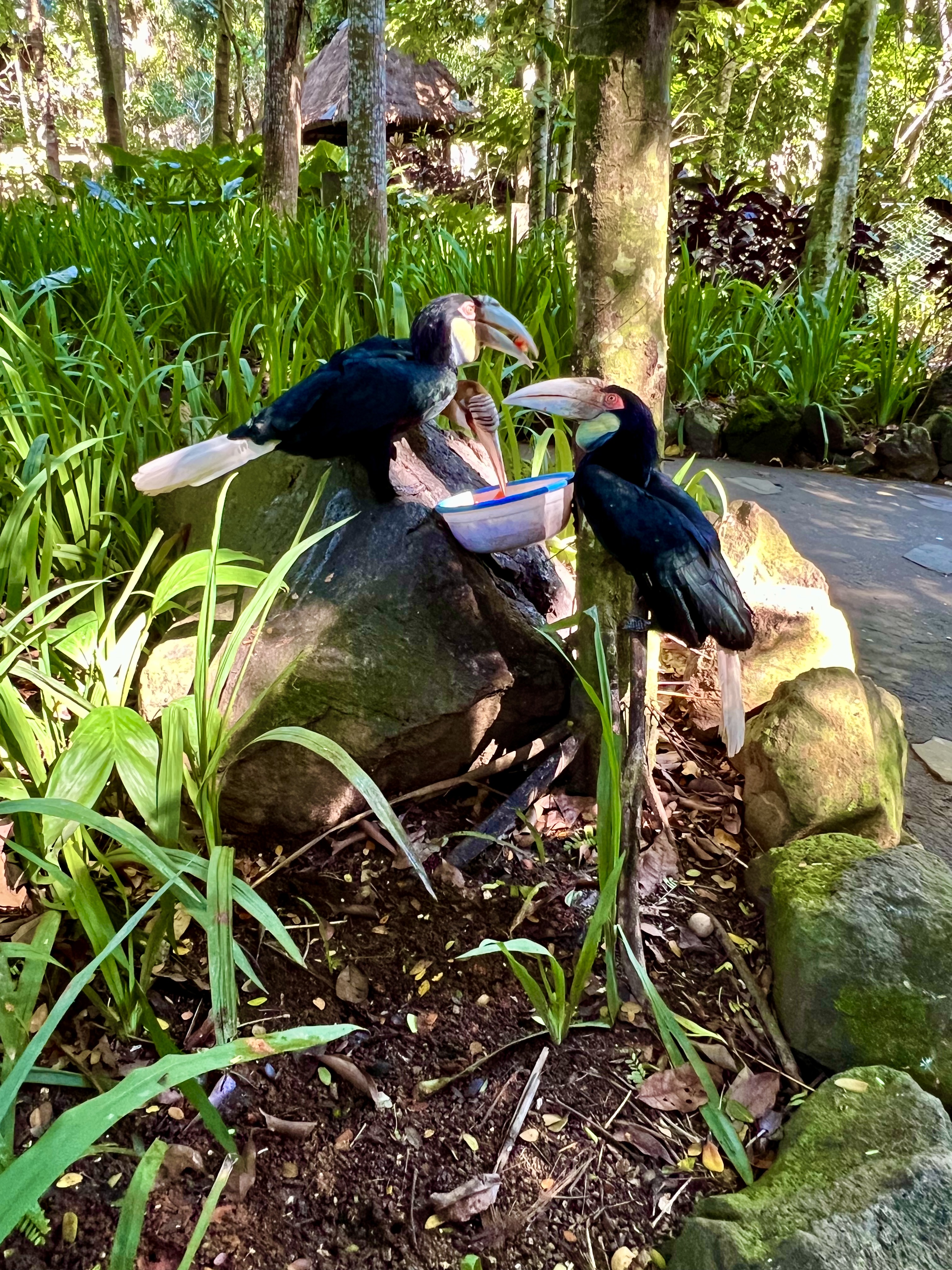
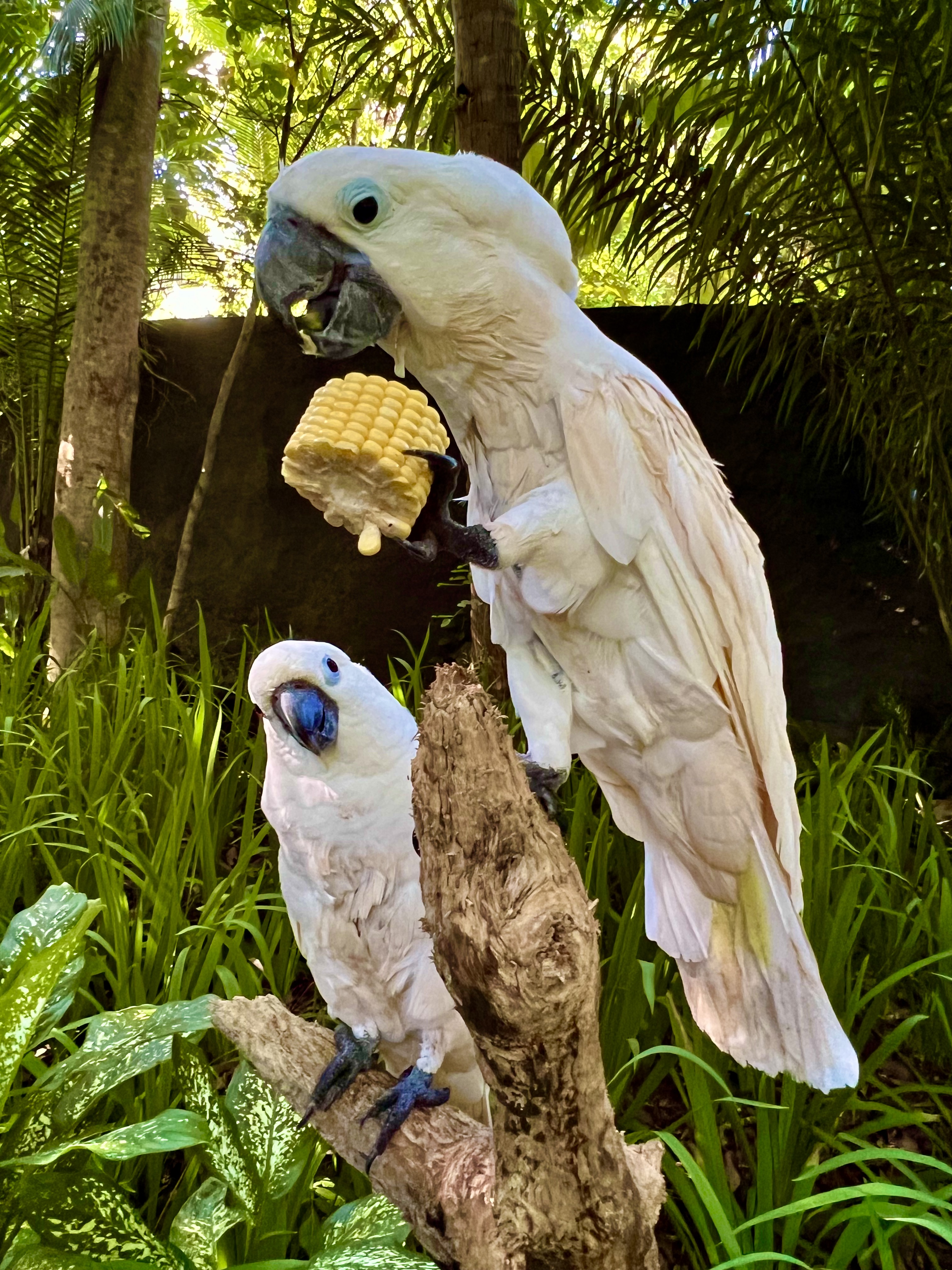
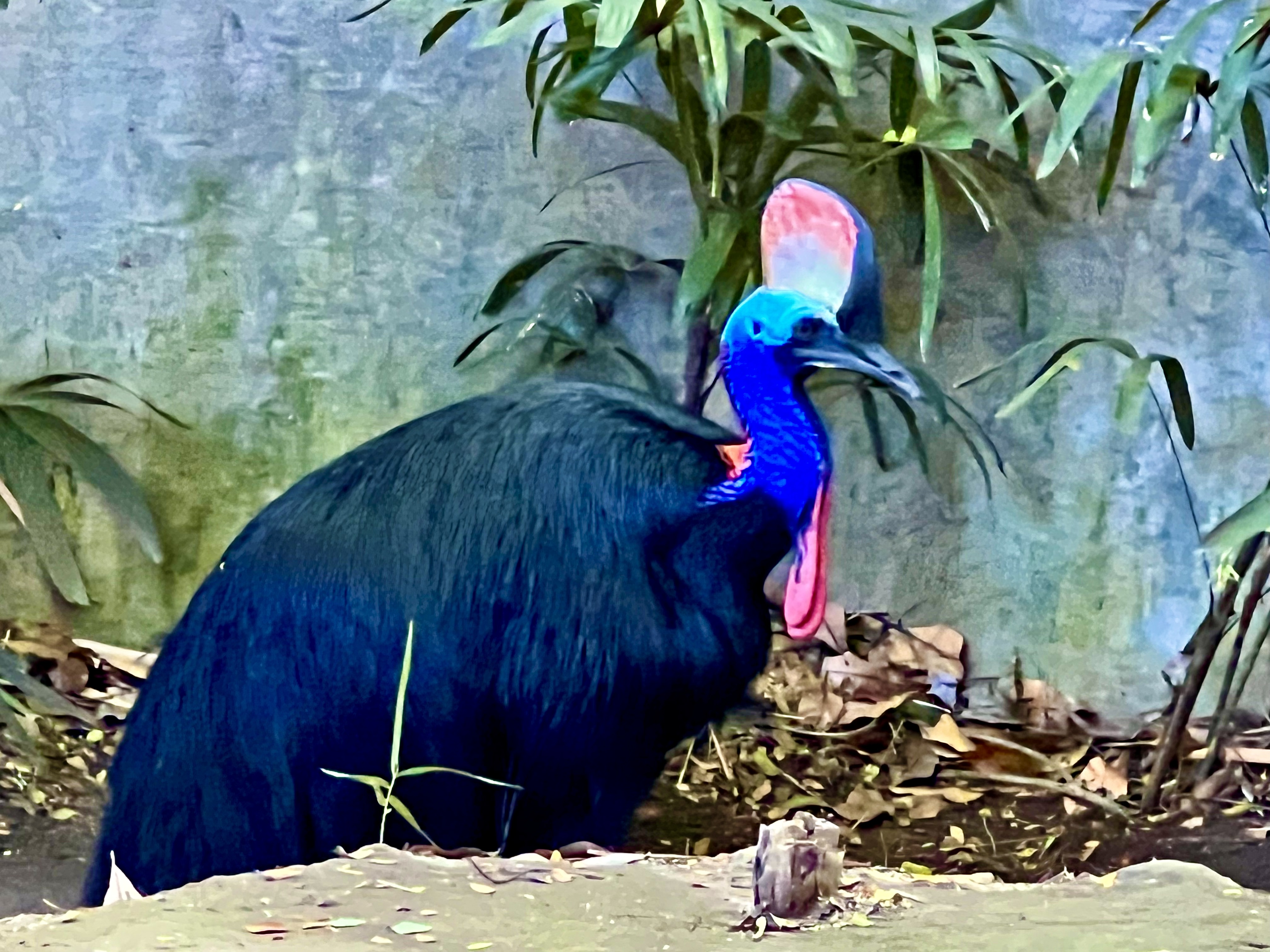
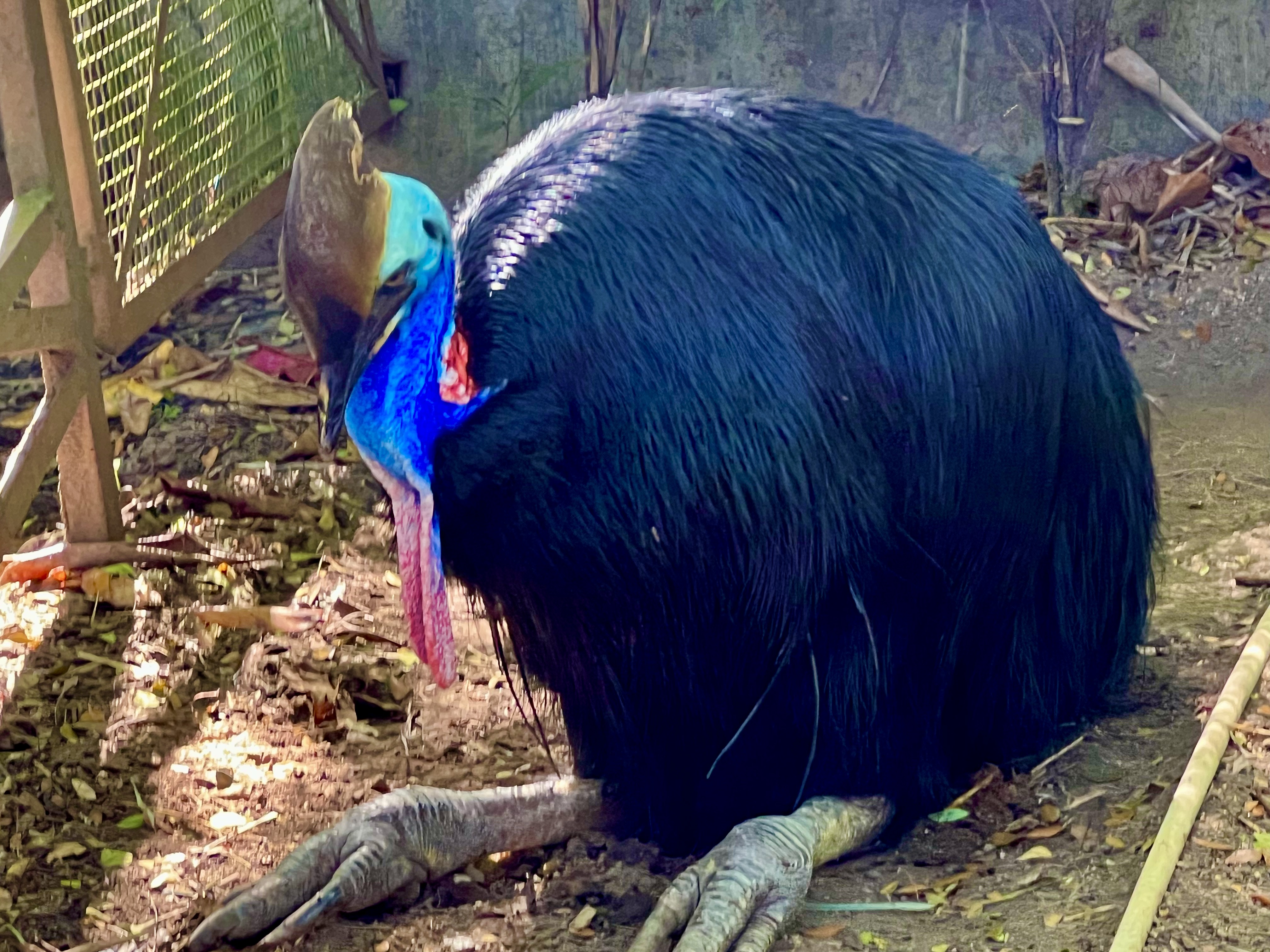
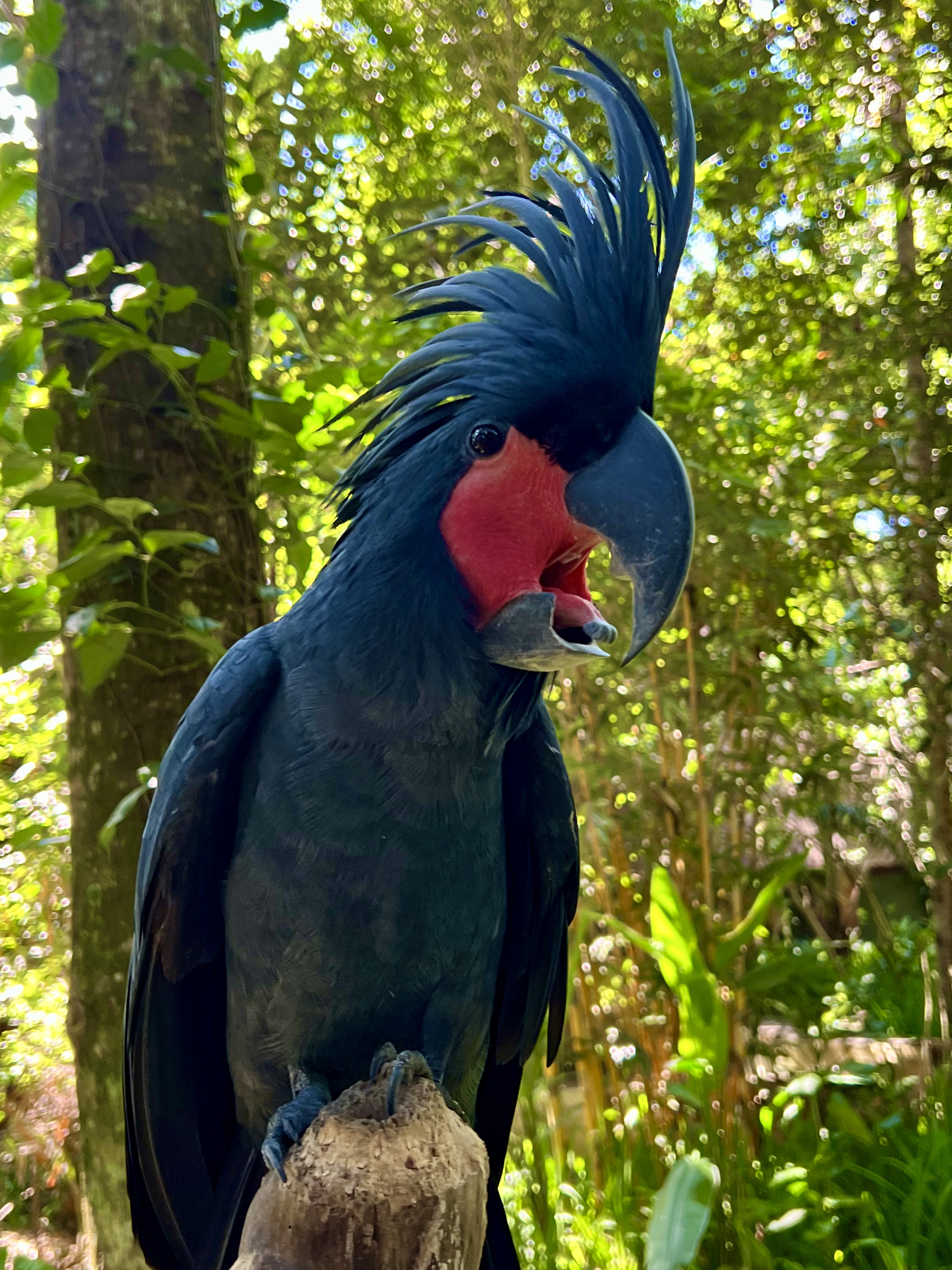
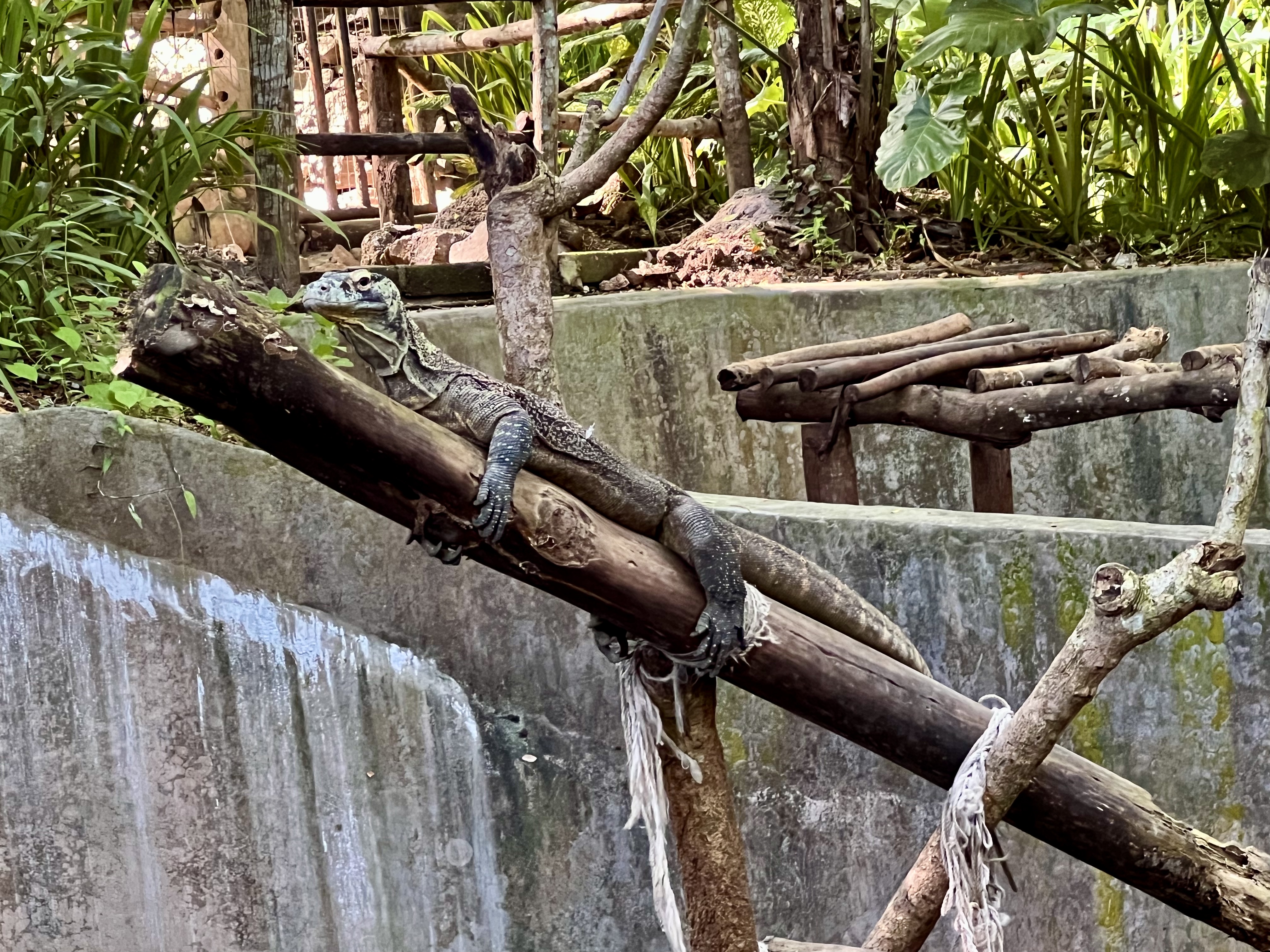
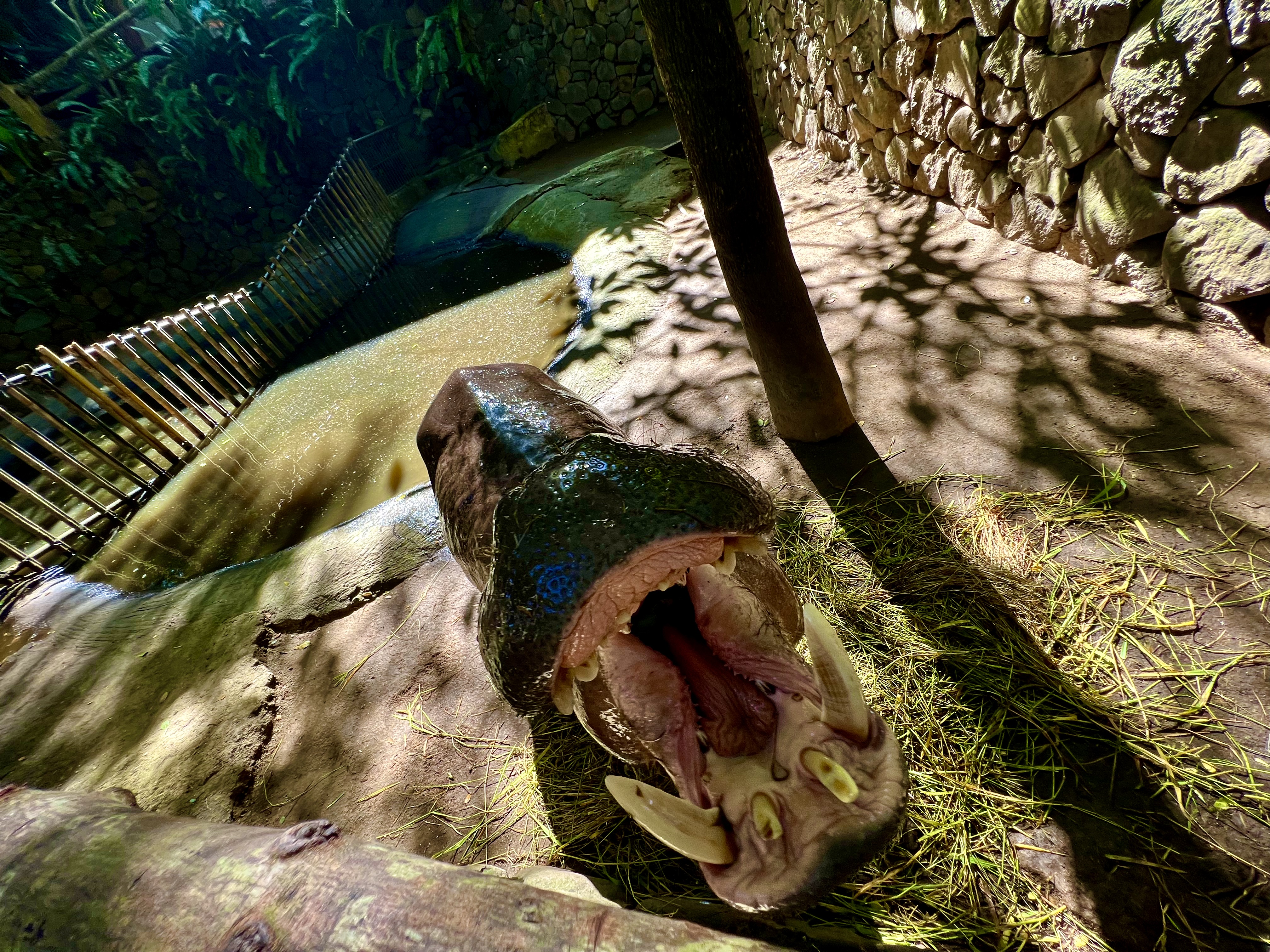
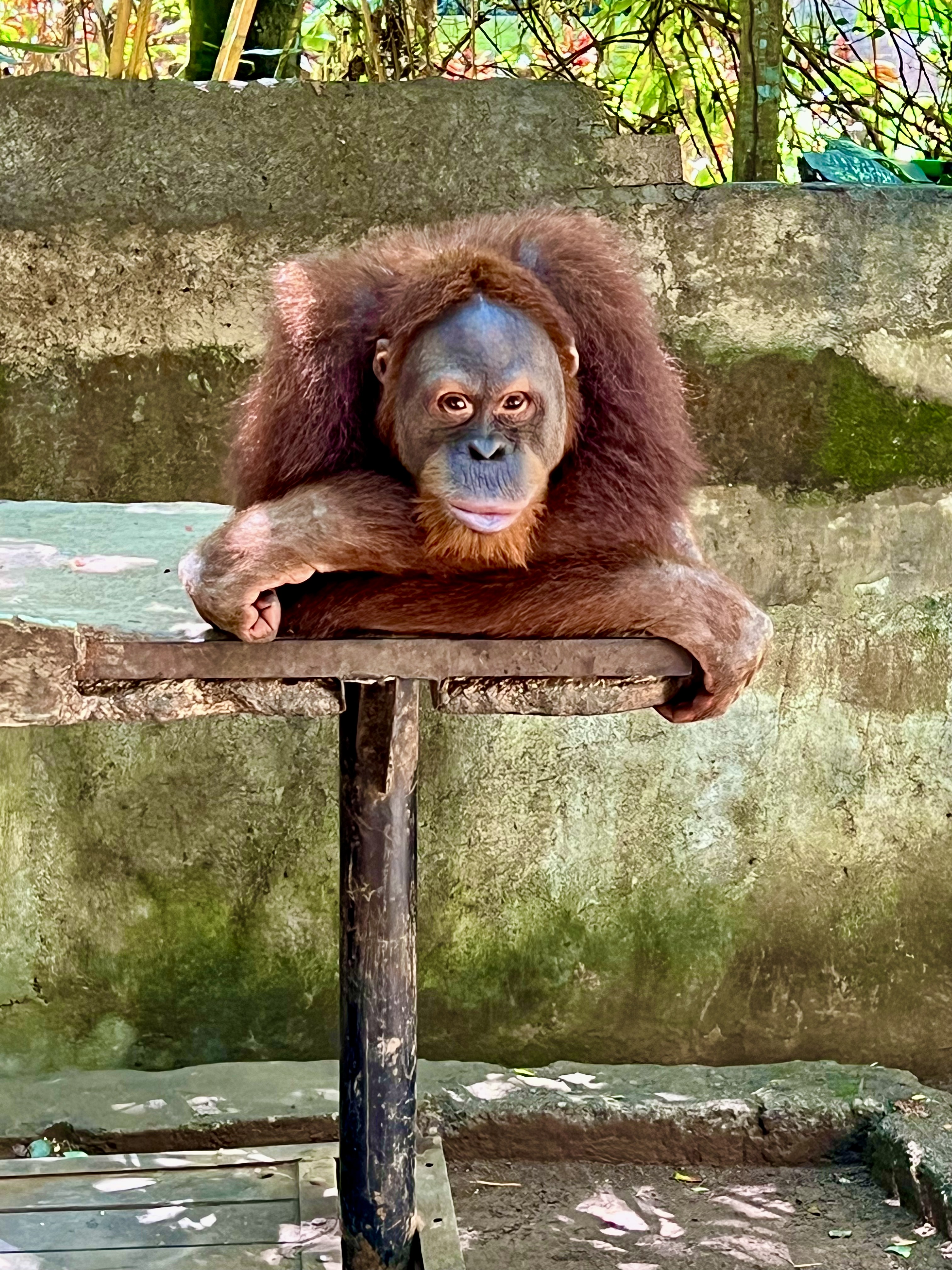
A few of the Wildlife Park inhabitants
There are many waterfalls in Lombok, but perhaps the two most famous are Sendang Gile and Tiu Kelep. It is entirely possible to do these waterfalls without a guide, but I was glad to have had one. Not only for the hand support crossing the slippery rock streambeds getting from Sendang Gile to Tiu Kelep, but also because the people here live off tourism, and they desperately need the income. The earthquake in 2018 devasted the area and they still hadn’t recovered from it when COVID happened. Evidence of the damage is still noticeable throughout the region. Locals struggle to get by. My guide told me that he took a loan from the bank to purchase a cow to help feed his family. Within the first month, the cow got sick and died, but he still has to make the payments to the bank. He is clearly not the only one in the region with such financial problems. Guiding between the waterfalls and on hikes through the Park cannot earn him much, but he has no other source of income.
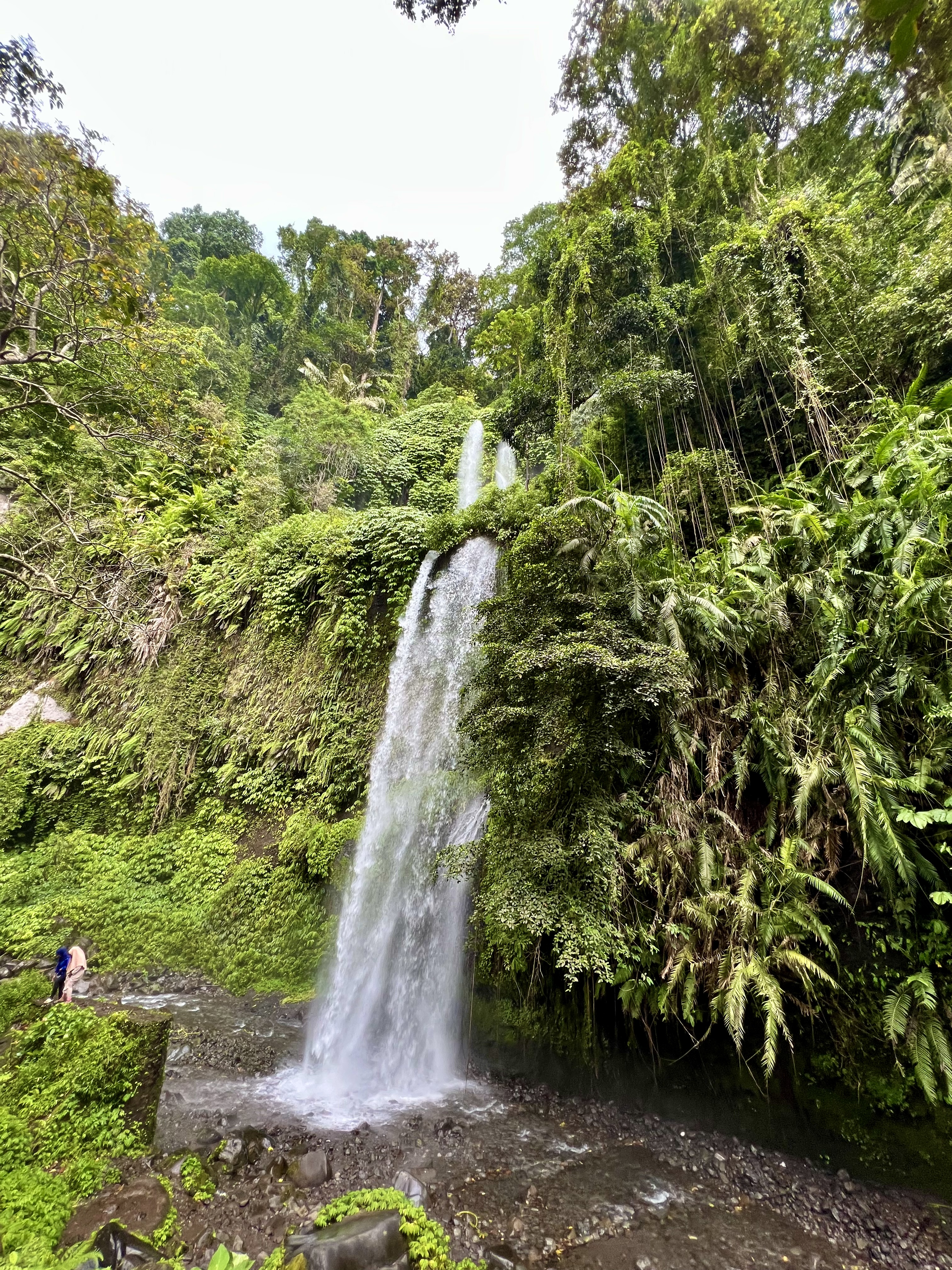
Sendang Gile Waterfalls
The path to Sendang Gile is a nicely laid out staircase. At the bottom are a couple of tea stalls serving local coffee and tea. From the first falls to the second, the path is windy, rocky, and crosses the stream a few times. Water shoes are beneficial as the way is very slippery. Park Rangers have placed chainlink fencing on the rocks to provide some stability, but it is only somewhat useful. The Tiu Kelep Falls, however, makes the ankle-turning path worthwhile. I was there on a Sunday and the place was filled with locals going for a swim in the small pools below the Falls. Ranjani National Park, which is named for the tallest mountain on the island, is a lush tropical forest, complete with some stinging plants near the pathway and thieving monkeys, but also lots of birds and colorful butterflies. Most of the forest looks untouched from human traffic and is quite beautiful.
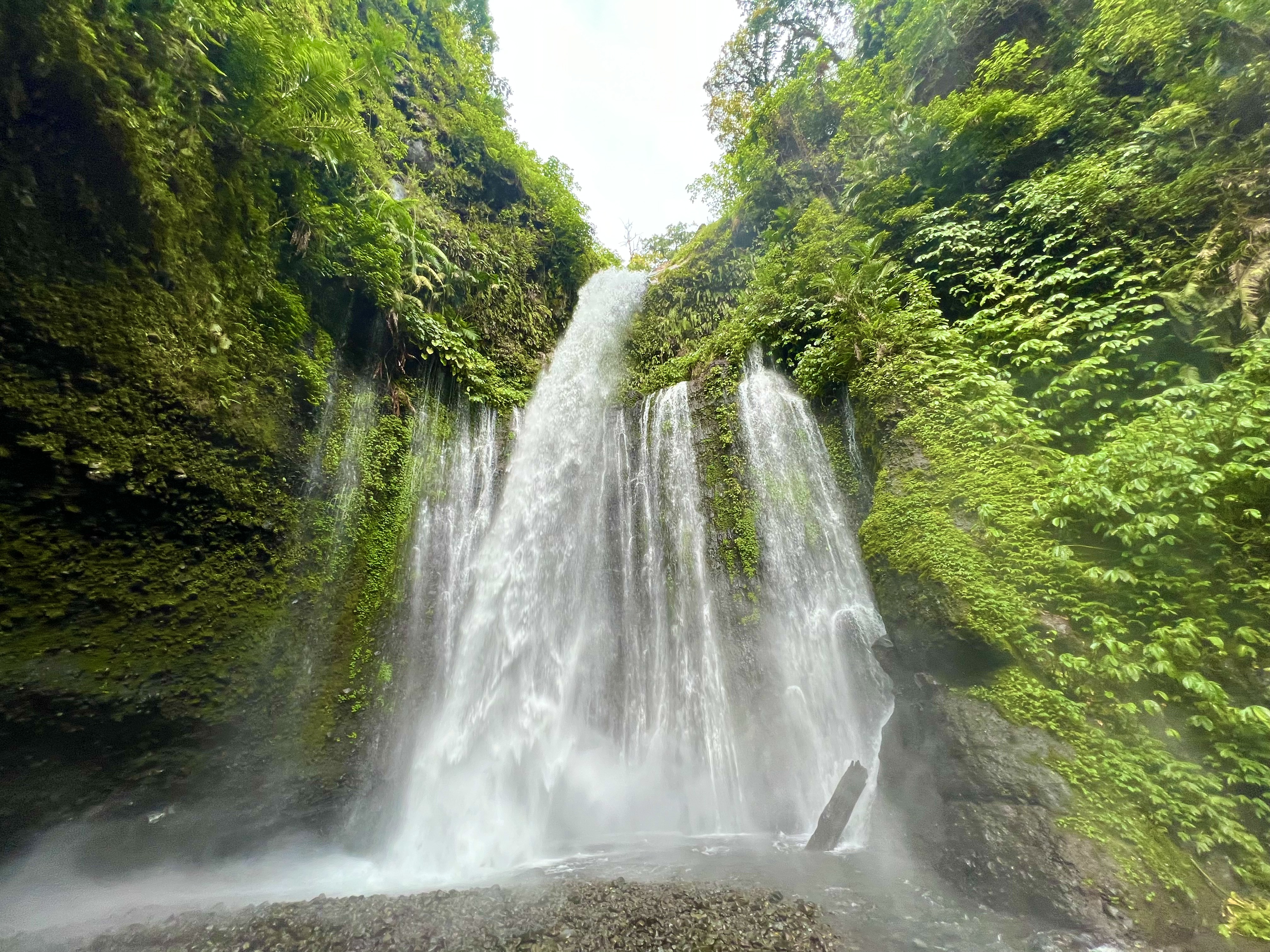
Tiu Kelep Waterfall
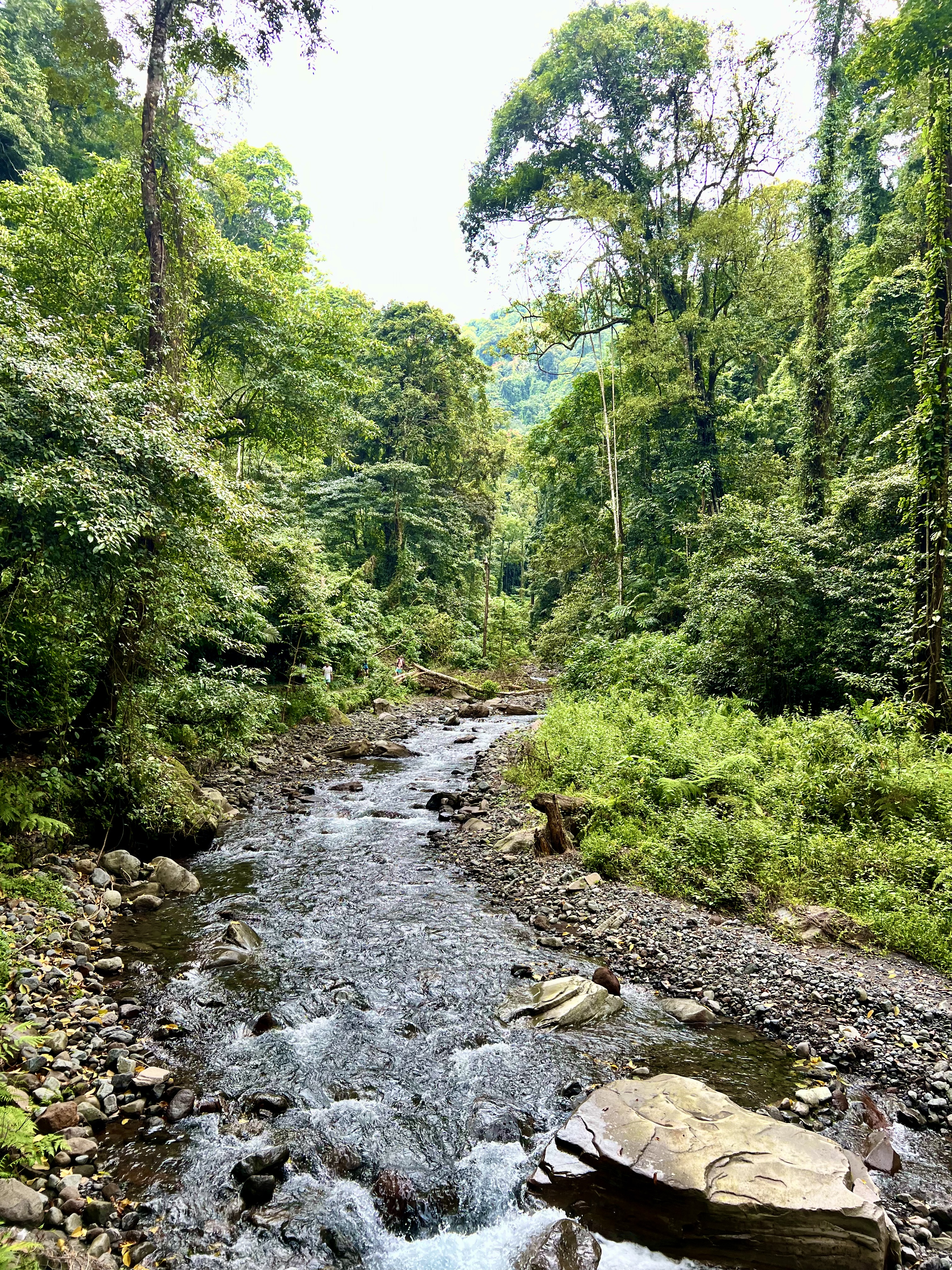
Ranjani National Park
The next day, I booked a snorkeling tour on a glass-bottom boat to the Gili Islands. I purposely wanted the glass-bottomed boat in case the waves were too high for decent snorkeling as the wind had picked up the day before and white caps dotted the sea. I got lucky, the day was calm and perfect for snorkeling. The tour had a hotel pickup, which was convenient. The drive from Senggigi to the boat took about an hour. At the office, the manager had a QR code that I was supposed to scan to get the insurance form. I scanned it, filled out the form and then tried to send it but the internet connection on my phone wouldn’t work as it was an unsecure network. This happened to me a number of times elsewhere on the trip. I tried four times at the manager’s insistence, but it just wouldn’t work. I said I could use one of their phones or write out the items on a sheet of paper, but he wasn’t either prepared or able to provide these options. In the end, I went without submitting the form. I was a bit worried that this might harbor a bad omen for the excursion, but it turned out to be a fabulous day. John (his Anglicized name) was the driver of the boat and also my dive guide. I had thought that there would be up to six people on the tour, but I was the only one that day. It was great to have the private tour and not have to swim into others looking at the fish and turtles.
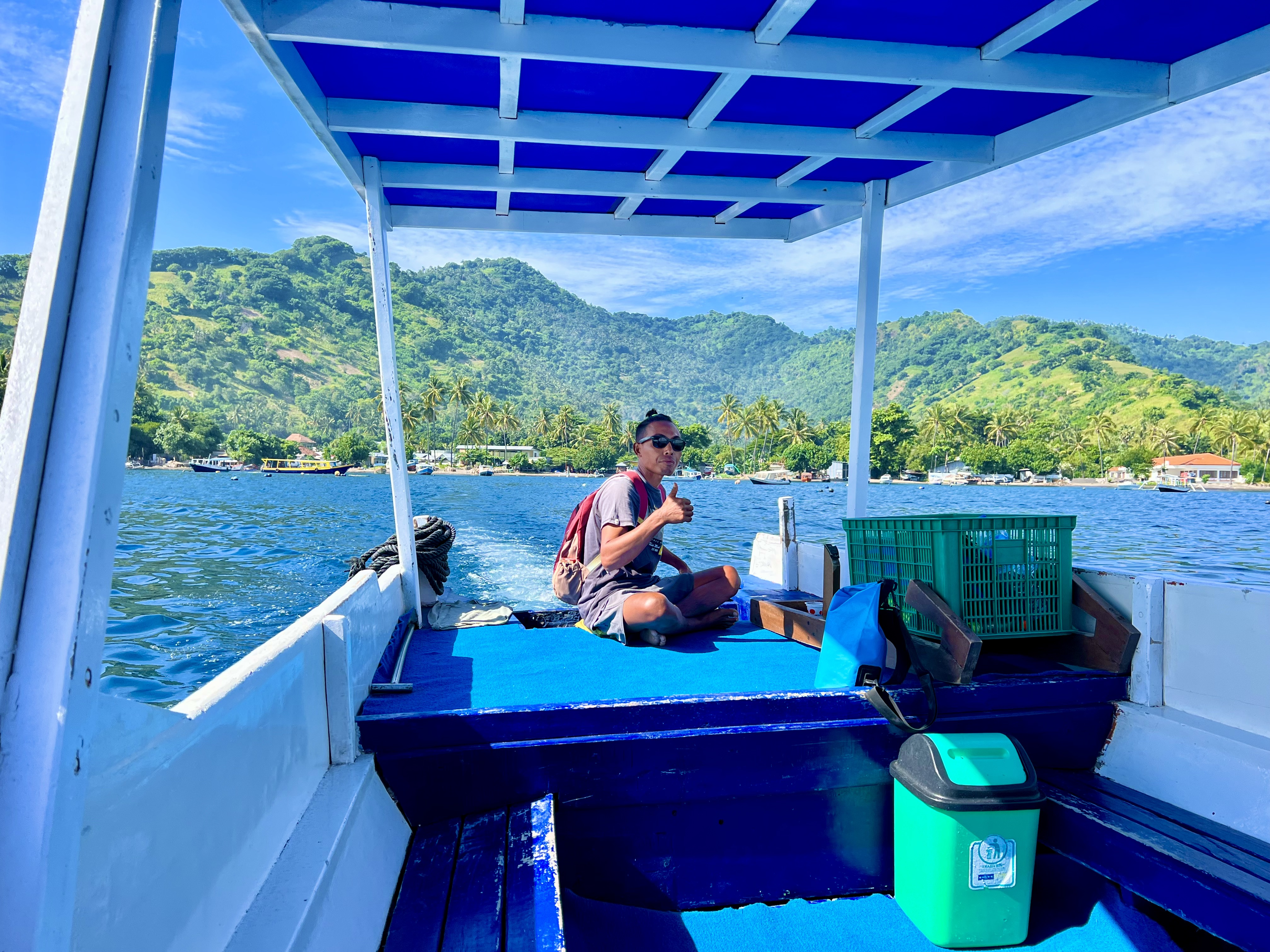
John guiding the boat and later the snorkeler
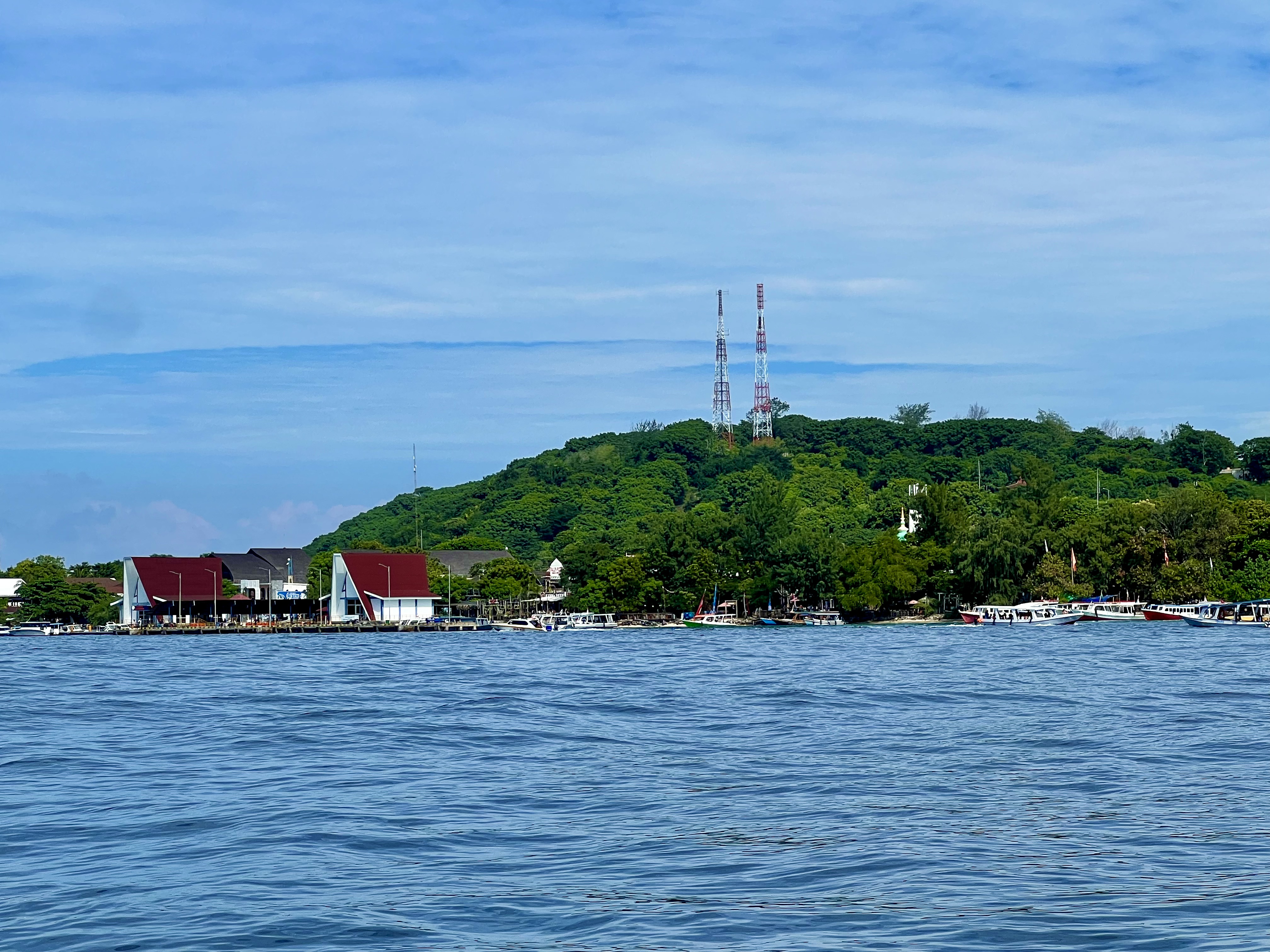
Arriving at Gili Trawangan
The boat ride across from Lombok to Gili Trawangan, the largest of the three Gili Islands, took about a half hour. We docked so that I could walk up the hill to the overlook. The path to the overlook went through the main tourist area complete with untold restaurants, bars, souvenir and beach attire shops. Vendors selling sarongs and pearl jewelry walked among the throngs of tourists hawking their wares. There is a staircase toward the end of the village that goes up the hill to the overlook. Unfortunately, about 10 meters in front of the summit large trees blocked the path and there was no way around them. I was only able to get a few photographs on the way back down to the boat.

Obstacles on the stairs to the Trawangan Overlook
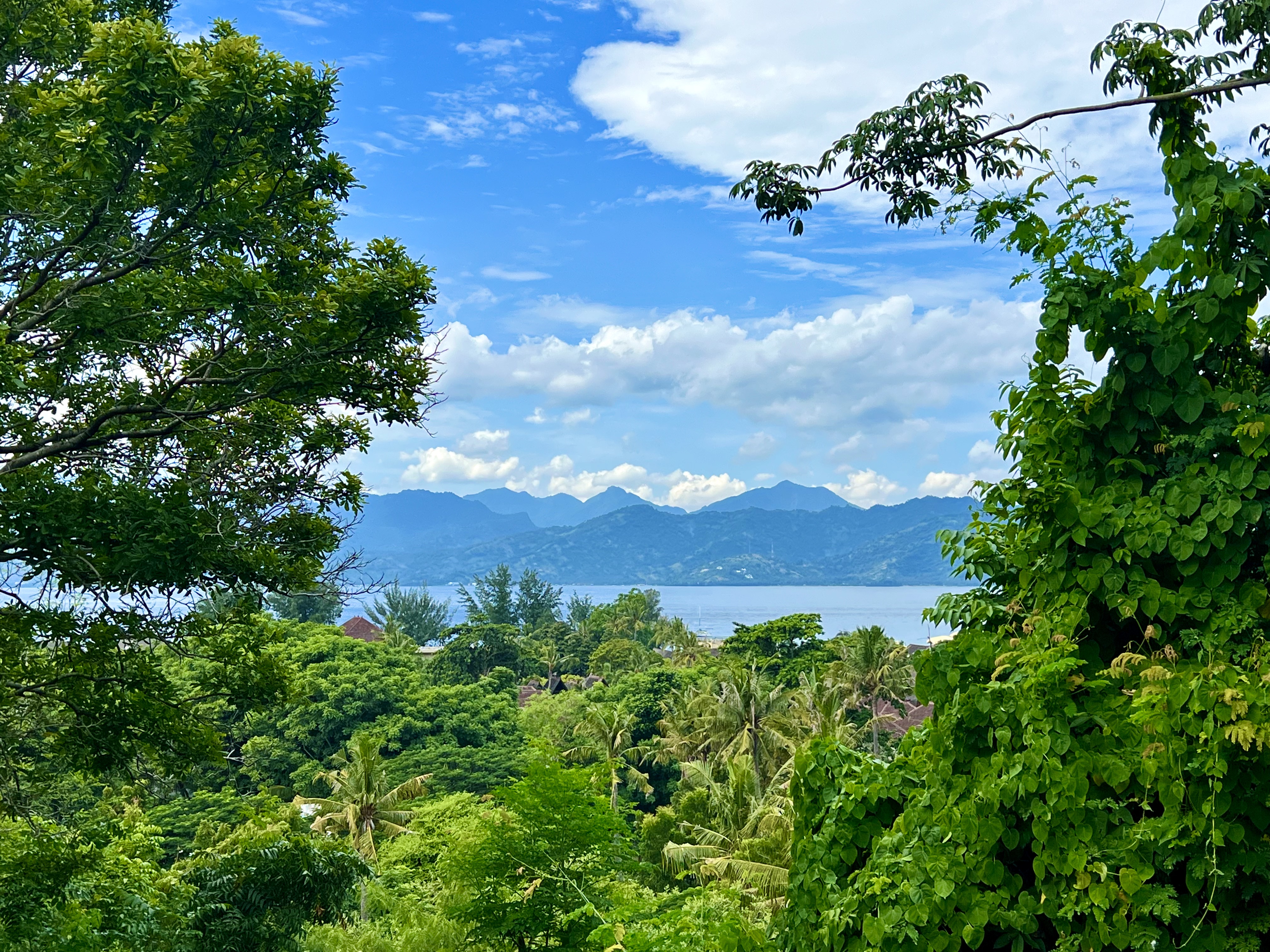
View of Lombok from near the Trawangan Overlook
We headed back out into the bay, put on mask, snorkel and fins and dropped into the clear lukewarm water. The coral was initially a disappointment. I thought sand was covering it, until I realized that it had been bleached. That didn’t stop the turtles or the fish though, and dozens of other vacationers were crowding around trying to get the best photograph. After about an hour, we got out away from the crowd and went over to Gili Meno in the hopes of finding better coral, more turtles, and less people. For the most part, we were successful. It was only by the sunken round-figured statue dedicated to Romeo and Juliet that the Instagram photo hungry horde congregated. The statue was placed in the water by a local hotel to attract snorkelers and divers. It does.
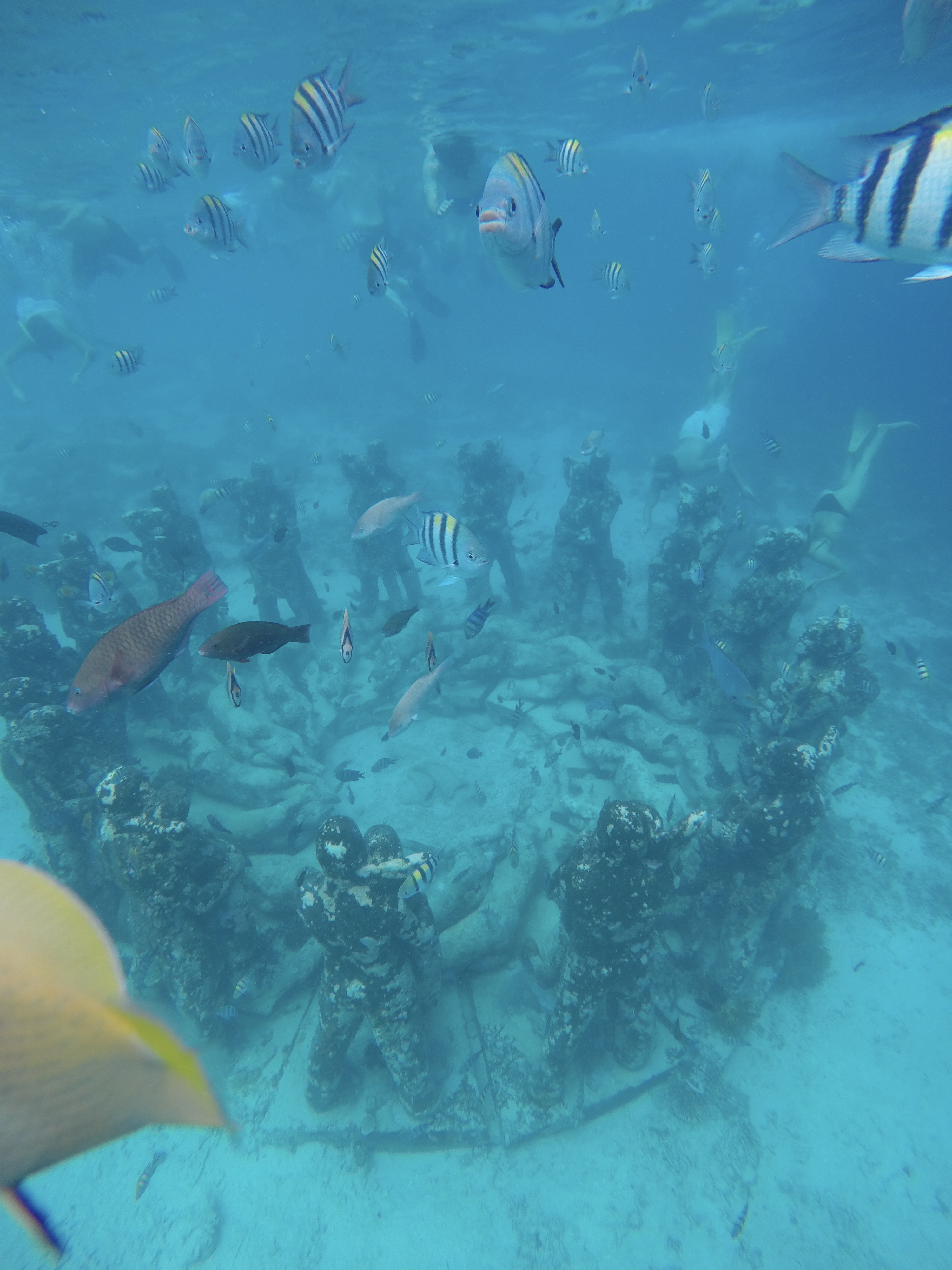
Another gimmick to help tourists get good photos, was to feed bread to the fish. The Gilis have a tremendous amount of colorful tropical fish even as the coral is declining. They also have lots of turtles. This may be because there is a hatchery on Gili Meno. The young are kept in tanks until they are ten months old and then released into the sea. They are so accustomed to people, that they don’t seem to mind all the attention from the snorkelers. Although, I must say, I was upset when I saw one person actually step on a turtle swimming near the bottom and I can’t even begin to count how many people I saw with shoes and flippers standing on the coral. It’s no wonder what’s left is dying. The coral’s destruction is not just due to tourism, though. I later learned that the Wallace Line that divides the Australian and Asian continents runs directly through the Badung Strait between Bali and Lombok. This explains the drier regions of Lombok that is closer to the Australian continental region while Bali falls to the Asian contenient. Fish from both the Pacific and Indian Oceans gather between and around the two islands. This makes for wonderful fishing, which led to fishermen from neighboring islands coming to the region to kill them through ammonia bombs filled with a mix of ammonia fertilizer and petrol. If that weren’t devastating enough, they also used cyanide spraying to capture the fish by paralyzing them so that they could then be swept up in the nets. These practices have since been banned, but the damage to the coral remains.
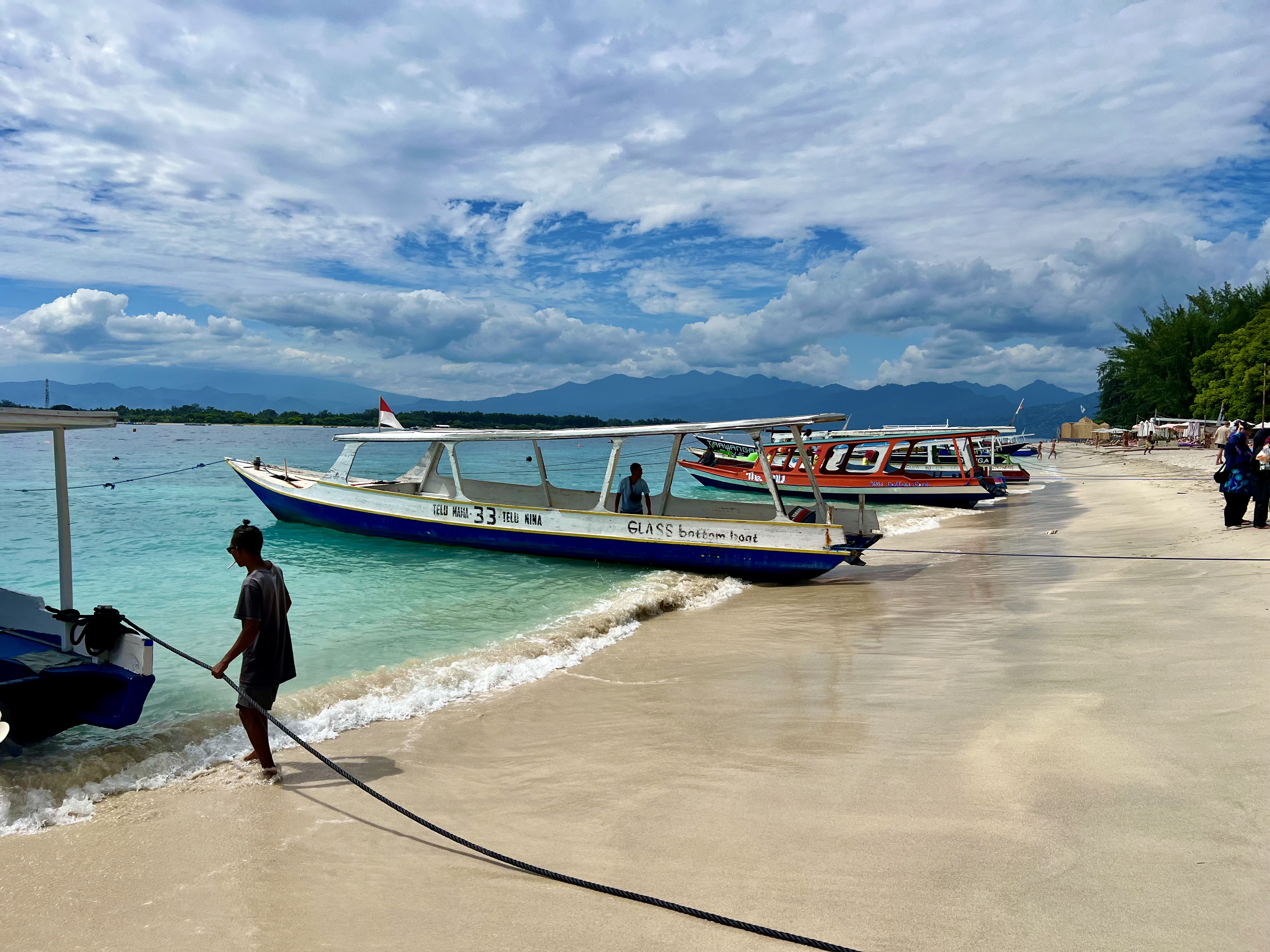

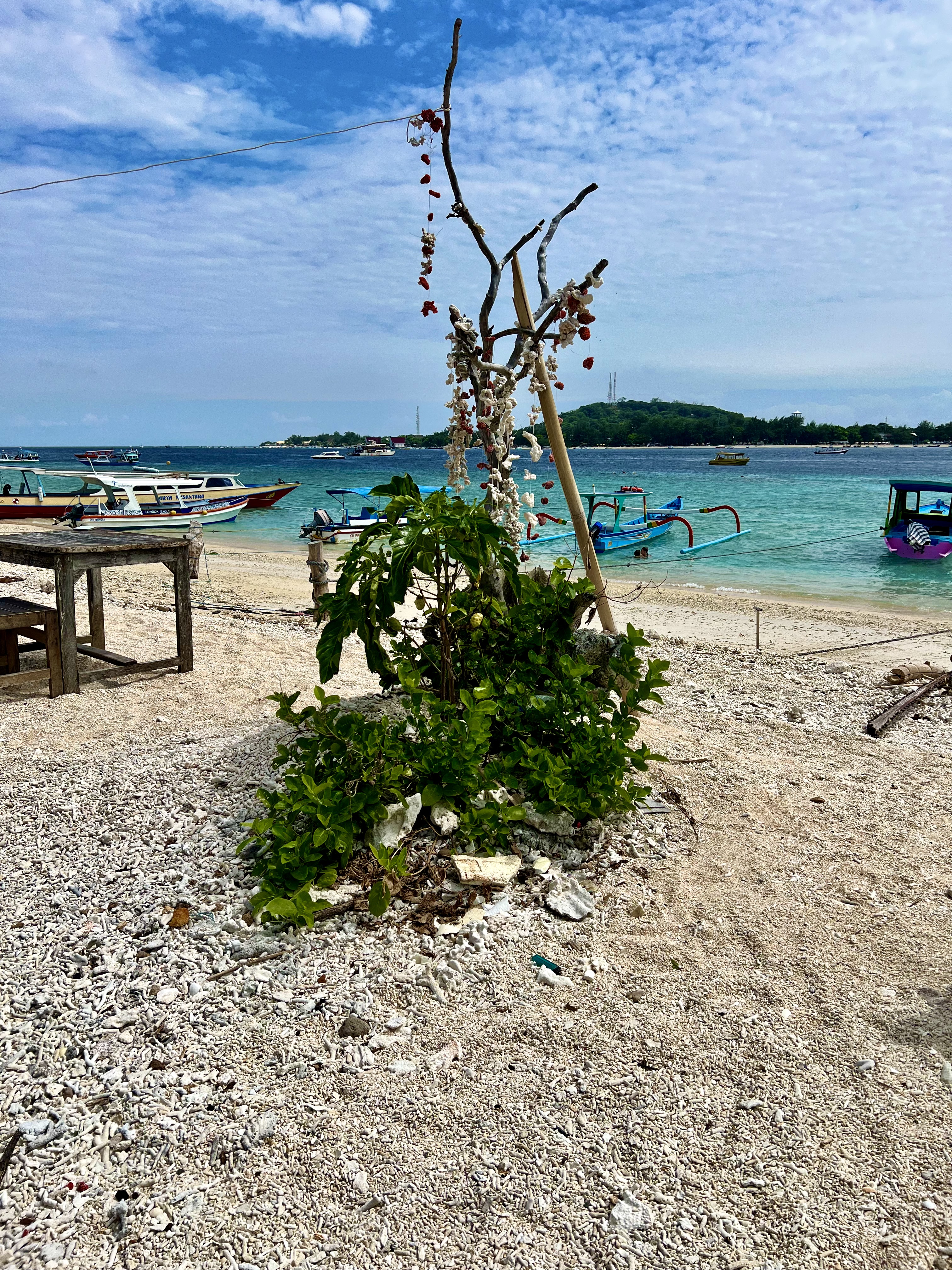
Gili Meno docking, hatchery, and view of Gili Trawangan from dead coral beach
While I didn’t get to the tourist areas around the sandy beaches in the south, nor to the Lesser Gilis, I did get photos of them from the plane to Bali.

South Coast of Lombok

South Coast with three Lesser Gilis
Lombok has a lot to offer those who care for the natural world from rainforests to marine life and cultural sites. And then there is also that delightful Wildlife Park.
 omegoodyssey