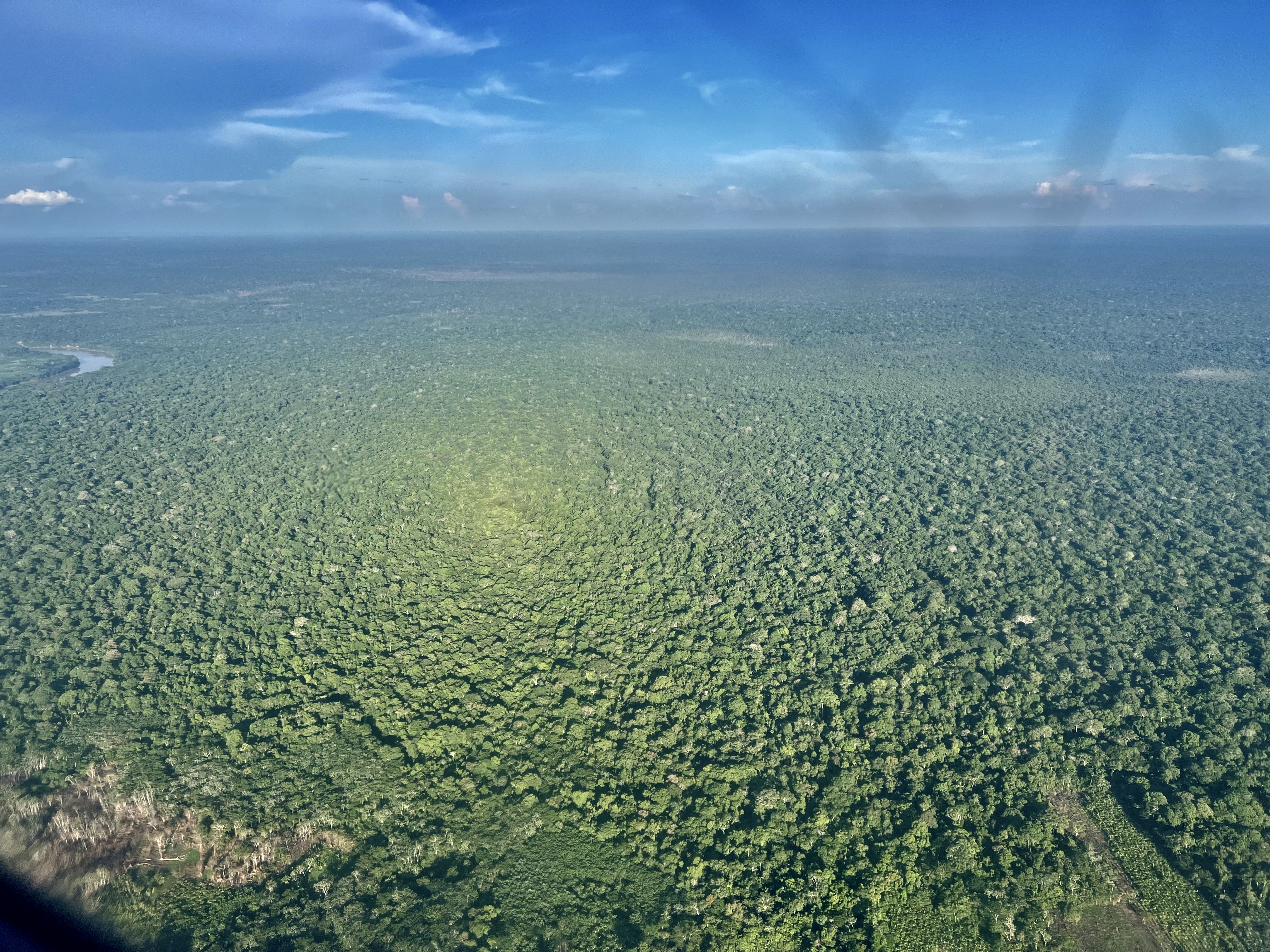
I’ve been very fortunate to have visited a number of tropical rainforest areas. In South America, my first trip to the Amazon basin was with my daughter twenty-four years ago when we went to an eco-lodge in Madadi National Park in Bolivia. That trip was wonderful and the environment around the lodge and upriver was pristine. This was the image of the Amazonian Basin I had in mind when I went up the Amazon River from Manali two years ago. Unfortunately, the shores bordering the Rivers Negra and Amazon within 200 miles of Manali are now lined by settlements with cows and fields replacing the forest and native wildlife. In the hopes of finding a more intact rainforest habitat, I booked a trip for three days to Tambopata National Reserve. Luckily, this part of the Amazon basin has a healthy forest that provides a sustainable habitat for wildlife. This may be partially due to the fact that most of the Reserve is protected from humans. There is only a limited area where non-indigenous people and tour groups are allowed to enter. The area we were allowed to access was filled with what appeared to be healthy wildlife.
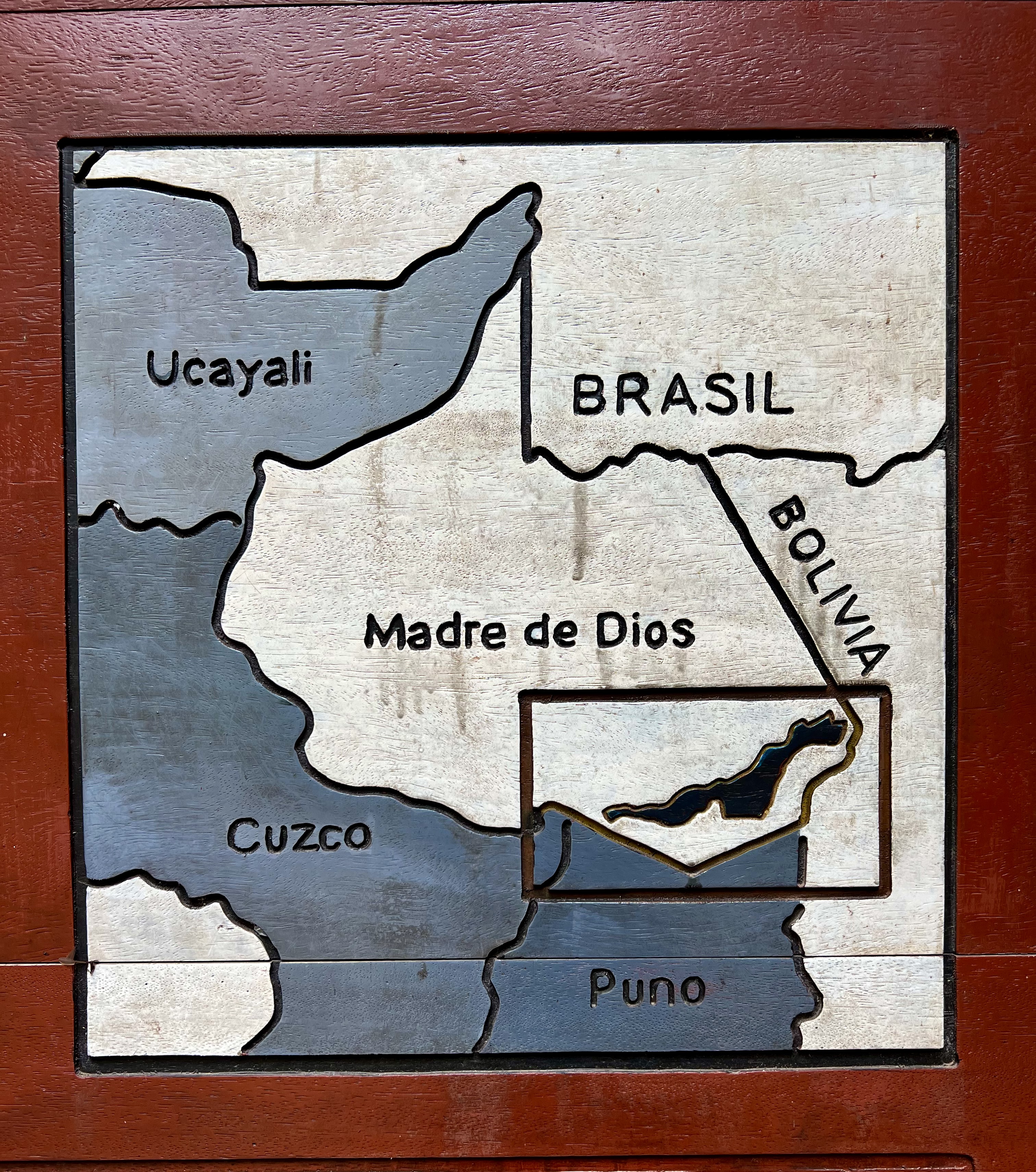
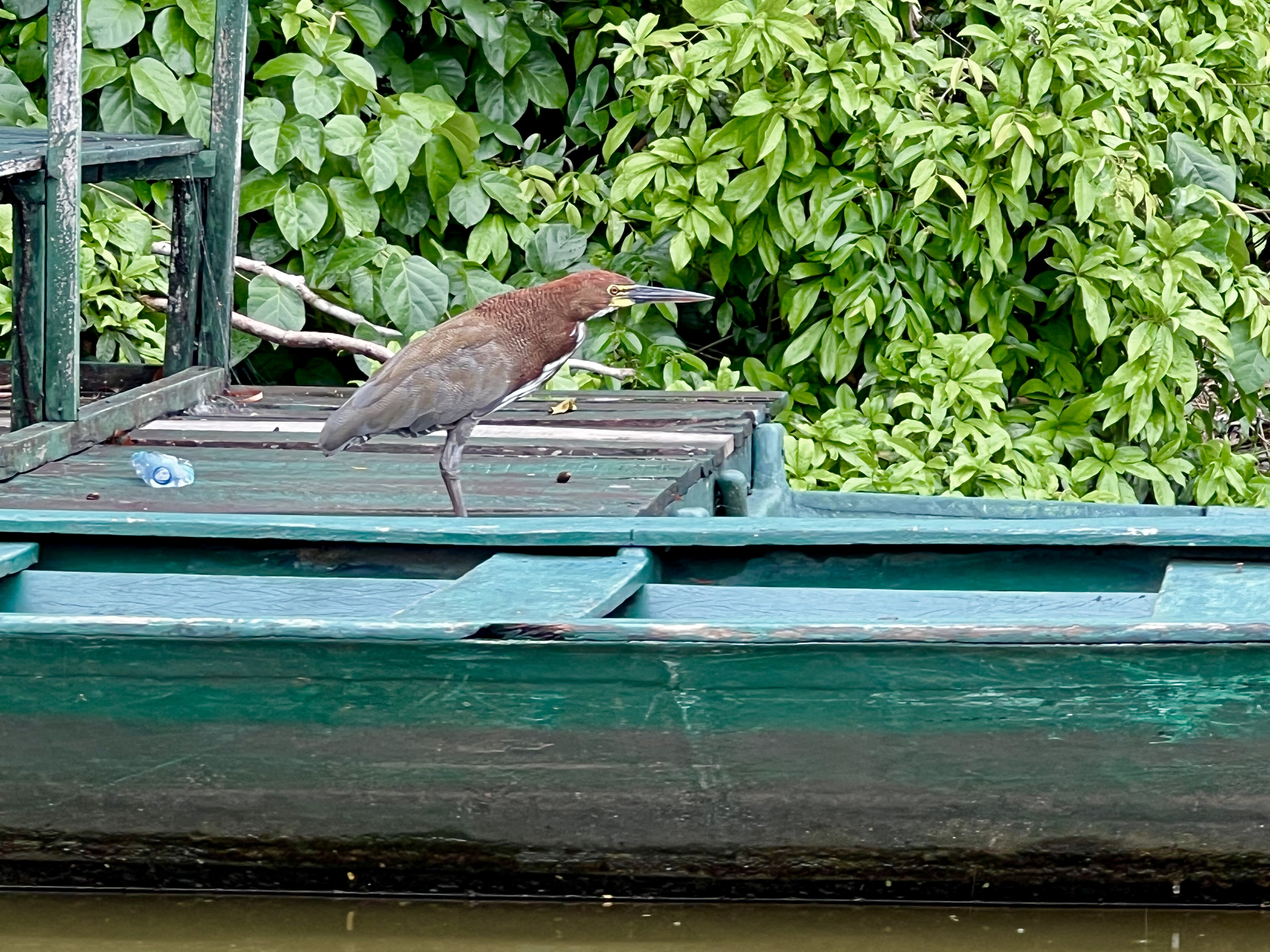
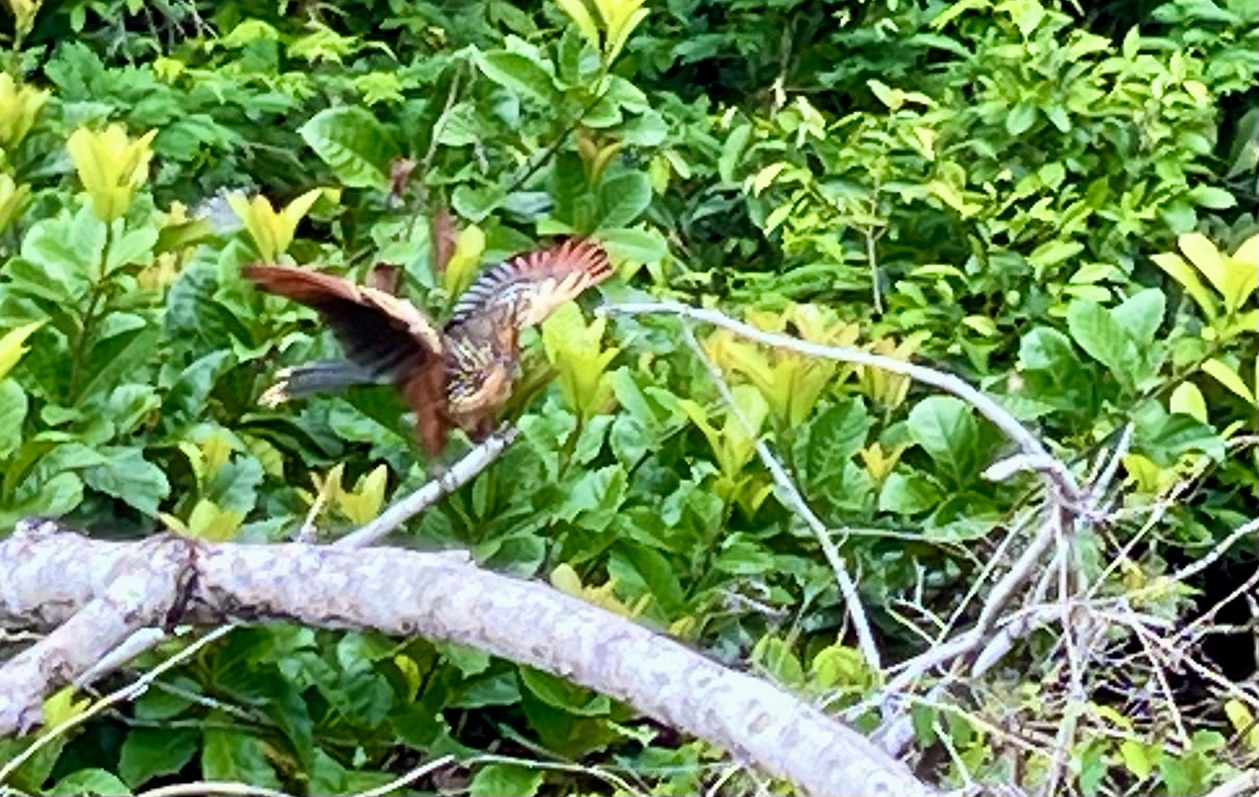
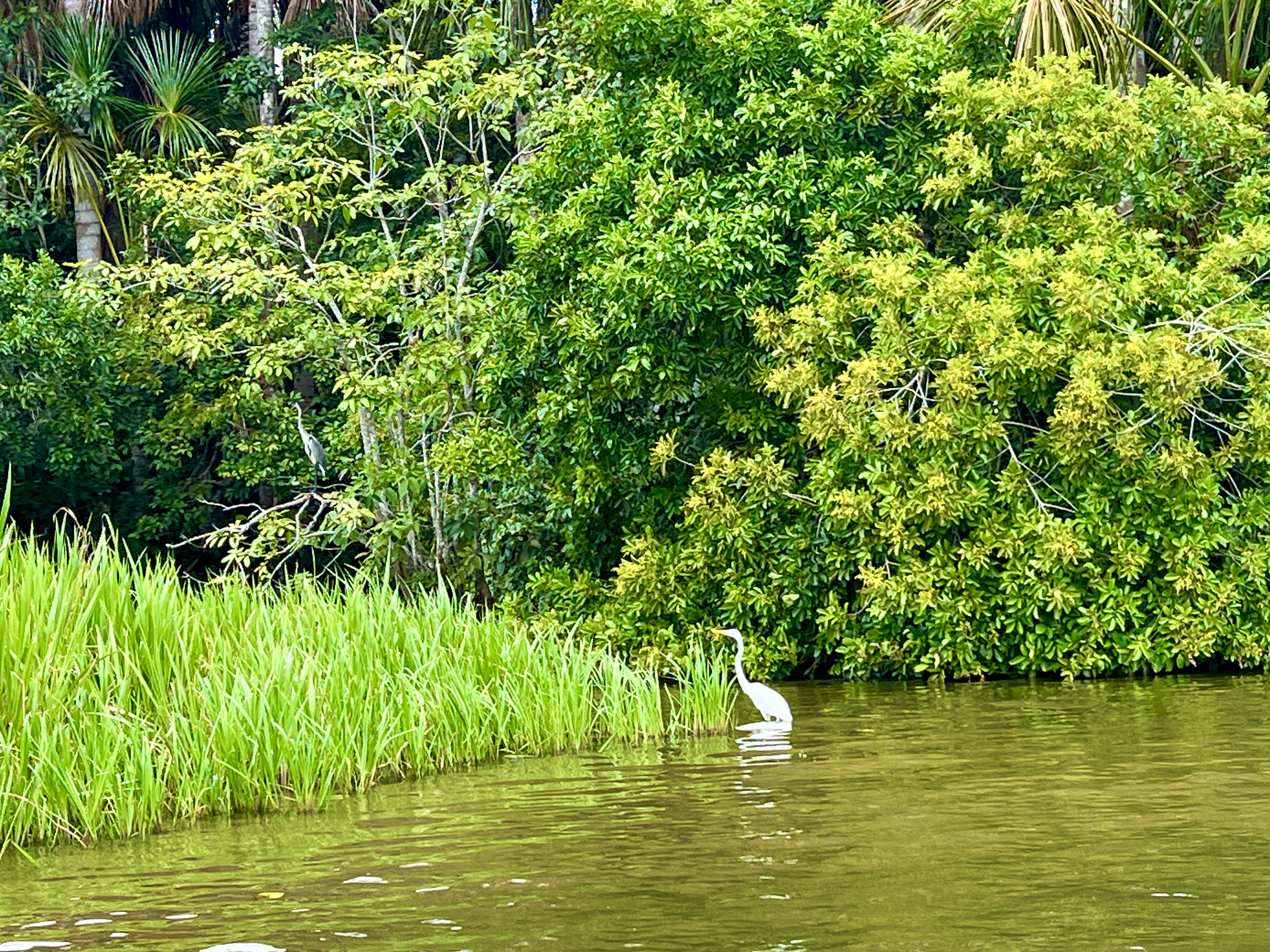
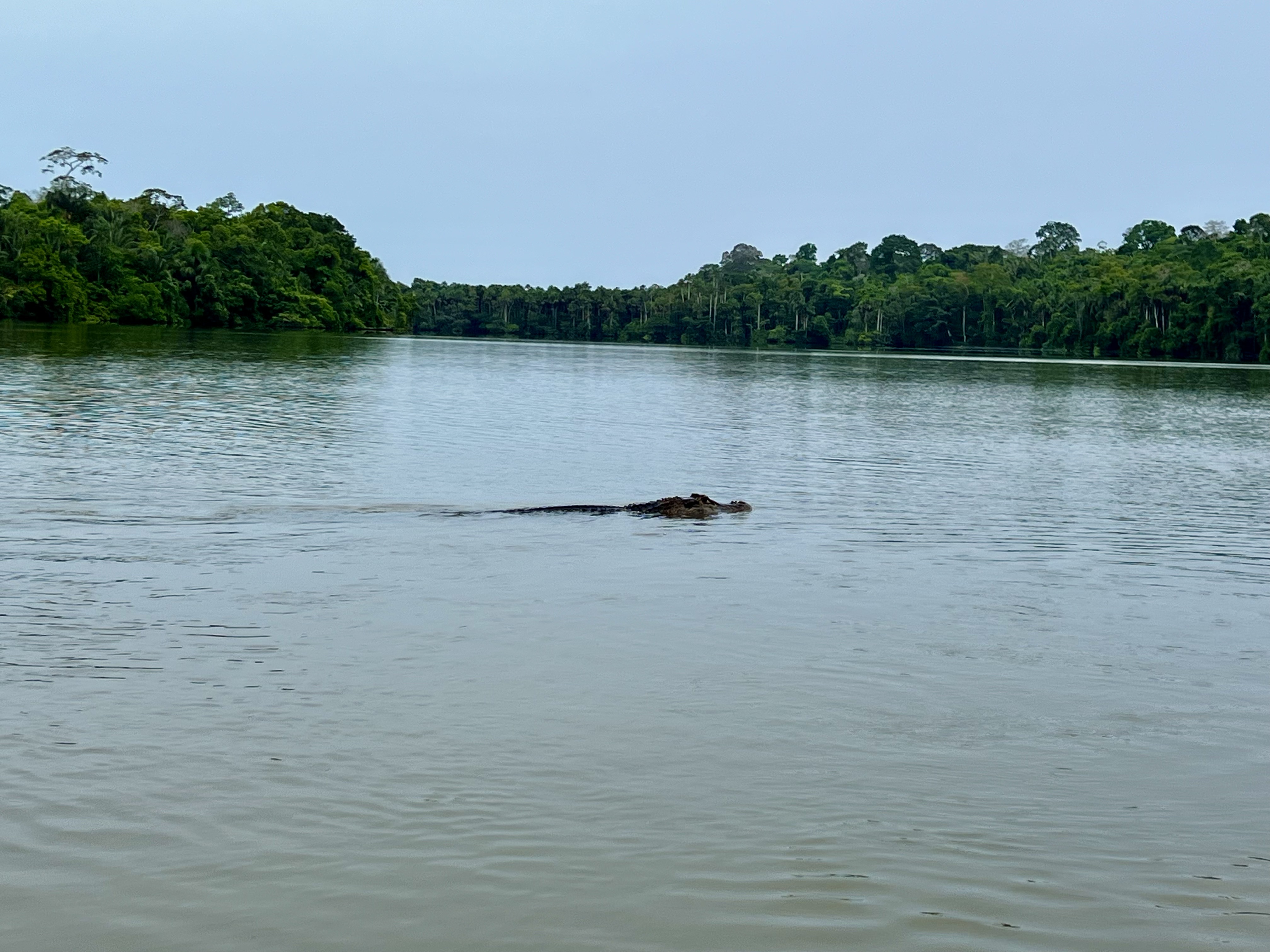
The Reserve was created in 2000 and researchers from across the world come to study the flora and fauna. There have been more than 630 bird, 1,200 butterfly,103 amphibians, 180 fish, 169 mammal and 103 reptile species identified within the 274,690 hectors of the Reserve’s borders. This doesn’t include the 40 species of intercontinental migratory birds. Some of the larger mammals who make the Reserve their home include, the lobo de rio, i.e., the great river otter, and a variety of larger felines, such as the puma, jaguar, ocelot, and margay. There are a number of primates, the most commonly visible are the brown capuchin and squirrel monkeys along with the loud red howlers. Snakes, including the boa constrictor and anaconda wander through the forests as well as electric eels in the rivers and lakes. Piranha, a favorite food for the three kinds of caiman in the reserve are found in Lake Sandoval. Lake Sandoval, an oxbow lake, has a circumference of about 3 km and is home to a wide variety of wildlife. We spent a delightful morning on a boat watching river otters, black and white caiman, monkeys and lots of birds. Unfortunately, I wasn’t able to catch the names of many of the avian species.
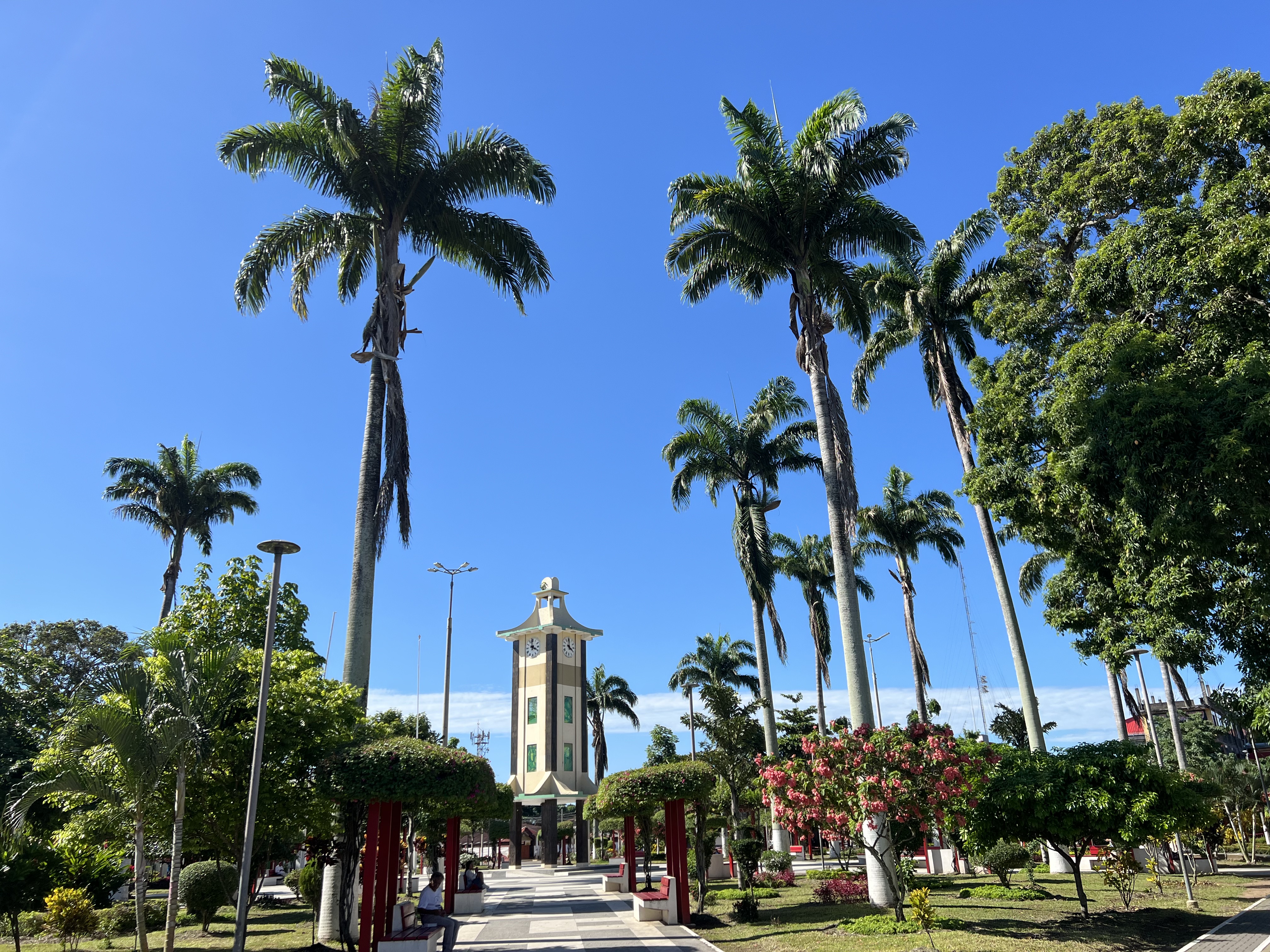
After arriving in Puerto Maldonado from Lima, I was met by the tour agency, arranged through my contact at the school in Cusco, and brought to the boat that took me, and others who were staying at the lodge over the next few days, down river for about an hour. After checking in, we headed out to a short nature walk in the forest behind the lodge. The excellent naturalist guide, Fernando, introduced some of the trees and plants in the area to our group, consisting of three young people from Deauville, France, a young couple from Krakau, Poland, a group of four thirty-year olds from Segovia, Spain and a woman from Beijing, China; we lost the Spaniards on the second day, but gained a delightful young couple from Gmunden, Austria, basically just around the corner from where I live. During my two and a half days in the Reserve, Fernando proved to be a wealth of information.
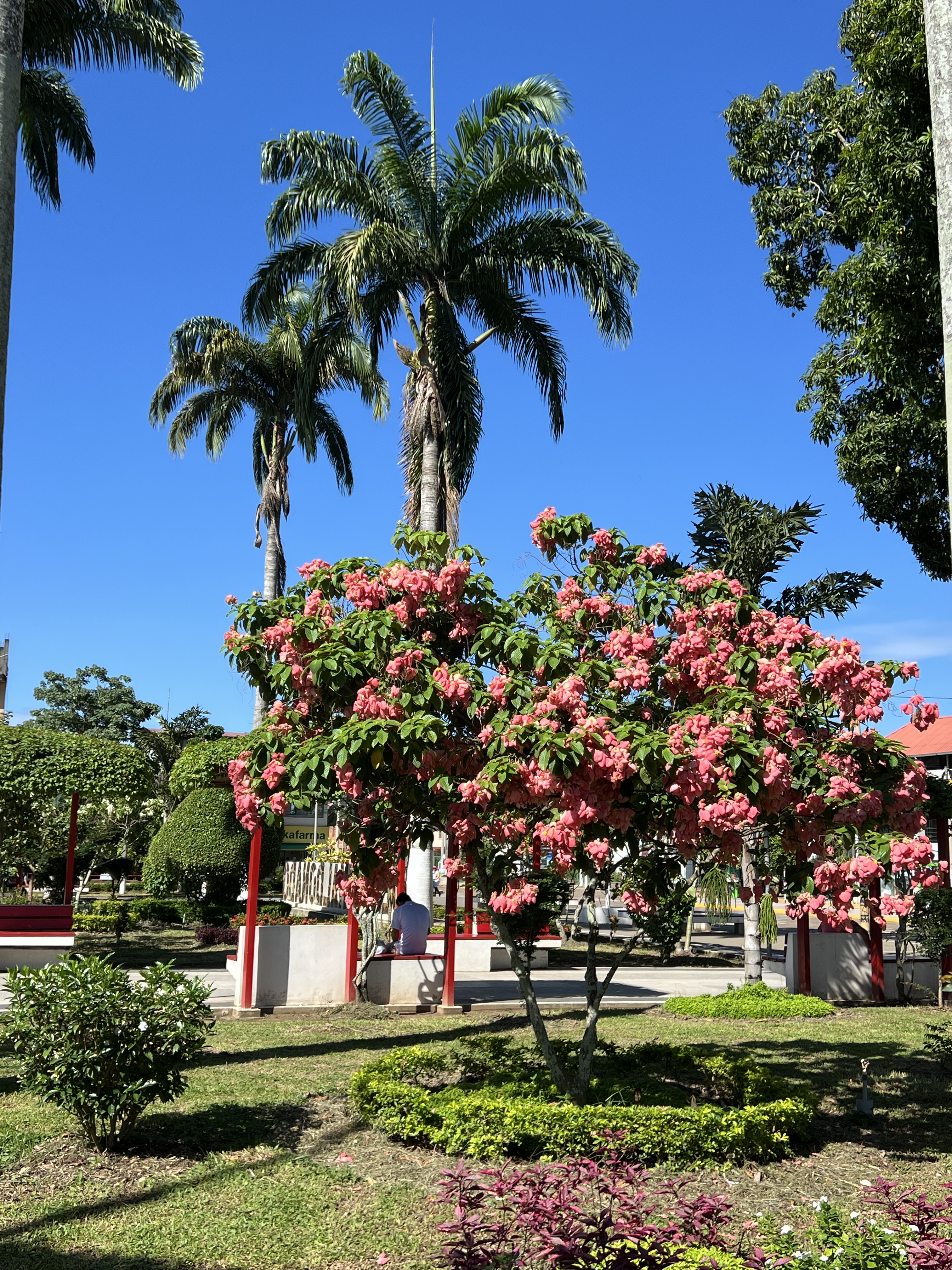
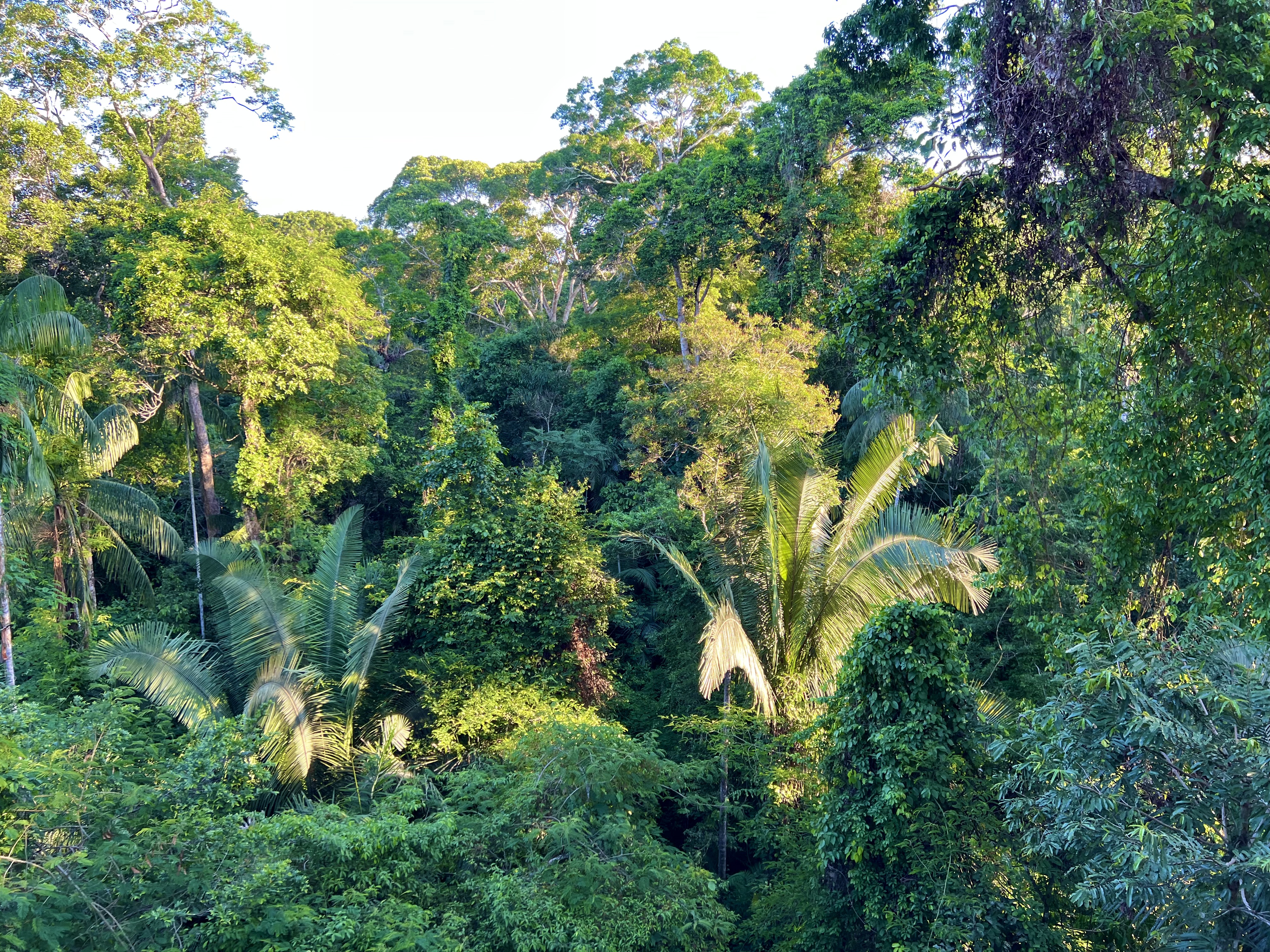
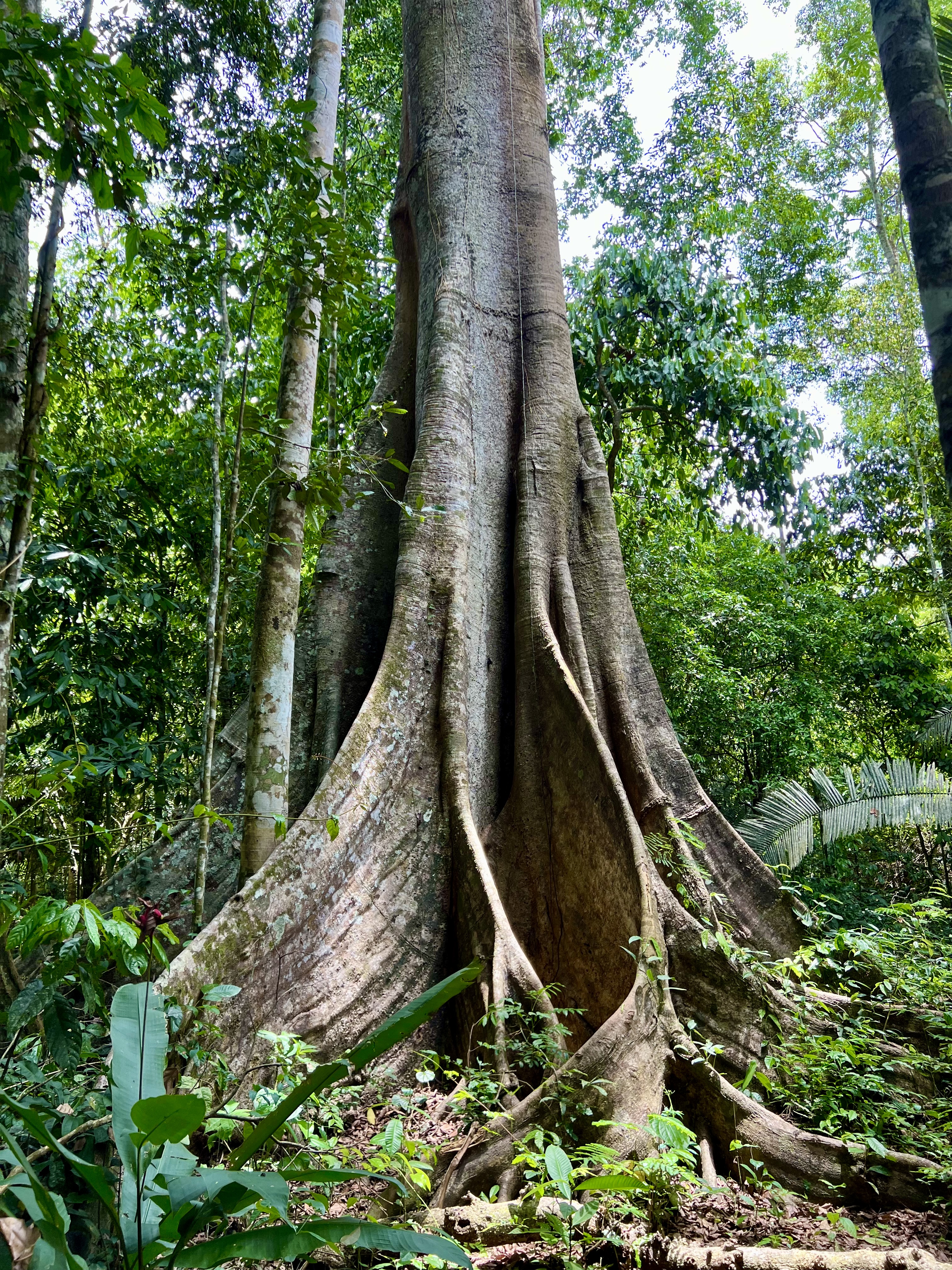
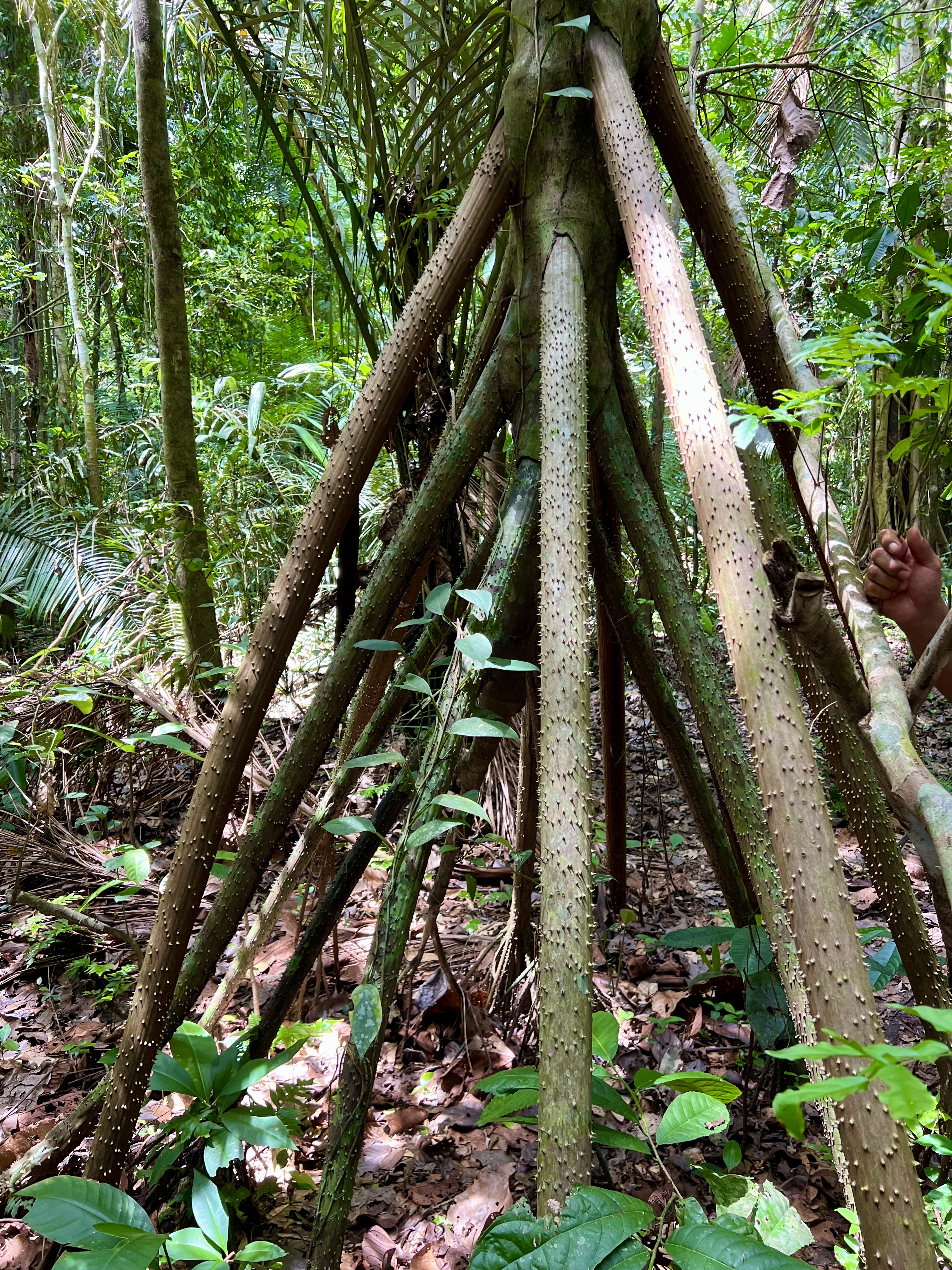
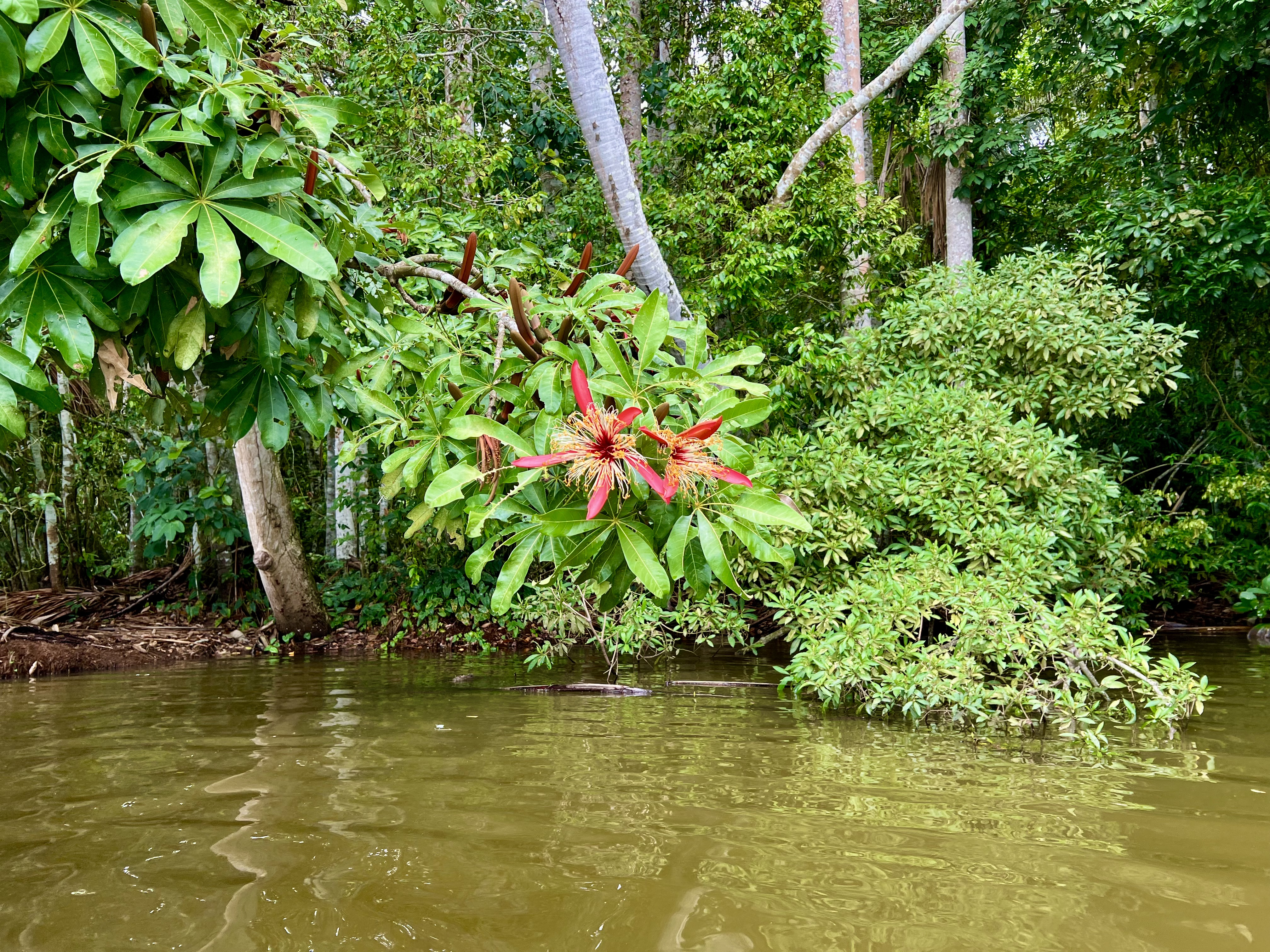
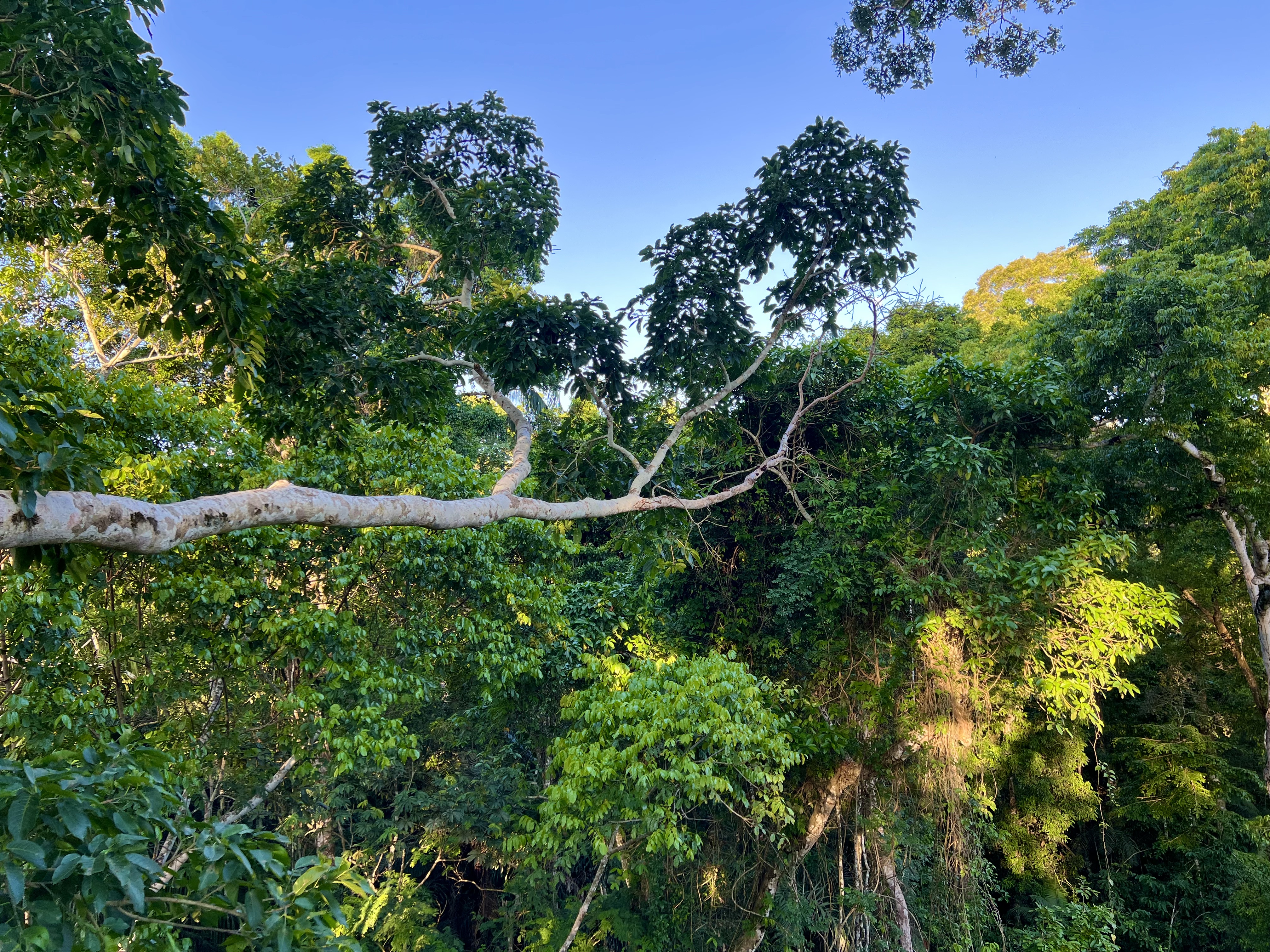
On the first day there were three excursions: the nature walk, a canoe trip to and walk on Monkey Island, which was only a few minutes from the lodge, and a caiman viewing at night. This worked out to being first, a bit about the flora, then a bit about the terrestrial fauna and finally the water’s inhabitants. During the nature walk, Fernando explained that there are two different species of termites living in the forest, one lives on tree trunks, with a mixture of their saliva and excrement forming tunnels on the sides of a tree. Apparently, this mixture can be collected from the tree trunk and used as an insect repellent. The termites don’t hurt the living trees as they only feed off of dead wood – the woodwork in my former house in Yuma, AZ, for example. The other kind are the ones that build mounds on the forest floor, which are the kind I have seen in equatorial regions across the globe. We also learned that the kapok tree is locally called ‘the mother of the forest’ because it can grow up to 60-70ft tall and live up to 1,000 years. It produces a cotton like substance from June to August that locals use for pillows and blankets. Other trees that were highlighted during the walk were the walking palm, which moves to where it can catch sunlight through the canopy, various other kinds of palms, fig and strangler fig trees. These, along with the kapok, were similar to those in Daintree National Park in Queensland, Australia, if a bit smaller than their Australian cousins.
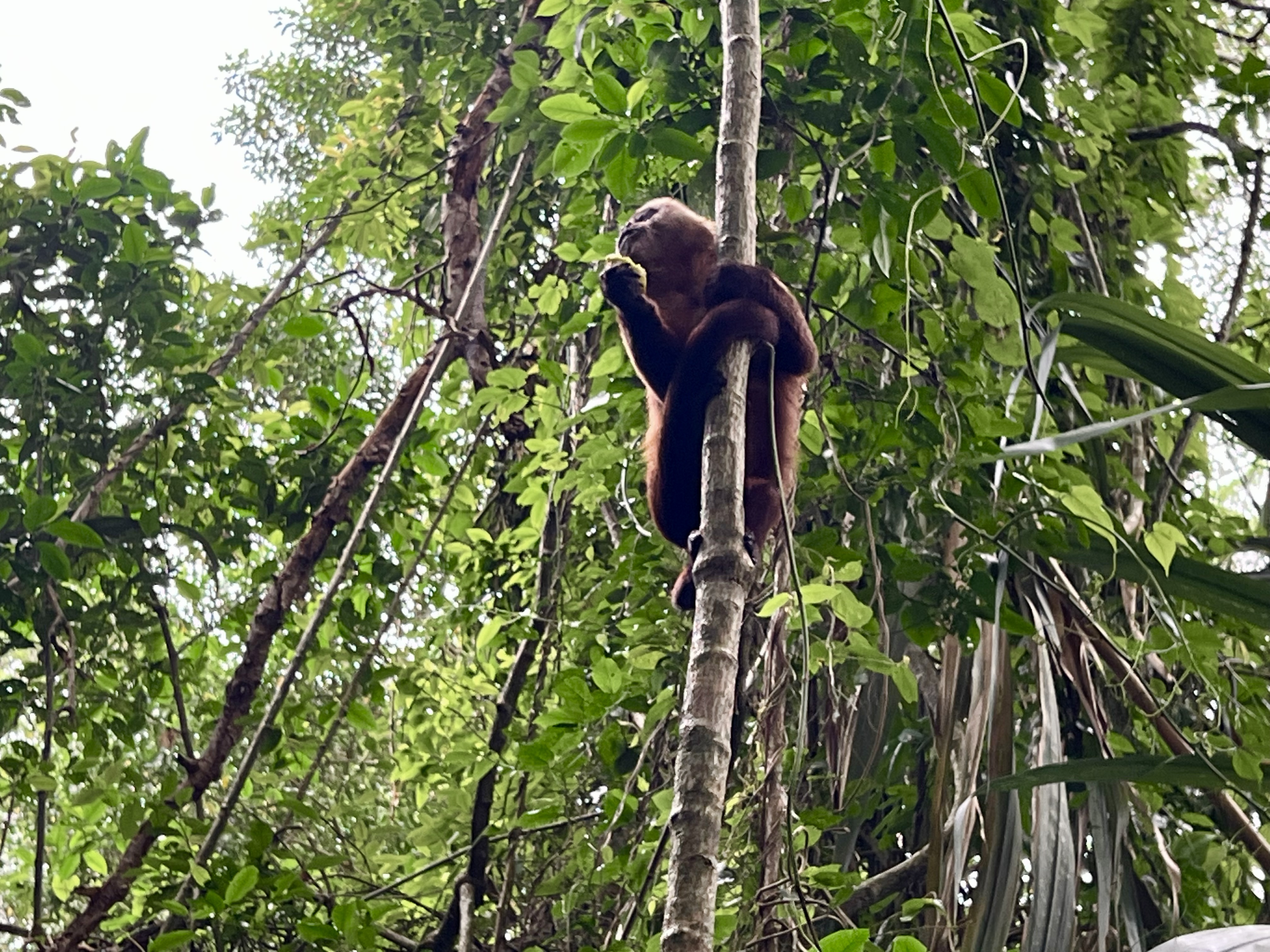
For the Monkey Island excursion, we took a boat to the island, then had a fairly short walk to where there usually is a family of brown capuchin monkeys. Squirrel monkeys apparently stay close to the brown capuchin clans, so if one sees one species, the likelihood is that the other is not too far away. In order to entertain the humans, the guides call the wild monkeys to get them to come and feed off the apples and bananas that the lodge staff have prepared for the tourists to give to the primates. Normally, I don’t like the idea of feeding wildlife, but as these monkeys are really wild and not domesticated at all, it seemed okay, and the monkeys, seemed pleased, even if one of the larger ones kept pushing one of the smaller ones away as he scampered down the tree trunk to grab the fruit. After the feeding, the humans migrated back to the boat and then back to the lodge.
We made it to the lodge just as the heavens opened up and the downpour began. I wasn’t sure whether we would be able to go on the caiman viewing due to the rain, but as the boat had a roof, we went. We were able to see a couple of white and black caiman heads and a wonderful owl, but unfortunately the pictures didn’t come out due to the light discrepancy between the spotlights and the dark surroundings. Nonetheless, the covered boat ride in the rain, was delightful.
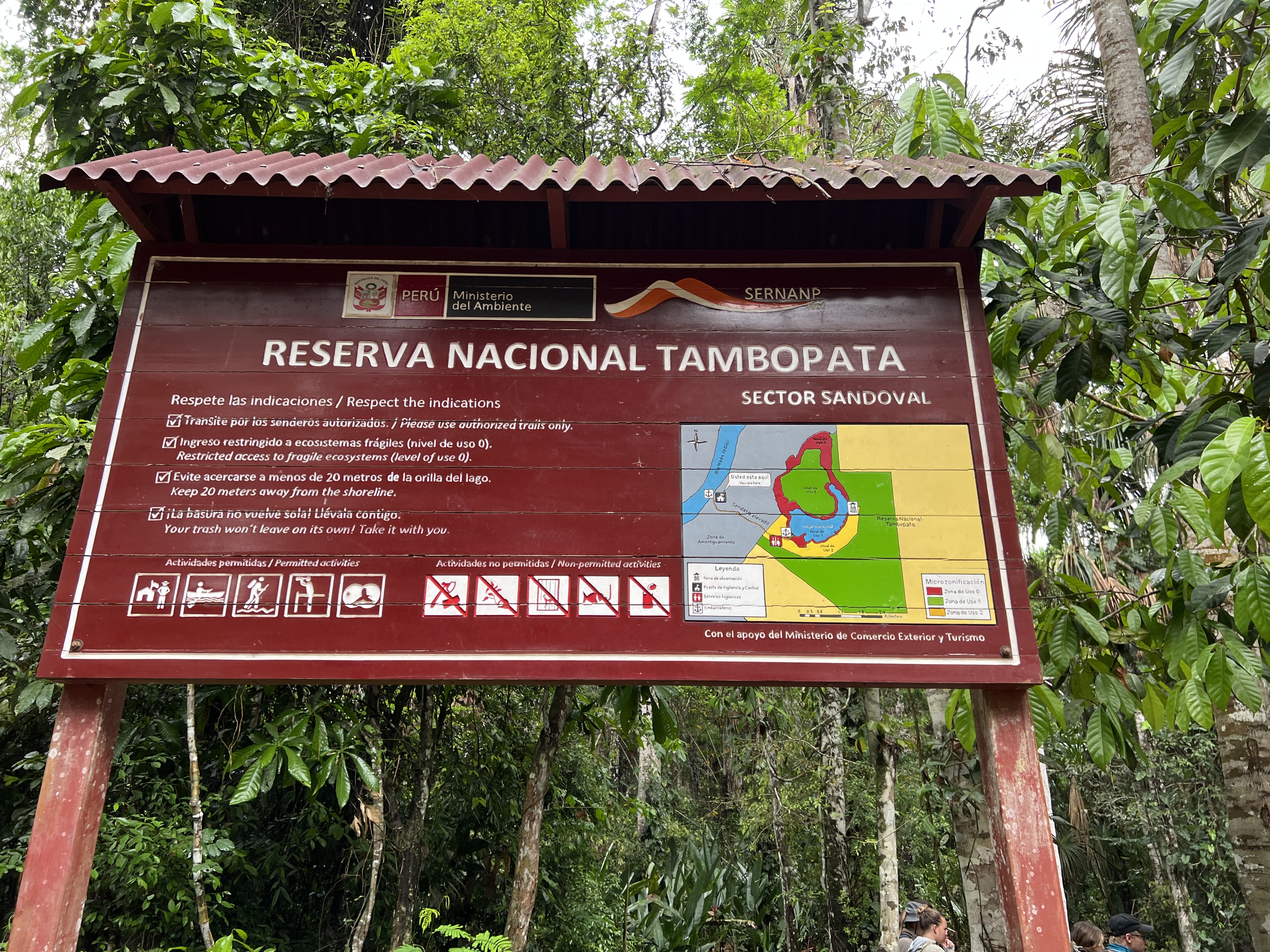
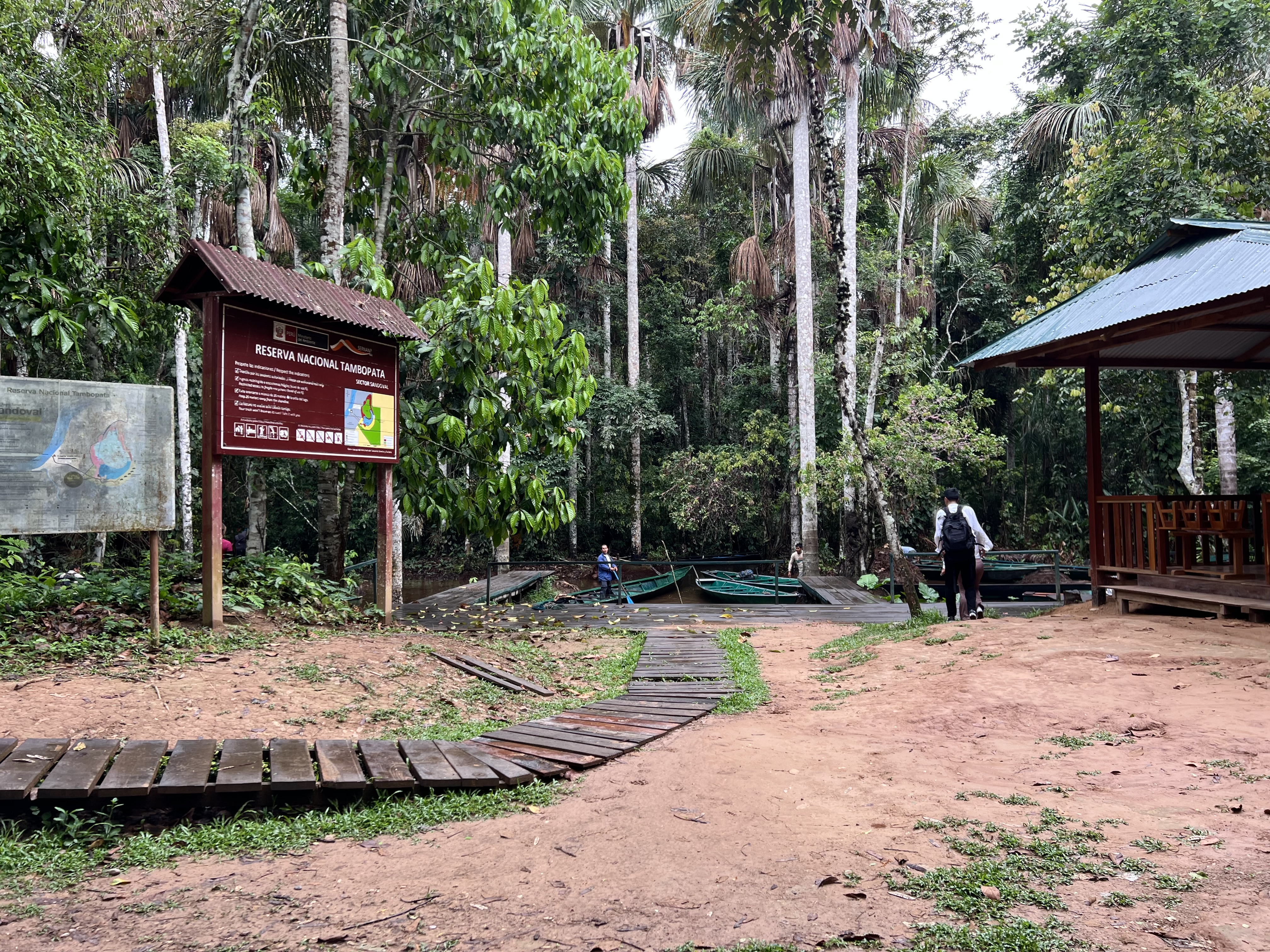
The following day, we were told that if it was raining, we should stay in bed longer, but if not we should be ready to get to the dining hall by 4:30am for the trip to Lake Sandoval. At 4:30 it was still raining, but by 4:45, it had stopped so I got up on the off chance that we would leave at 5. We left at 5:10 after Fernando woke everyone up. The day was overcast but not rainy, which made it a perfect day for wildlife viewing as it wasn’t unbearably hot. The boat ride took about forty-five minutes, then there was a 3km walk on a wooden boardwalk through the rainforest to the canoe dock for the lake. The riverboats are motorized, but the large canoes on the lake are paddle-powered.
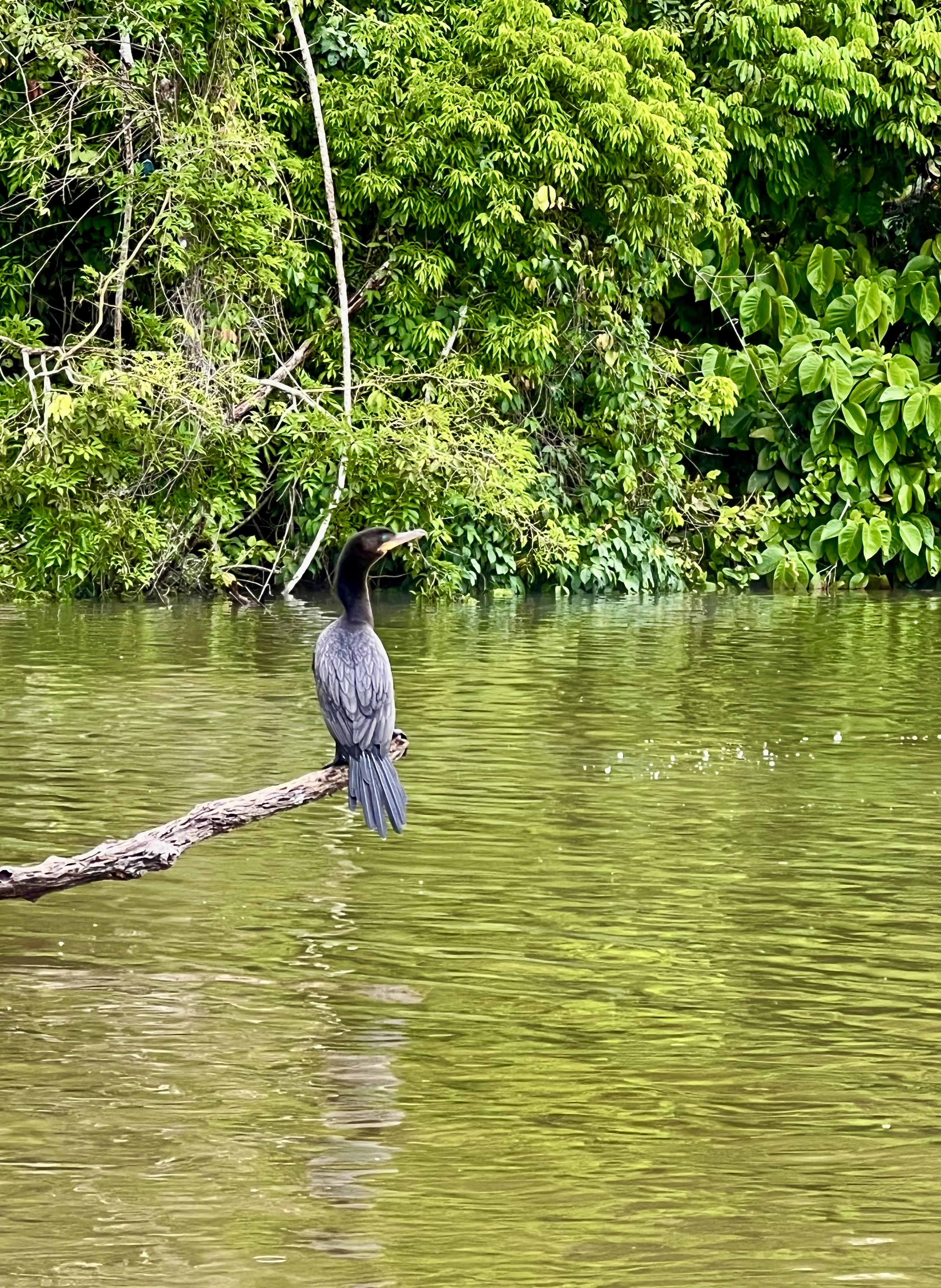
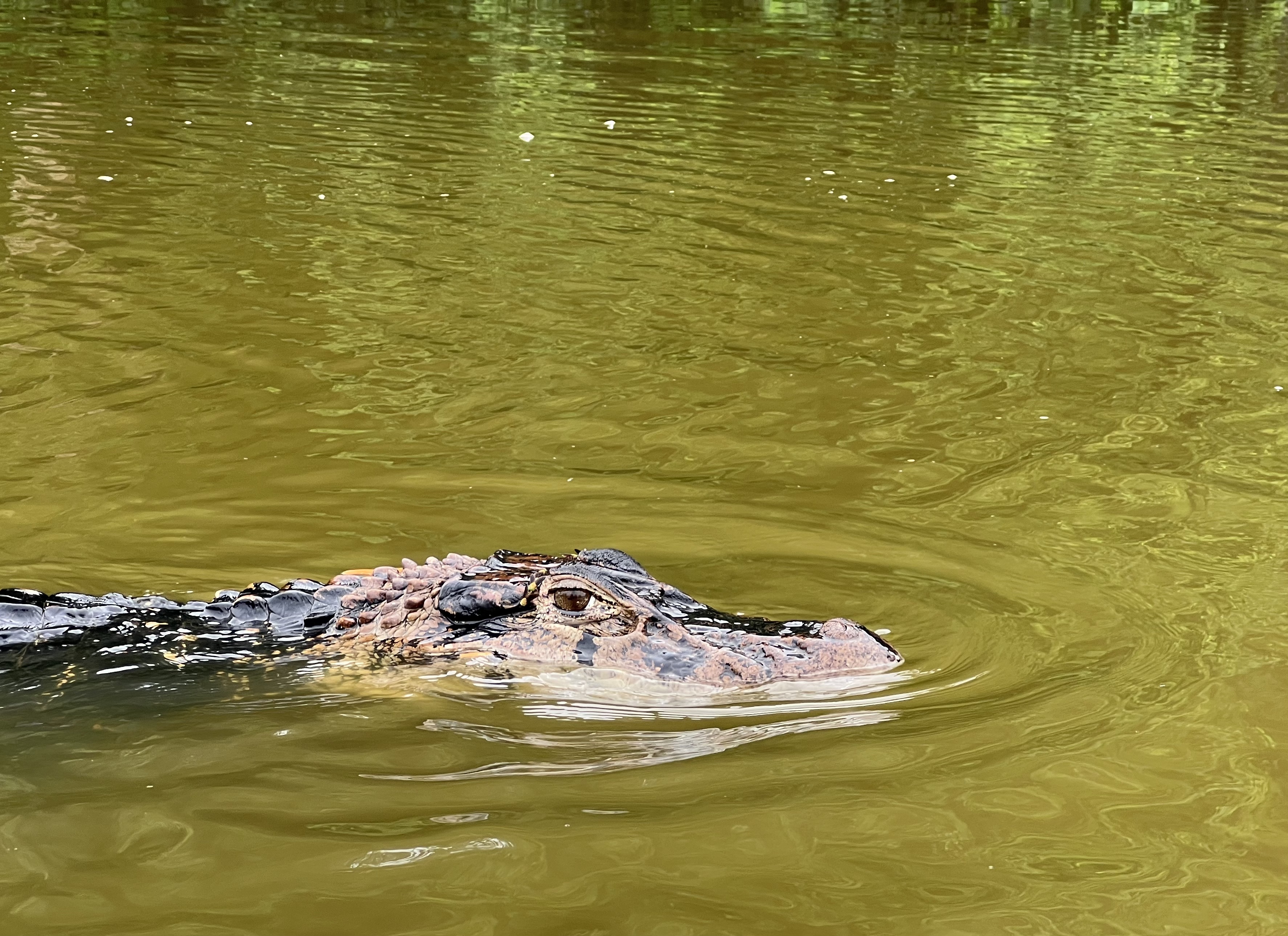
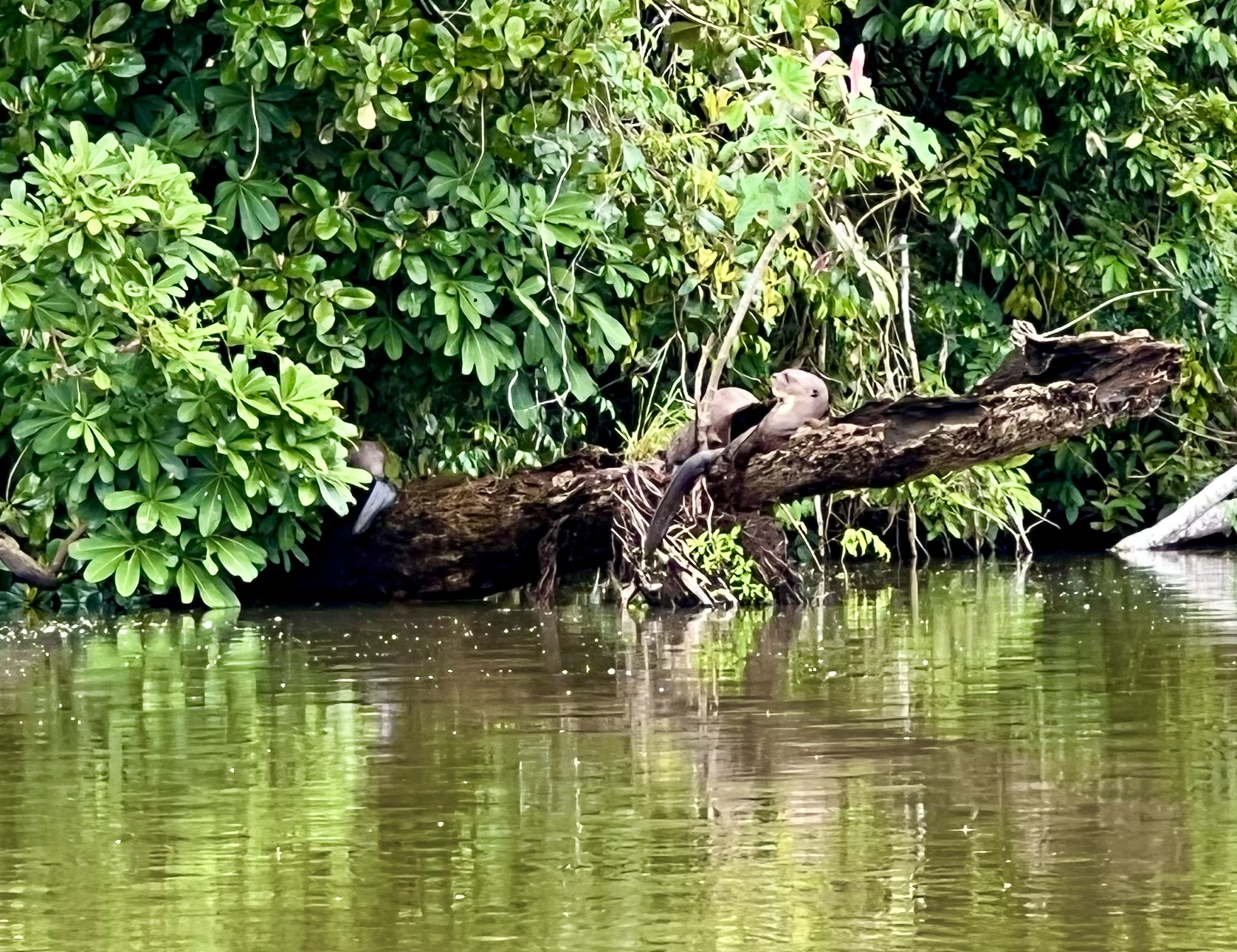
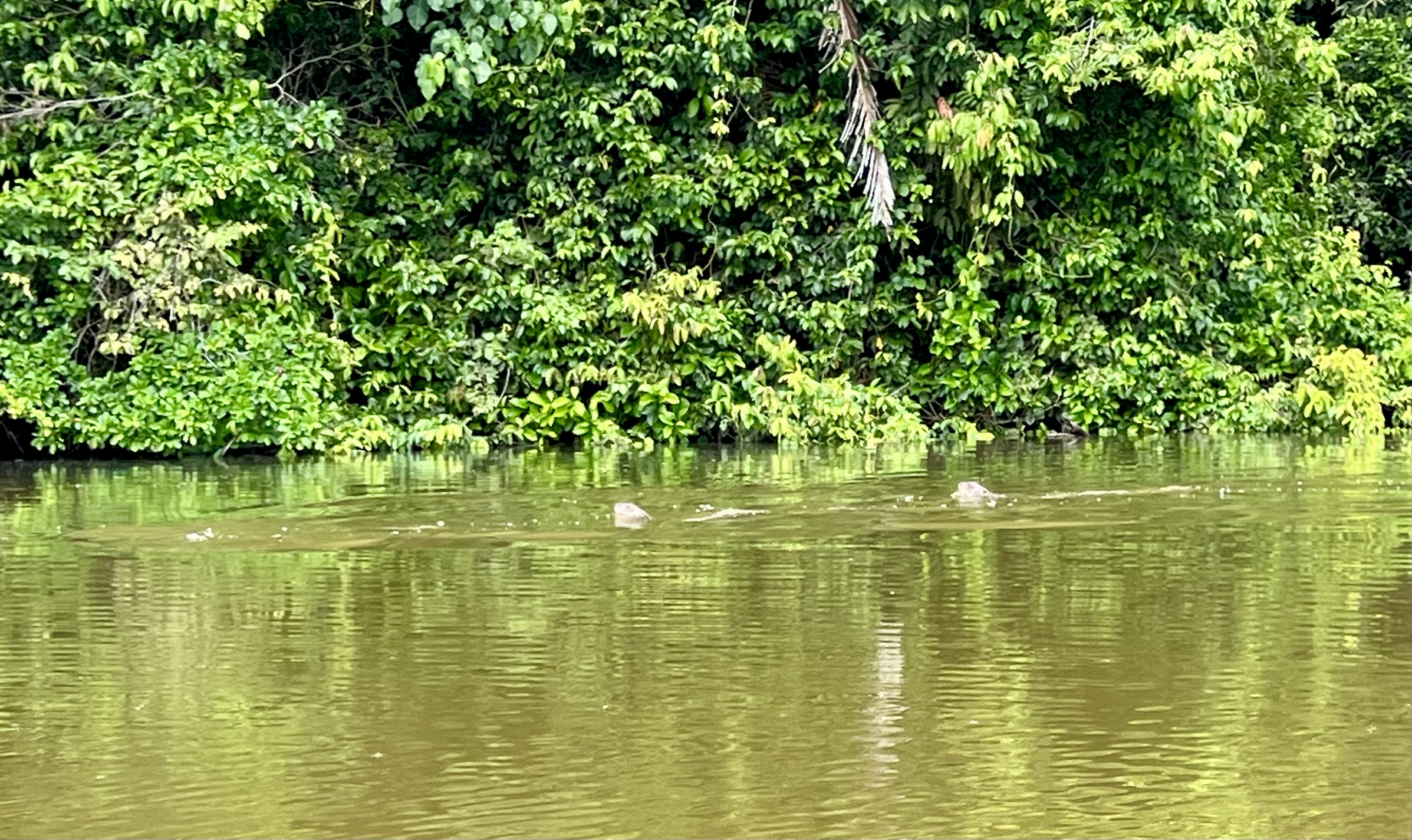
During the walk, we saw a few more brown capuchin monkeys and could see movement from the squirrel monkeys, but they weren’t visible due to the dense brush. Floating/paddling along the sides of the lake, we were very lucky to see a number of birds, many I knew, such as the blue and yellow macaw, the great white heron, the kingfisher, and the anhinga, but many I had not come across before and do not know the names of. We saw the head of a white caiman and were entertained by a black caiman that came right up to the boat. The best part, for me at least, was when we came across a family of giant river otters playing on a log. After they had amused themselves, they dove into the water and swam in our direction, but with a good 30 feet between us, before they disappeared underwater.
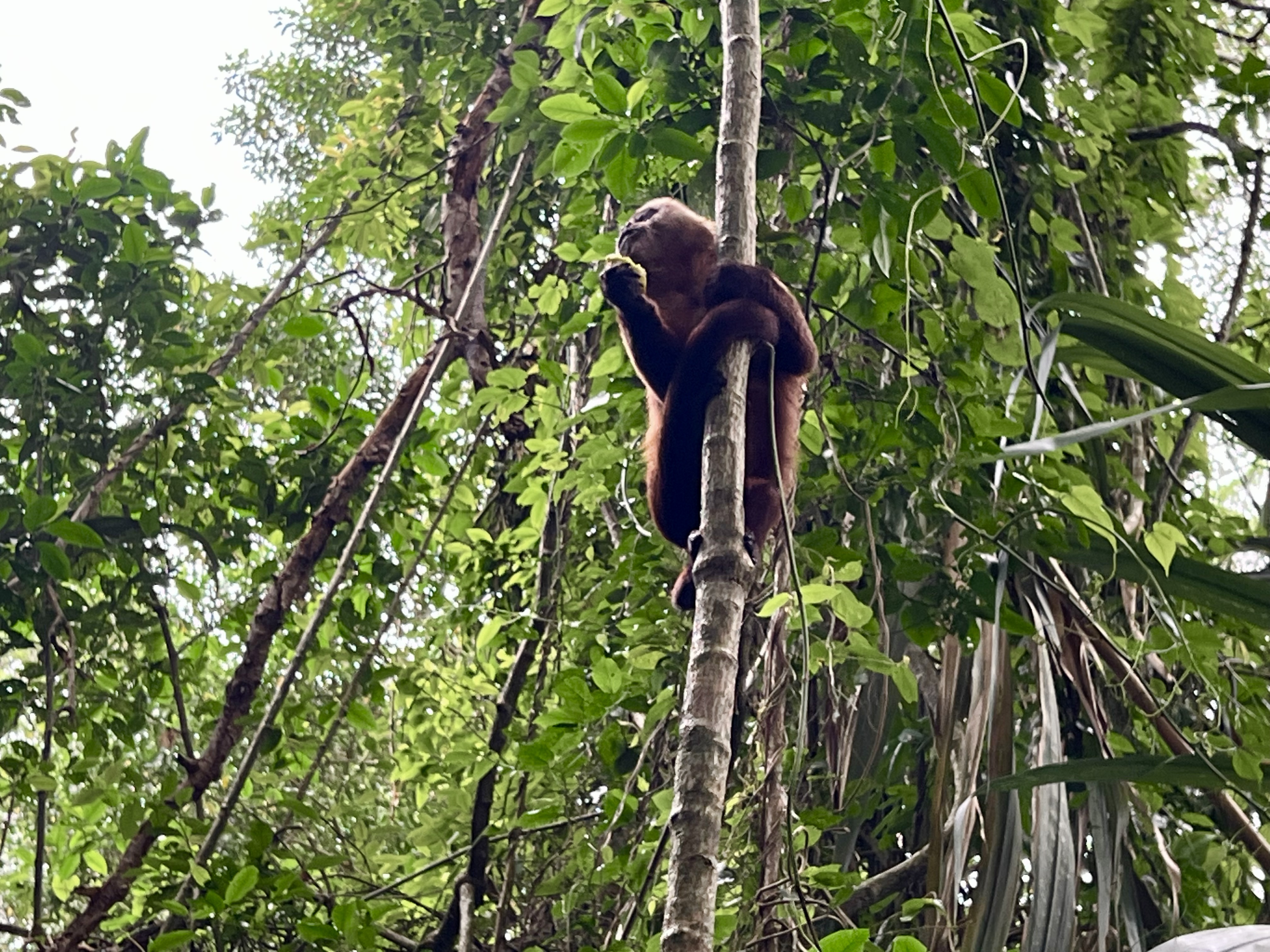
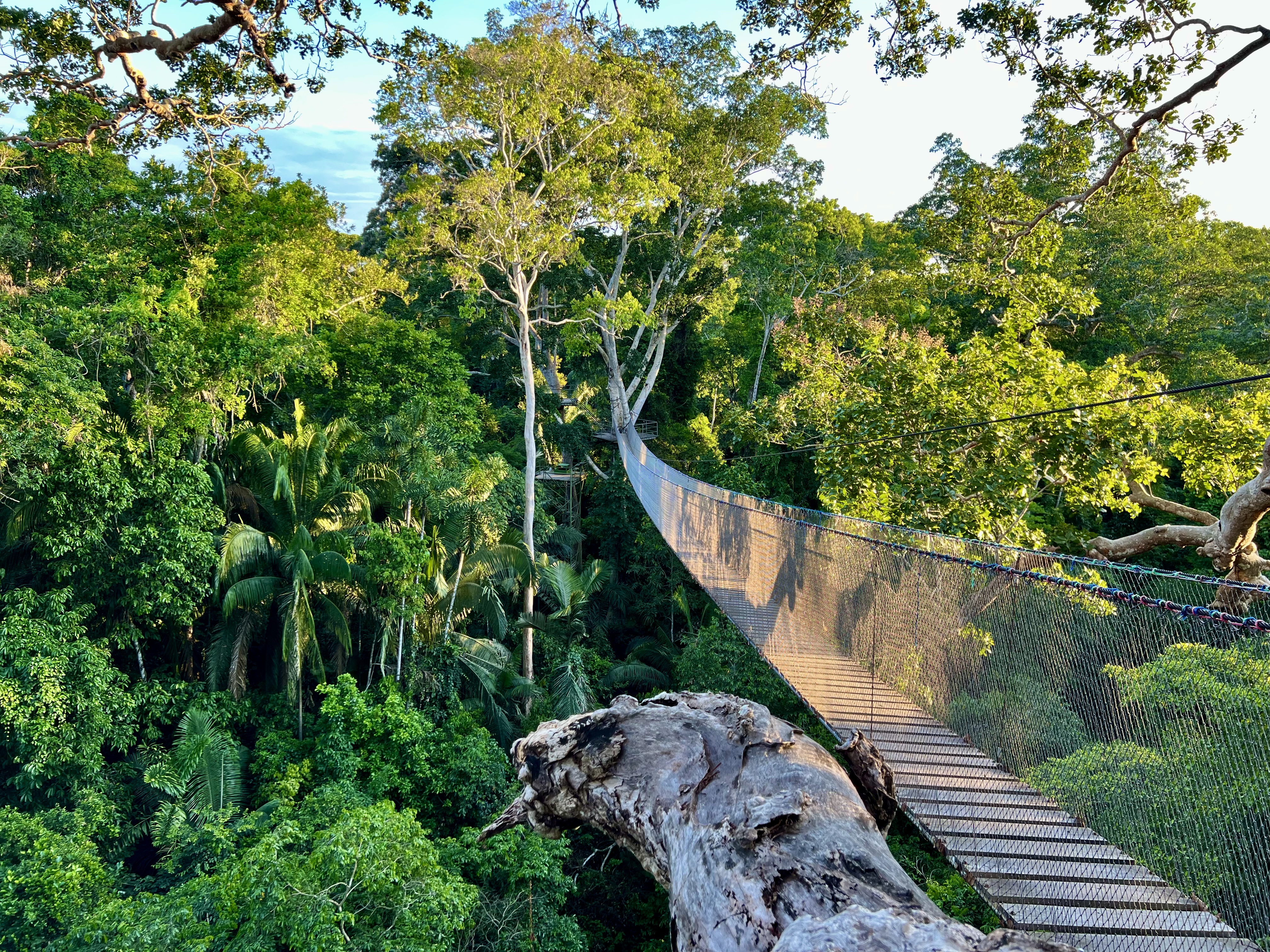
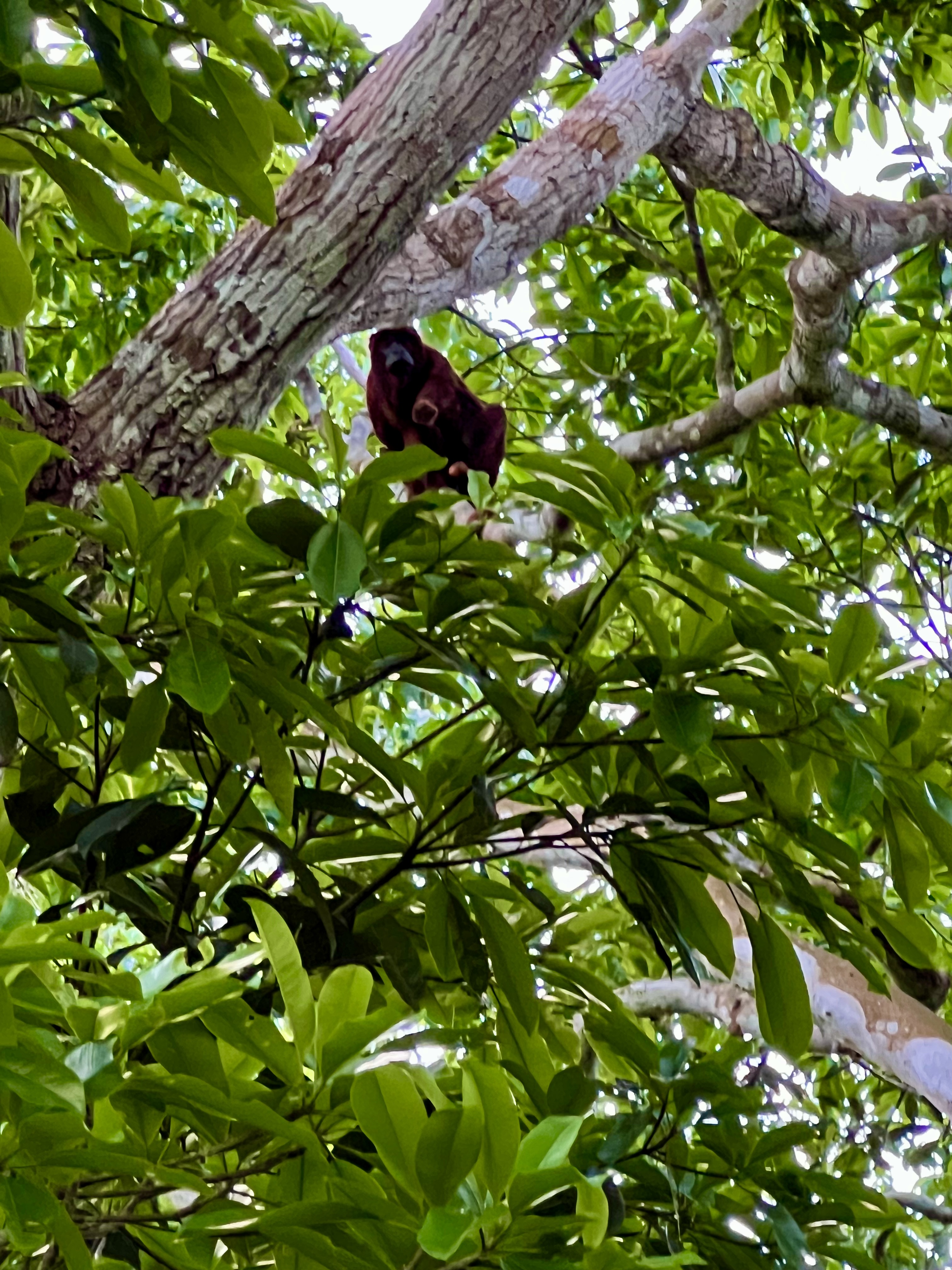
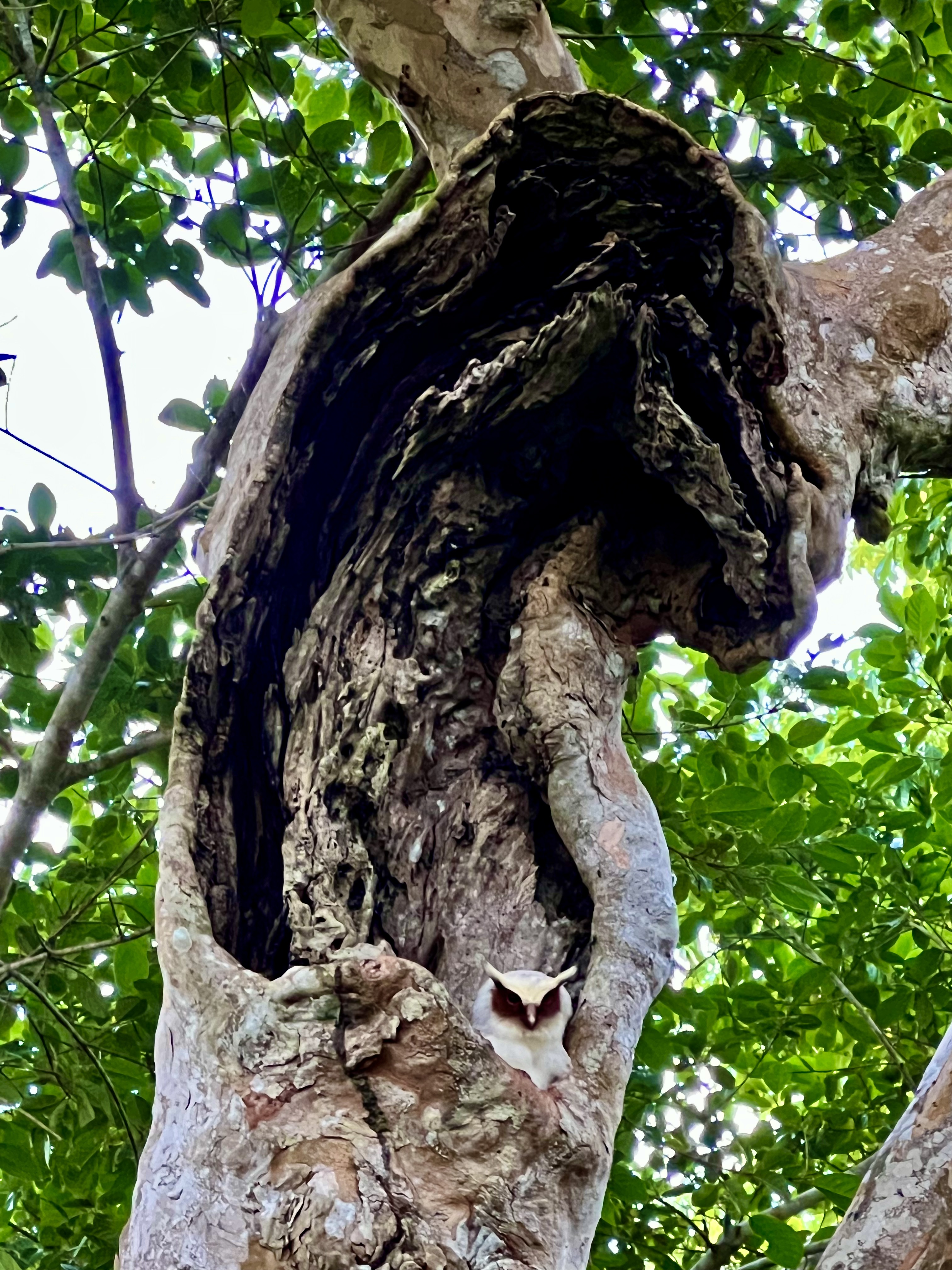
After a few hours on the lake, we returned via the path we took when we arrived to meet our riverboat that took us back to the lodge in time for lunch. In the late afternoon, we gathered again, this time for a canopy walk on a couple of swinging bridges near the forest canopy. Again, we were incredibly lucky as a red howler monkey was playing in a tree not too far from the tower platform that stabilizes one side of one of the bridges. A small owl stuck his head out of a cavern in the tree in front of the platform and watched us the entire time we were watching him and the monkey. I had the sense that the wildlife here carefully pays attention to what the human tourists do, much the way we watch them. The final event of the day was a night-time walk on a path behind the lodge to see tarantulas and other creepy crawly jungle critters. We did see a number of the furry anchariids, as well as the very nasty black and large bullet ants, but no snakes, for which I was actually quite grateful. The best part of the night walk was seeing a porcupine in a tree. I didn’t know they existed in the rainforest, as I’m familiar with the ones that meander through the Wasatch Mountains in Utah and those in Michigan and Maine, i.e., very different habitats than in the tropical rainforest.
The next morning was another early one, this time the riverboat left at 4am. The goal was to see parrots and macaws at a clay lick about an hour and a half from the lodge. It was a delightful morning boat ride watching the sun come up behind us as we motored down the Tambopata River past Puerto Maldonado to the lick. The river itself is not attractive as it is a dirty sandy brown color with clumps of debris, mud, logs and plastic floating on the surface, but the forest on the sides appears dense and healthy. When we arrived at the lick, just before I could take any pictures, a pigeon scared off the birds who were feeding. They either flew completely away or headed into the trees near the lick. As many of the ones there were green parrots, it was almost impossible to recognize them amid the green leaves. As we headed back to town, where I was getting off to go to the airport to fly back to Lima, we again got very lucky and saw not one but two three-toed sloths in the trees by the shoreline, and one was hanging upside down chomping on green leaves.
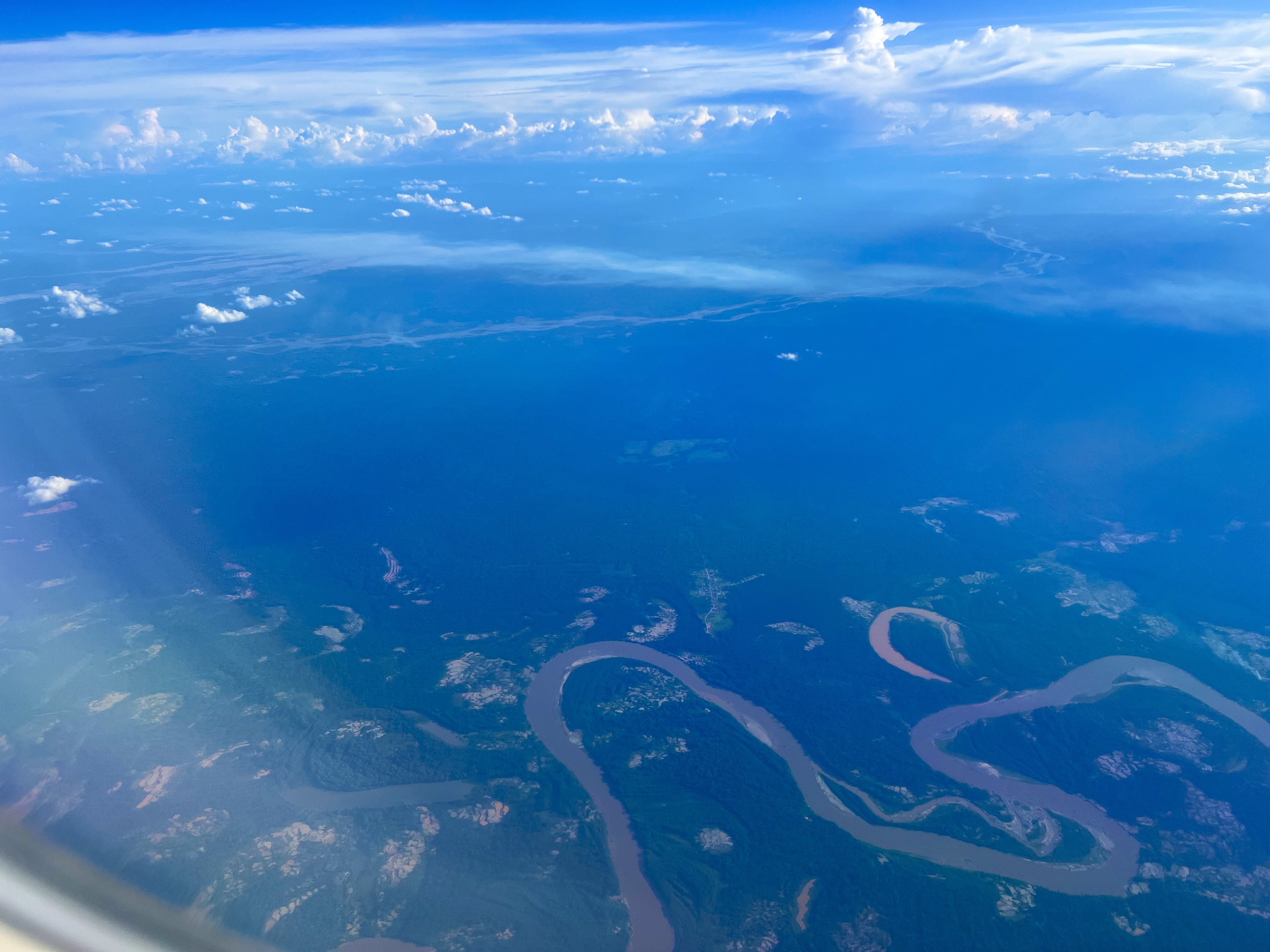
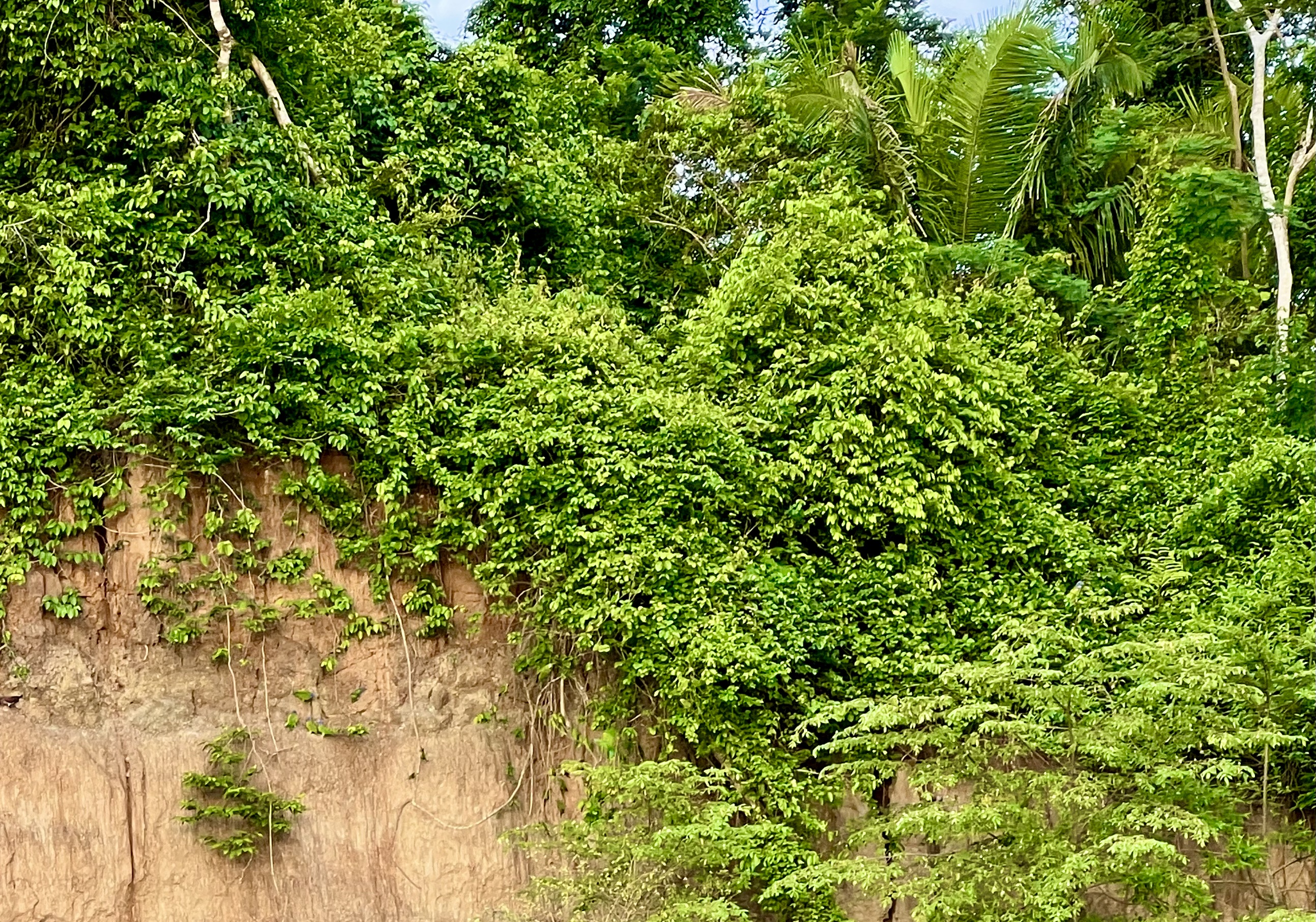
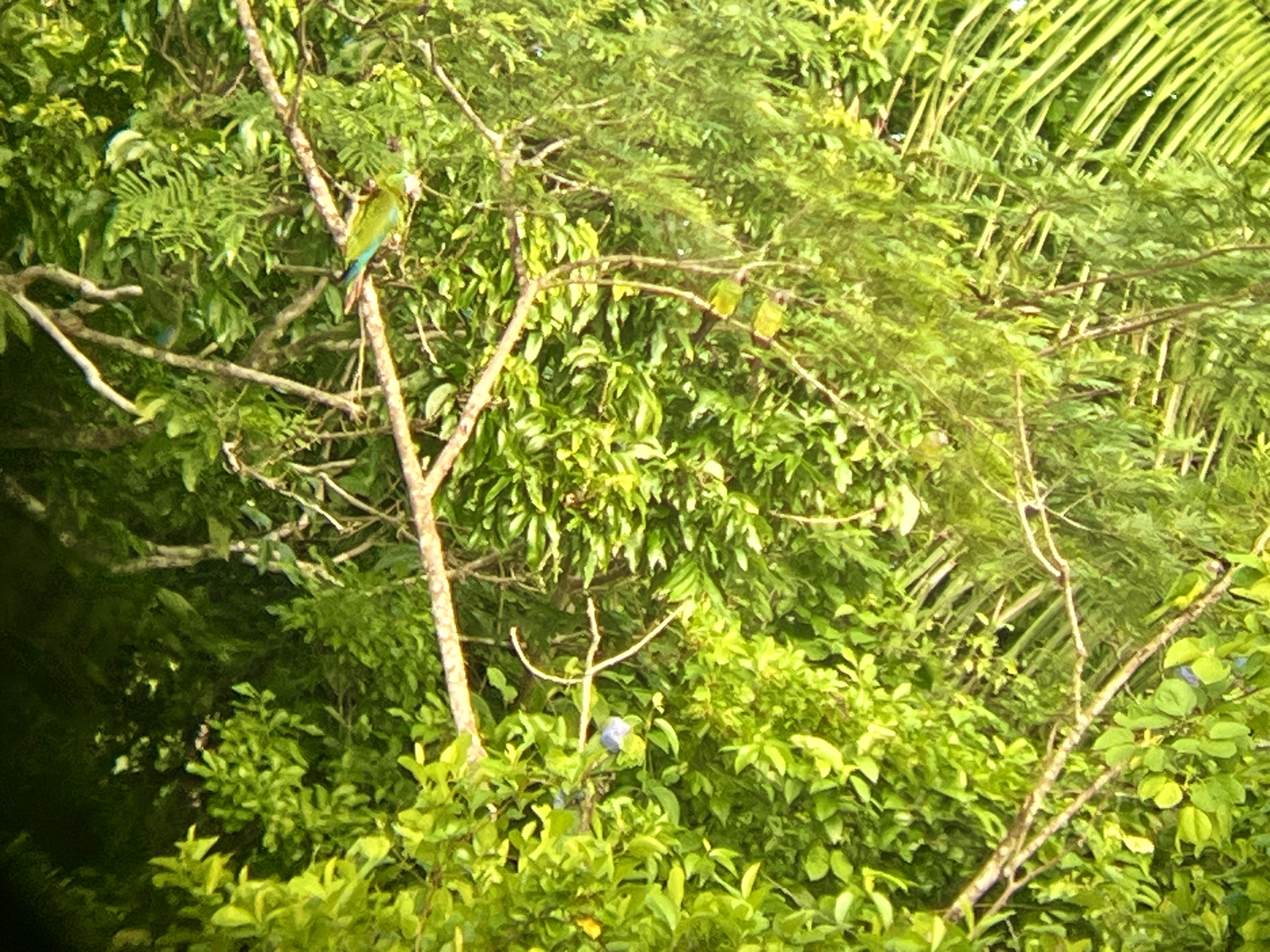
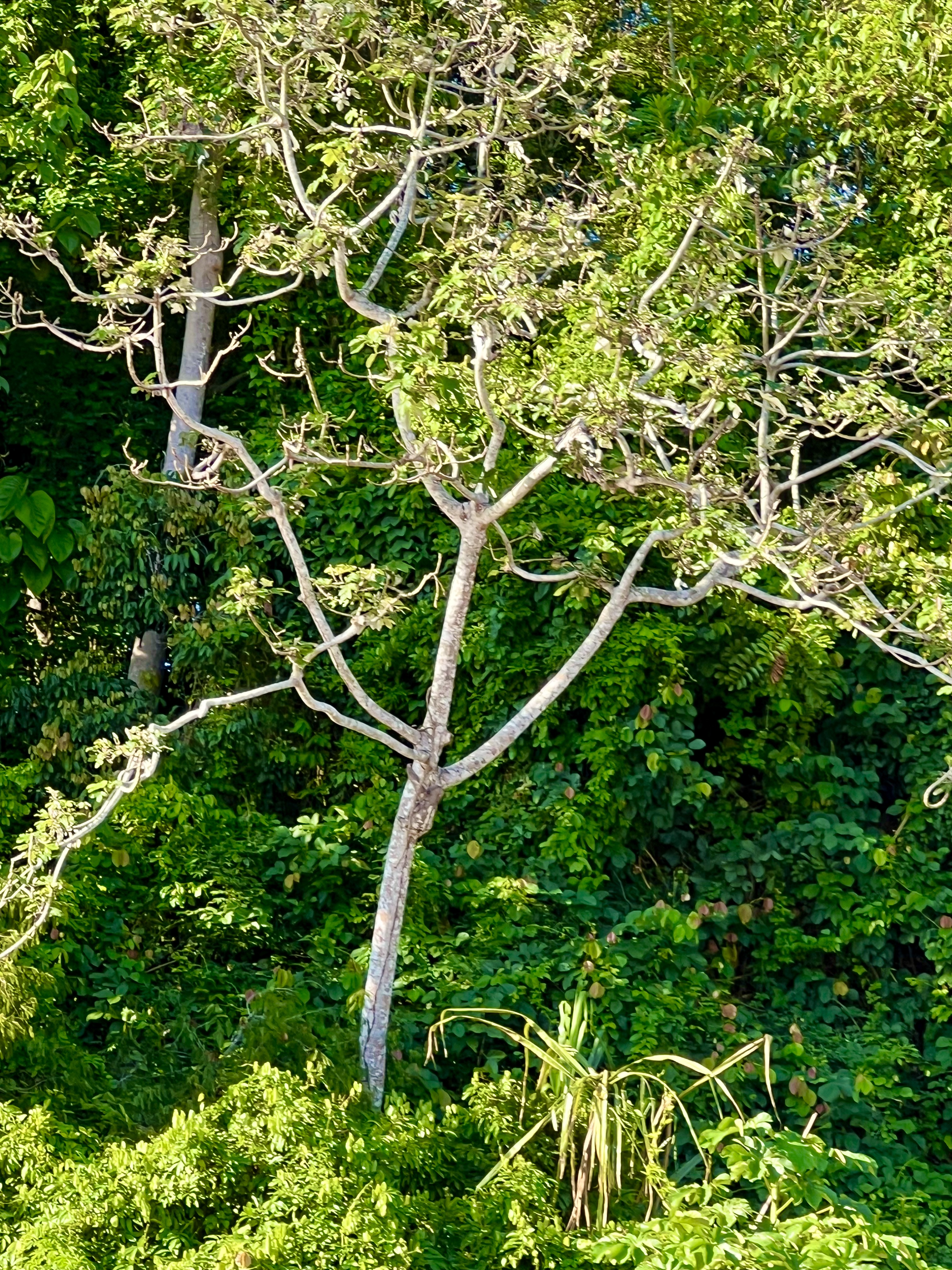
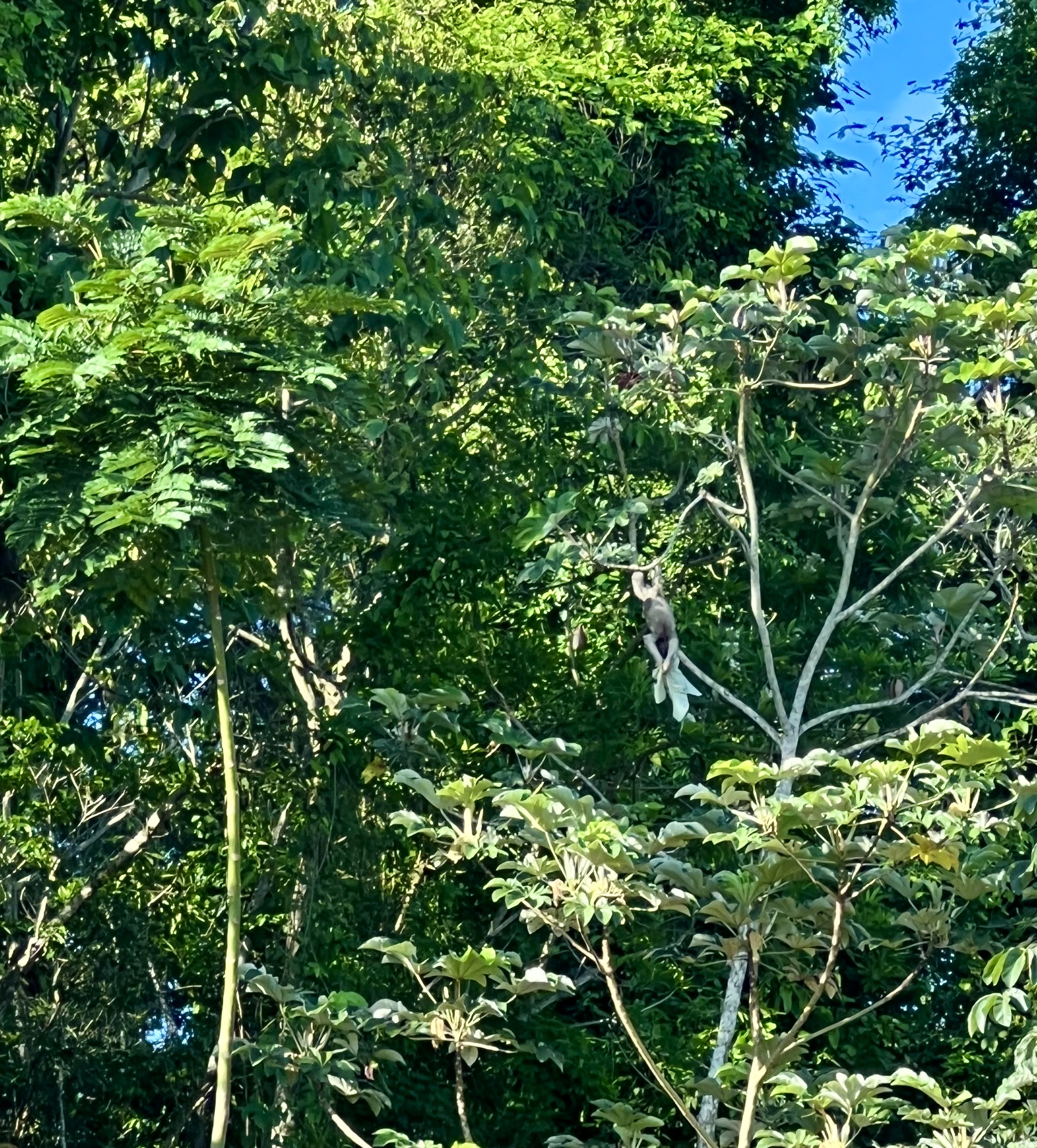
Tambopata National Reserve is home to a seemingly healthy wildlife population. If the huge butterfly population is any indication, the forest with its very diverse flora and fauna is intact. Those who work here appear to understand the importance of keeping it that way, not just for the sake of the forest, but also for their economy as the region lives as much from tourism as it does from its exports of plywood, fruits and cocoa plants.
I want to thank Fernando from Monte Amazónico Lodge for sharing his expertise with me and other interested tourists.
For those who are curious about the lodge, the accommodations include private bathrooms, but no hot water as the energy comes from the sun and this is the rainforest. In my room, I was spared the cockroaches and mini-frogs that shared my room in Brazil. The room was clean and well-kept, if basic. The wifi signal doesn’t work, or at least it didn’t for me, so it is a good place to escape cell phones and computers. There is a charging station in the dining room, though. The food was copious – as elsewhere in Peru, rice and potatoes with meat or fish, but at least here there was a small salad accompanying the meal and/or a soup. Desserts were delicious, chocolate or pineapple pudding or caramelized papayas. The staff was helpful, courteous and knowledgeable about the area. They make an effort to keep everyone safe and happy.
 omegoodyssey