Bardia
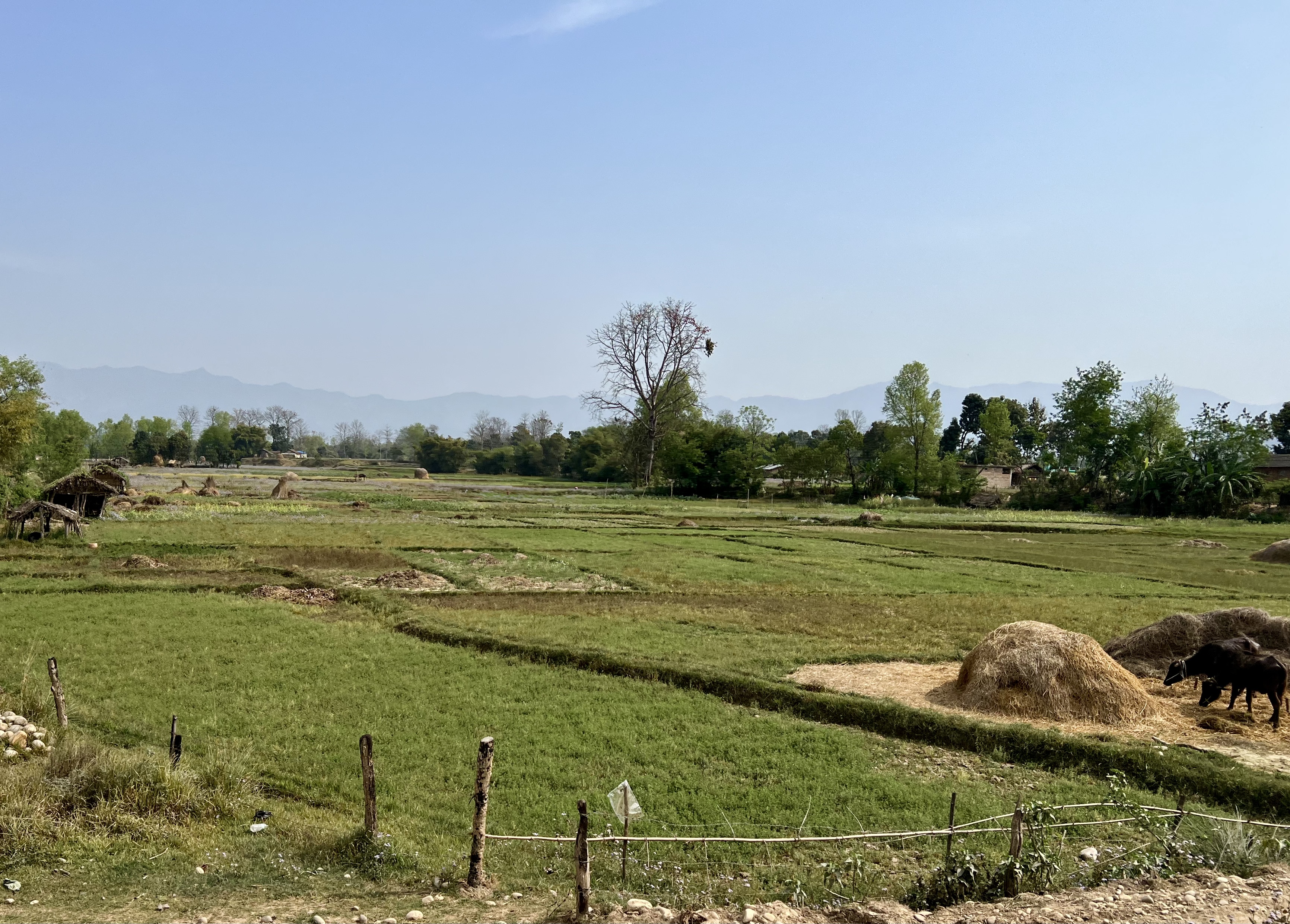
The Terai is completely different from the rest of Nepal. Nepal is a country where, within 130 miles of each other, the jungle meets the highest peaks on the planet. The close geographical distance, however, does not mean that it is easy to get from one eco-system to another. The roads are generally bad and the travel distances quite long. When possible, it is better to fly from Kathmandu to a nearby local airport and then drive to the place one wants to get to. The distance from Kathmandu to Bardia National Park was what had kept me from coming here in the past, but I wanted to walk in tiger country, and the only park where one is allowed to do that is Bardia.
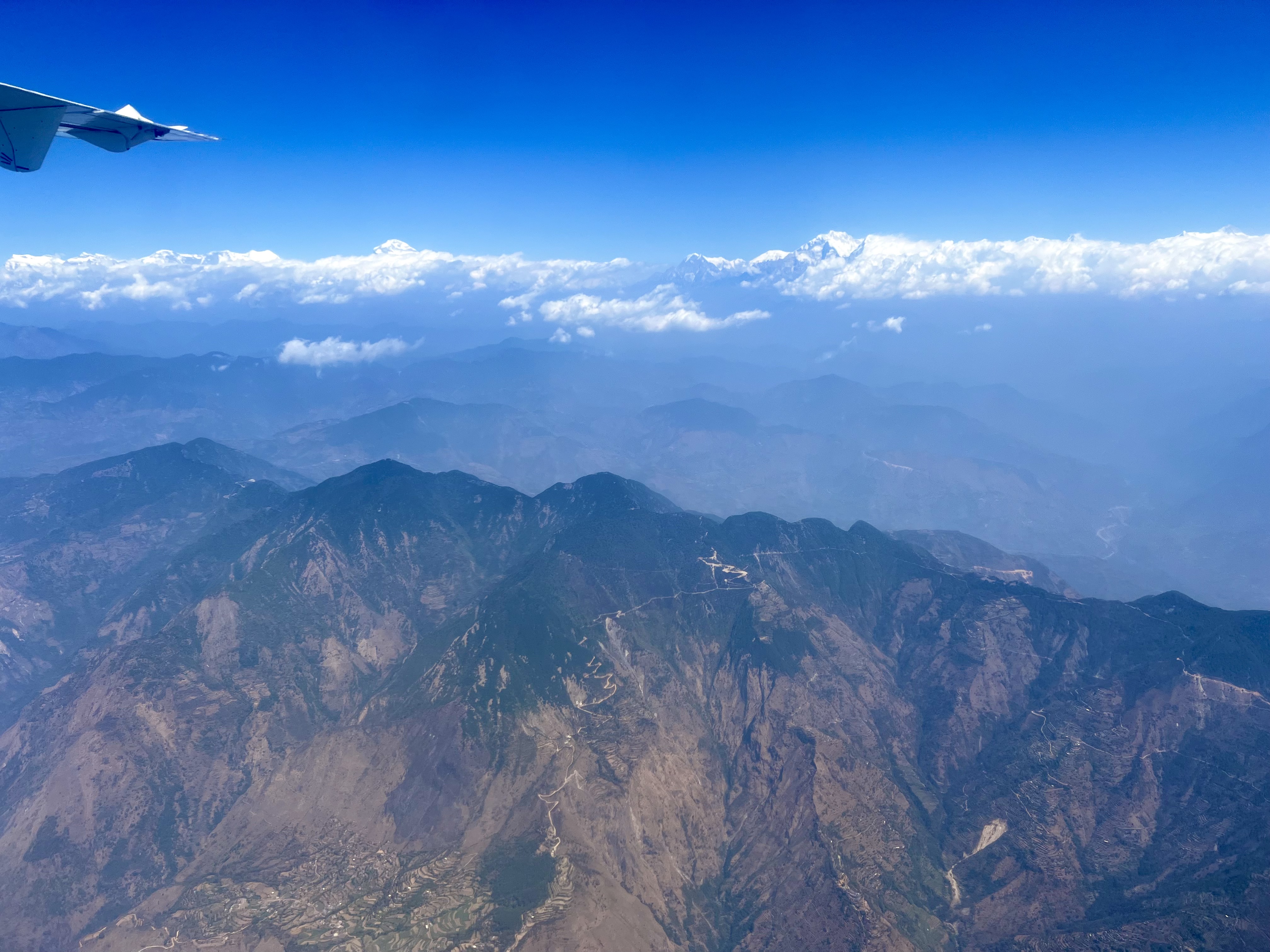
I was in Chitwan National Park in 2000 when it was still relatively quiet, and it was an amazing experience. We didn’t see a tiger but were able to get fairly close to some of the rhinos. Now it is overrun with tourists and jeep tours as it is the closest park to Kathmandu – only a 5-6 hour drive – and I didn’t want to be one of a mass of tourists. Bardia is about 20 hours away by bus, but the flight only takes 50 minutes in the air when it actually takes off. When I got to the airport, I found out that my Shree Air flight was cancelled – without any warning. The staff at the airport counter were very helpful and immediately booked me on an earlier flight with Yeti airlines. In fact, we started a half hour later than the original flight was scheduled for, but we did take off and land. I was lucky to have a window seat and the Langtang and Annapurna range white glacial peaks glistened through the clouds, while the brownish hills below were covered with haze. The driver from the Wild Planet Eco Retreat met me at the airport to start the 2+ hour drive to the park. Amazingly, here on this western end of the country the roads are much better than they are elsewhere, and the trip proceeded without problems from Nepalgunj.
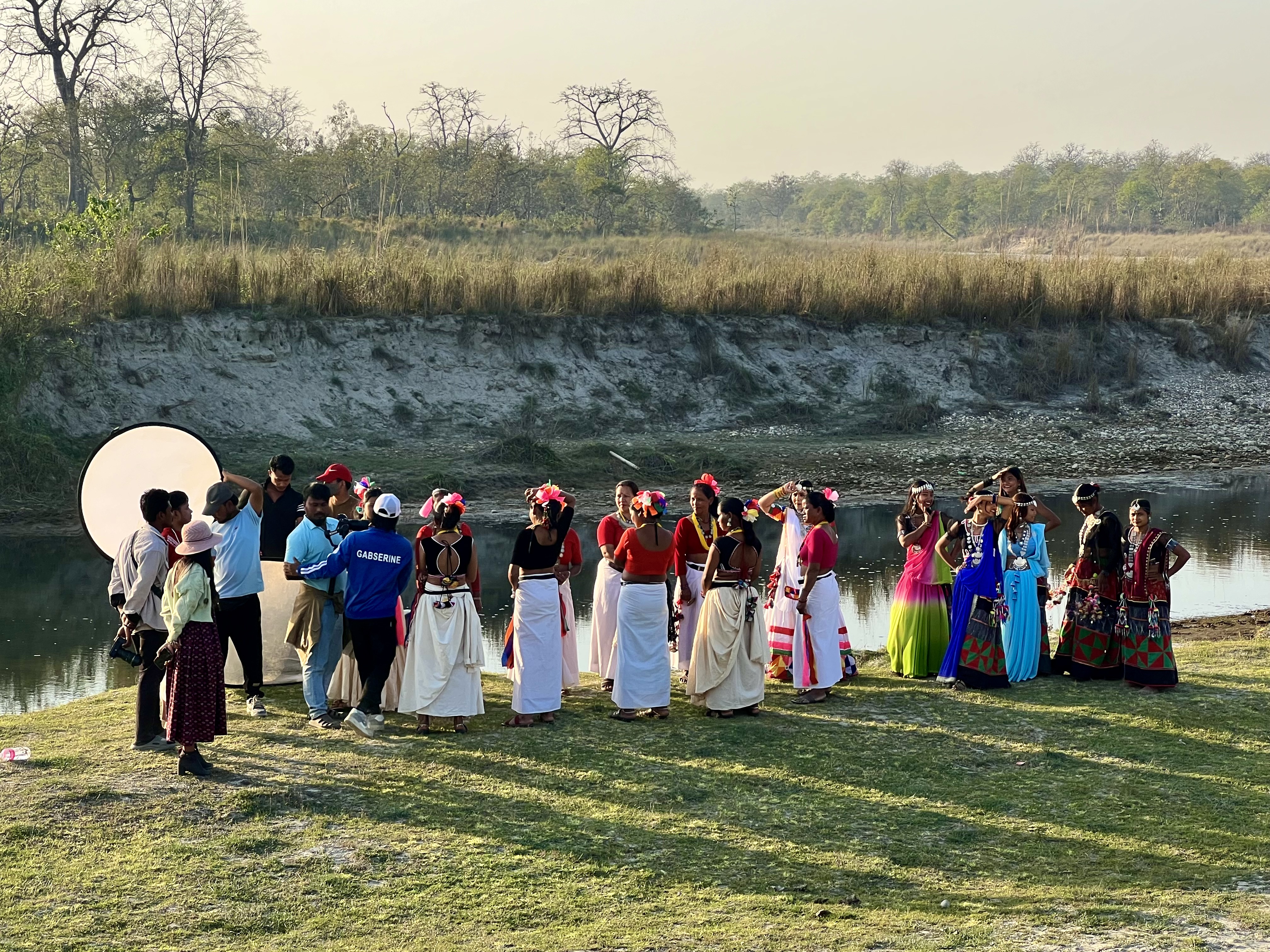
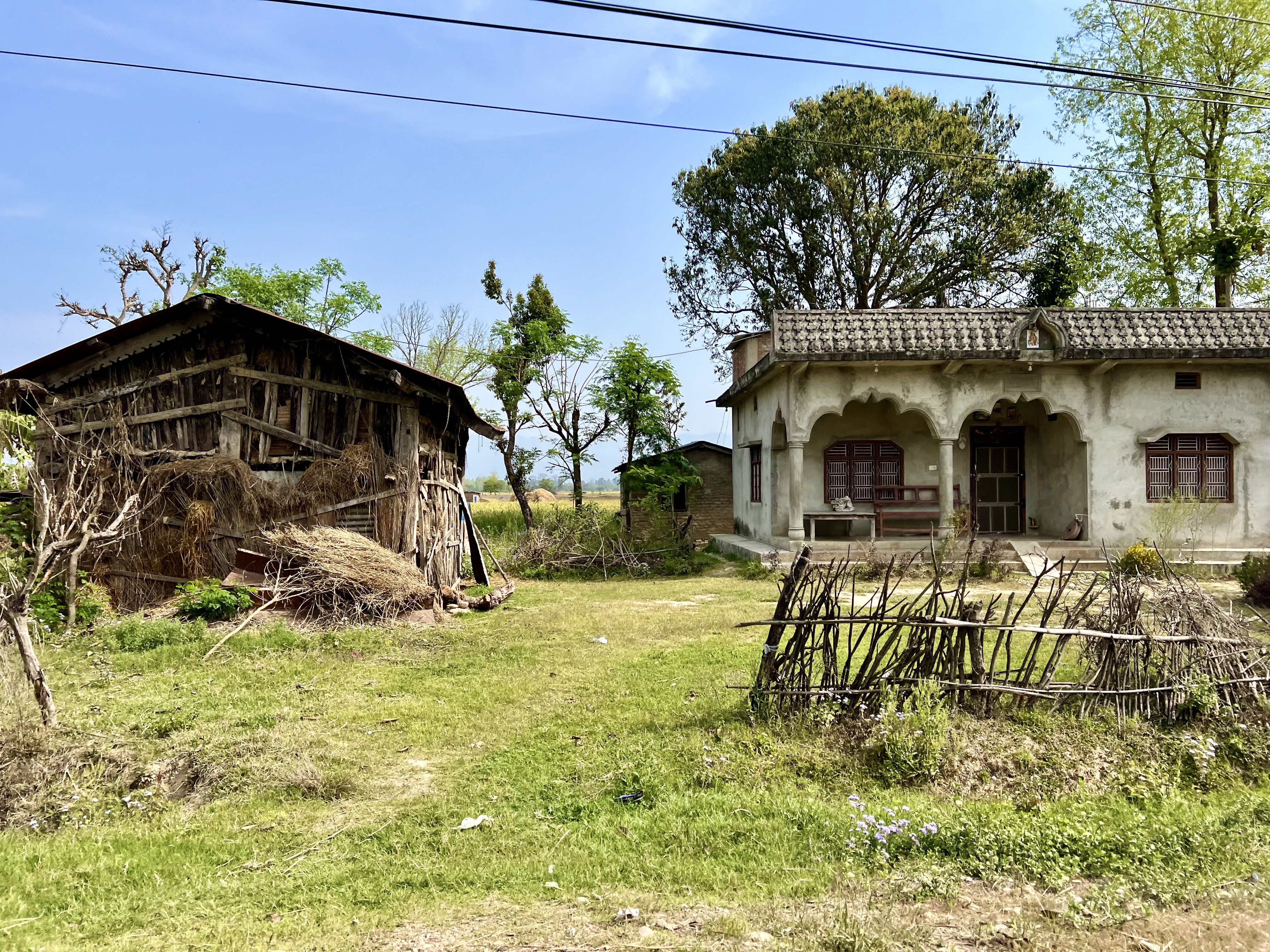
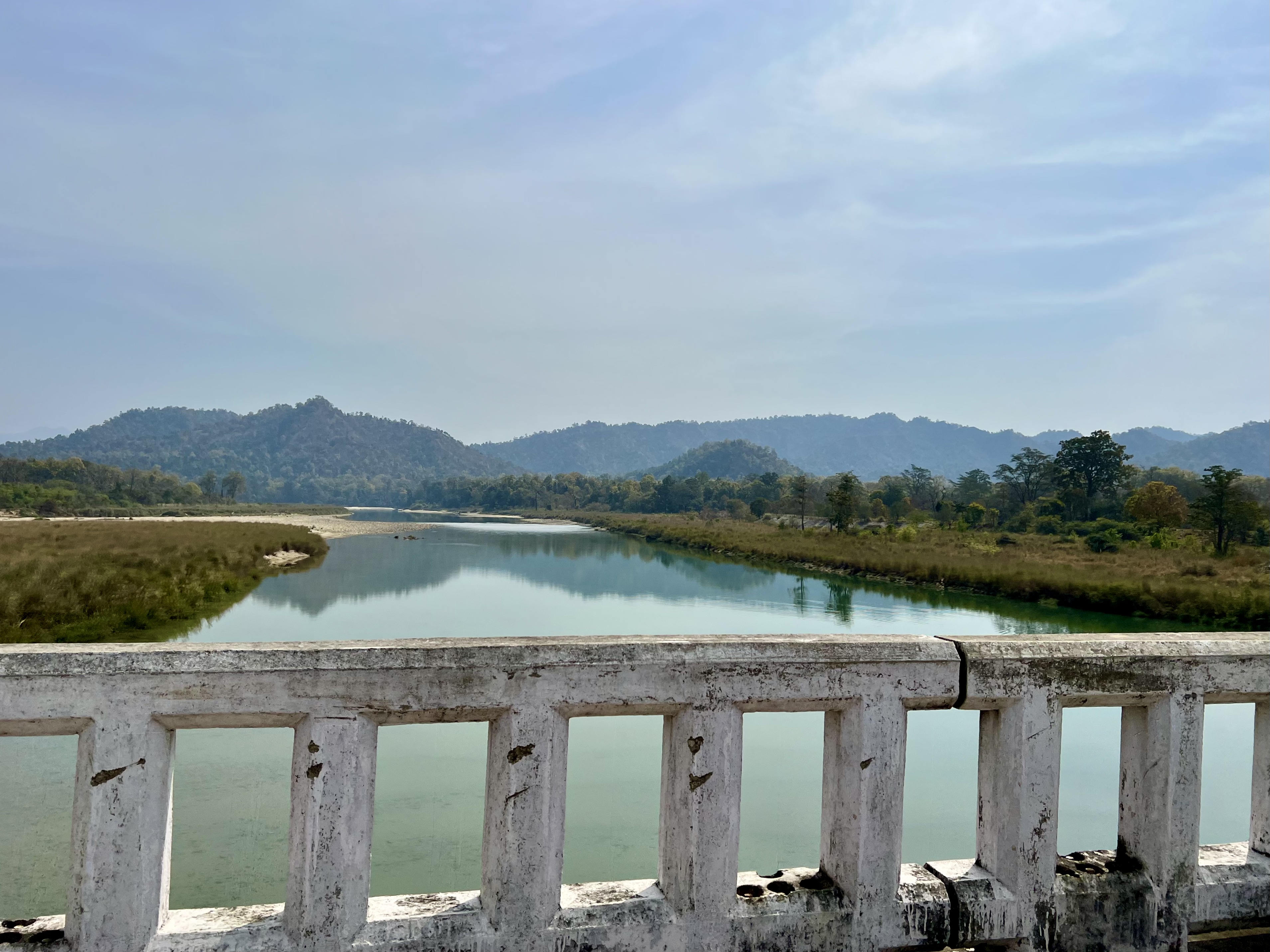
Upon arriving in the late afternoon, I was taken on a walk along the river near the village of Thakurdwara. Along the way, we came across a film crew on the shoreline preparing a video of a local dance a’ la Bollywood style. The director, a man, was showing the ‘bride’ how to dance with her hips and hands, while the ‘bridegroom’ stood there and tried to keep a straight face. The girls in the chorus practiced their moves along with the ‘bride’. The music was to a local song. It was nice introduction to a bit of local lore.
Along the way we saw a wire fence that had been installed to keep the park animals away from the village, but it was obvious where the elephants had simply ignored the wire and crashed right through it.
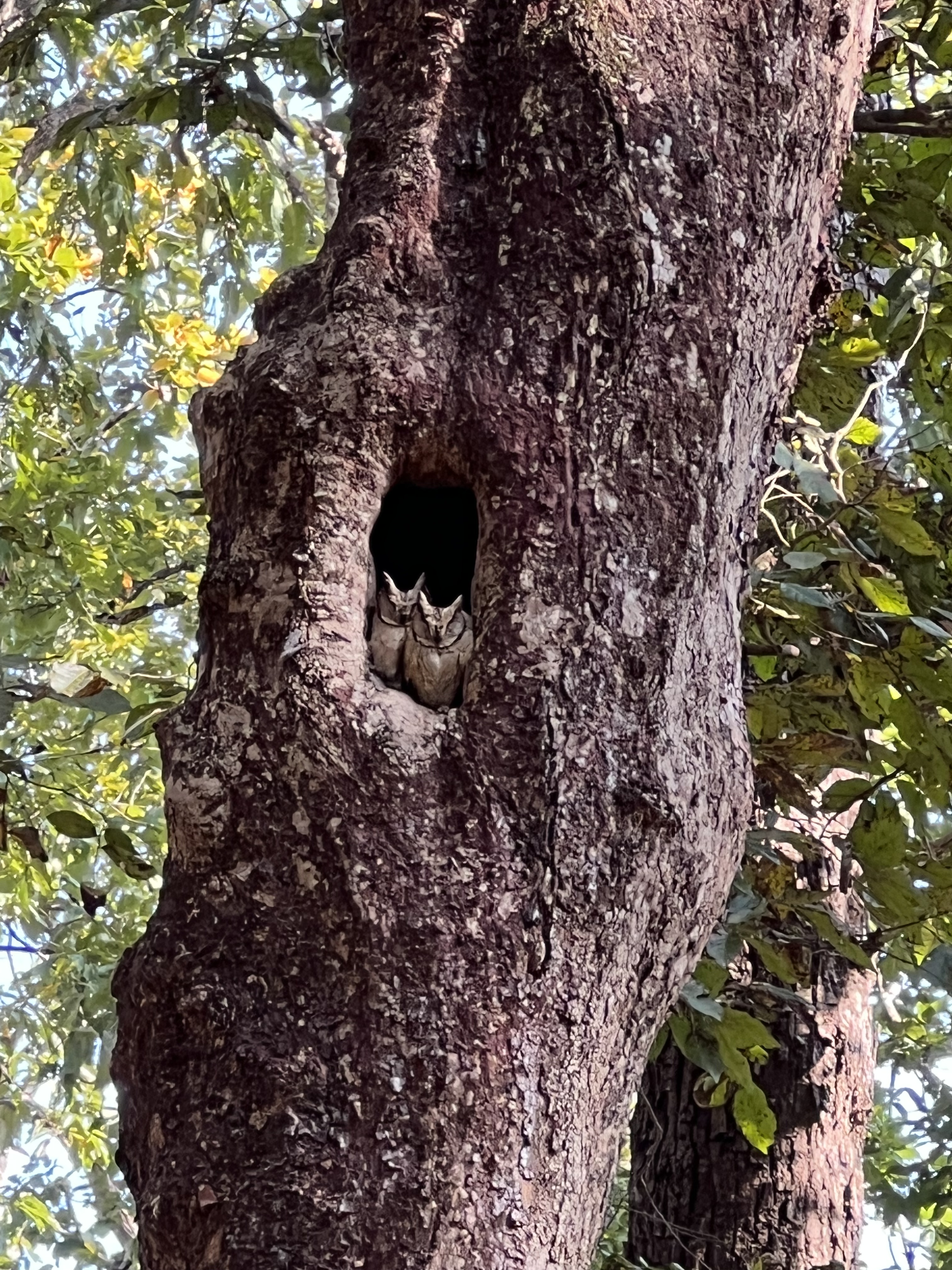
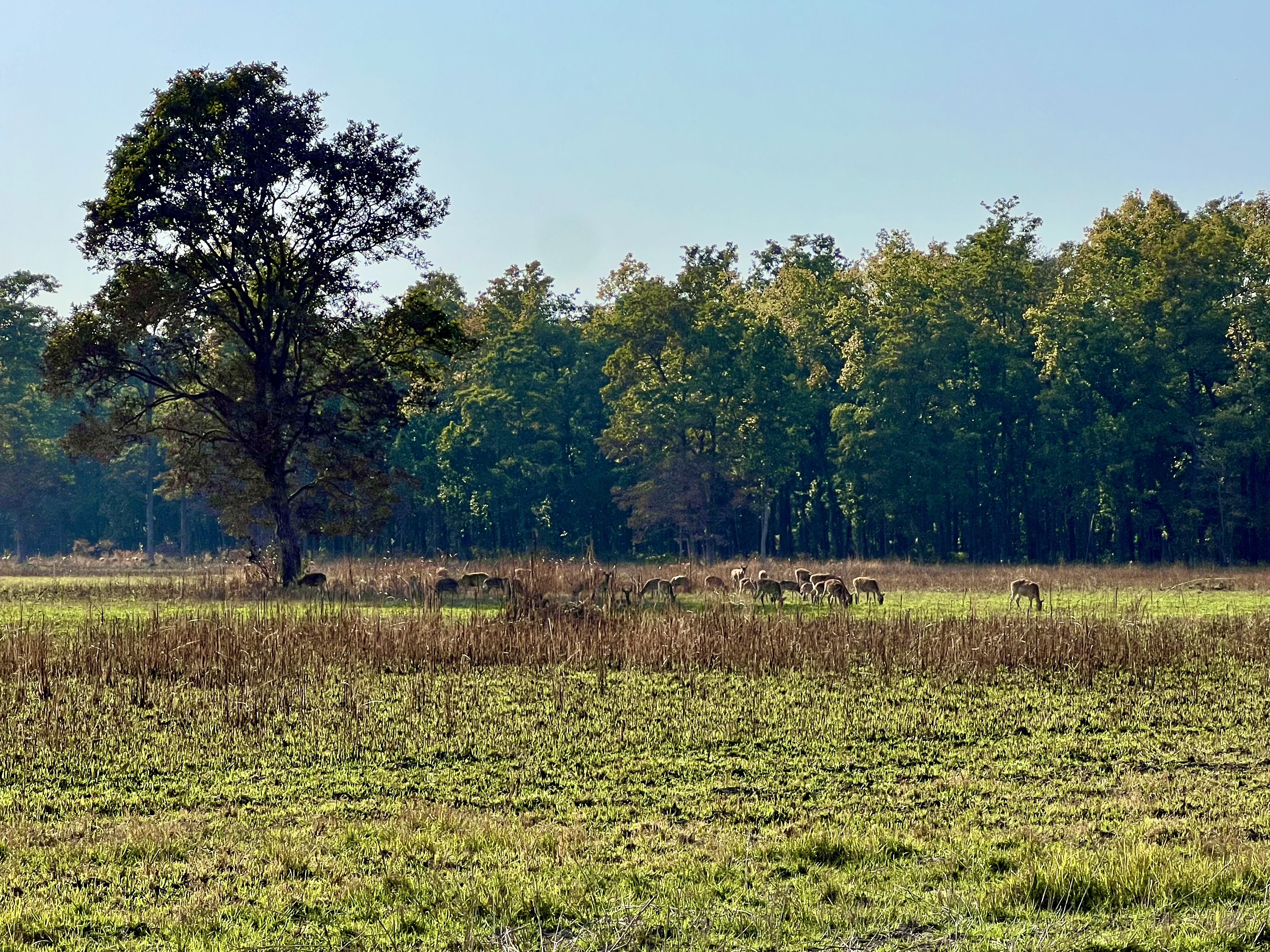
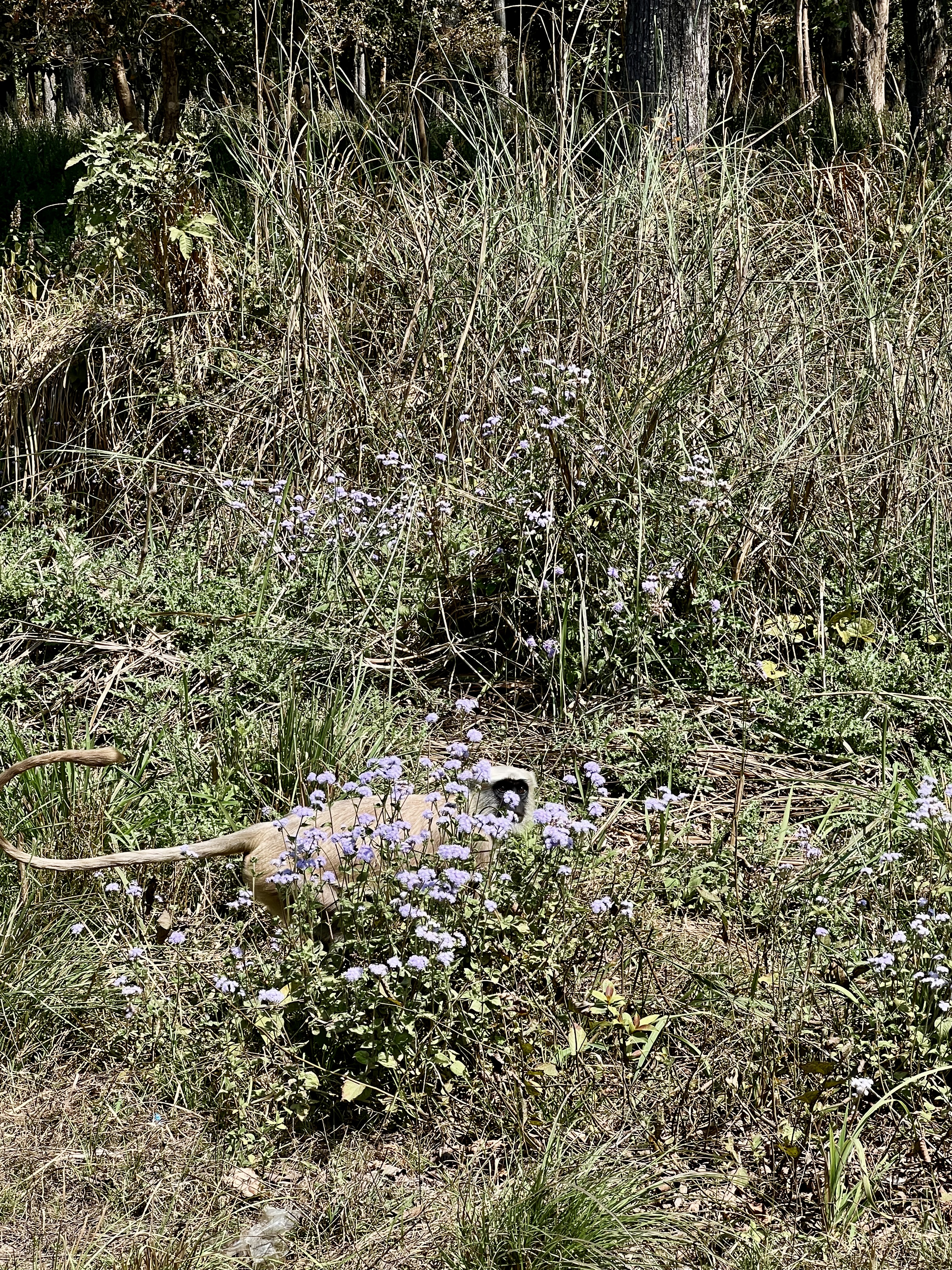
The first day at Wild Planet I went on a jeep safari that started at 7am and lasted until 6:30pm. I went on two jeep safaris and one walking tour while I was there. There were only a couple of people, Bettina from Switzerland and Brent from Canada, staying at the retreat as it was before the major tourist season. Bettina and I teamed up on the safaris making them less expensive. On the first day we saw the most wildlife, including two tigers – one female darting across the road and one male very far away sleeping on stones in the riverbed. The first tiger was too quick to photograph and the second too far away for my iphone, but Prakesh, our guide, had a very long lens on a very expensive camera and was able to capture some hazy footage. We missed seeing one other tiger because another jeep came up too loudly and the cat vanished back into the bush. We did see one wild bull, a boar that followed us around a bit, two otters, a momma rhino with baby crossing the river, a male rhino taking a bath in the river, domestic elephants grazing on tree leaves in the wild, eagles, owls, kingfishers, langur and rhesus monkeys in the fields and in the trees, barking/ spotted and chital deer. To locate some of the larger animals, our driver, Dave, was in constant communication with the other guides and drivers. When he heard that a tiger had been sited, he raced the jeep toward the site as if he were a Formal One race car driver. It was a wildlife rich day and a thrilling jeep trip.
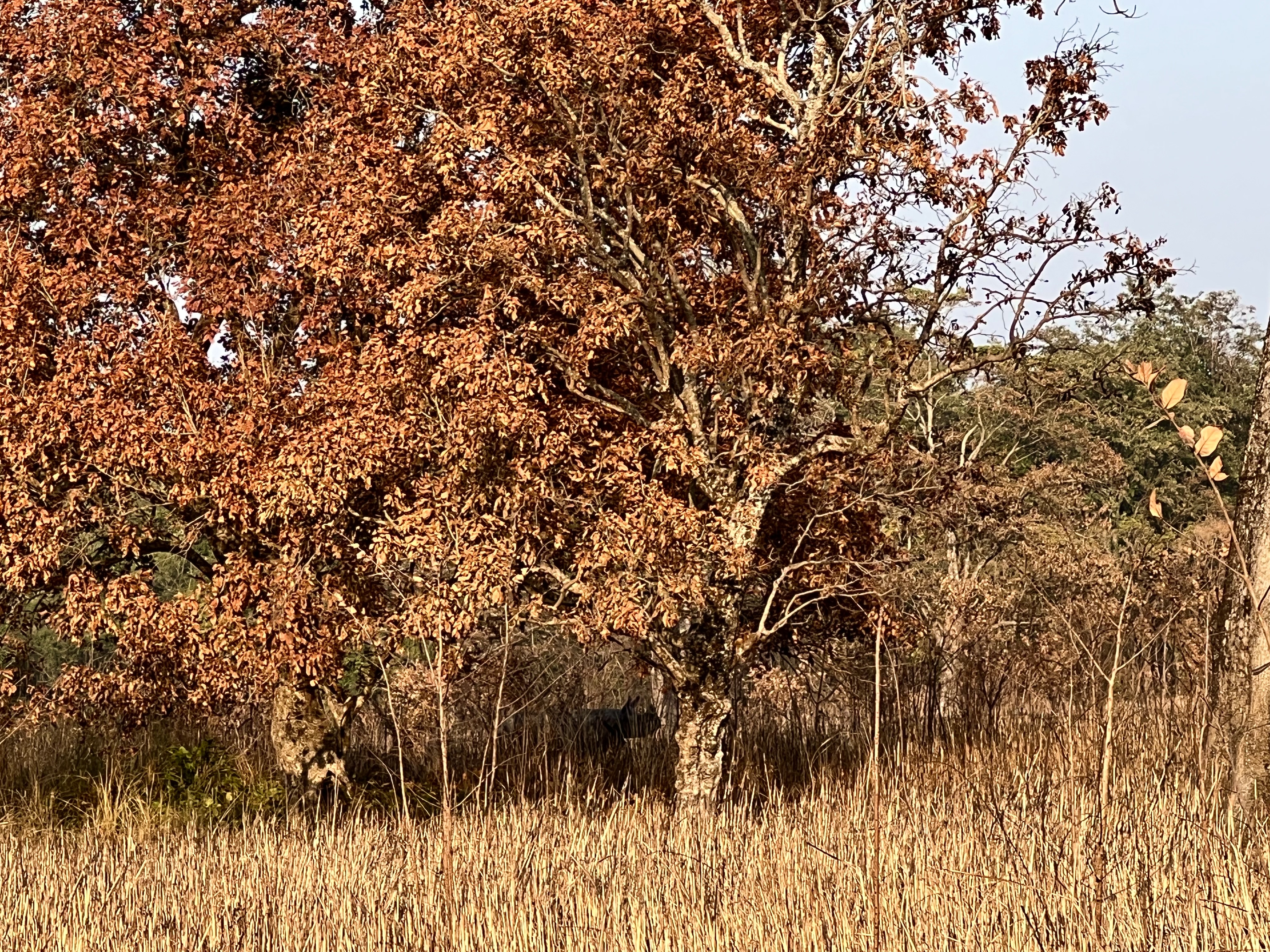
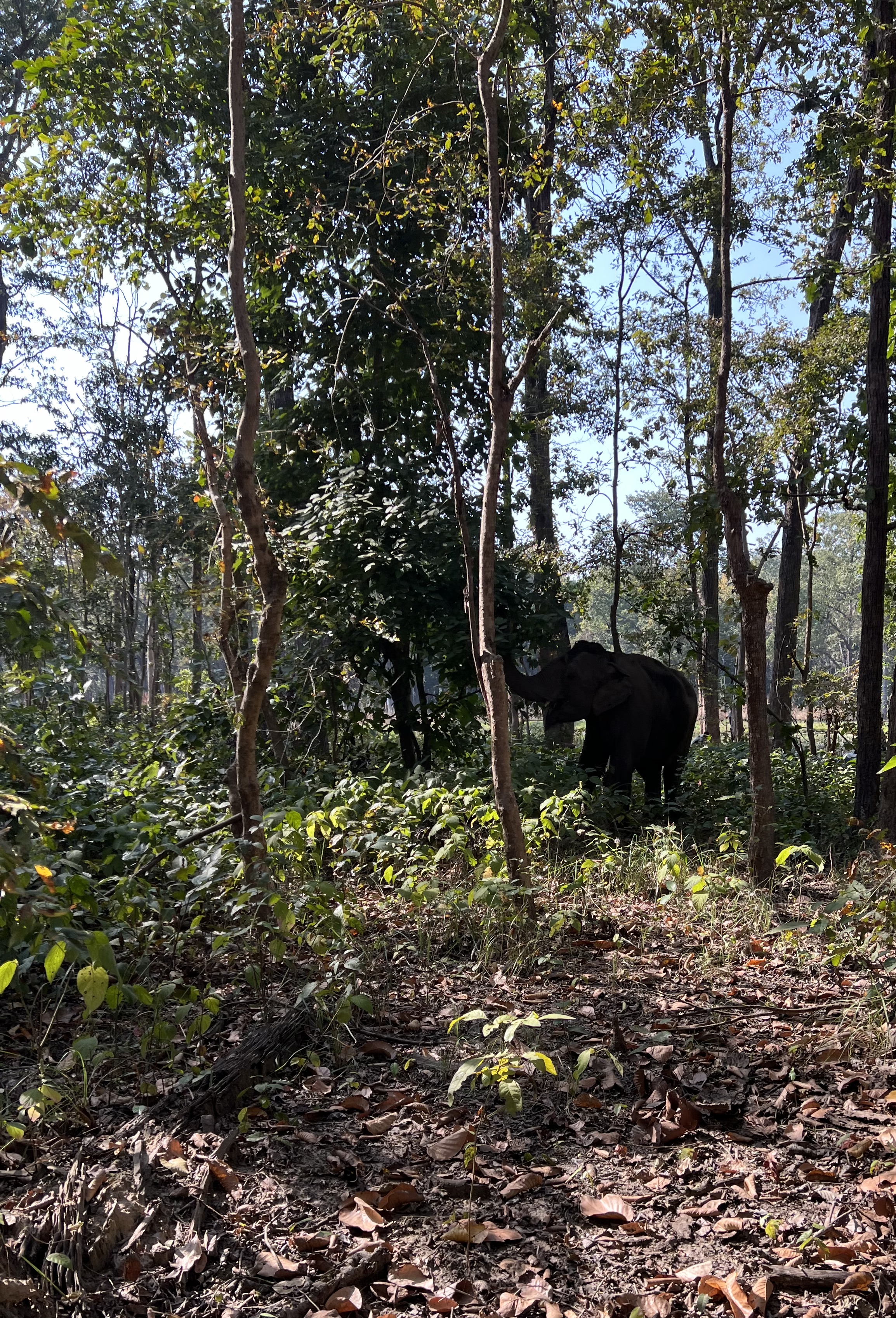
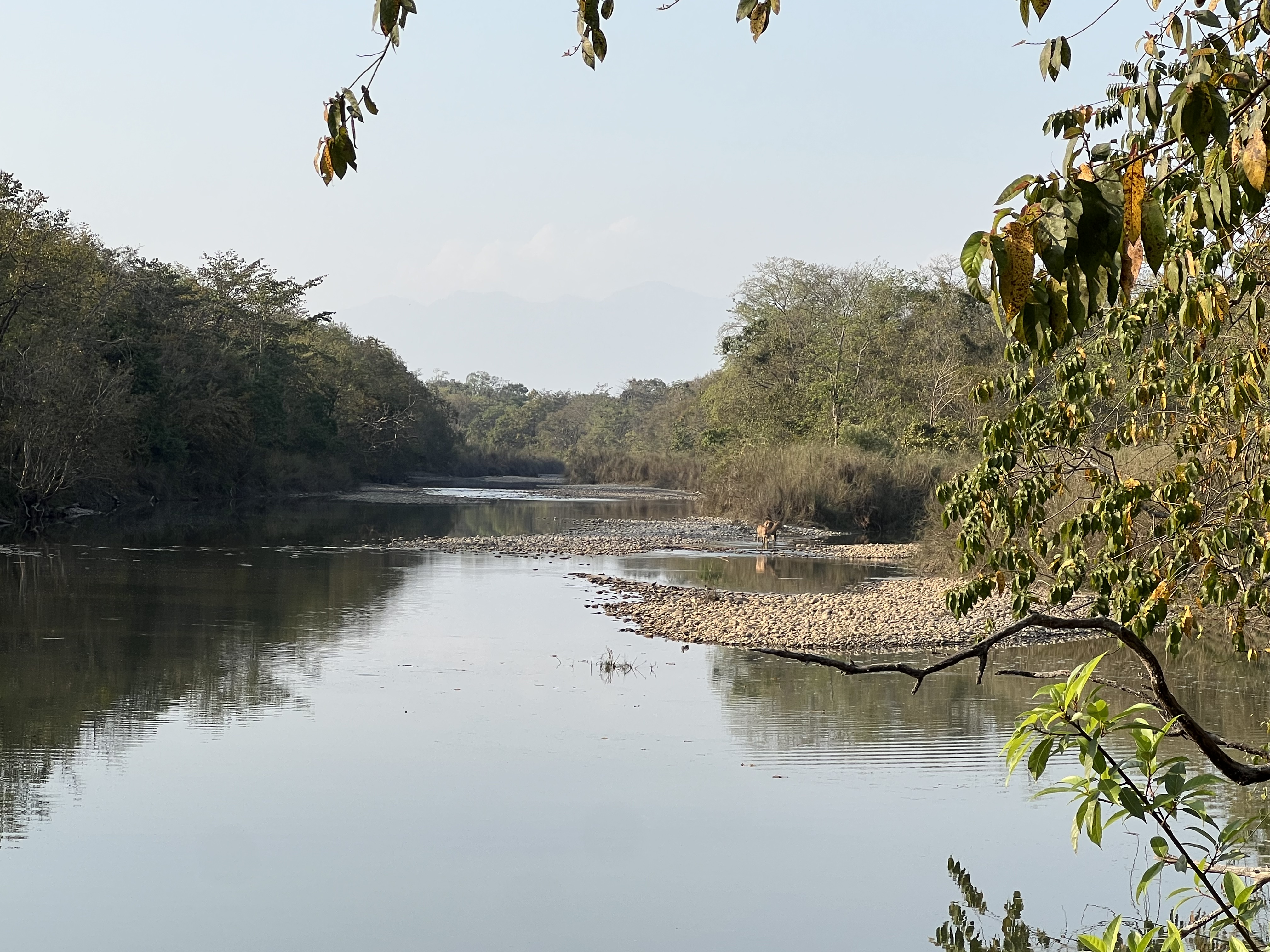
On the second day of the jeep safari Bettina and I were accompanied by Baba, Prakesh’s older brother and primary owner of the Wild Planet Eco Retreat as the main guide, as well as Madhu, who had been a guide in Bardia before he married a Swede and moved to Sweden, and Suzan, who had just passed his guide license along with Dave, who is also a guide. Even with all four of them, this day was less successful as far as the larger animals went, but we detoured to a more secluded part of the park and up into the hills. Here again, Dave proved to be an excellent driver as the jeep climbed the uneven, rocky clay path up the curves on the hillside. When we stopped for a break, it was completely still except for the wind, birds and monkeys. There were no other jeeps, nor people anywhere, just lots of langur monkeys and various kinds of deer. The forest was beautiful and serene.
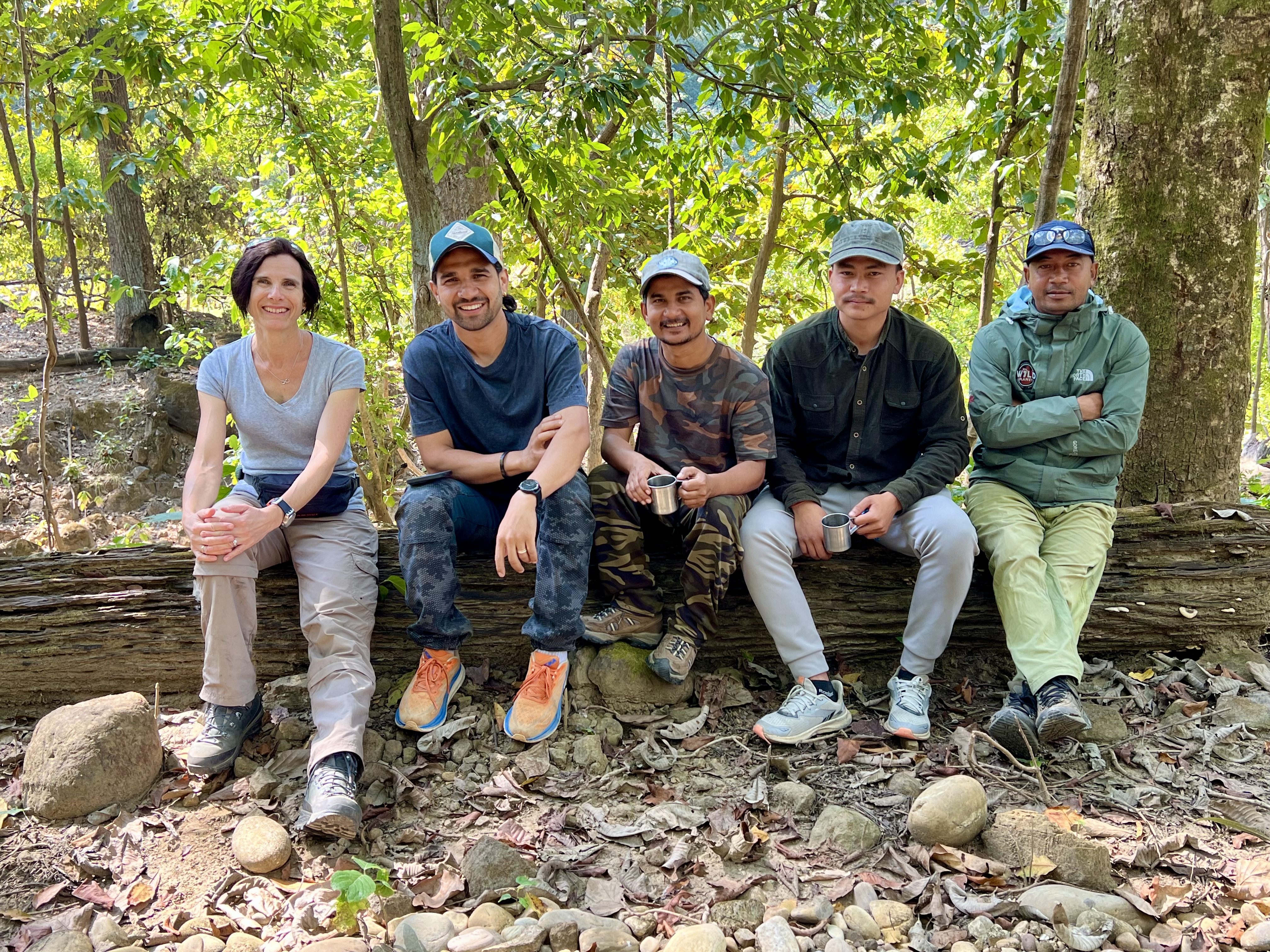
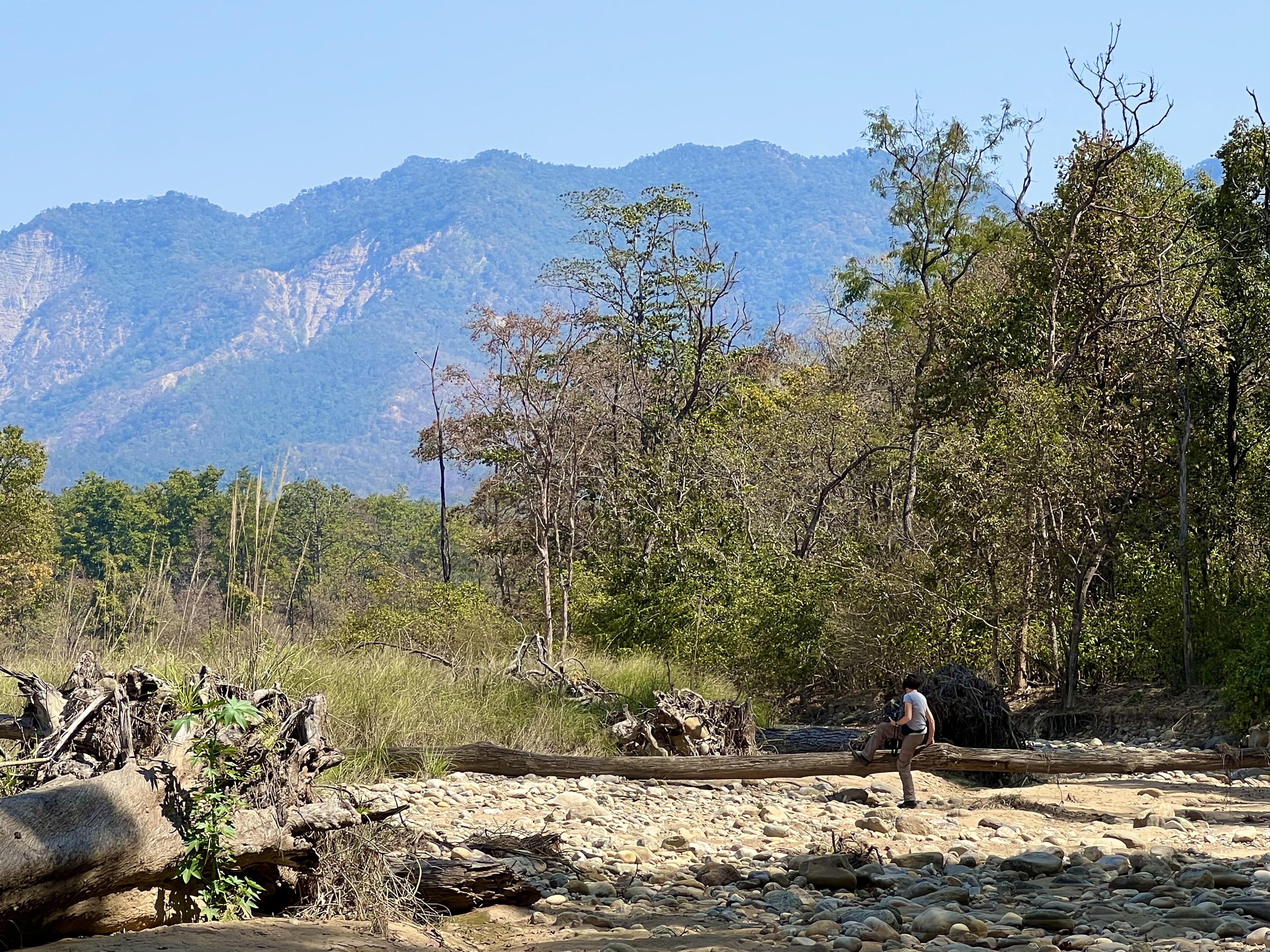
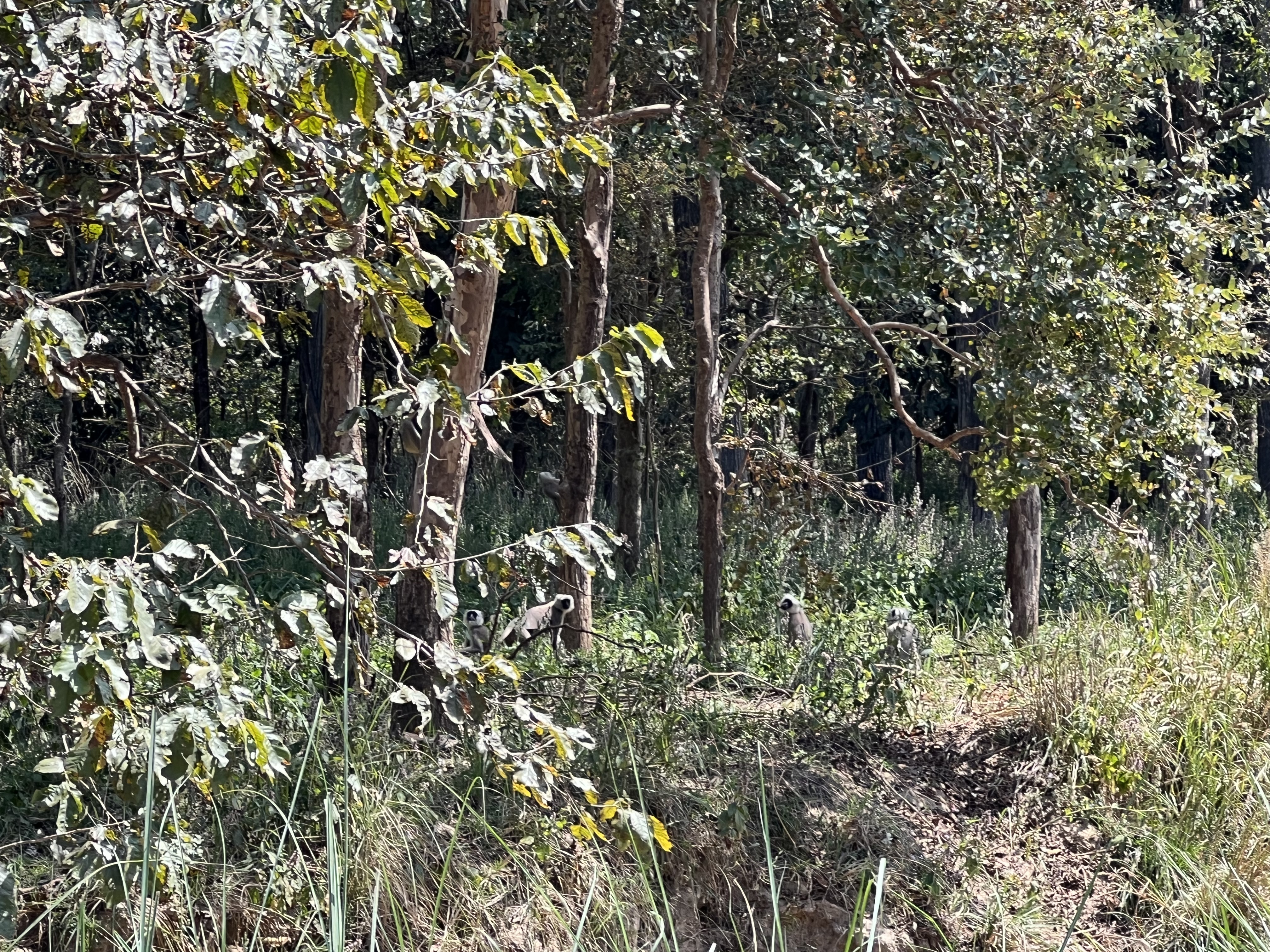
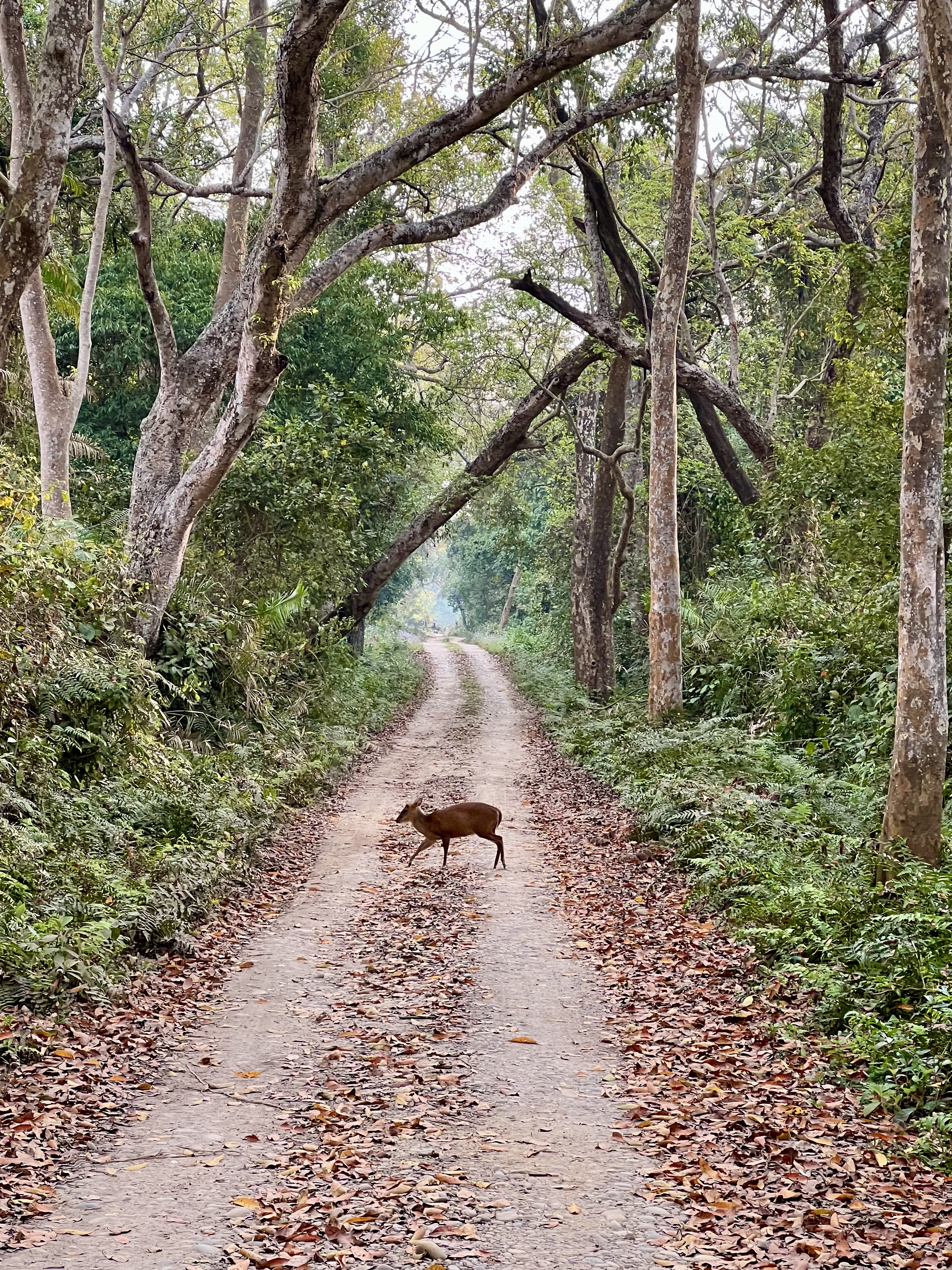
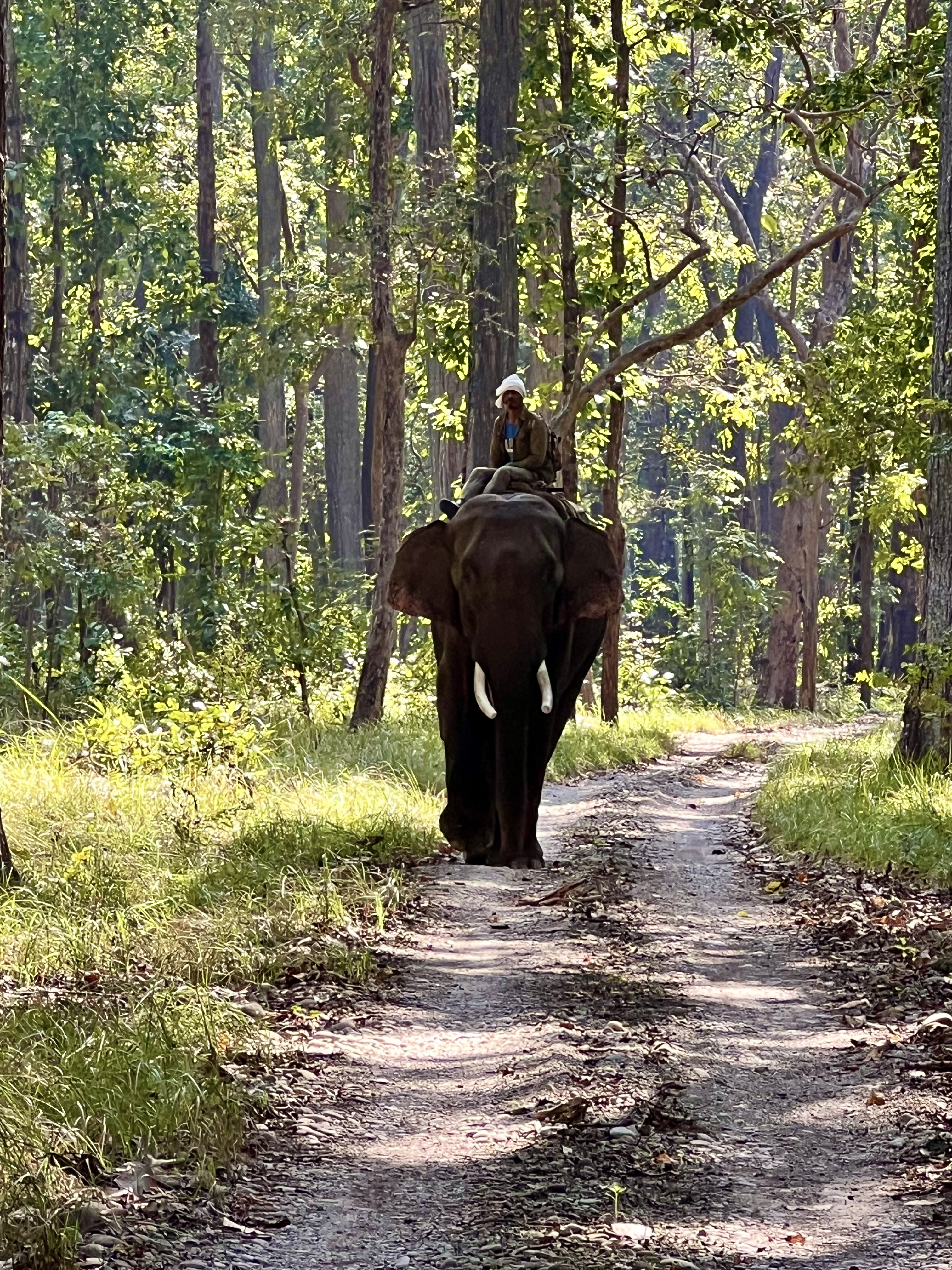
In the afternoon, we headed back to the region we had been in the day before and saw many more monkeys, and a new form of deer, a hog deer, which is fatter than the barking deer but about the same height. Others saw a sambur deer, but I didn’t. I did see a few eagles, bright blue kingfishers and a green beecatcher and a mongoose rush across the path. At the end, we saw a few domestic elephants with sikhars on their way to a site where the rangers were going to capture a tiger for collaring in a few days. They need about three days to set up the camp for the capture. The collaring helps the rangers keep track of the tiger count as well as the individual tiger’s behaviors. I learned more about this technique and tiger behavior from “Bones of the Tiger” by Hemanta Mishra and Jim Ottaway, Jr. Penguin Books, 2013. What was clear was that the tigers really are nocturnal, they sleep most of the day in the tall grasses or bushes, which makes them difficult to see. It was only when we heard the barking deer call, a sign of danger, that we could assume a tiger was on the move.

The other book that Mishra and Ottoway Jr. wrote is called “The Soul of the Rhino” (Penguin Books, 2008). It is the counterpart to the tiger book, both of which are mostly about the animals and history of Chitwan but are also relevant to Bardia. The first explains how Chitwan changed from a royal hunting ground to a conservation park and the second how Bardia inherited rhinos from Chitwan and how their numbers were almost devastated during the Civil War with all the poaching. There were originally 100 rhinos brought from Chitwan, but the numbers dropped to the single digits after the Civil War. Today there are 38 rhinos in the park and 123 tigers. One of the stories in the rhino book recounted a folktale the Tharu people have about the rhinos. The Tharu are the traditional inhabitants of the Terai. The tale was told to Mishra by the lead elephant driver for the Royal Elephants, Tapsi.
“The creator was not drunk but stoned when he made the rhino. God Brahma gave life to the rhino more than ten million years ago. Brahma, who created the universe, enriched the earth with every form of plant and animal life but was still not content with his creations. He summoned Viswakarma, his master designer.
‘Viswakarma,’ commanded Brahma, ‘make me a new and perfect creature. It must not resemble any beast in this world in shape, size, or personality.’
‘Yes, my Lord,’ uttered Viswakarma. What choice did he have? His master, the creator of the world, had hit a creative impasse. Now he had to come up with something to avoid the wrath of his master. Viswakarma decided to travel across seven seas, seven mountains, and seven lands in search of an inspiration. After wandering for eons through forests, river valleys, and mountains, Viswakarma reached Mount Kailas, the abode of Lord Shiva, God of Gods.
Shiva was in deep meditation. All of his eyes, including his third eye in the middle of his forehead, were closed. Viswakarma then stood on one leg, folded his palms, and prayed non-stop for ten thousand years, chanting, ‘Om Namo Shivaya Om Namo Shivaya Om Namo Shivaya.’
Viwsakarma’s devotion impressed Shiva. He finally opened this third eve and roared, ‘Viswakarma! I am pleased with you. Why are you here? What can I do for you?’
Thrilled and relieved, Viswkarma kissed the earth, folded his palms, and cried at the top of his lungs, ‘O Lord of thirty-three million gods, preserver of the truth, destroyer of the demons, I travelled through many lands, crossed many oceans, and drank from many rivers to seek your blessing. O God of Gods, my Master Lord Brahma has ordered me to make a new creature, something that has never been seen before on earth. What am I to do?’
The Almighty’s advice was short and simple: ‘Create an animal as elegant as Biphanke Ghode, the flying horse; as holy as the River Ganges; as fat, strong, and arrogant as Nandi, my bull.’
Shiva placed his right hand on Viswakarma’s forehead and blessed him. ‘Even humans shall not destroy the new animal you create, proclaimed Shiva. ‘They shall preserve your extraordinary creation forever.’
But how shall I go about creating such a beast?’ inquired Viswakarma.
‘That is your concern not mine,’ retorted Shiva, before he settled back into meditation.
‘Oh my gods,’ thought Viswakarma. ‘I’m no better off than I was when I started out.’
To stoke his mind, Viswkarma smoked marijuana non-stop for twenty-one thousand years, at which point his efforts were rewarded with visual grace. Viswakarma started hallucinating about a solution to his problem and went right to work.
He picked the best parts of many animals on earth and stitched them together. The result was beyond his expectation, a masterpiece of the art of imperfection. His creation had the skin of an elephant, the hooves of a horse, the ears of a hare, the eyes of a crocodile, the brains of a bear, the heart of a lion, and horns like Nandi, Shiva’s bull. In his zeal, Viswakarma creatively twisted, molded, and further modified these parts, even fusing two horns into one.
Viswakarma then took his invention to Brahma.
The beast was clumsy and ugly. But its clumsiness concealed a wonderful gracefulness. And its ugliness hid an elegant beauty. Brahma was pleased. He breathed into the creature the elixir of life and freed the beast into the forests of the Terai under the watchful shadows of the Himalayas, the abode of God Shiva. He gave it the name ‘Gainda’, meaning ‘fat and stubborn’.
The author then goes on to say that: “Tapsi ended his story with a ring of high-pitched laughter. My thoughts were more sobering, however. I was reflecting on how ironic it was that the Almighty had not foreseen the turn of events in the twentieth century. Poacher and the growing population in Nepal have destroyed the rhino and its habitat…. I thought that the fable of Viswakarma’s rhino also echoed some scientific truth. When scientists began classifying the world’s creatures in the eighteenth century, they were unable to assign the rhinoceros to any existing family in the animal kingdom. Consequently, they classified the rhinoceros as a separate and distinctive family of its own, the Rhinocerotidae, which means ‘nose horn’. (Mishra, Ottaway 24-27) It is amazing how folktales manage to capture a truth that is often hidden from modern science.
For my last full day in Bardia, I finally went on a walking safari. This entailed far less walking than I had imagined and far more sitting waiting for a tiger to appear. While stationary, Bettina, Baba – our guide – and I saw more langur monkeys than I could count and deer of all sorts grazing together everywhere. The barking and spotted deer seemed to like to stay together, while the chital and sambur were often off to the side and the hog deer were often only in small groups. When we were on foot it was an experience to walk through the tall grasses higher than my head knowing that we were in an area with five tigers, three females and two males. Normally, the tigers are solitary and keep far away from each other, but it is mating season and there is more than enough food for all five large felines. We kept seeing fresh tracks and scratches in the sand where the tiger(s) had marked their territory along with the pungent odor of their urine, but an actual sighting was difficult.
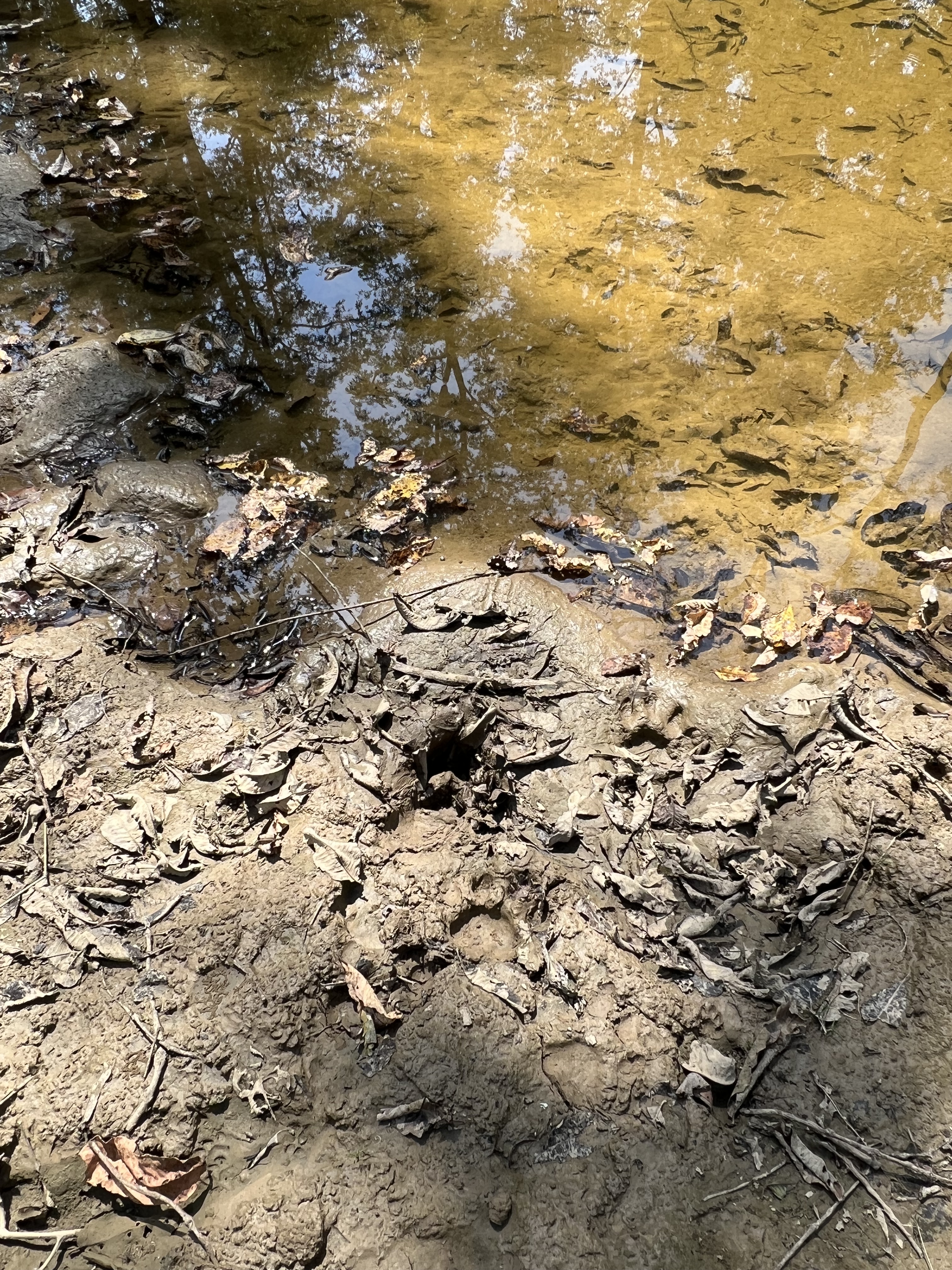
After waiting for about five hours, Bettina, Baba and I finally saw a male tiger. He was close enough for Bettina to get a photo with her lens extended to the full extent, but far too far away for my iphone. The Eco Retreat’s binoculars, were good enough for a clear view, though, and I was happy to see him in full view. After he wandered back into the bush, we again waited for hours for him to come back out to go for a drink in the river, but he didn’t show himself and we finally gave up and went to another spot. We didn’t see anything there after waiting again for a couple of hours, so we walked back & low and behold, his footprints were where we had been – we just didn’t wait long enough! We also saw fresh rhino prints but didn’t see the actual animals. Even though we didn’t see any more rhinos, wild elephants or leopards, we did see a tiger in the wild amid the grasses and that was a pretty amazing sight.
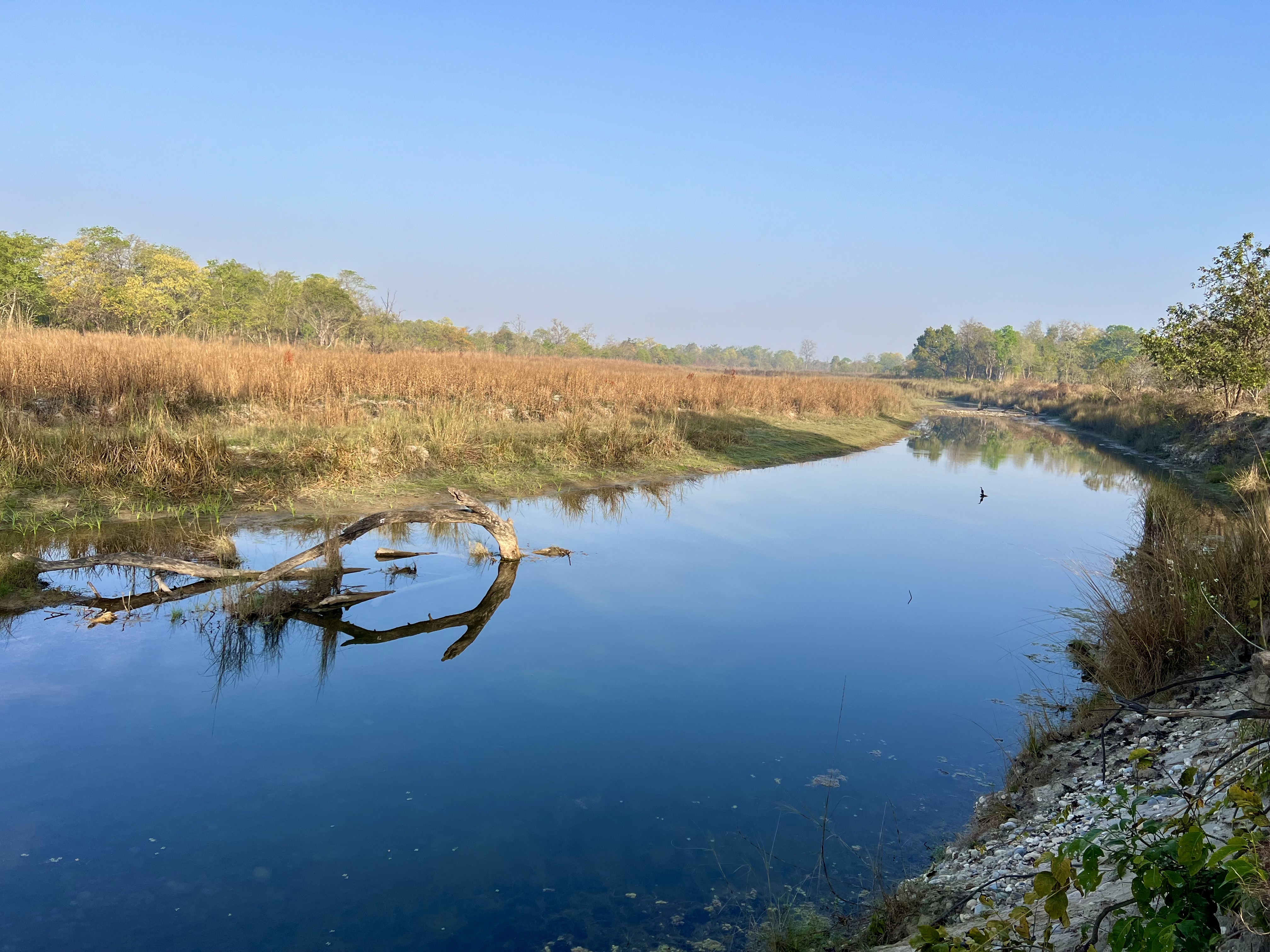
While we were waiting, we were sitting on the forest floor covered with brown fallen leaves, and I reflected that I wouldn’t dare do this in Central or South America as I would be eaten alive by ants and various other bugs. There were a few ants, but there wasn’t anything that was too bitey or stingy. And during this dry season, there were only a few mosquitos! (I was told that they would come en masse during the monsoons.) As it was, it was a beautifully serene hot day in the wilds of the Terai.
There are many places to stay in Bardia, from the exclusive Tiger Tops Resort, where the clients had folding chairs, tables with snacks and drinks for sitting and waiting for a tiger at a spot near the river, to our Wild Planet Eco Retreat for $6 per night. The wildlife experience is perhaps better with less people, like we had. The only real difference is in the accommodations themselves. We had a shower, but there were two separate hoses, one for scalding hot water and the other for freezing cold water; these two needed to be mixed in a bucket that was then used for the actual shower. I’m sure Tiger Tops had more convenient facilities, but the Eco Retreat was probably much more fun and the difference in experience is more culturally interesting at the less costly places. The guides are determined to help their clients see wildlife and there is an abundance to offer. They also treat you as extended family, sharing personal histories and stories around a firepit in the evenings. The locals become friends, which isn’t usually the case in the larger places. Additionally, the people who migrate to the less costly quarters have often fascinating experiences to share as they are more likely to have traveled the world solo. For example, Brent, a Canadian and self-professed earthquake predictor. He monitors earthquakes worldwide and has made a very uncomfortable prediction that a major mega-quake will happen in Japan and simultaneously near Mindoro and north of New Zealand before Christmas 2024 or at the latest by the beginning of 2025. Let’s hope he’s wrong! Nepal has had its share of earthquakes; the last major one in 2015 devastated the entire Kathmandu Valley and beyond. Since then, however, the city has been rebuilt and modernized. On the Yeti flight back to Kathmandu from Nepalgunj, I was amazed at how even the former rural areas are now budding towns, and the Kathmandu Valley no longer seems like a valley but a metropolis. I wonder what Manjushri would say to his work if he surveyed the valley today. He is the god who drained the former lake to create the valley at the beginning of human time. Luckily, the main sites have retained their sacred spirit, but tranquil wildlife filled Bardia and the surrounding villages are worlds, not just a flight, away from the colorful lively chaos of the city.

 omegoodyssey